Paul Nicklen Opened His Cabin Window to a Polar Bear. Then She Tried to Come Inside
(This is the story behind the photograph, a glimpse into the moment, the process, and the vision that brought it to life.)
What would you do if a polar bear appeared outside?
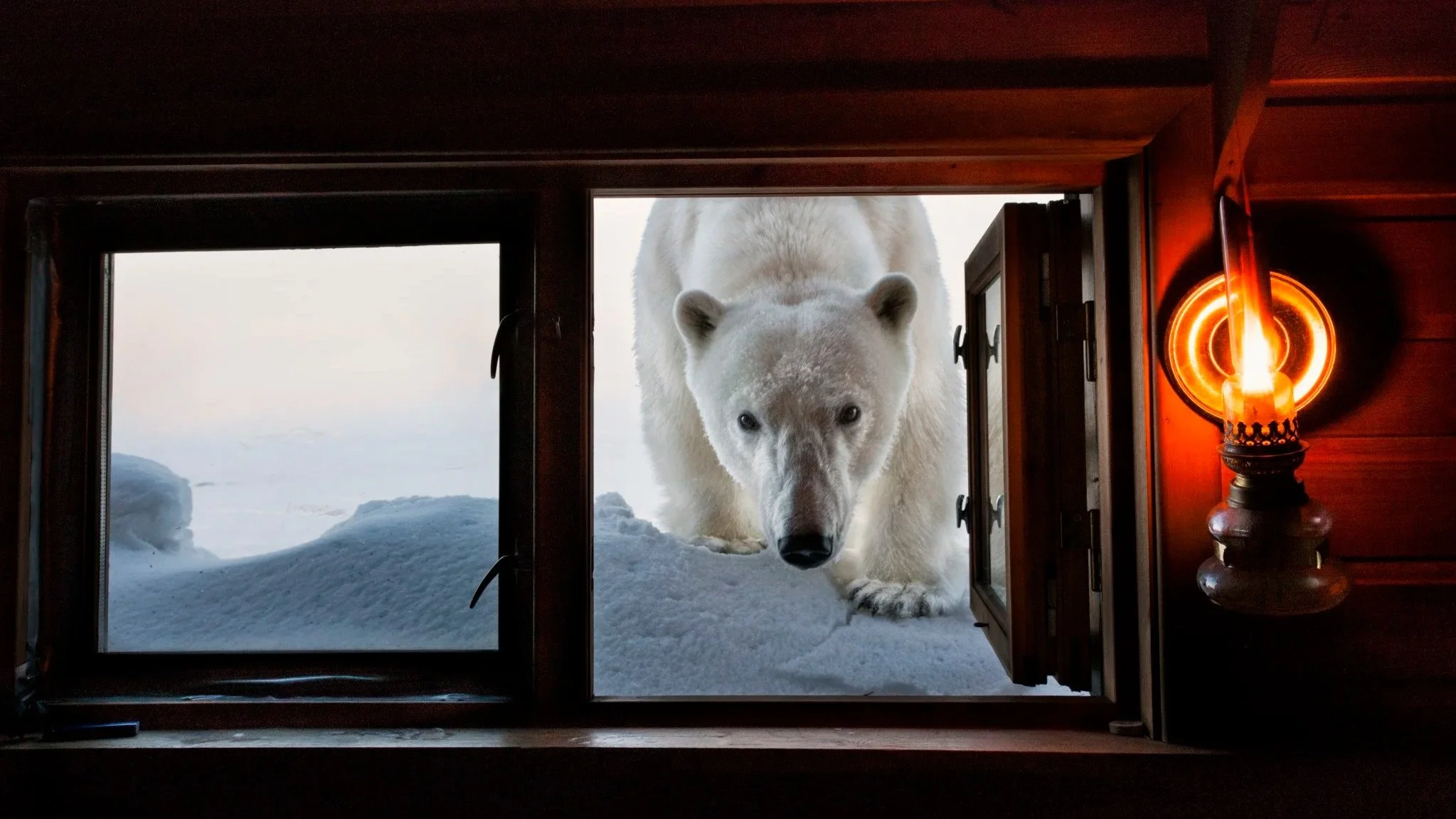
Paul Nicklen opened the window. He was spending a month in a tiny cabin in Svalbard when a polar bear mother appeared during a blizzard. When she tried to come inside, he stayed at the window and began photographing her.
He did not see the encounter as a conflict.
Nicklen has spent much of his career photographing wildlife in the Arctic and other remote parts of the world. He knew the animal in front of him could be dangerous, but that was not what he saw at that moment. The bear looked calm, beautiful and peaceful.
The photograph came from the difference between what the situation looked like and what was actually happening.
Paul Nicklen was spending a month in Svalbard, Norway, when a polar bear appeared outside his window.
It was March, in the middle of the Arctic winter. Nicklen was staying with Norwegian Carl Erik Wilhelmsen in a cabin only two metres wide and three metres long. Outside, temperatures had fallen to around minus 30 degrees Celsius. Storms were common, and on this day a whiteout had made going outside almost impossible.
“It was cold. It was dark. It was minus 30, and it was always stormy. On this day, there was a whiteout, so we decided to stay home.”
The two men were sitting inside their tiny cabin while snow piled against the walls. The snowdrift had reached the bottom of the window when Nicklen looked outside.
“I looked up during the blizzard, and there was a polar bear mother standing there.”
His reaction was not to move away. He opened the window.
“I don’t know what happened, but I got excited, so I opened up the window just to say hi to her. Then I realized that she could fit through the window. She wanted to come in, so now I had to stand there and keep her busy.”
What had started as an unexpected encounter quickly became something more important to Nicklen.
A polar bear approaching a camp can be treated as a threat. In Svalbard, Nicklen explains, people can legally shoot a bear in such a situation. He had never wanted to do that. Instead, he began to see the encounter as a way to photograph the complicated relationship between people and polar bears.
“I realized it was a very important picture because it talks about human-bear conflict. When a bear comes near your camp, you can legally shoot them. I’ve never had to shoot a polar bear, so I just wanted to spend some time with her.”
But Nicklen did not want his photograph to make the bear appear threatening simply because she was close to people. Standing on the other side of the window, she seemed calm.
“I wanted to show how calm and beautiful and peaceful she looked. In some ways, people would call this conflict. I call this beauty and peace.”
Inside the dark cabin, Nicklen lit a small lamp. Outside was the white of the storm and the enormous body of the bear. The window became a border between the warmth inside and the Arctic landscape beyond it.
Nicklen photographed her as she remained beside the cabin.
There was no attack and no dramatic escape. Eventually, the bear simply lost interest.
“I took her photo and lit that little lamp. Then she just got bored of me and kept walking down the coast. We had a lovely encounter.”
The photograph was later published in National Geographic and became one of Nicklen’s widely published images. But what makes the story unusual is not only how close he was to a polar bear. It is how differently he understood the situation.
When asked whether he had been afraid, Nicklen said he had not.
“It’s not like the bear is just going to lunge and attack you. I’ve had to punch bears in the face before. I would have slapped her on the nose before there was ever an issue. They’re really amazing animals.”
That confidence came from years spent around wildlife. Nicklen does not suggest that polar bears are harmless. Instead, he believes that danger has to be understood in context.
“I’m not saying that they’re not going to be dangerous, but compared to you getting in your car in Prague, the risk of that encounter versus you being in a car in Prague is you’re a thousand times more dangerous than I am at that moment.”
The photograph shows a polar bear looking through the window of a tiny cabin during an Arctic storm. It could easily have become a photograph about danger.
Nicklen saw something else.
The important part was how peaceful the bear actually was. The danger was there, but it was not what Nicklen saw in front of him.

Sometimes the best project begins when the first idea fails. You arrive with a plan, but what you find does not fit it. Story Behind The Photograph