Welcome to this edition of Photography Critique. Today, Tomasz Trzebiatowski looks at street photos from our readers with an editor's eye. We’d love to read your comments below.
Tomasz Trzebiatowski is the editor-in-chief of Frames Magazine.
He looks at photographs as someone who decides what gets printed.
In this episode, he looks at 14 street photos sent in by our readers.
He talks about busy frames, about backgrounds that compete with the subject, and about why a strong photograph makes you ask questions.
At the end, the roles switch, and I critique one of his own photographs.
Busy frames and tight frames
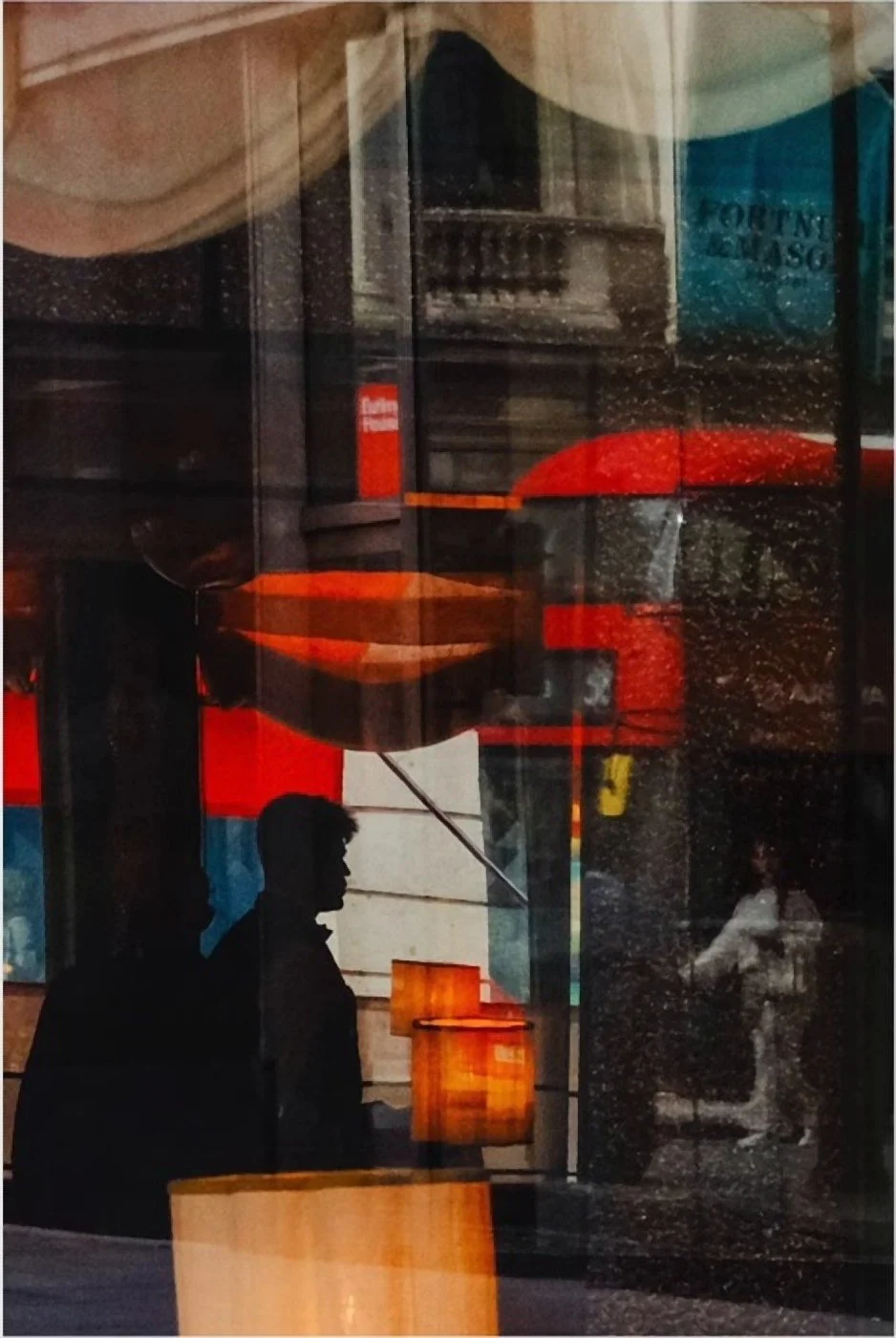
Tomasz Trzebiatowski: You started with a strong one. I'm a big fan of Saul Leiter-type photography, and if you didn't tell me who took it, I would almost guess it was a Saul Leiter shot. That's the highest compliment.
I like this kind of complex, three-dimensional street shot. There is always a thin line between an image that is too chaotic and one that is too simple. This one is very busy, but in this case that is exactly what makes it so interesting. I would guess it's London, I can see the double-decker, and I love the lamps going into the image and making a line at the bottom. Maybe it's a reflection, maybe it's through glass from inside a building, you don't really know. It's full of mood, and it makes me feel I'm there, looking out.
The colour palette is slightly subdued, not pastel, but not screaming at me either. It's very coherent. I would strongly consider it for print.
Martin Kaninsky: Is there something you would improve?
Tomasz Trzebiatowski: Almost nothing. If anything, my eye keeps jumping to the lamp at the bottom of the frame. It fights for my attention a bit too much. I can imagine it was a quick shot, because the photographer was catching the silhouette, so I know it's not easy. But I would try a slightly different angle, to lose that first lamp or put it slightly off-centre.
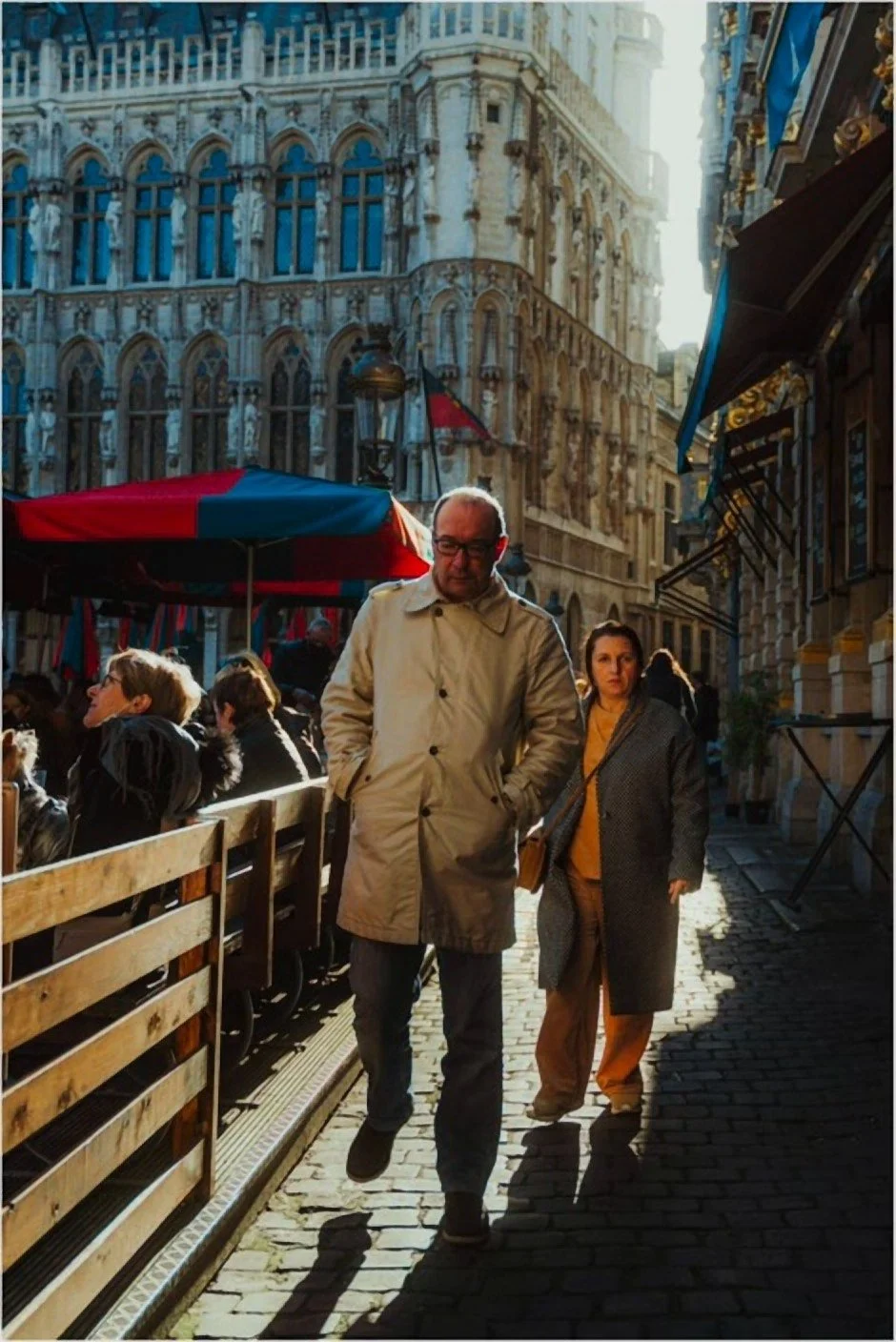
Tomasz Trzebiatowski: It's a nice shot, but it doesn't strike me very strongly. The backlight is nice, and the light reflecting back on the people gives it a real street mood.
The composition is not ideal for my taste. The space between the fence and the gentleman walking towards us is slightly too tight. And the pose of his leg: half a second earlier or later, he would have had a more natural, more pleasing step.
I would also try to get the lines of the building in the background, the one on the left with the blue windows, really straight. That would settle the whole scene. There's a lot to it, and slight adjustments would make it even better.
Pictures that ask questions
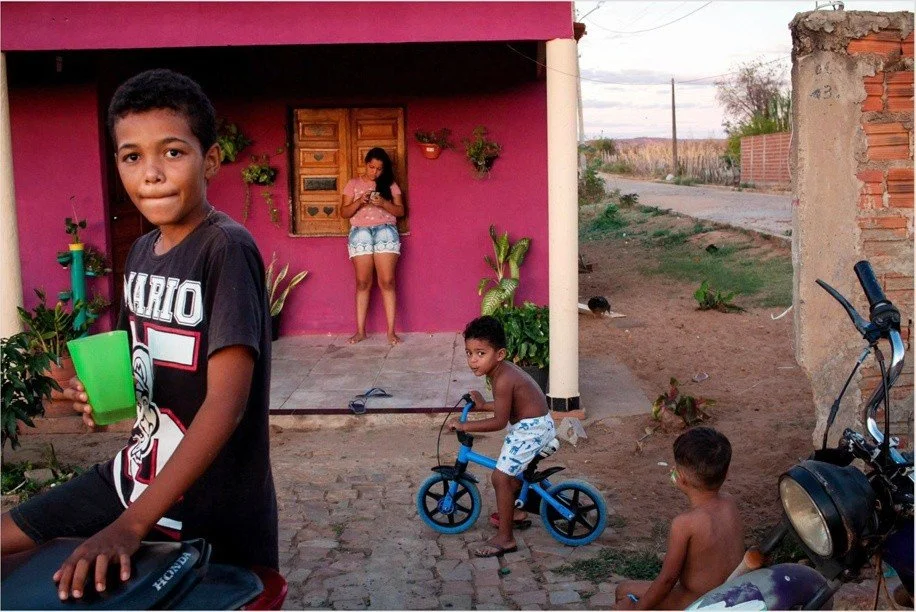
Tomasz Trzebiatowski: I like it a lot. We all know thousands of pictures by the masters, and this one looks as if somebody was inspired by David Alan Harvey and Alex Webb. It's very Alex Webb-ish. It drags me into the scene. It's so real and so lively.
The composition is a bit chaotic again, but it has a flow. It starts with the boy on the motorbike in front, goes round to the woman on her phone at the back, and comes back through the boys. It's a little story in one shot. I immediately want to know who these people are, whether they are a family, whether they live here. If a photograph drags me in and makes me ask more questions, it's a strong photograph.
Martin Kaninsky: When you want to find a strong photograph, what are you looking for?
Tomasz Trzebiatowski: I look at very different kinds of images, from different genres and styles, and another editor would look for different things. But if I had to put my finger on the common denominator: the photograph gets really strong when it makes me ask more questions about it.
I don't have to understand everything, I don't have to know everything about the picture, but if it causes me to ask the question, dig deeper, stay and keep looking, this is a strong photograph.
It might be an abstract, it might be a photojournalistic shot, it might be anything. If there are more questions I want to ask the photographer, it's already a good shot.
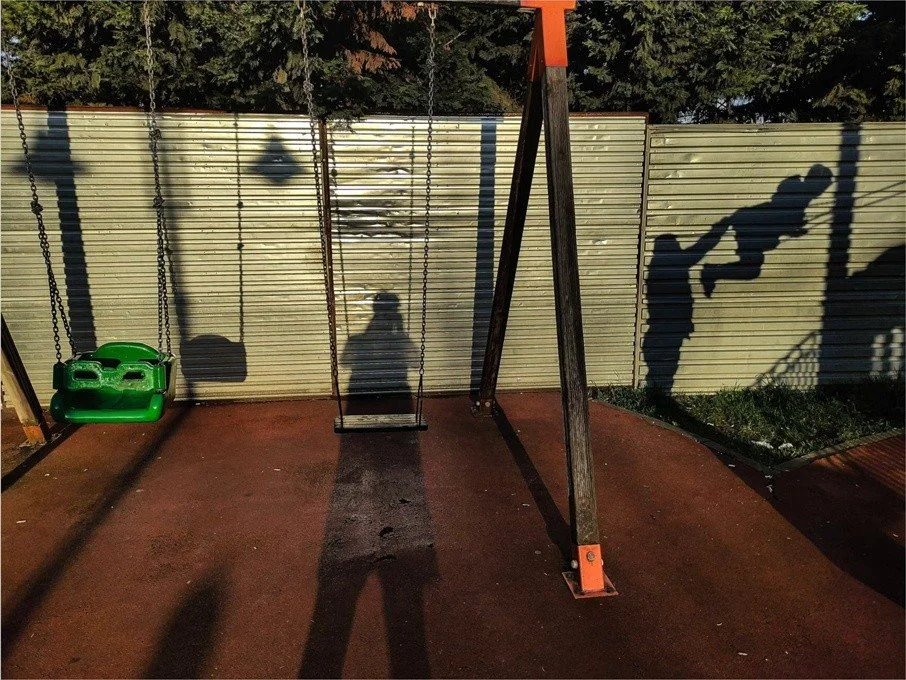
Tomasz Trzebiatowski: Again, a very good shot, by somebody with a good eye. I can see the photographer's shadow, and the shadow of what is probably a child on a swing with a parent.
The photo before showed the story straight in front of us. Here we only have shadows. We know even less: we don't know how the people look or where they are. That means even more questions, so it drags me in even more.
You could argue about which rule of composition was used here, and maybe none was. When you know the rules and start breaking them, there is a little chaos, but something keeps your eye wandering. You start with the photographer, you ask what he is shooting, and then you go right and find the child. There is a story here too. I wouldn't change much.
A small change of angle
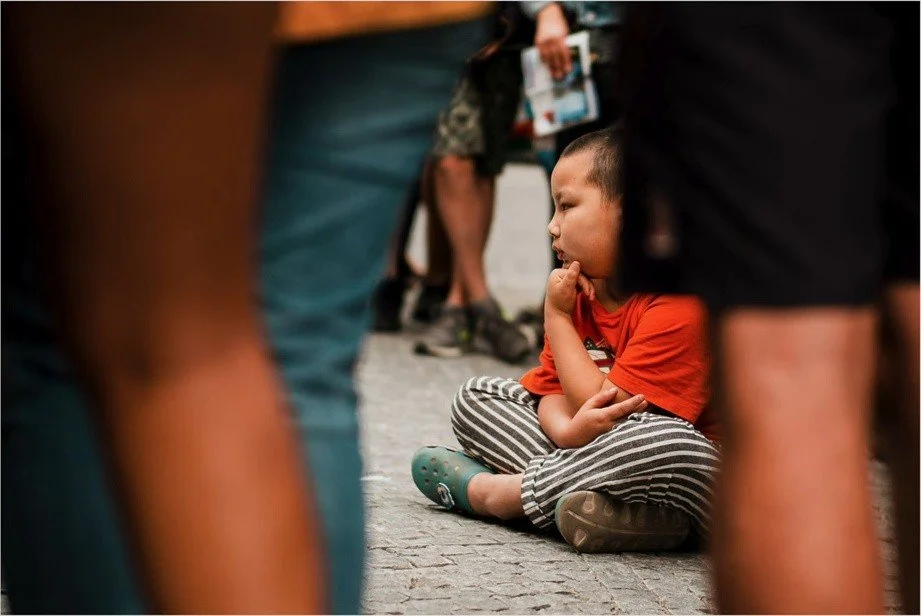
Tomasz Trzebiatowski: A nice intention. The photographer noticed the boy sitting on the street. I see people standing around, probably watching some kind of street performance, and the boy is watching it with them. Going down and shooting through the legs of the crowd is a nice idea.
If it were me, I would move the camera a little to the left and include a bit more of him. That would also remove the white space just behind his head, which competes with his face. You would probably see more of his eye too, and that would make it even more personal. Maybe it wasn't possible, of course, but visually speaking, that's what I would try.
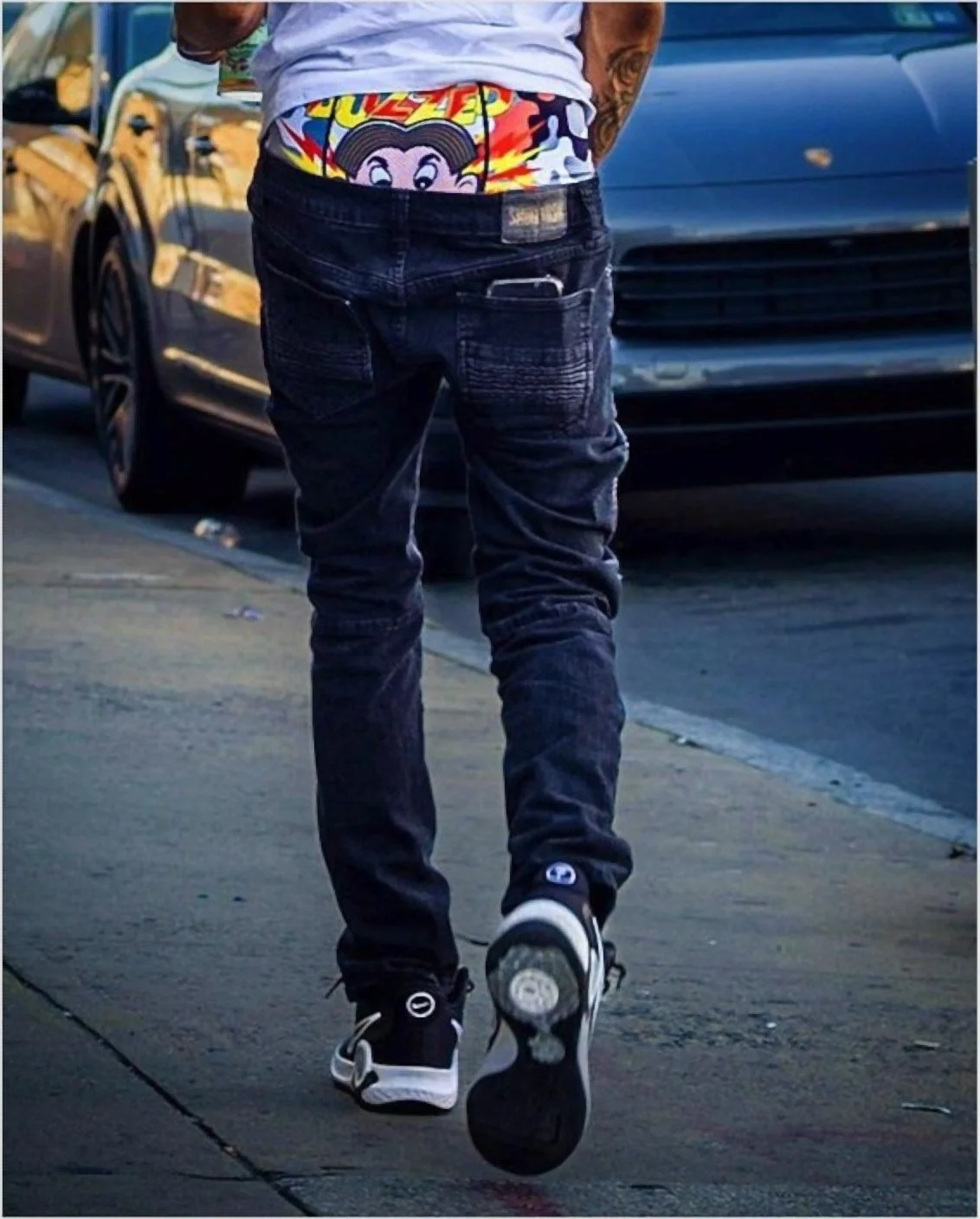
Tomasz Trzebiatowski: Nice pants. This is clearly a humorous street shot. People often argue online about shots from behind, whether they are fair or respectful. I personally don't have a problem with them. The person stays anonymous here.
The composition is not ideal. The car in the background, with its reflections, is a little blurred, but not enough. It still competes with the main subject. His leg is in motion, so it's not entirely sharp either.
In the first photo you showed me, there was so much in the frame that the whole scene became one thing. Here there are just a few elements, and they compete with each other a little too much. Maybe the photographer could have followed the guy for a few minutes and looked for different backgrounds.
Martin Kaninsky: That's what we do, right?
Tomasz Trzebiatowski: Yes. It's a good, humorous shot. Just follow the guy for a few minutes and look for a different background.
Emotion and story
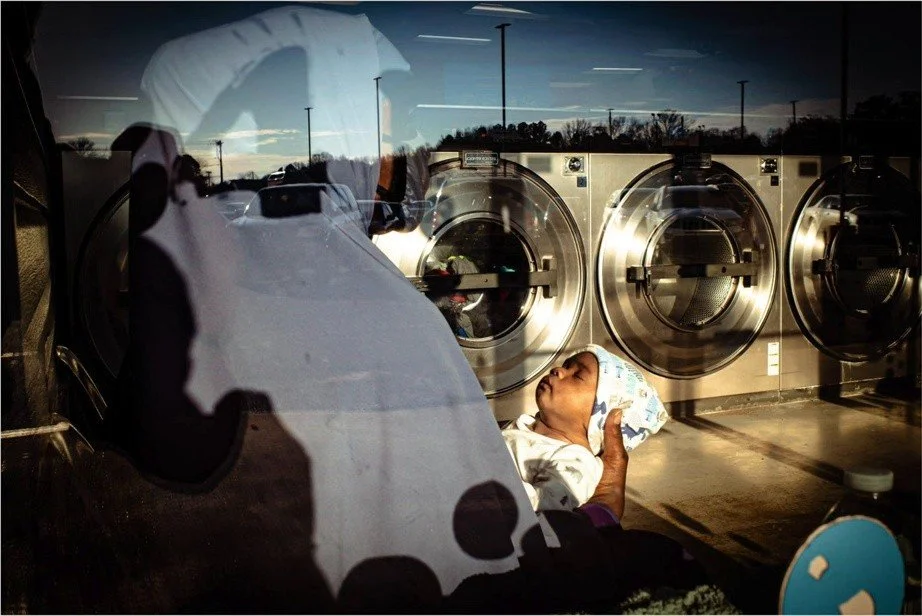
Tomasz Trzebiatowski: I like it. Again there is a lot in the frame, maybe reflections through glass, and I'm drawn in by the story. It's a public laundry, I think. Probably a mother or a grandmother with a child, waiting for the laundry, and the child is asleep. A very intimate moment. She's wearing a mask, so probably Covid times.
For me there are two kinds of shots I enjoy equally. One is compositionally excellent: it strikes you with geometry and lines, and you can see how much effort went into designing it. The other works because of the emotions in it. When you combine geometry and emotion, those shots become extremely strong.
The main strength here is emotion: the intimate feeling between the woman and the child. It shows real life. The light is nice too, maybe a late evening or early morning. The focus is on the child, who is the main subject, and the whole story starts from that point.
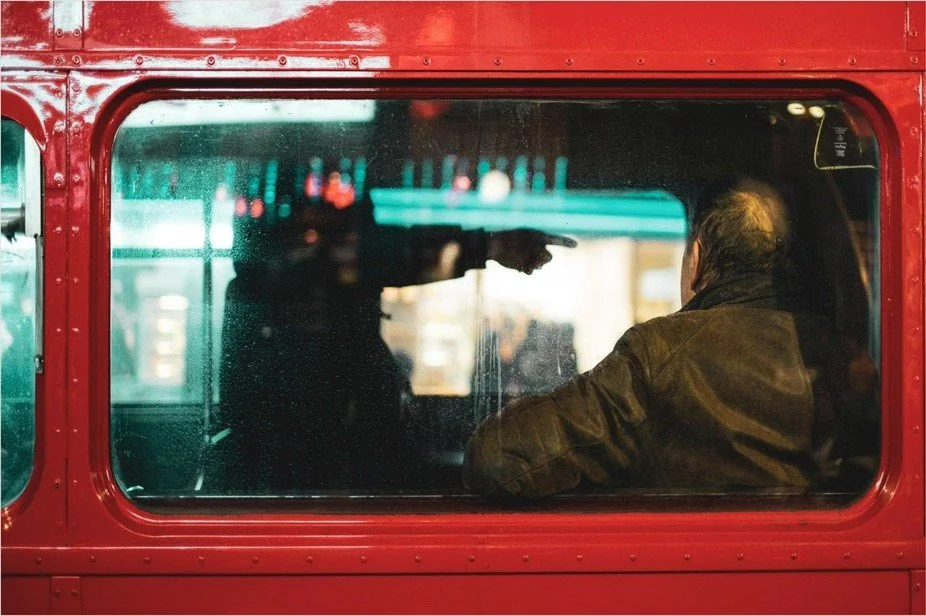
Tomasz Trzebiatowski: Very good, with a similar vibe to the previous one. Something is going on in the bus. Maybe an argument, maybe a conversation, and we don't even know if it's between the standing person and the sitting man, or if he's just watching something else.
The colours are beautiful, close to a Saul Leiter palette. The window isn't entirely clean, and that adds atmosphere. It's a real shot of real life. With the light and the composition, it's basically perfect: the man sits nicely in the lower right part of the frame, the pointing finger is clearly separated, and there is space between the subjects. Bravo, good shot.
When the background competes
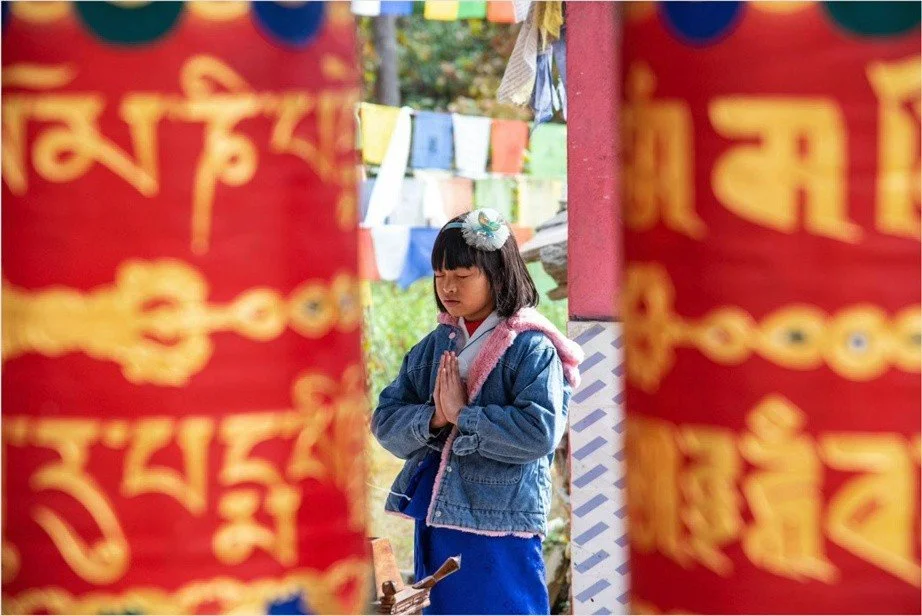
Tomasz Trzebiatowski: The idea is similar to the boy on the ground, shot through the legs. Here a girl is praying at what looks like a religious place, somewhere in Asia, I imagine.
What disturbs me a little is the very bright background behind her. It shows us where we are, but it's too bright for my taste, and my eye keeps jumping to the fence with the colourful things. The main subject was supposed to be the girl. I understand why it happened: it was a sunny day, she has dark clothes and dark hair, and the camera exposed for her. You couldn't do much on the scene. In post-processing you could darken the background a little.
If I'm nitpicking, there are two more things: the wooden thing sticking out at the bottom, and the column touching her head from behind. Both compete with her a little. But it's a nice shot.
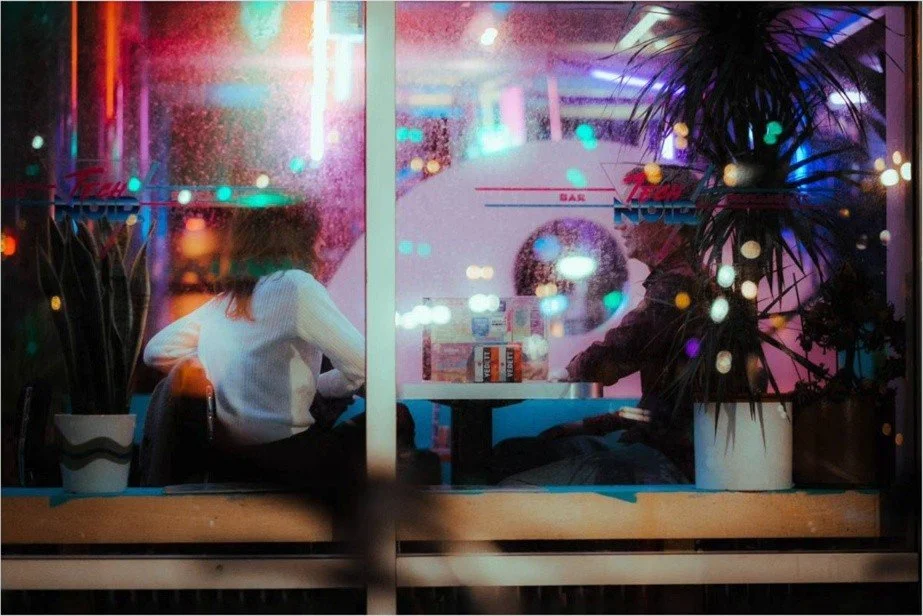
Tomasz Trzebiatowski: This one gives me the atmosphere of an evening bar, and a couple, maybe on a date. There is a nice mix of light from inside and outside, and the colours really carry the mood.
I'm struggling a bit with the composition, mainly because the man's face is covered, and because of the plant. But you would have to go inside and ask them to move the plant. I always believe in capturing life as it is, and the plant was there. If you moved to the left and shot it from an angle, I don't think it would work so well. Now it's a straight-on shot through the window, a clearly presented scene. I give it ninety out of a hundred. The mood is great, and the lights are great.
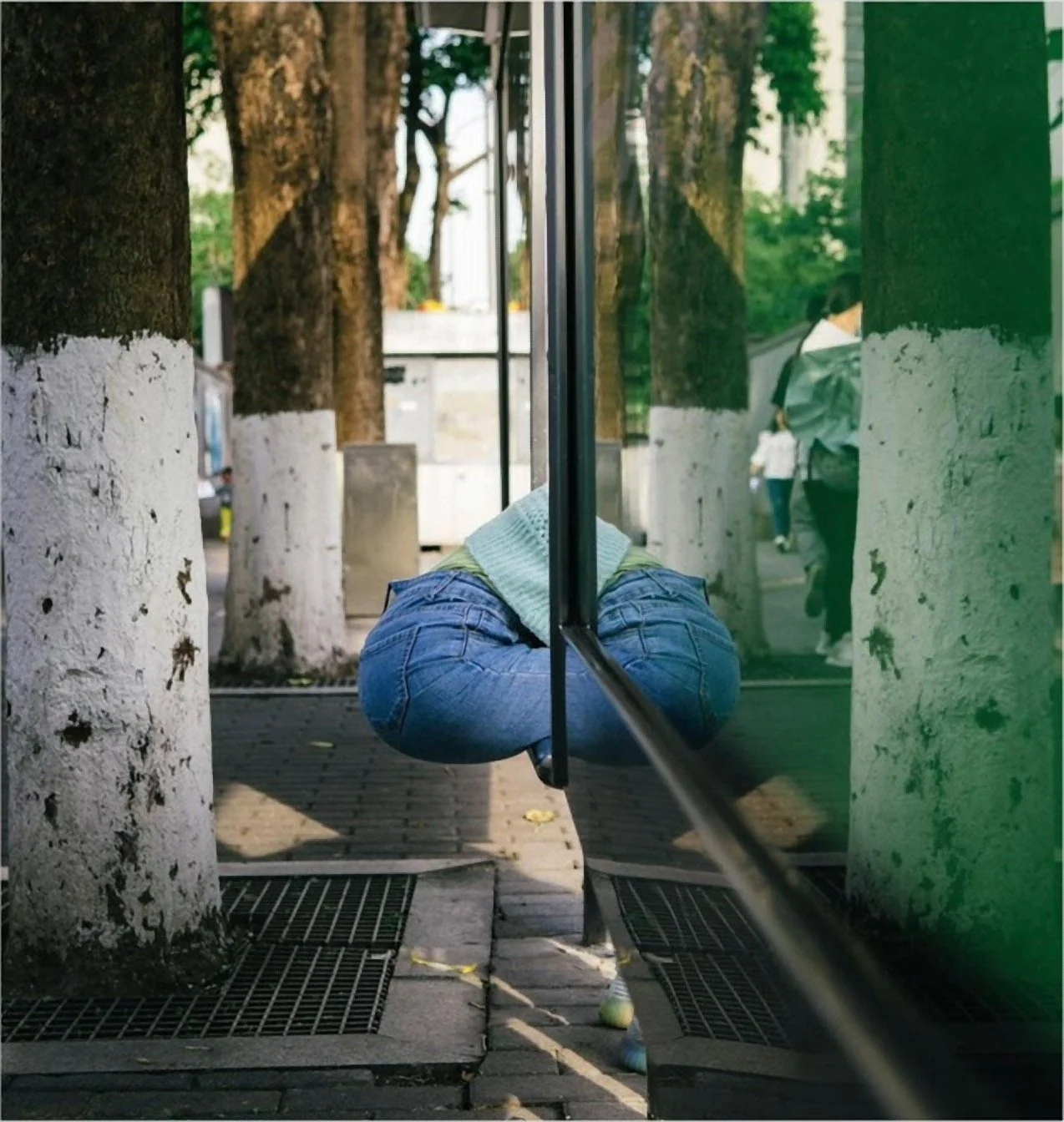
Tomasz Trzebiatowski: Somebody is sitting there, and there is a reflection. Parts of a human body, played with reflections and symmetry, naturally catch our attention. I see her feet now, so it's probably a bus stop.
It's a difficult one. There are good elements, but there are also people reflected in the glass, walking and smoking, and I struggle to know where to look. We are human, so a human element always catches our attention. I see the woman first, then I start looking at the people walking, and I lose focus. My eye goes back and forth, and I can't settle on what the image is about. There is even a boy in yellow trousers on the left.
It would be stronger with only her sitting there, without those people. The bright background with the sky is fine in this case, because the painted white parts of the trees balance the darker and lighter tones. My main criticism is the human elements I can't stay focused on.
Real life and its places
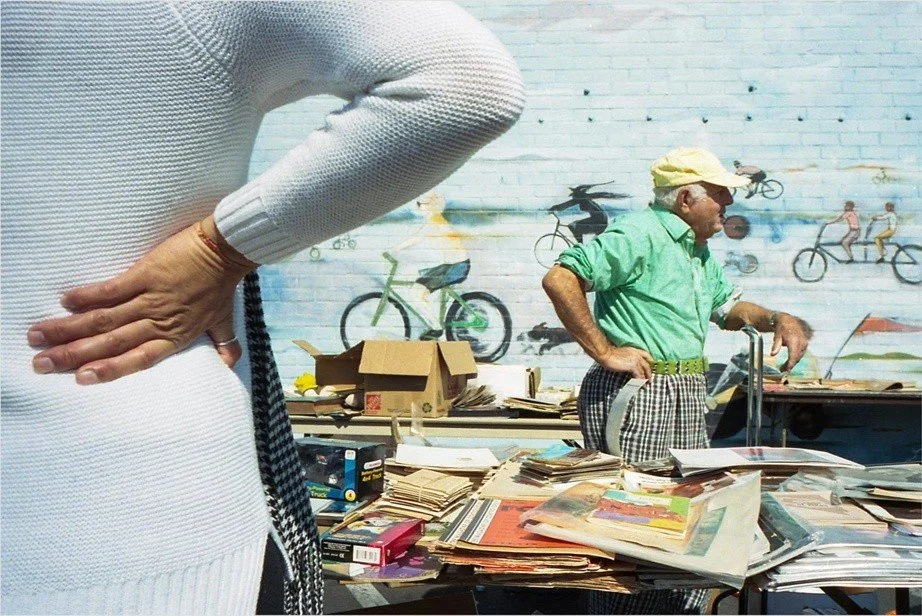
Tomasz Trzebiatowski: Good shot, I like it. It's one of those real-life shots. The photographer included the hand and the body of the woman at the very front, and that gives it a real three-dimensional feeling. The man in the back is the main subject, his face is there, but she adds to the story. It's some kind of market, and one of them is probably selling the books. You want to wander around the frame and figure it out.
On my monitor it's slightly bright. I like the blacks going really black, so I would bring the exposure down by about a stop and add a little contrast. Her arm at the top is close to overexposed.
Martin Kaninsky: Do you mind the painting on the wall colliding with his hat?
Tomasz Trzebiatowski: Now that you say it, I see it, but it didn't disturb me. The whole wall is painted, it adds to the atmosphere and shows us the place, and it's a little more blurred than him. It's a nice environmental portrait of a kind.
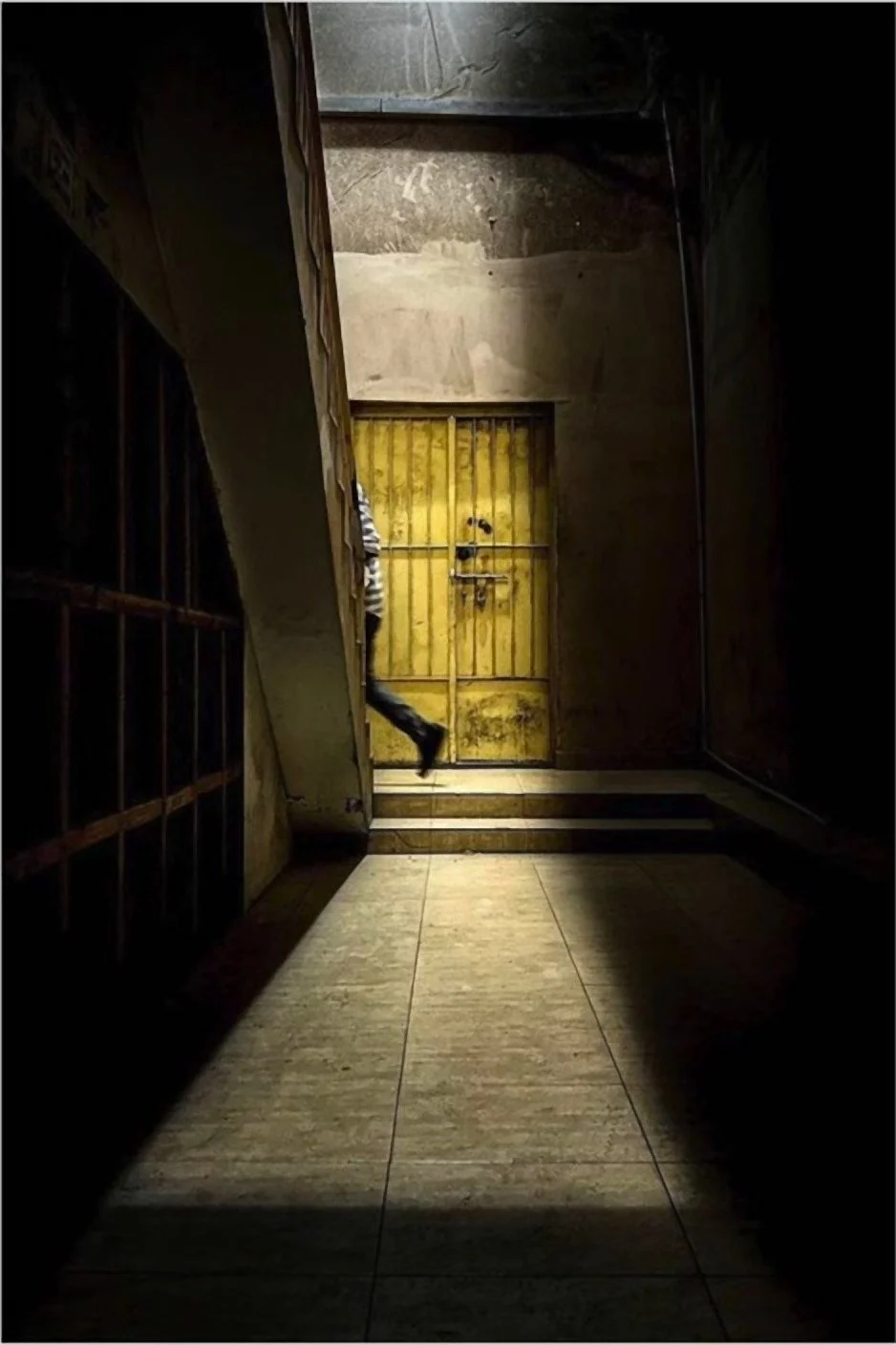
Tomasz Trzebiatowski: This is my kind of shot, a hundred percent. This is what I'm after when I walk around with a camera. Of course that's a personal opinion. As many eyes, so many interpretations.
I love the negative space, the framing of the shadow area, and there is still detail everywhere in those shadows. Sometimes I like it when areas go pitch black too, and I do that myself, but here the photographer kept the detail, and it looks beautiful. The light is soft, coming from somewhere above, a splash of yellowish colour, not too vivid, on an old staircase.
The leg of the person adds movement to the static scene, and a mystery: who is this person, and where are they going? The composition is almost symmetrical, but not quite. There are vertical lines, horizontal light and the diagonal of the stairs. So much to follow, and just wander around. Lovely.
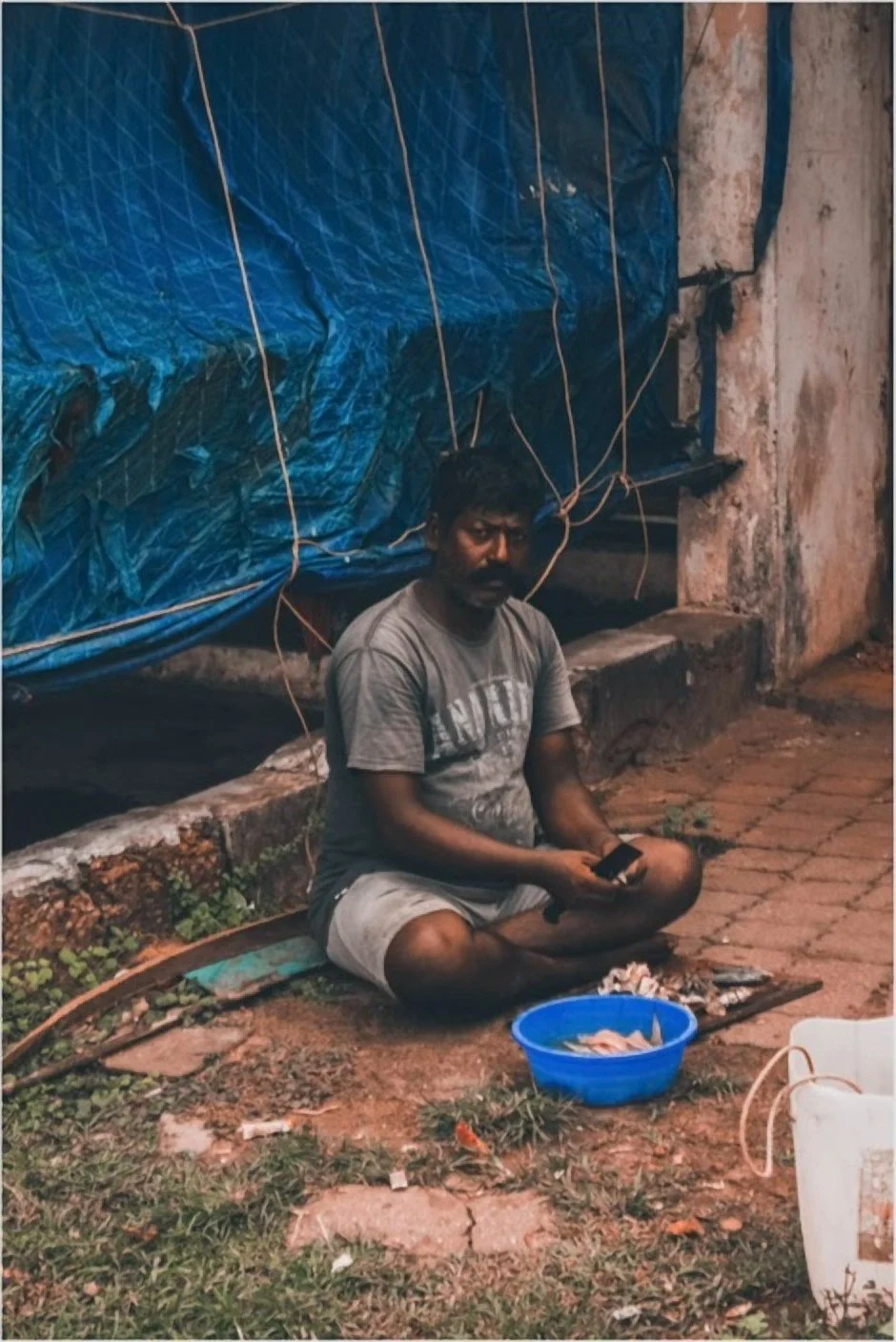
Tomasz Trzebiatowski: A nice environmental portrait. I think he's preparing some kind of fish. The expression on his face is very interesting. We don't know whether he was aware of the camera, whether he was posing or it was candid.
I'm on the fence about the bag. Without it, my eye wouldn't go to that corner, because there would be nothing bright there. But it's part of his environment and his life, and it makes the scene real. His head is in front of the blue surface, so he doesn't disappear, but with his darker skin against the darker background, he could pop more. If the background were light green or yellow, we would see his expression better, and I feel the shot is about his expression.
Martin Kaninsky: The thing is, there was no yellow curtain.
Tomasz Trzebiatowski: I know. That's why I was struggling. It's an environmental portrait, and the scene is what it is. I think it would work nicely in a series about this man: one intentional portrait, where you pose him and control the background, two shots of the details of the fish or his hands, and then this one. It's a very nice shot. The light and the colours are nice too.
His own photo: shadows on a wall
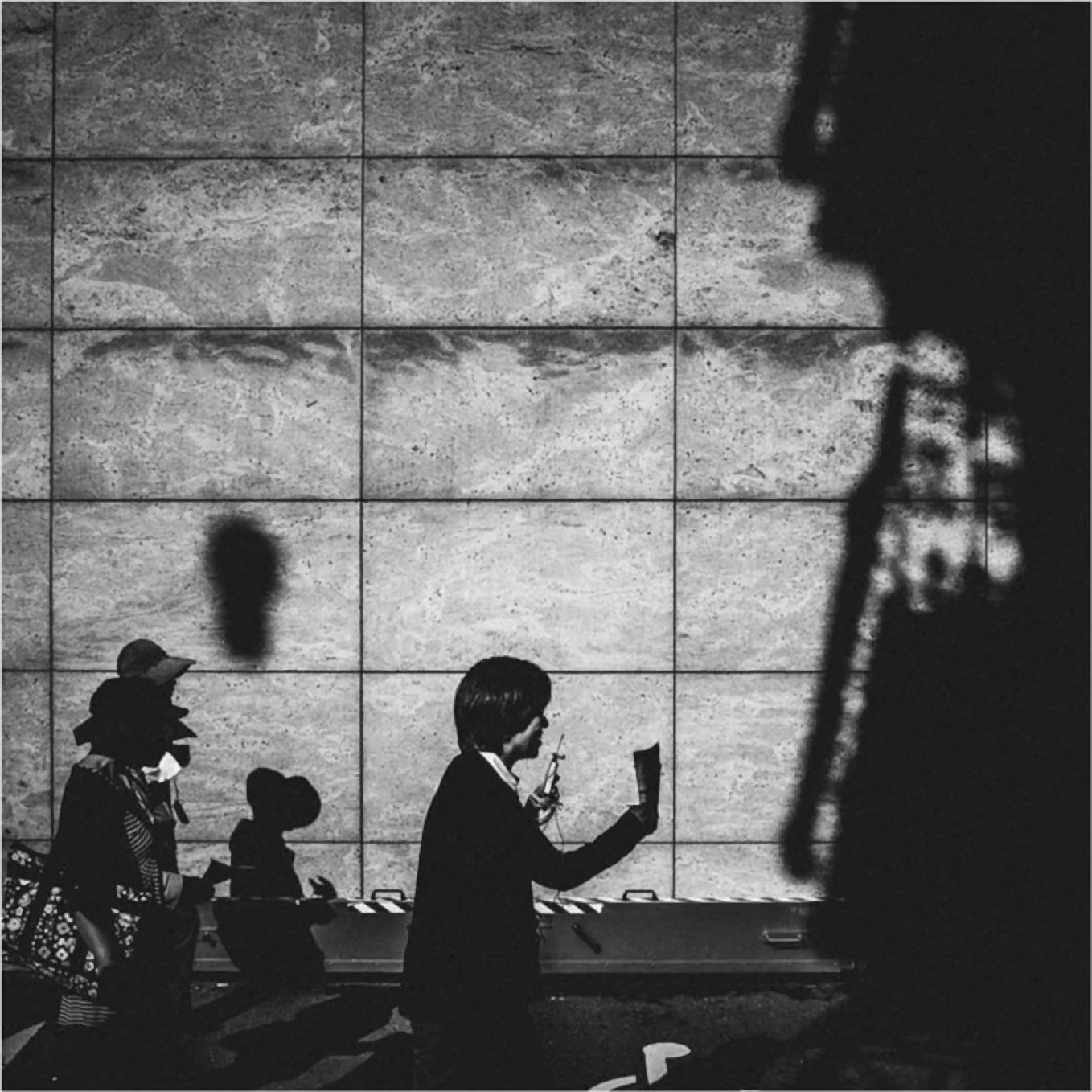
Martin Kaninsky: Now I want you to use the same lens on this one.
Tomasz Trzebiatowski: Martin found it somewhere. It's my photograph from about ten years ago. It's the kind of image I often try to create: a real street scene, not posed. It's a bit chaotic, but for me it's a geometric play with lines, shadows and shapes. I tried to show the movement and the life, and there is contrast everywhere, even subconsciously: dark and bright areas, static lines on the wall against people moving.
In retrospect, I would go a bit lower with the camera. I think I know exactly where it was, and I was shooting slightly from above, standing, with a quick reaction. Lower, I would get a bit more of them, so the head of the woman in the middle would sit in the middle of the next tile. But now I'm only fantasizing about what I would have done.
Martin Kaninsky: The shadow on the right side makes me wonder if it's a fence or a shop. It looks like a monster, and they're walking into its mouth. I also wish the subjects were more separated. The first person in the middle is nicely separated, you can see he's carrying something in his hand, but the two others are together. If they had walked in a line, one by one, I would probably like the picture more. But those things you can't really influence.
Tomasz Trzebiatowski: That's exactly the point of critique, especially of street and photojournalistic shots. There is so much we as photographers don't control. That's why so much is about selection and self-criticism.
When we start in photography, we shoot a scene, we have five shots, we feel none of them is really worth showing, but we have to show something, so we choose the best one anyway. With the years, I very often erase everything I shot, because there is nothing worth showing. In spontaneous photography like street photography, you have to be really strict with yourself during selection. And now that you talk to me about this picture, I have to defend it, because I showed it to the public.
Tomasz Trzebiatowski is the editor-in-chief of Frames Magazine, and he looks at very different kinds of images. Asked what makes a photograph strong, he did not name a genre or a style. He talked about what a picture does to him while he looks at it. A photograph does not have to explain itself to hold us.
“I don't have to understand everything, I don't have to know everything about the picture, but if it causes me to ask the question, dig deeper, stay and keep looking, this is a strong photograph.”Tomasz Trzebiatowski
