AT A GLANCE
- Known for
- Warm, often funny black-and-white pictures of everyday life, dogs and famous people
- Worked in
- Mostly black and white; also a large archive of color slides
- Camera
- A Leica M3 rangefinder for personal work; a Rolleiflex early on and for commercial jobs
- Also
- Magnum member from 1953 and its president for three years in the late 1960s; made films, including 18 comedies for HBO
- Start with
- Snaps (Phaidon, 2001)
- Links
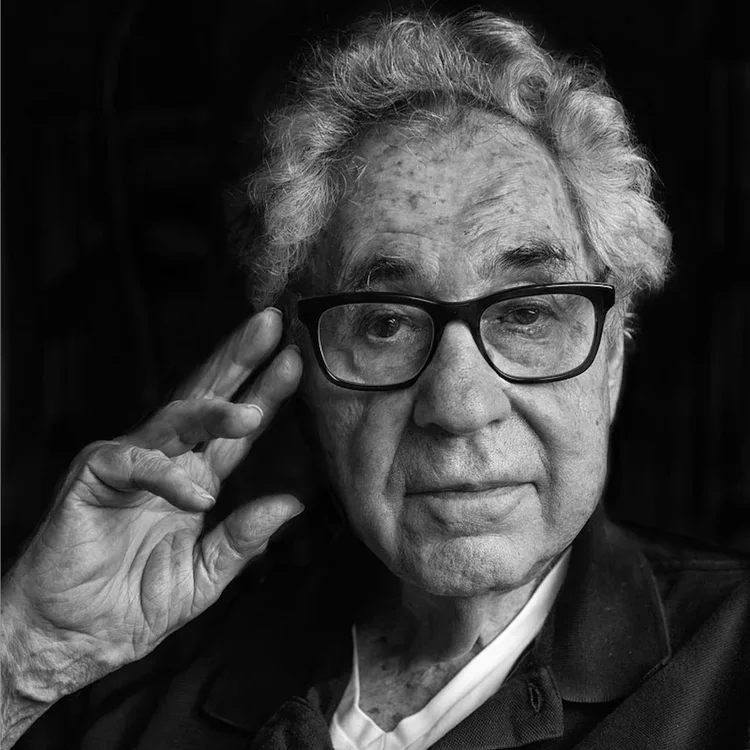
Elliott Erwitt (1928–2023) was an American photographer, born in Paris and raised in Milan. He joined Magnum Photos in 1953 and worked for magazines such as Life, Look and Collier’s. His gentle, funny pictures of people and dogs made him one of the best-loved photographers of his time.
The story
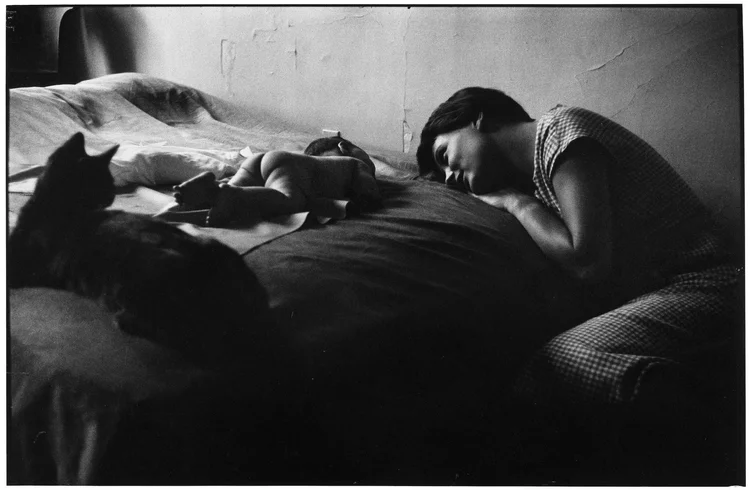
In 1953 Elliott Erwitt was back in New York after two years in the Army. At home, his wife Lucienne lay on the bed and looked at their daughter Ellen. The baby was six days old. A cat sat close by and watched. Erwitt made the picture. “It’s the only frame on a roll of photographs,” he said many years later.
He had come a long way to that room. Born Elio Romano Erwitz in Paris in 1928, to Russian-Jewish parents, he grew up in Milan. In 1939 the family left fascist Italy for the United States. As a teenager in Los Angeles he started with an old glass-plate camera. He also worked in a commercial darkroom, printing pictures of film actors.
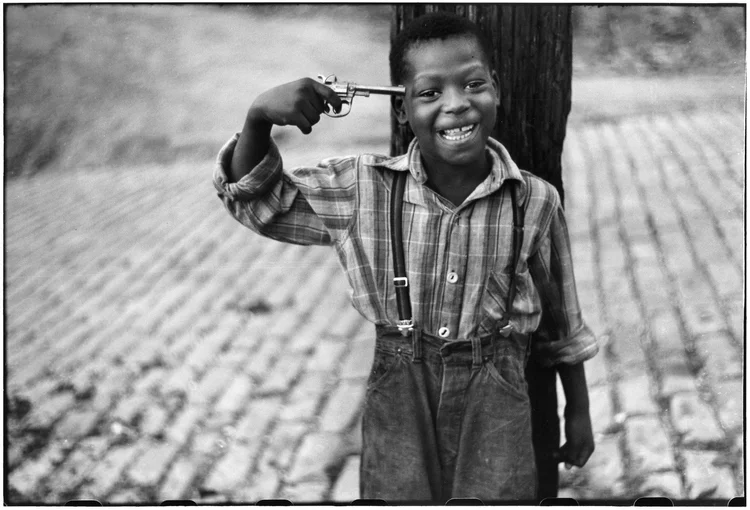
In 1948 he moved to New York. There he met Edward Steichen, Robert Capa and Roy Stryker. Stryker sent him to photograph Pittsburgh in 1950 and gave him free rein. One picture from the city shows a smiling boy holding a toy gun to his own head. Erwitt made ten exposures and chose the second, where the smile is widest.
After about four months in Pittsburgh, the Army drafted him. He served in a Signal Corps unit in Germany and France, doing photographic work. When he came home in 1953, Capa invited him to join Magnum. The work for magazines began.
But the small picture from home travelled further than any assignment. Steichen chose it for The Family of Man, the great 1955 exhibition at the Museum of Modern Art. It has been printed again and again ever since. In the decades that followed, Erwitt photographed Nixon and Khrushchev, Marilyn Monroe, Jacqueline Kennedy and a great many dogs. He died at his home in New York in November 2023, at the age of 95.
So one frame on one roll, made in his own bedroom, became one of the best-known pictures of a mother and child. Erwitt never lost his sense of humor about it. “It’s put my daughter through college,” he said.
The work


- 1928Born Elio Romano Erwitz in Paris
- 1939Family leaves Italy for the United States
- 1948Moves to New York
- 1950Photographs Pittsburgh for Roy Stryker
- 1951Drafted; Army Signal Corps in Germany and France
- 1953Joins Magnum Photos
- 1955Family photo shown in The Family of Man at MoMA
- 1959Photographs Nixon and Khrushchev in Moscow
- 2023Dies at home in New York
Lessons
Look at home first. One of his most famous pictures shows his own wife, baby and cat, made in their New York home in 1953.
Make a few frames, then choose. In Pittsburgh he made ten exposures of the boy with the toy gun and picked the second. He also said that going back to contact sheets often showed him pictures he had missed.
Keep one camera for yourself. On assignments he took one camera for the client and one for his own pictures.
Try this: for one week, photograph dogs from their own eye level. Get down low, as Erwitt did, and look for the moment where people and dogs seem to share a joke.
Gear
Erwitt used many cameras over seventy years. He talked about the main ones in interviews.
Glass-plate camera: in Los Angeles, at about sixteen, he began with an old glass-plate camera.
Twin-lens reflex camera: he took a Rolleiflex on a trip to France and Italy in 1949. Its waist-level viewer let him come close to people quietly, and he could set it on the ground for low angles. Later he used it mostly for commercial work.
Leica M3 rangefinder: his favorite camera for personal work, which he called “the best.” He used it with 35mm, 50mm and 135mm lenses and liked Kodak Tri-X film.
View camera: for advertising jobs.
Books
Snaps (Phaidon, 2001). The first big survey of his whole career, with more than 500 photographs on over 540 pages, many of them not published before. The pictures are grouped in nine chapters named after simple actions, such as Look, Move, Read, Rest and Touch. Famous images, like Nixon and Khrushchev arguing in Moscow, sit next to small, personal scenes of people, places and animals. Texts are by his friends Murray Sayle and Charles Flowers. A shorter edition followed in 2013. The best book to start with.
Elliott Erwitt: Home Around the World (Aperture and the Harry Ransom Center, 2016). Made for the first exhibition after the Ransom Center at the University of Texas at Austin received his archive of about 47,500 photographs. The book has 312 pages and about 250 images from sixty years of work. Edited by curator Jessica S. McDonald, with essays by Stuart Alexander, Sean Corcoran and Steven Hoelscher. For readers who want to see his life’s work with serious, well-researched texts.
Pittsburgh 1950 (GOST Books, 2017). In 1950, at 22, Erwitt photographed Pittsburgh for Roy Stryker’s Pittsburgh Photographic Library, as the city changed from smoky industry to something cleaner and newer. He was drafted after about four months and left the negatives behind. For decades they stayed at the Carnegie Library of Pittsburgh. This 136-page clothbound book uses both the chosen pictures and the rejected ones, and most had never been published. For readers interested in how a young photographer found his eye.
Elliott Erwitt’s Dogs (teNeues; new edition 2021). A large book of his dog pictures, with 159 black-and-white photographs on 144 pages. It shows dogs of every size and mood, from wild and silly to calm and loyal, often with their owners close by. Text in several languages. A good gift, and an easy way into his humor.
In his words
“When the photograph happens, it comes easily, as a gift that should not be questioned or analyzed.”
“Contradictions are perfect for photographs; they make them interesting.”






Rules and techniques, when you apply them you will create a certain visual effect. And this is something this series is gonna be about. I want to introduce you to specific rules and techniques that can be used while you doing photography and its up to you to decided whenever it is right or wrong for your composition.