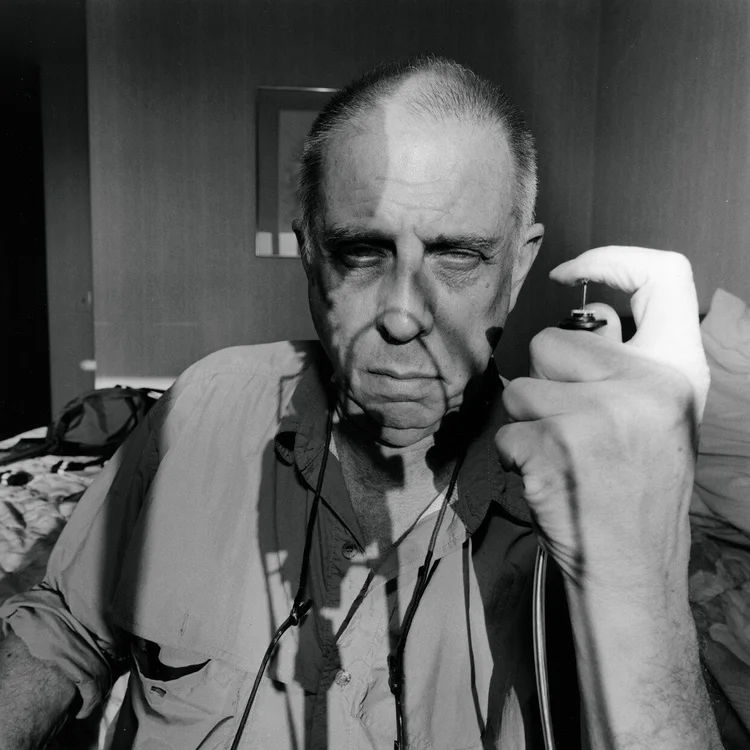
AT A GLANCE
- Known for
- Layered pictures of the American “social landscape”, and self-portraits made with his shadow and reflection
- Works in
- Black and white
- Camera
- 35mm Leica from 1955; Hasselblad Superwide from the early 1990s
- Also
- Shown in New Documents at MoMA in 1967 with Garry Winogrand and Diane Arbus; MacArthur Fellow in 1990
- Start with
- Self Portrait (The Museum of Modern Art, 2005)
Lee Friedlander (born 1934) is an American photographer from Aberdeen, Washington. Since the 1960s he has photographed what he calls the American social landscape: streets, shop windows, motel rooms, monuments and roadsides. His pictures are full of reflections, signs and shadows, and very often his own shadow is one of them.
The story
At sixteen, a teenager from Aberdeen, Washington, heard Charlie Parker for the first time. He had already been taking pictures for about two years. The music stopped him. “I was dumbfounded,” Lee Friedlander remembered. “I somehow knew exactly where he was coming from.”
After that, jazz pulled him along. As a young man he followed bands and travelled long distances to hear them. Photography was the other pull. He studied briefly at the Art Center School in Los Angeles, and in 1955 he moved to the New York area. There he made portraits of musicians for record covers, mainly for Atlantic Records. John Coltrane, Aretha Franklin and Miles Davis all stood in front of his camera.
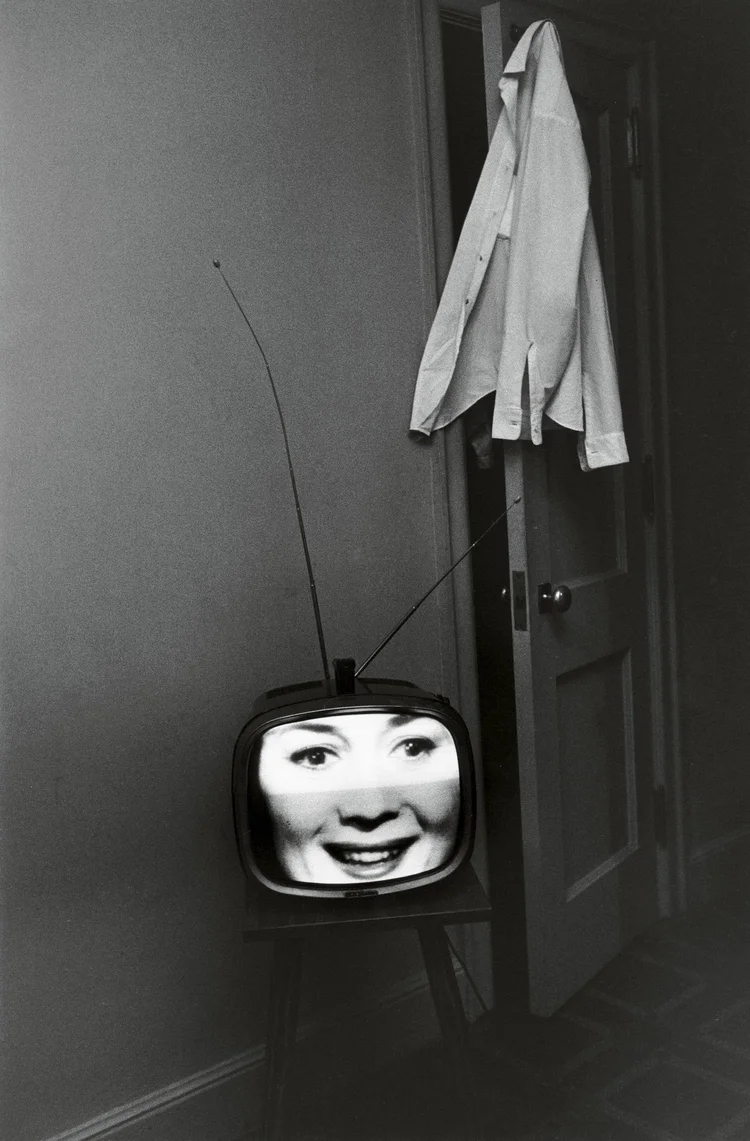
But paid work was only half of his life. With a small Leica he photographed the country itself, what he called “the American social landscape.” Two Guggenheim fellowships, in 1960 and 1962, helped him travel. In motel rooms he noticed the television sets, with a face glowing on the little screen in an empty room. In 1963 Harper’s Bazaar published the series with a text by Walker Evans. Evans called the pictures “deft, witty, spanking little poems of hate.”
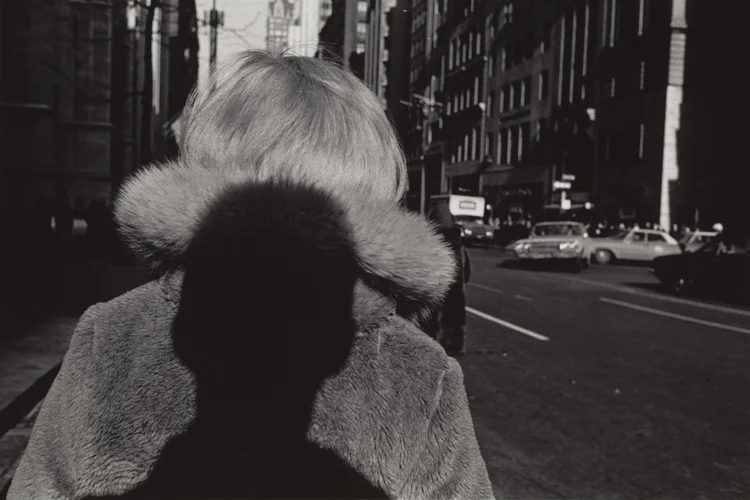
Something else kept slipping into his frames: the photographer. His shadow fell on strangers. His face showed up in shop windows and mirrors. On a New York street in 1966, the shadow of his head lies on the fur collar of a woman walking in front of him. At first, he wrote, “my presence in my photos was fascinating and disturbing.” In 1970 he gathered these pictures in Self Portrait, his first monograph and the first book of his own Haywire Press.
Many projects followed: public monuments, factory workers, nudes, desert landscapes. In the early 1990s he changed to a square-format Hasselblad Superwide. The camera was new. The freedom was not. The texts for his 2020 exhibition in Madrid compare that freedom to the improvisation of jazz. It goes back to the boy of sixteen and the sound of Charlie Parker. “He made me understand that anything was possible,” Friedlander said.
The work


- 1934Born in Aberdeen, Washington
- 1948Begins photographing almost every day, at 14
- 1955Moves to the New York area and takes up the 35mm Leica
- 1963First solo show, at George Eastman House; The Little Screens in Harper’s Bazaar
- 1967Shown in New Documents at MoMA
- 1970Publishes Self Portrait with his own Haywire Press
- 1990Receives a MacArthur Fellowship
- 2005Retrospective at the Museum of Modern Art
- 2026Aperture publishes Life Still, rare and unpublished photographs
Lessons
Use the whole frame. Reflections, poles, signs and shadows are part of his pictures, not mistakes. Look at every corner before you press the shutter.
Put yourself in the picture. His shadow and reflection became a subject of their own, from Self Portrait in 1970 to a new series of self-portraits made with the Hasselblad.
Photograph almost every day. He began photographing almost daily at 14. A Yale curator said in 2010 that his longest break in recent memory was about three months, when he had both knees replaced.
Try this: on a sunny day, walk with the sun behind you. Make ten photographs where your shadow is part of the scene. Keep the one where the shadow changes what the picture is about.
Gear
35mm Leica rangefinder: he took up the 35mm Leica for his personal work in 1955. It is the camera of his street pictures from the 1960s and 1970s.
Hasselblad Superwide: a square-format camera he began to use in the early 1990s, when he started working in the Sonoran Desert. Its negative is nearly four times the size of the Leica negative, which gave his landscapes more depth and detail.
In recent years he has gone back to the 35mm Leica. He makes his own prints and works without an assistant.
Books
Self Portrait (Haywire Press, 1970). His first monograph and the first book of his own small press. A 1969 portfolio of his prints with etchings by Jim Dine helped pay for it. In nearly 50 pictures he appears as a shadow on the street or a reflection in windows and mirrors, and only rarely in full view. The book moves from awkward early attempts to a playful use of his own shadow. New editions followed from Fraenkel Gallery and D.A.P. in 1998 and from the Museum of Modern Art in 2005, with an afterword by John Szarkowski. The 2005 edition is the easiest to find. For anyone who wants to make self-portraits that are about a place as much as a face.
The American Monument (Eakins Press Foundation, 1976). A large oblong book with 213 photogravure plates, bound like a ledger. The pictures were chosen from more than 1,000 photographs of public monuments across the United States, from Plymouth Rock to a Pony Express plaque in Salt Lake City. Statues stand among traffic lights, wires, cars and shop signs, and the result is both funny and quietly poetic. The first edition was limited to 2,000 copies, so today it is mostly a book for libraries and collectors. A key book for seeing how much he can fit into one frame.
Friedlander (The Museum of Modern Art, 2005). The catalogue of his MoMA retrospective, organized by Peter Galassi, chief curator of photography. It has 480 pages and 764 plates, from his early street work and the little screens to monuments, factory workers, nudes and the later Hasselblad landscapes. The exhibition then toured Europe, starting at the Haus der Kunst in Munich. This is the big overview, the book to look for if you want his whole career in one place.
America by Car (D.A.P./Fraenkel Gallery, 2010). Nearly 200 square photographs made around the turn of the century, driving ordinary rental cars across most of the 50 states. The mirrors, windshield and side windows of the car become frames inside the frame. Through them we see roadside bars, motels, churches, monuments, bridges and open land, and now and then his own reflection. A good book for anyone who travels by car with a camera.






Commodo cursus magna, vel scelerisque nisl consectetur et. Donec id elit non mi porta gravida at eget metus.