AT A GLANCE
- Known for
- Warm, playful pictures of everyday life in Paris and its suburbs, above all Le baiser de l’hôtel de ville (1950)
- Worked in
- Black and white
- Camera
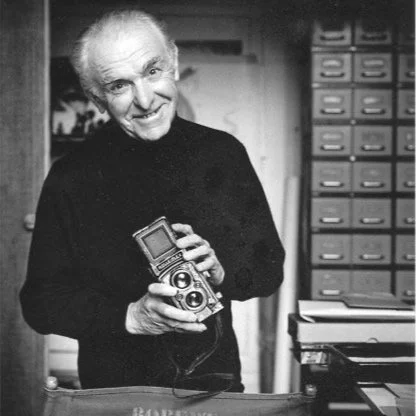
- A Rolleiflex for about two decades, bought with his first commission; he also used a Leica
- Also
- Forged papers for the Resistance during the war; worked for Vogue Paris and Life; Kodak Prize 1947, Niépce Prize 1956
- Start with
- Robert Doisneau: Paris (Flammarion, 2005)
- Links
Robert Doisneau (1912–1994) was a French photographer of everyday life in Paris and its working-class suburbs. He worked for the Rapho agency for most of his career and made pictures for magazines such as Life and Vogue. His photograph of a couple kissing near the Hôtel de Ville (1950) is one of the most reproduced images in the world.
The story
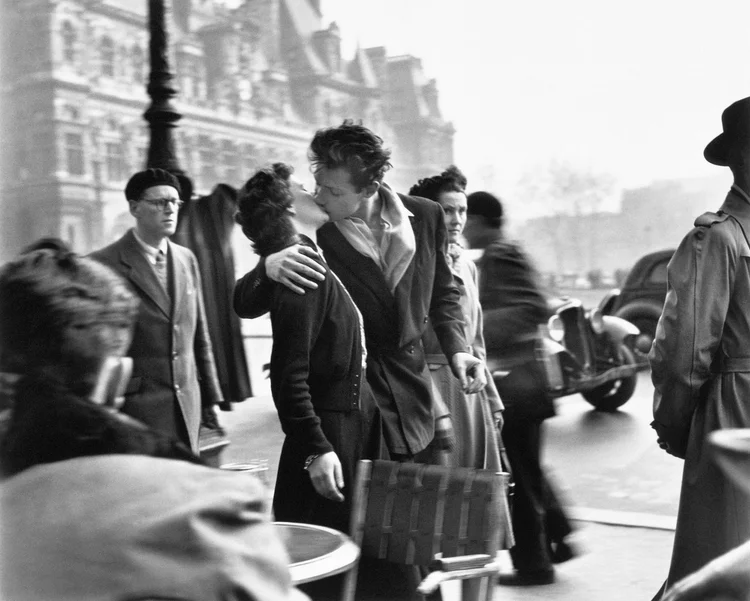
In 1950 Life magazine asked Robert Doisneau for a story about lovers in Paris. He sat at a café called Le Villars, across the street from an acting school. A young couple walked past, kissing. Françoise Delbart was 20 and Jacques Carteaud was 23, and both wanted to be actors. Françoise later remembered that he told them they were charming and asked them to kiss again for his camera. They walked with him to the Place de la Concorde, the Rue de Rivoli and finally the Hôtel de Ville. There, with his Rolleiflex, he made the picture.
Asking strangers had not always come easily. Born in Gentilly, just outside Paris, he trained as an engraver and lithographer. His first photographs show cobblestones and posters, but no people. A commission from the town of Gentilly paid for his own Rolleiflex. From 1934 he photographed the Renault factory at Billancourt, until he was fired in 1939 for faking the time clock. During the war his old training found a new use. “My diploma in lithographic engraving enabled me to make excellent forged papers,” he said of his work for the Resistance.
After the war he joined the Rapho agency and walked the streets of Paris and its suburbs. Life published the kiss on 12 June 1950. For more than thirty years it was one picture among many. Then, in 1986, a publisher made it into a poster, and it went around the world.
Fame brought trouble. A couple said they were the lovers and took him to court. Françoise sued too. In 1993 the courts dismissed both claims, and the story that the scene had been set up became public. Still, Françoise always said that the feeling was true. “The photo was posed,” she said, but “the kiss was real.”
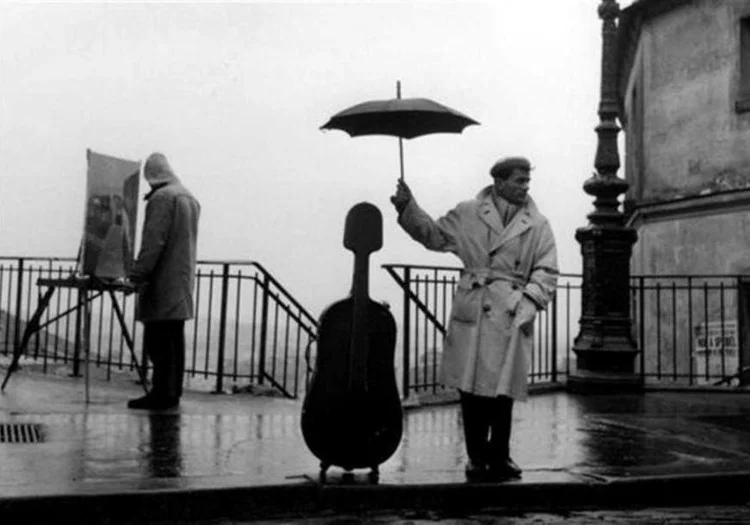
Doisneau never minded a little theater. His friend the cellist Maurice Baquet, whom he met just after the war, became his partner in many playful pictures.
When he died in 1994, he left about 450,000 negatives. The young man who did not dare to photograph people is remembered for two strangers he asked to kiss. Late in life, in a letter to his biographer Peter Hamilton, he described his work this way: “I gently took hold of the treasures that some of my contemporaries were carrying about quite unawares.”
The work


- 1912Born on 14 April in Gentilly, near Paris
- 1929Graduates from the École Estienne in engraving and lithography
- 1931Becomes camera assistant to the sculptor André Vigneau
- 1934Starts as an industrial photographer at Renault in Billancourt
- 1939Is fired by Renault and drafted into the army
- 1946Joins the Rapho agency, where he stays for the rest of his career
- 1949Publishes his first book, La Banlieue de Paris, with Blaise Cendrars
- 1950Makes Le baiser de l’hôtel de ville for Life magazine
- 1994Dies on 1 April, two weeks before his 82nd birthday
Lessons
Ask. He saw a kiss and simply asked the couple to do it again. They tried three places before the Hôtel de Ville.
Stay with your own streets. His first book, La Banlieue de Paris, showed the suburbs where he grew up. He worked from the same flat in Montrouge for more than fifty years.
Play with friends. With the cellist Maurice Baquet he made funny, staged pictures for decades. A willing friend can turn a walk into a small theater.
Try this: when you see a small moment you were too slow to catch, ask the people if they will do it again. Photograph it in three different places and compare the results.
Gear
Doisneau did not write much about equipment. Two cameras are well documented.
Twin-lens reflex camera: he bought his own Rolleiflex with money from a commission for the town of Gentilly and used this type of camera for about two decades. The Smithsonian says he used a Rolleiflex for the kiss in 1950.
Rangefinder camera: the Philharmonie de Paris lists the Leica among the cameras he used, next to the Rolleiflex he carried on his shoulder in the suburbs.
Books
Robert Doisneau: Paris (Flammarion, 2005; new compact edition). A thick book of 400 pages with more than 600 photographs of Paris, many of them rare or never published before. The pictures were chosen by his daughter Francine Deroudille, and the book includes quotations from Doisneau himself. It is arranged by theme, from the gardens and the Seine to the people of the city, and mixes famous images like the kiss with casual snapshots. The best single book for anyone who wants to see his Paris as a whole.
La Banlieue de Paris (Pierre Seghers, 1949). His first book, made with the writer Blaise Cendrars, who wrote the text. It has 130 photographs of the working-class suburbs around Paris, such as Gentilly and Montrouge, made just before these places changed. Martin Parr and Gerry Badger included it in The Photobook: A History and called it a valuable document. Original copies are rare and expensive, so look for it in libraries or in later editions.
Robert Doisneau: The Vogue Years (Flammarion, 2017). His best photographs for Vogue Paris, made between 1949 and 1965. Fashion shoots, society balls and costume parties sit next to portraits of artists and celebrities and everyday street scenes in France. It includes a personal homage by Edmonde Charles-Roux, a former editor of Vogue Paris. The open-spine binding lets the book lie flat. A good choice for readers who know only his street work.
Robert Doisneau: A Photographer’s Life (Abbeville Press, 1995). The first authorized biography, written by Peter Hamilton, who curated Doisneau’s first solo retrospective outside France in 1992. It has 386 illustrated pages and draws on unpublished archives and conversations with Doisneau in his last years. It follows his work in the photojournalism of the 1930s, his humanist pictures of the 1940s and 1950s and his montages of the 1960s, including his work for Vogue and Life. The book for readers who want the full story of his life.


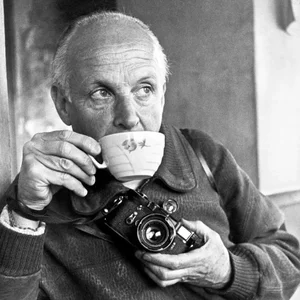

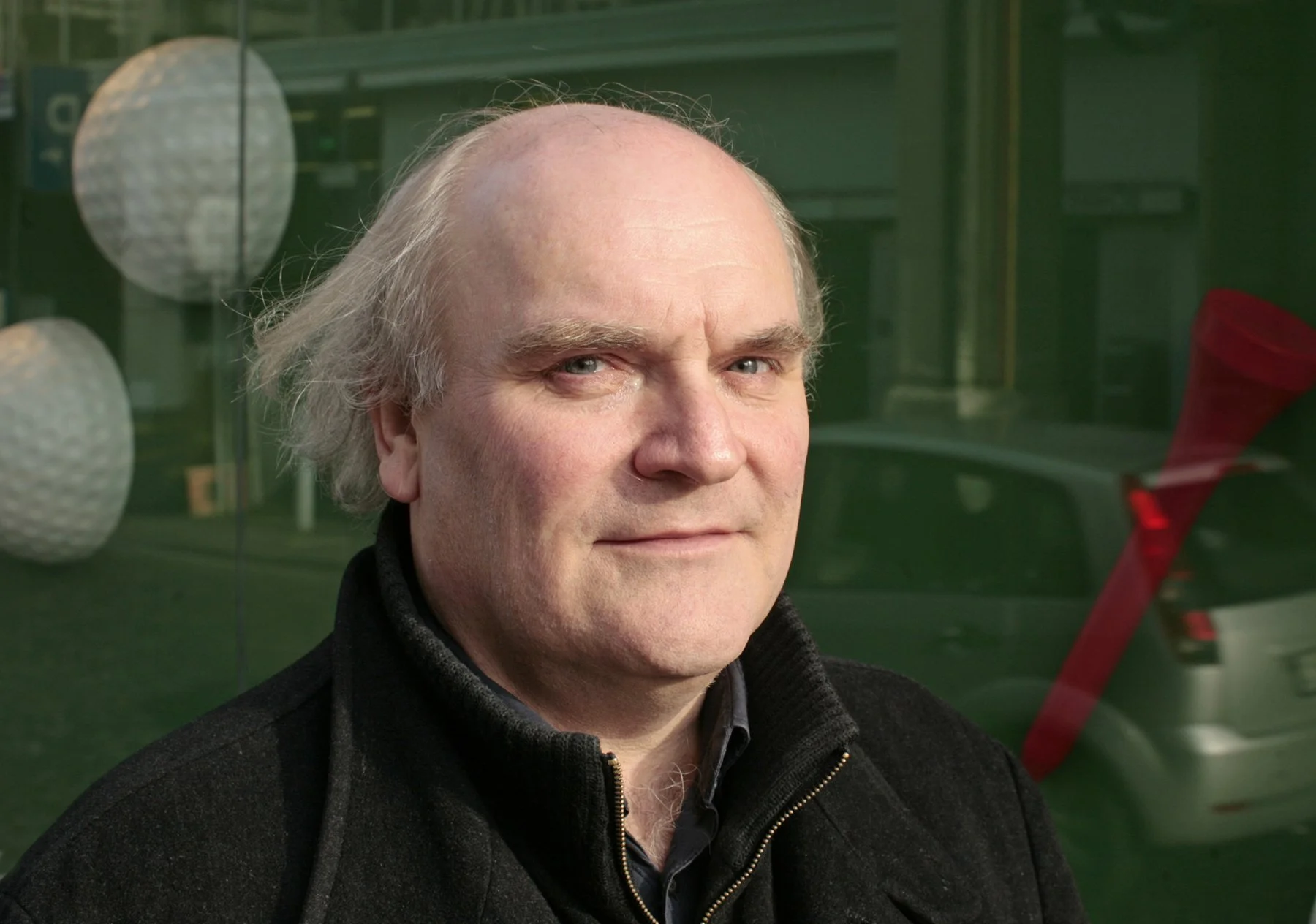




This week It would have been 108 years since Robert Doisneau was born. Doisneau was a part of this classic era of photojournalism in Europe, part of the same generation as, for example, Cartier Bresson or Robert Capa. He is also responsible for of one of the most well-known romantic pictures in the world. Let’s check out Robert Doisneau.