Rolleiflex 3.5 A


This page shows a 3D model of a twin-lens reflex camera. It needs WebGL. Here is a picture instead.
It started with a no
The Rolleiflex 3.5 A is a twin-lens reflex camera for roll film. It was made in Braunschweig, Germany, from 1951 to 1954.
Its story begins in the same town, during the First World War. Reinhold Heidecke was a production manager at the camera maker Voigtländer. Around 1916 he had an idea for a new kind of camera that used roll film. The company said no. Roll film was hard to keep flat, and the cameras Voigtländer already made were selling well.
So Heidecke started his own firm with Paul Franke, a salesman he knew from Voigtländer. They began with stereo cameras. At the end of the 1920s they brought out the first Rolleiflex. It took square pictures on roll film through one lens. A second lens above it showed the photographer the picture.
One job was still left to the photographer. To find the first picture, you had to wind the film and watch a small red window in the back. In 1937 the Rolleiflex Automat took that over. Rollers inside feel the film as it passes, and the counter starts by itself.
The 3.5 A of 1951 comes from that line. The idea Voigtländer had refused was now a camera that found the first picture by itself.
Two lenses, one picture
The top lens is for looking. Behind it a fixed mirror sends the image up to a ground glass. You hold the camera at your waist and look down into the hood. The image is upright, but left and right are swapped.
The bottom lens takes the picture. The shutter and the diaphragm sit inside it. Both lenses are on one panel, so when you focus one, you focus the other.
Because the mirror never moves, the finder does not go dark when you press the release. The leaf shutter is quiet.
One swing of the crank moves the film, counts the frame and tensions the shutter. A roll of 120 film gives twelve square pictures.
- Made
- 1951 to 1954
- Maker
- Franke & Heidecke, Braunschweig
- Film
- 120 roll film, 12 pictures of 56 x 56 mm
- Taking lens
- 75 mm f/3.5
- Viewing lens
- 75 mm f/2.8
- Shutter
- Leaf shutter, 1 s to 1/500 s and B
These photographers worked with a Rolleiflex. In most cases it was not this exact model, but a camera of this type.
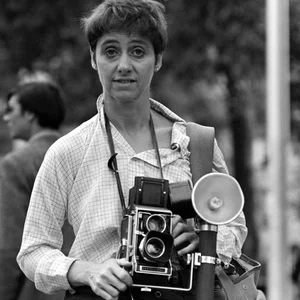 Diane Arbusfrom about 1962
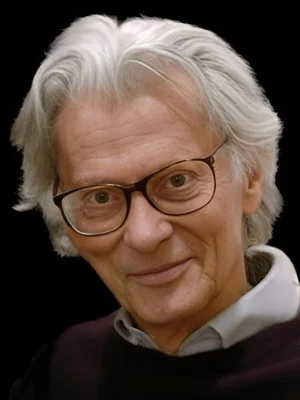 Richard Avedonfrom 1942
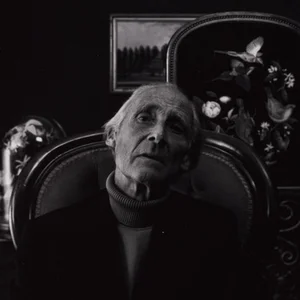 Bill Brandtdocumentary work, 1930s
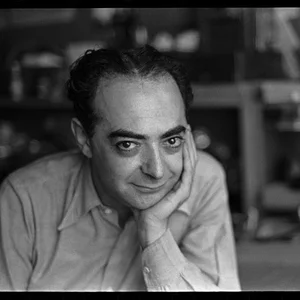 Brassaïfrom the mid-1930s
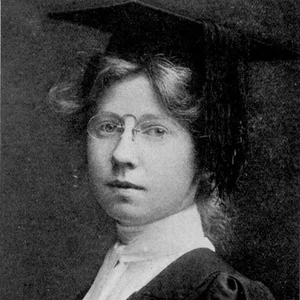 Imogen Cunninghamfrom 1938
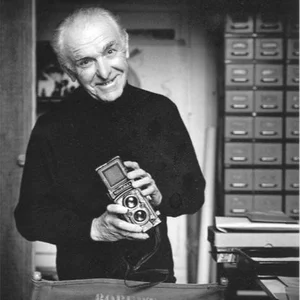 Robert Doisneaufrom 1932
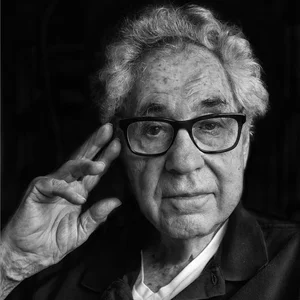 Elliott Erwittfrom the late 1940s
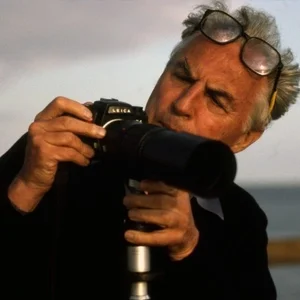 Ernst Haas1946 to about 1949
 Fan Hofrom his teens
 Rinko Kawauchisince her early work
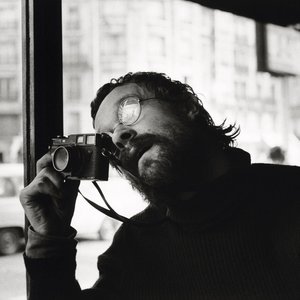 Josef Koudelkaearly theatre work
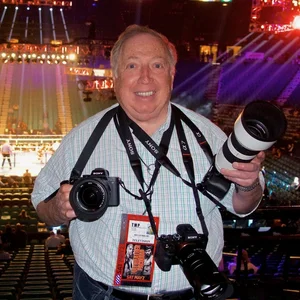 Neil Leiferearly career, to 1965
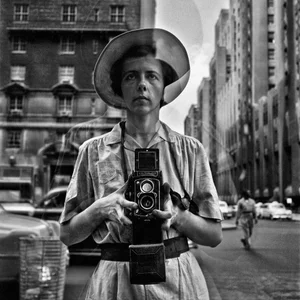 Vivian Maierfrom 1952
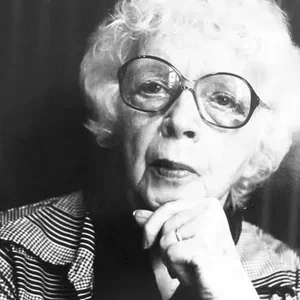 Lisette Modelfrom the 1930s
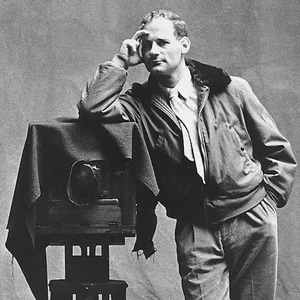 Irving PennCuzco, 1948
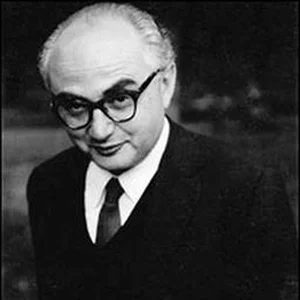 David “Chim” Seymour1947 and 1948
400 parts, built only from code. The plate reads About Photography, not the maker's name. The scene is a drawing after the Old Town Square in Prague. It is simplified, not exact. Sounds are made by code, not recorded.