AT A GLANCE
- Known for
- Fashion pictures and portraits for Vogue, still lifes, and portraits of people in Peru, Dahomey, New Guinea and Morocco
- Worked in
- Black and white and color; known for his platinum-palladium prints
- Camera
- Rolleiflex, and Deardorff large-format view cameras in the studio
- Also
- Worked for Vogue for more than sixty years and photographed his 165th Vogue cover in 2004
- Start with
- Irving Penn: Centennial (The Metropolitan Museum of Art, 2017)
- Links
Irving Penn (1917–2009) was an American photographer. For more than sixty years he made fashion pictures, portraits and still lifes for Vogue, in a calm and simple style. He also photographed people in Peru, Africa and New Guinea in small daylight studios, and he was a master printer in platinum.
The story
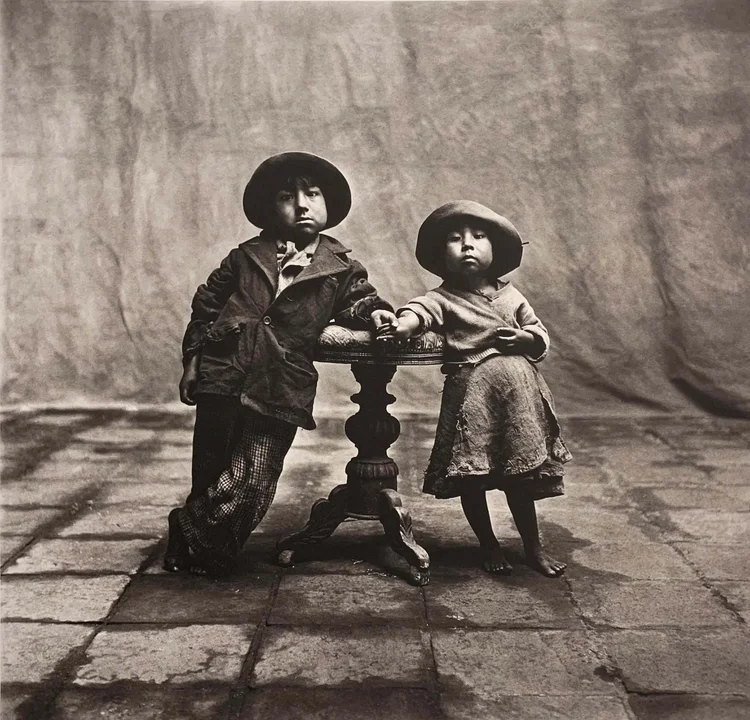
In December 1948, Irving Penn finished a Vogue fashion assignment in Lima, Peru. Instead of flying home, he went up into the Andes, to Cuzco. It was the Christmas season. Country people had come into town from the valleys and the hills to sell crafts and shop at the big market. Penn rented a local photographer’s daylight studio for three days.
Many families came to that studio every year for their portrait. This time they found a stranger from New York behind the camera. And the money went the other way. “Instead of them paying me, I paid them for posing,” he remembered. In three days he made more than 2,000 exposures with his Rolleiflex. One shows a brother and sister, barefoot, leaning on a small table with their hands linked.
Photography had not been the plan. Born in Plainfield, New Jersey, in 1917, he studied design in Philadelphia with Alexey Brodovitch, the art director of Harper’s Bazaar. In 1938 he bought his first camera, a Rolleiflex, with money from drawings the magazine had published. Later he spent a year painting in Mexico. Then, in 1943, Alexander Liberman hired him at Vogue and encouraged him to take photographs. His first color still life became the Vogue cover of October 1, 1943.
Earlier in 1948, back in New York, he had started something unusual. He pushed two studio flats together to make a narrow corner, with old carpet on the floor. Writers, artists, musicians and dancers had to find their own place inside it. Cuzco gave him the same thing in another form: a small, borrowed room with daylight, and people who came in from outside.
He kept coming back to that idea. Vogue published the Cuzco pictures in 1949. From 1967 to 1971 he traveled with a tent studio he had built, to Dahomey, Nepal, Cameroon, New Guinea and Morocco. In 1974 he gathered these portraits in a book with a fitting title, Worlds in a Small Room.
So the famous people in New York and the families in Cuzco had something in common. Each one stood in a small space, away from their usual world. Penn noticed what this did to his sitters. “This confinement, surprisingly, seemed to comfort people, soothing them. The walls were a surface to lean on or push against.”
The work


- 1917Born in Plainfield, New Jersey
- 1938Buys his first camera, a Rolleiflex
- 1943First Vogue cover, a color still life
- 1948Corner portraits in New York; Cuzco studio in Peru
- 1950Marries the model Lisa Fonssagrives in London
- 1960First book, Moments Preserved
- 1975Cigarette photographs shown at MoMA
- 1984Retrospective at the Museum of Modern Art
- 2009Dies at his home in New York, aged 92
Lessons
Build a small stage. A tight corner or a plain room takes away the rest of the world. Then the person is all that is left in the picture.
Look past the assignment. After the job in Lima he stayed on and rented a studio in Cuzco. That side trip became one of his most important series.
The print is part of the work. He went back to the Cuzco negatives for decades and printed them in silver and in platinum-palladium.
Try this: build a corner at home with two large boards, set at an angle a little narrower than a right angle. Invite three people to step inside, one at a time. Do not pose them. Watch how each one uses the walls, and photograph that.
Gear
The Art Institute of Chicago, which holds his archive, describes the cameras he used.
Rolleiflex: his first camera, bought in 1938. He used a Rolleiflex in Cuzco in 1948 and on all the travels in Worlds in a Small Room.
Large-format view camera: in his early studio work for Vogue he used 4x5 and 8x10 Deardorff view cameras for still lifes, portraits and fashion.
35mm camera: with a telephoto lens, for many magazine travel assignments from 1950.
Banquet camera: a wide large-format camera with 12x20 inch negatives, from 1979. He could contact print them in platinum without enlarging.
In the studio he also used modified fresnel stage lights. For more than sixty years his backdrop was an old Paris theater curtain painted with gray clouds.
Books
Irving Penn: Centennial (The Metropolitan Museum of Art, 2017, distributed by Yale University Press). The catalogue of the big Met retrospective for the hundredth anniversary of his birth, by curators Maria Morris Hambourg and Jeff L. Rosenheim, with more contributors. It has 372 pages and close to 300 photographs, some never published before. Essays cover his portraits, fashion, nudes, still lifes and his pictures of people in Peru, Benin, New Guinea and Morocco, plus his advertising work and printing. It ends with an illustrated chronology. The best first book.
Passage: A Work Record (Alfred A. Knopf and Callaway Editions, 1991). Penn’s own visual memoir of his career, in time order, with 300 pages and 468 illustrations. The introduction is by Alexander Liberman, the Vogue art director who first asked him to take photographs. There is a detailed work chronology at the end. For readers who want to see how the whole career fits together, in the order he made it.
Worlds in a Small Room (Grossman Publishers, 1974). A slim book of 95 pages with 76 duotone portraits from about twenty years of travel. Penn calls himself an ambulant studio photographer here. It starts with the Cuzco studio of 1948 and goes on to the tent studio he took on five trips from 1967 to 1971. For anyone interested in how a simple setting can change a portrait.
Still Life: Irving Penn Photographs, 1938–2000 (Bulfinch Press, 2001). 144 pages and 98 pictures of his still life work, from food and flowers to cigarette butts and found objects. The introduction is by John Szarkowski, the former photography director of the Museum of Modern Art. Penn oversaw the design and production himself. A good book for still life and product photographers.