AT A GLANCE
- Known for
- Spending the night with strangers in Russia, the United States and Egypt, and photographing their homes
- Works in
- Color
- Camera
- Canon EOS 5D Mark II with a 17–40mm zoom for her work in the US and Egypt
- Also
- Short films, such as Dvalemodus, and the long collaboration with Agata Kay
- Start with
- As It May Be (Aperture, 2018)
- Links
Bieke Depoorter (born 1986) is a Belgian photographer and a member of Magnum Photos. She is known for asking strangers if she can spend the night in their homes, first in Russia, then in the United States and Egypt. Her books include Ou Menya, As It May Be and Agata.
The story
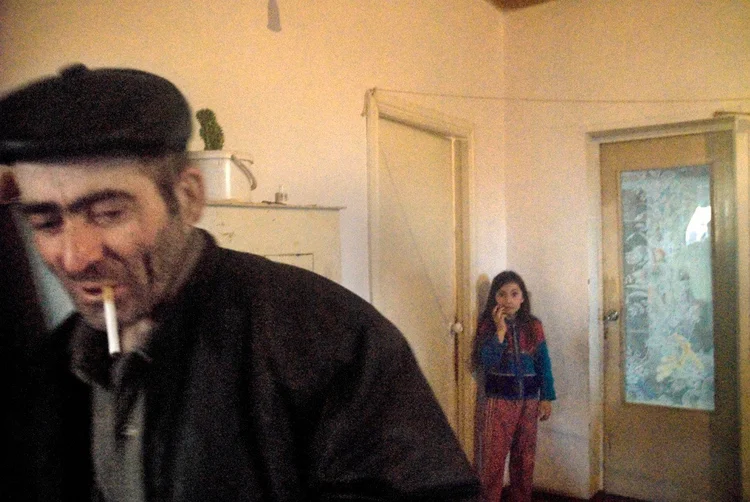
Bieke Depoorter did not speak Russian. So before she got on the Trans-Siberian train, a friend wrote a note for her on a piece of paper: “I am looking for a place to spend the night. Do you know people who would have a bed, or a couch? I don’t need anything in particular, and I have a sleeping bag.” She carried the note and her camera from village to village.
It was her graduation project at the Royal Academy of Fine Arts in Ghent. She made three trips of one month each. Some days nobody said yes. When someone did, she slept on a couch, in the old bunk bed of a grown child, or on newspaper spread over the floor. “We cannot really talk,” she said, “but we can communicate in other ways. It’s strange, but very fast they don’t see me as a stranger anymore.” Each morning, before she left, she took a picture of the bed she had slept in. In 2009 the project, Ou Menya, won the Magnum Expression Award.
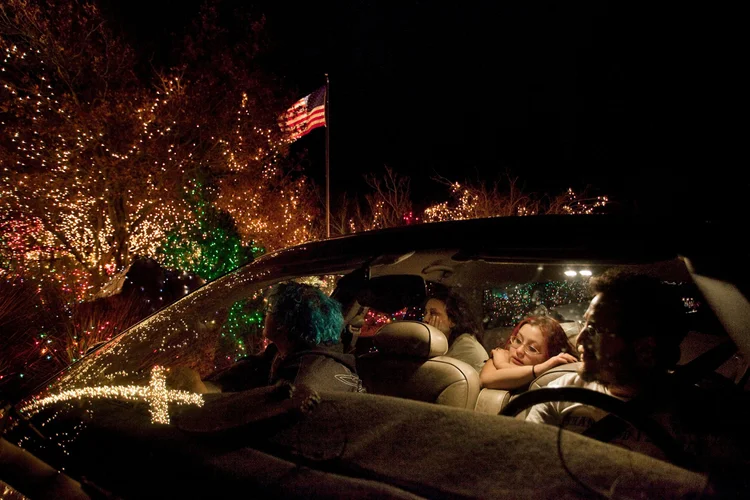
The method stayed with her. For four years she asked for a bed across the United States. On one December night she photographed a family in a car, looking at Christmas lights.
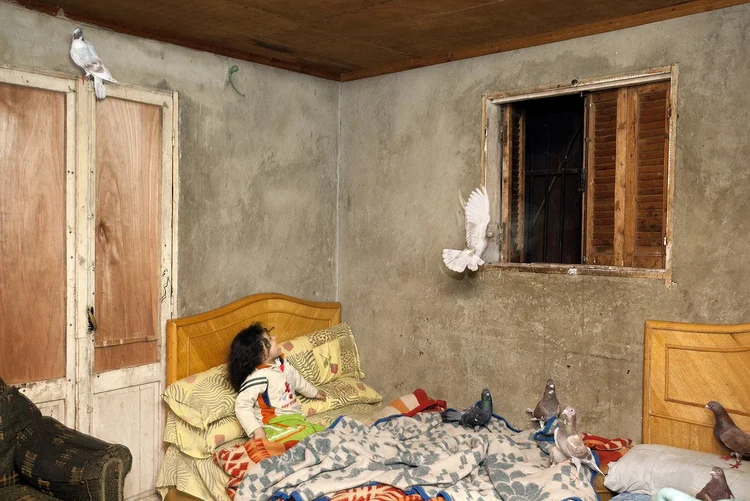
Egypt was harder. After the revolution of 2011, people were friendly in the street but did not invite strangers inside. “I wanted to try to find trust in a place where there’s no trust,” she said. With an interpreter, she walked whole days until someone took her in. In Cairo in 2012 she photographed a child in bed while pigeons flew around the room. Later she went back with a draft of the book and let people write their comments on the pictures.
The bed pictures were never meant to be seen. About ten years later she found them again, hundreds of them: air mattresses, couches, carpets, kitchen floors. In 2026 they became a book, The Beds I Slept In. The small habit from those mornings turned out to be a record of trust. Each bed was a yes from a stranger. “Sometimes you really start to love the people, and sometimes it’s hard to leave because of love. But I couldn’t take any of these pictures if I didn’t spend the night. It seems like one night is not a lot, but it’s a lot if you spend it,” she said.
The work


- 1986Born in Kortrijk, Belgium
- 2009Master’s in photography in Ghent; Magnum Expression Award for Ou Menya
- 2011Publishes Ou Menya; first of eight trips to Egypt
- 2012Becomes a Magnum Photos nominee at 25
- 2014I Am About to Call It a Day; Magnum associate
- 2016Full member of Magnum Photos
- 2018As It May Be published by Aperture
- 2022Shortlisted for the Deutsche Börse Photography Foundation Prize
- 2026The Beds I Slept In, book and show in Nieuwpoort
Lessons
Ask, and keep asking. Some days in Russia nobody said yes. She kept walking until someone did.
Stay long enough. She could not have made these pictures without spending the night. At night, she says, people are more real.
Give the pictures back. In Egypt she showed her draft to people in the street and let them write on the photographs. Their words became part of the book.
Try this: ask someone you do not know well if you can photograph their home in the evening. Stay until it gets dark. Then show them the pictures and write down what they say.
Gear
Full-frame digital camera: Canon names the EOS 5D Mark II as her camera for I Am About to Call It a Day in the US and As It May Be in Egypt.
Wide-angle zoom lens: a Canon EF 17–40mm f/4L for most of those pictures, useful in small rooms. For some later pictures in Cairo she used a 24–70mm.
Cinema camera: she shot her first short film, Dvalemodus, on a Canon C100 Mark II, so she could keep using her own lenses.
In Russia she worked in low light and did not use flash, so many of the Ou Menya pictures are grainy.
Books
Ou Menya (Lannoo, 2011). Her first book, with 128 pages of color photographs and texts in English, Dutch and French. It comes from three one-month trips along the Trans-Siberian railway, when she stopped in small villages and asked families if she could stay the night. The pictures show people at home, close together in small rooms, and the short bond between them and the guest. The project won the Magnum Expression Award in 2009. Good for anyone interested in how trust makes intimate pictures possible.
As It May Be (Aperture, 2018; first published by Hannibal in Belgium in 2017). The book shows Egyptian families at home, photographed between 2011 and 2017. In 2017 she took a draft back to Egypt and asked people, from open-minded to very conservative, to write on the photographs. Their handwritten Arabic comments, funny, angry or sad, now sit on top of the pictures. A booklet gives the English translations, and there is an essay by the Belgian journalist Ruth Vandewalle, who worked with her in Egypt. A book about photography itself, and about who has the right to tell a story.
Agata (self-published, Ghent, 2021; second edition with Des Palais, 2022). In 2017 in Paris she met Agata Kay, a young Polish woman working in a strip club, and they began a long collaboration. The book follows them through France, Germany, Belgium, Greece and Lebanon, with photographs, Agata’s handwritten notes and their letters. It is Japanese-bound, and some pages are sealed, so the reader must tear them open. A chapter is built from the diaries of Germaine, the woman who once owned the house where Agata was living. For readers who want to think about the power between photographer and subject.
The Beds I Slept In (Hannibal, 2026). A thick softcover of 416 pages with hundreds of pictures of the places strangers made for her to sleep in Russia, the United States and Egypt between 2008 and 2016: air mattresses, couches, carpets and floors. She took them each morning but never meant to publish them. Years later she found them again and saw a record of trust. The book goes with her exhibition at Westfront Nieuwpoort in Belgium, from June 2026 to January 2027. A quiet, small-format book that tells the story behind all her early work.
In her words
“For me, there’s something special about night and people inside their homes. When it gets dark, the atmosphere changes. People are more real, in a way.”
“On the street you pretend to be someone else. I do this myself. But when you come home, that layer falls away.”



What can one photo teach you about memory and truth? Bieke Depoorter was nearly finished with her book when she found an old diary from her childhood. Story Behind The Photograph