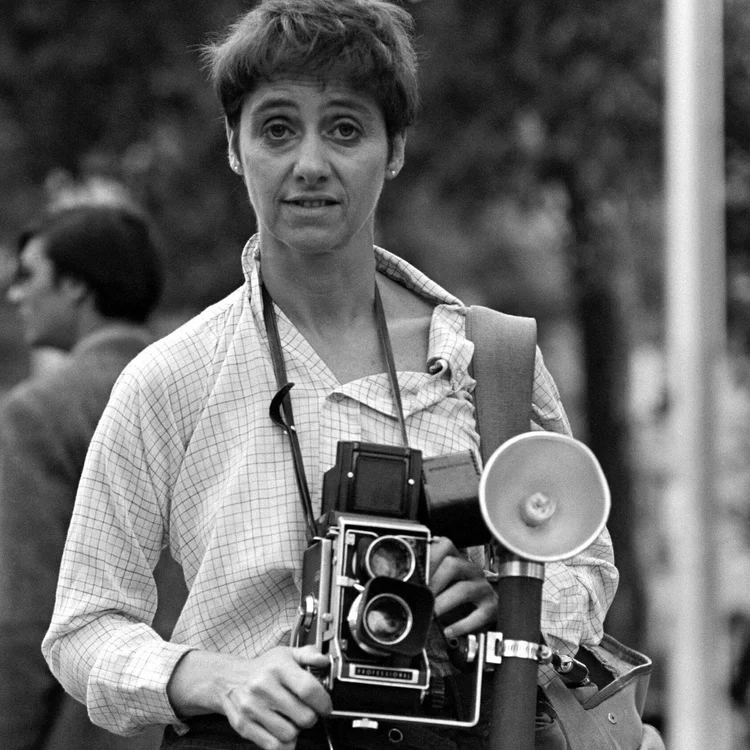
AT A GLANCE
- Known for
- Square, direct portraits of people at the edges of society, and of ordinary families, made in the 1960s
- Worked in
- Black and white
- Camera
- A 35mm Nikon at first; from 1962 a Rolleiflex, and from 1964 also a Mamiya with flash
- Also
- Shown in New Documents at MoMA in 1967; in 1972 the first American photographer shown at the Venice Biennale
- Start with
- Diane Arbus: An Aperture Monograph (Aperture, 1972)
Diane Arbus (1923–1971) was an American photographer from New York. After ten years in fashion photography with her husband, she began her own work in 1956. Her square black-and-white portraits of people many others overlooked made her one of the most important photographers of the 1960s.
The story
In 1956 Diane Arbus took a roll of 35mm film and marked it “#1.” It was a small thing, but it meant a new start. For ten years she had run a fashion studio with her husband, Allan. She was the art director. She thought up the shoots, and the pictures went to magazines. Now she left that work and began to number her negatives.
The push came from a class with the photographer Lisette Model. Model told her to follow her own work, and she gave her a lesson Arbus never forgot. “It was my teacher, Lisette Model, who finally made it clear to me that the more specific you are, the more general it’ll be,” Arbus said.
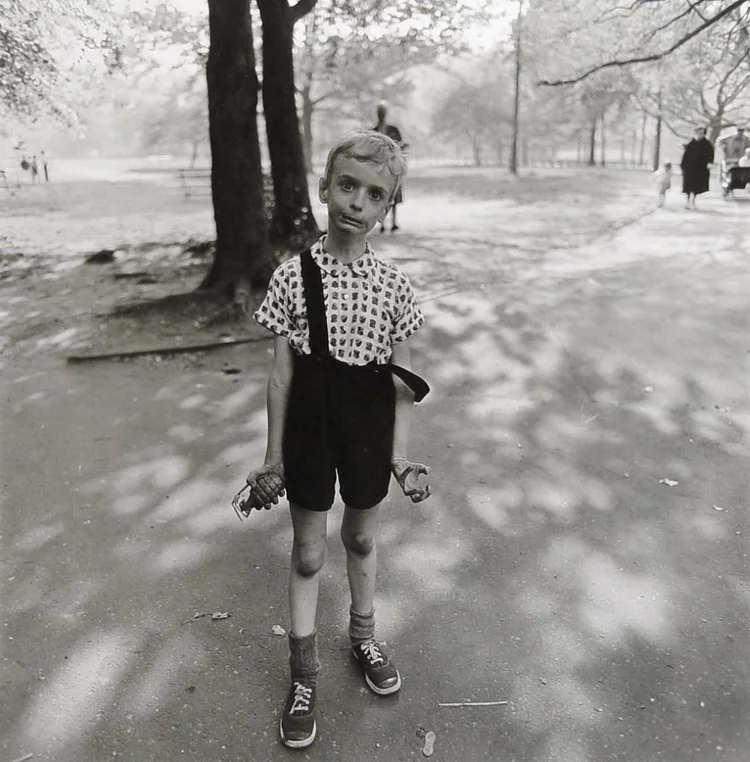
At first she walked the streets of New York with a small Nikon. “In the beginning of photographing I used to make very grainy things,” she remembered. Over time, though, she wanted to see every detail. So in 1962 she changed to a Rolleiflex, a camera with a square negative. One picture from that year marks the change. In Central Park a thin boy holds a toy hand grenade and pulls a face at the camera. Her contact sheet shows that she talked with him and moved around him, looking for the right moment.
In 1963 she won a Guggenheim Fellowship for a project on “American Rites, Manners and Customs.” She won it again in 1966. In 1967 the Museum of Modern Art showed her work in New Documents, next to Lee Friedlander and Garry Winogrand. That same year, at a Christmas party for twins and triplets in New Jersey, she met two seven-year-old sisters, Cathleen and Colleen Wade.
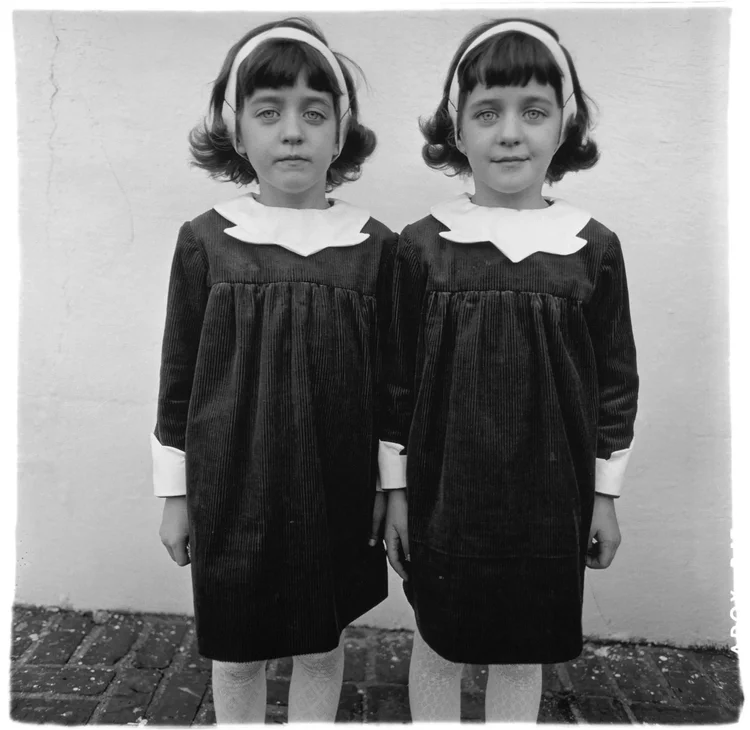
Arbus died in New York in July 1971. She was 48. The next year her photographs went to the Venice Biennale, and a large show opened at the Museum of Modern Art. The book that came with it has the twins on the cover. It has never gone out of print.
The roll marked “#1” was the start of fifteen years of looking closely at people, one by one. “I really believe there are things which nobody would see unless I photographed them,” she said.
The work


- 1923Born Diane Nemerov in New York City
- 1941Marries Allan Arbus, who gives her a camera
- 1946Opens the studio Diane & Allan Arbus
- 1956Studies with Lisette Model, marks her first roll “#1”
- 1962Changes to a square-format Rolleiflex
- 1963Guggenheim Fellowship, renewed in 1966
- 1967New Documents at the Museum of Modern Art
- 1971Dies in New York City
Lessons
Be specific. Her teacher told her that the more specific a picture is, the more general it becomes. Arbus built her work on that idea.
Mark your new beginning. When she left fashion work in 1956, she started numbering her negatives from one.
Stay and talk. Her contact sheets show that she spoke with people and moved around them before she found the picture.
Try this: choose one person you find interesting. Ask if you can photograph them, talk with them for a while, and make a square portrait with direct light.
Gear
Arbus changed cameras as her way of seeing changed. The main steps are known from museum sources.
Graflex camera: Allan Arbus gave her a Graflex soon after they married in 1941.
35mm camera: from 1956 to 1962 she worked mostly with a 35mm Nikon, on the street.
Twin-lens reflex camera: in 1962 she changed to a 2¼-inch square Rolleiflex. It stayed central to her work for the rest of her life.
Mamiya with flash: from 1964 she also used a 2¼ Mamiyaflex with a flash. Flash became part of the clear, direct look of her later portraits.
Books
Diane Arbus: An Aperture Monograph (Aperture, 1972; Fortieth-Anniversary Edition, 2011). Edited by her daughter Doon Arbus and her friend, the painter Marvin Israel, it was made for the 1972 retrospective at the Museum of Modern Art. It holds 80 photographs, with Identical twins on the cover, and short texts in her own words. The book has never gone out of print. It is the best place to start, and the 2011 edition is easy to find.
Diane Arbus: Revelations (Random House, 2003). Made for a large exhibition organized by the San Francisco Museum of Modern Art. It has about 200 full-page plates from her whole career, many not published before. There is an essay by curator Sandra S. Phillips and a text by Neil Selkirk, the only person allowed to print her negatives since her death. The heart of the book is a 104-page chronology by Elisabeth Sussman and Doon Arbus, with more than 300 extra images and excerpts from her letters and notebooks. For readers who want to know her life in her own words.
Diane Arbus: In the Beginning (The Metropolitan Museum of Art / Yale University Press, 2016). By Jeff L. Rosenheim and Karan Rinaldo. It looks at her first seven years, from 1956 to 1962, using the Met’s Diane Arbus Archive. Over 100 early street pictures and portraits, more than half published for the first time, show how her style grew before the square format. For readers who already know the famous pictures and want to see where they came from.
Diane Arbus: Portrait of a Photographer (Ecco, 2016). A long biography by the journalist Arthur Lubow, based on interviews with her friends and colleagues and on letters not available before. It follows her life from her childhood in a wealthy New York family to her last years, and looks closely at the work. There are no photographs in it, because the estate did not allow them, so it is best read next to one of the books above.




Five well-known photographs and three names under each. Can you name the photographers? Open a hint if you get stuck.