AT A GLANCE
- Known for
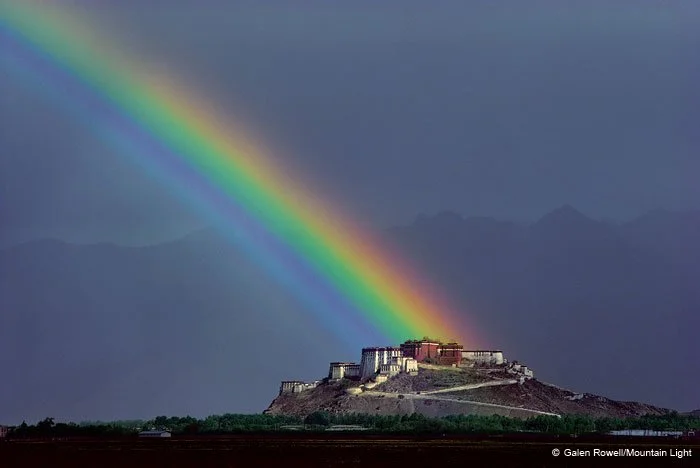
- Rainbow over the Potala Palace and the “dynamic landscape” of mountains and wild places
- Worked in
- Color, on 35mm slide film (Kodachrome, later Fuji Velvia)
- Camera
- Nikon 35mm SLRs
- Also
- Mountaineer with more than 100 first ascents, writer of 18 books
- Start with
- Mountain Light: In Search of the Dynamic Landscape (Sierra Club Books, 1986)
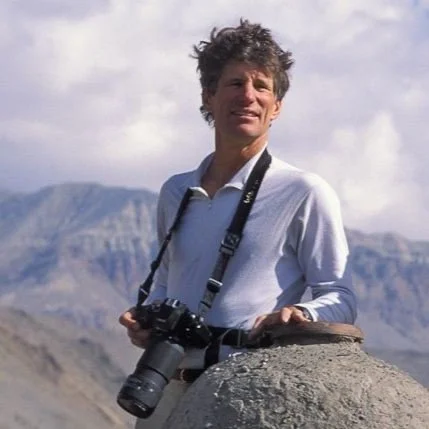
Galen Rowell (1940–2002) was an American photographer, writer and mountaineer. He carried a light 35mm camera up walls and peaks around the world and made color photographs of mountains in rare light. He called this way of working “participatory photography.”
The story
Lhasa, Tibet, October 1981. Galen Rowell saw a rainbow near the Potala Palace. From where he stood, it did not line up with the palace. He looked for a ride to a better spot, but there was none. So he took his camera and tripod and ran. Lhasa lies at about 12,000 feet, and he ran nearly a mile. At last he reached a place where the rainbow seemed to fall right onto the palace. Other people in his group stayed where they were. Their pictures missed it.
Running for a picture was not new to him. He was born in 1940 and grew up in Berkeley, California. His parents took him to the High Sierra as a boy. At 16 he made his first roped climb in Yosemite and began to photograph his climbs. For years, though, photography was only a hobby. Through the 1960s he ran an auto repair shop in Berkeley.
In 1972 he sold the business to become a full-time photographer. At the time he had two young children. A year later, with about $50 left in the bank, he won an assignment from National Geographic to photograph a climb in Yosemite. The story ran in June 1974, on the cover. Bigger trips followed. In 1975 he joined the American expedition to K2. Later he went to the Himalaya, Alaska, Patagonia and both poles.
He never used a big view camera like Ansel Adams. He worked only with small 35mm cameras and color slide film. They were light enough to take on a climb or a run. He did not wait for a scene. He moved into it. His photograph of the Potala later went on the cover of his book Mountains of the Middle Kingdom (1983) and into Mountain Light (1986). It became his best-known image.
The run in Lhasa looks like luck. It was really his whole method in one moment: see the light, know where it will be, and get there first. In a 1987 interview he said he was always looking for “the fleeting happening. The unrepeatable moment.”
The work


- 1940Born on August 23 in the San Francisco Bay Area
- 1956First roped climb in Yosemite, at 16
- 1972Sells his auto business and becomes a full-time photographer
- 1974First National Geographic story, a Half Dome climb, runs as the cover story
- 1975Joins the American K2 expedition
- 1981Photographs the rainbow over the Potala Palace; marries Barbara Cushman
- 1984Receives the Sierra Club's Ansel Adams Award for Conservation Photography
- 1986Publishes Mountain Light
- 2002Dies on August 11 with Barbara in a plane crash near Bishop, California
Lessons
Move for the light. In Lhasa he ran nearly a mile to put the rainbow over the palace. The others stayed and missed it.
Think of light first. He wrote that at the magic hour his thoughts turned to light, not to the landscape. Then he looked for something on the ground to match it.
Travel light. He used only 35mm cameras so he could carry them on climbs and runs, far from roads.
Try this: next time you see strong light, ask where you must stand to put it behind your subject. Then go there, fast.
Gear
Nikon 35mm SLR: he began using Nikon 35mm cameras and lenses in 1968. In Tibet in 1981 he carried a Nikon F3. Later he often worked with a Nikon FE or FM2 and a zoom lens.
Slide film: he shot mostly Kodachrome from the late 1960s through the 1980s, and Fuji Velvia from 1990.
Graduated neutral density filter: he helped develop a set made by Singh-Ray and sold under his name. It darkens a bright sky so the land below keeps its detail.
He also used balanced fill flash to open up deep shadows in outdoor scenes.
Books
Mountain Light: In Search of the Dynamic Landscape (Sierra Club Books, 1986). His best-known book. Eighty of his favorite photographs are grouped into eight “exhibits” by the kind of light they show, such as “Magic Hour” and “Unexpected Convergence.” Between them, chapters tell how he grew from a climber with a camera into a working photojournalist, and how each picture was made. It includes the story of the Potala rainbow. It is good for anyone who wants to understand light in the outdoors. A later edition from Counterpoint has a foreword by David Muench.
Galen Rowell's Inner Game of Outdoor Photography (W. W. Norton, 2001). A collection of 66 essays from his column in Outdoor Photographer, with more than 160 color photographs. It explains how to see a picture in your mind before you take it, and also covers practical things like packing gear, pushing film and using fill flash. A friendly book for photographers who want both method and ideas.
My Tibet (University of California Press, 1990). Text by the Fourteenth Dalai Lama, with an introduction and 108 photographs by Rowell. The Dalai Lama writes about his early life in Lhasa, about pilgrimage, and about the link between peace and care for the environment. Rowell's pictures show Tibet's land and culture. For readers interested in Tibet as much as in photography.
Galen Rowell: A Retrospective (Sierra Club Books, 2006). Made after his death, this large book gathers more than 175 photographs from his whole career. Robert Roper writes a biographical introduction and the critic Andy Grundberg looks at the work. Friends and colleagues add short texts. The best single overview of his life and pictures.