AT A GLANCE
- Known for
- Color close-ups of forks, knives, spoons and plants in her kitchen sink (from 1977); later tabletop still lifes of bottles, fruit and shells
- Worked in
- Color and black and white, including platinum-palladium prints from 1979
- Camera
- Many formats, from 35mm to 11x14-inch; a large-format camera from 1978; later a banquet camera
- Also
- Guggenheim and NEA fellowships (1978); MoMA retrospective (1987); taught the first color photography course at Purchase College
- Start with
- Jan Groover, Photographer: Laboratory of Forms (Scheidegger & Spiess and Photo Elysée, 2019)
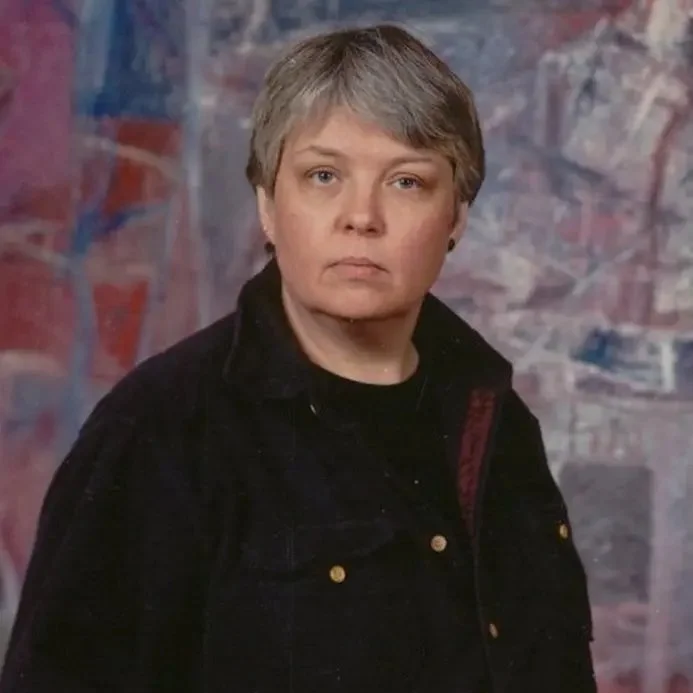
Jan Groover (1943–2012) was an American photographer who started out as a painter. She is best known for her color still lifes of kitchen utensils from the late 1970s, which helped color photography win a place in museums. In 1987 the Museum of Modern Art in New York gave her a mid-career retrospective.
The story
In 1977 Jan Groover set out to make still lifes. First she tried dried flowers and vases. The pictures did not work, and she later destroyed them. So she took her camera to the kitchen sink. Within half an hour, she knew what she was doing.
The sink was full of ordinary things: plates, knives, forks, spoons and houseplants. Up close, under artificial light, they became larger than life. Leaves glowed against shiny metal. “I started with that kind of subject matter because I figured it was the most direct, that it was the heart of the subject,” she said.
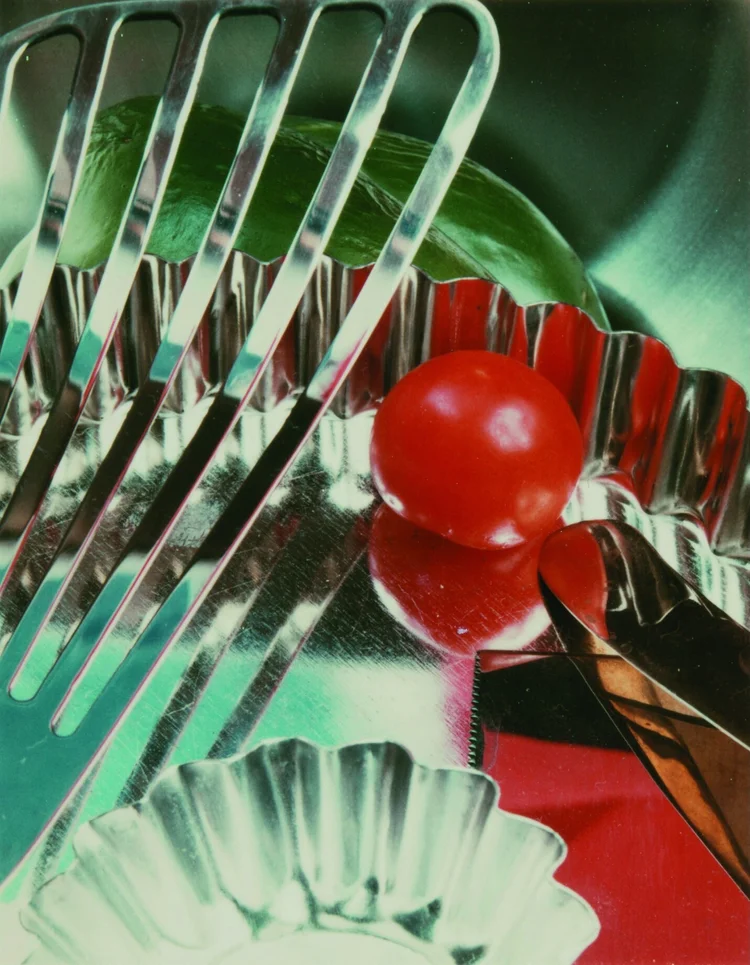
Painting had come first. Groover grew up in Plainfield, New Jersey, and studied painting at Pratt Institute in Brooklyn. In 1967 she bought her first camera, which she called her “first adult decision.” While teaching at the University of Hartford, she was still painting minimal abstractions. “With photography I didn’t have to make things up, everything was already there,” she said.
The kitchen pictures changed her career. Her 1978 show of them caused a sensation, wrote Andy Grundberg in The New York Times. In January 1979 one of her still lifes was on the cover of Artforum. Color photography was still new in the art world, and her work helped it gain respect.
But the pictures were never just found. The kitchen series began with chance arrangements, which she then composed more and more carefully. Later she moved to a studio table, with bottles, fruit and shells placed on fake Greek columns. Each arrangement was first sketched in pencil and tested with a Polaroid.
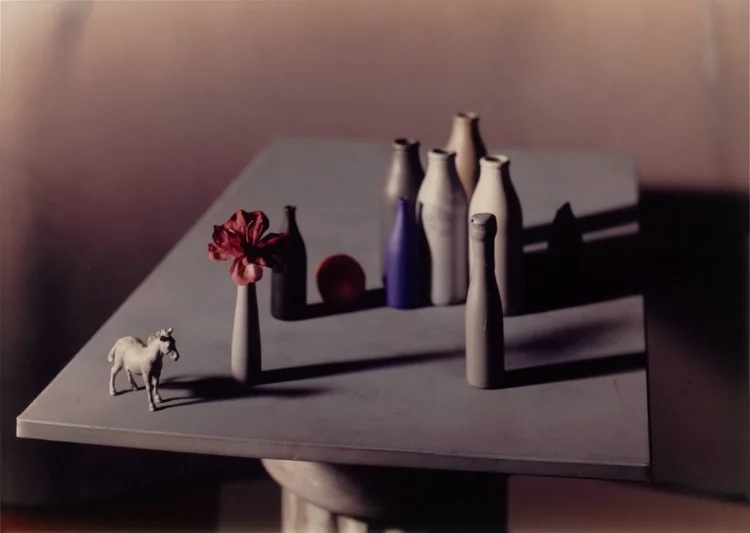
Years later she looked back on why she had left painting. She had not wanted to invent everything herself. “Then I found out that you have to make everything up anyway.”
The work


- 1943Born on 24 April in Plainfield, New Jersey
- 1965Graduates in painting from Pratt Institute
- 1967Buys her first camera
- 1974First solo show, at Light Gallery in New York
- 1978Kitchen still lifes shown in New York; Guggenheim and NEA fellowships
- 1979Starts making platinum-palladium prints
- 1987Mid-career retrospective at the Museum of Modern Art
- 1991Moves with Bruce Boice to Montpon-Ménestérol, France
- 2012Dies on 1 January in Montpon-Ménestérol
Lessons
Start with what is near. Her best-known series began at her own kitchen sink, with forks, spoons and plants.
Plan the picture. She sketched her arrangements in pencil and tested them with Polaroids before the final shot.
Look at form, not meaning. She chose objects for their shapes, surfaces and light, not for what they stood for.
Try this: take five things from your kitchen, like a fork, a spoon, a glass and a leaf. Put them in the sink or on a small table. Move them around for half an hour and make one picture after each change. Keep the frame where the shapes work best together.
Gear
Groover used many camera formats, from 35mm up to 11x14-inch, and several printing processes.
35mm camera on a tripod: for her first serious series in 1973, she stood by a highway with a fixed 35mm camera and pressed the shutter as cars passed.
Large-format camera: she bought her first one right after her 1978 grant from the National Endowment for the Arts. Large sheet film gave her rich color and surface detail.
Banquet camera: an old panoramic camera with a long, narrow frame. She used it for later still lifes, to widen and bend the space on the table.
Platinum-palladium printing: from 1979, at the suggestion of her friend Jed Devine, she made platinum-palladium prints, a process from 1873 with soft, rich tones.
Books
Jan Groover, Photographer: Laboratory of Forms (Scheidegger & Spiess and Photo Elysée, 2019). Edited by Tatyana Franck for the retrospective at the Musée de l’Elysée in Lausanne, which later traveled to the Fondation Henri Cartier-Bresson in Paris. It is the first full monograph on Groover, with 192 pages and about 145 illustrations. It follows her from early painting and the highway pictures, through the kitchen still lifes, to her later years in western France. Texts by Bruce Boice, her husband, and by Emilie Delcambre Hirsch, Paul Frèches, Tatyana Franck, Sarah Hermanson Meister and Pau Maynés Tolosa. The best place to start.
Jan Groover (The Museum of Modern Art, 1987). Written by curator Susan Kismaric for Groover’s mid-career retrospective, which showed about 80 photographs made since 1971. A slim paperback of 64 pages, with 24 black-and-white and 12 color pictures. Kismaric’s essay explains, step by step, how Groover moved from painting to the highway series, the kitchen sink and platinum prints. Good for readers who want to understand her early years.
Pure Invention: The Tabletop Still Life (Smithsonian Institution Press, 1990). Part of the Photographers at Work series. A short paperback of 63 pages, with tabletop still lifes reproduced in duotone from her platinum-palladium prints. It includes an interview in which Groover talks about her influences, her ideas and her goals. Useful for anyone interested in still life and in how she thought about her work.
Jan Groover (Little, Brown, 1993). With an introduction by John Szarkowski and 57 plates. It covers her whole career up to that point: the color close-ups of kitchen utensils and houseplants, triptychs of suburban New Jersey, empty lots in New York, tabletop still lifes of bottles, fruit and bones, and new pictures of her home in the French countryside. A good overview if you can find a used copy.
In her words
“With photography I didn’t have to make things up, everything was already there.”
“I started with that kind of subject matter because I figured it was the most direct, that it was the heart of the subject.”
“Formalism is everything.”