AT A GLANCE
- Known for
- Humanist street photographs of Paris and New York, such as Aubervilliers (1947), and his Penn Station series (1958)
- Worked in
- Black and white; color in later series such as Manhattan Pastorale
- Camera
- A Leica M on the fishing boat off Ibiza; an 8x10 view camera in his last years
- Also
- Photo League member and teacher; monthly column Speaking Out in Camera 35 (1971–79); painter and sculptor
- Start with
- Louis Stettner (Thames & Hudson / Fundación MAPFRE, 2024)
- Links
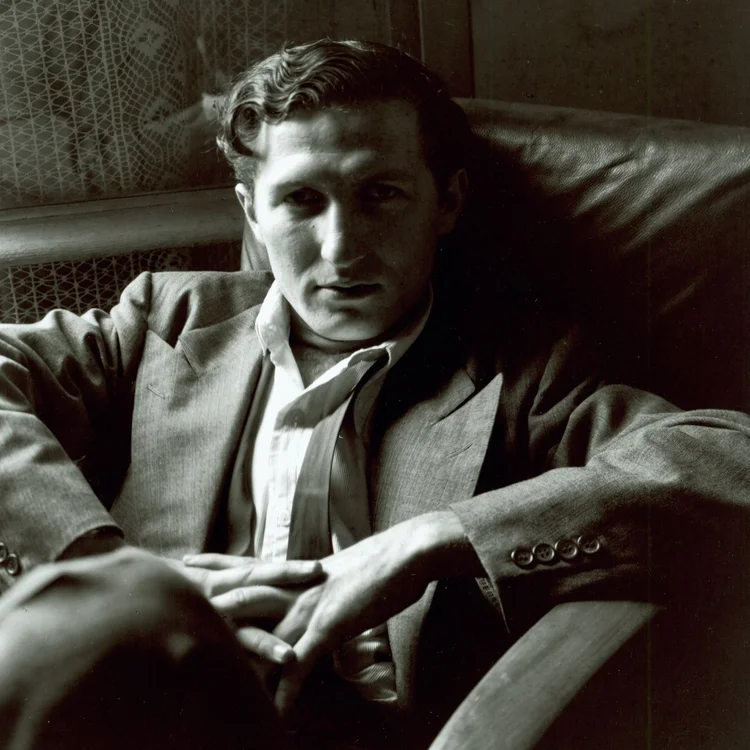
Louis Stettner (1922–2016) was an American photographer who spent his life between New York and Paris. He photographed ordinary people at work, at rest and in the street, and his pictures join American street photography with French humanist photography. He was also a teacher, a writer on photography and, late in life, a painter and sculptor.
The story
As a teenager in Brooklyn, Louis Stettner heard that someone wanted to sell an old wooden camera on a tripod. “I gave a week’s salary and bought it,” he remembered many years later. “I was naive.” One of his first pictures showed the tree in his backyard.
Soon photography was at the center of his life. On Saturdays he studied photographs at the Metropolitan Museum of Art. At the Photo League in New York he took the only photography classes he ever had. At 18 he volunteered as an army photographer and was sent to the Philippines. Later he was sent to photograph Hiroshima.
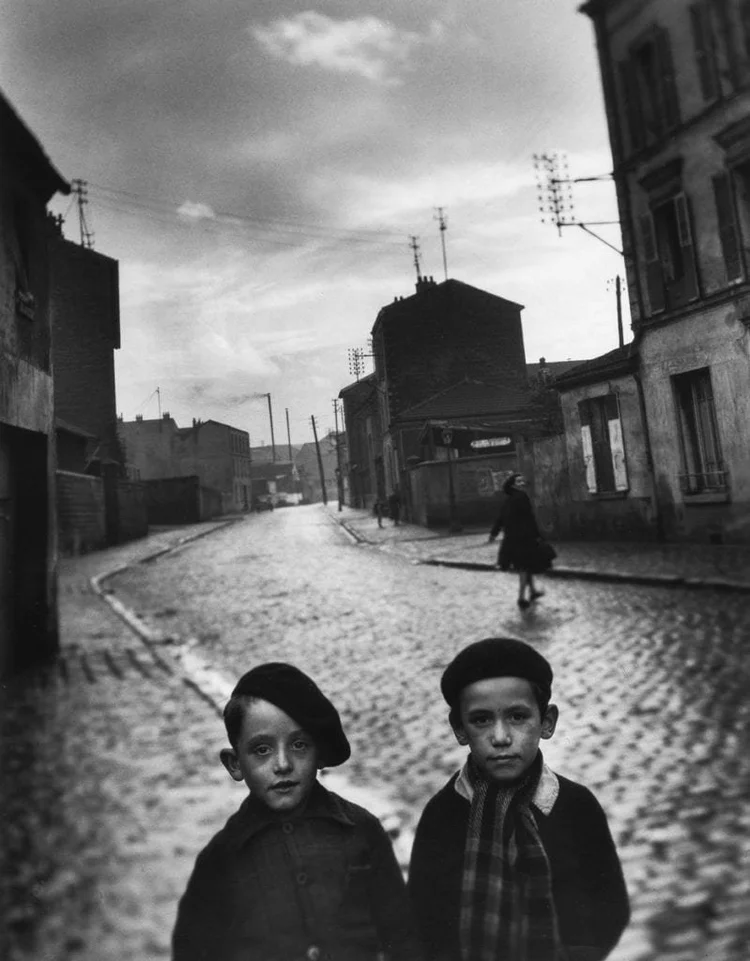
After the war, Paris called. “I came to Paris in July 1946, intending to stay only three weeks and remained for five years,” he said. Every day he took long walks with his camera. Brassaï became his friend for life. In Aubervilliers, a working-class town on the edge of Paris, he photographed two boys in berets on a wet cobbled street.
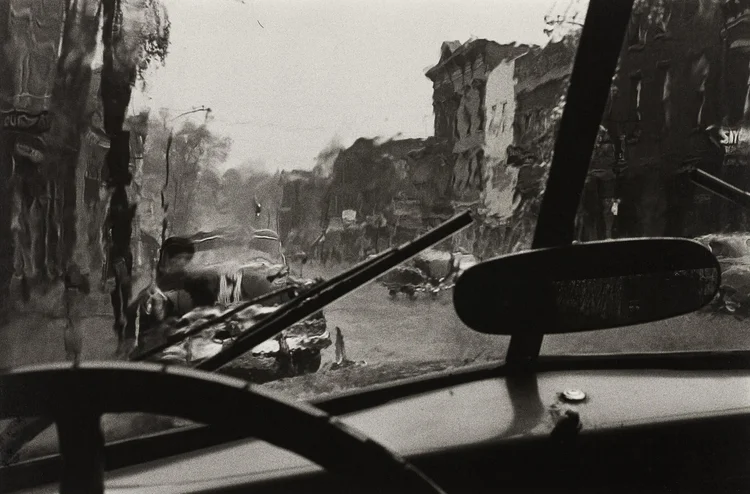
Back in New York in the early 1950s, he worked for Life, Time and Fortune. But the times were hard. He refused to give the FBI the names of Photo League members, and he lost a government job. “It was a very bad period,” he said. Still, he kept working on his own projects: the crowds in Penn Station, two Spanish fishermen at sea off Ibiza, and Windshield, Saratoga Springs, a street seen through a car window in the rain.
In 1990 he settled for good in France, in Saint-Ouen, on the edge of Paris. He began to paint, draw and make sculpture. In his nineties he was still photographing, now the landscape of the Alpilles in Provence, with an 8x10 view camera and the help of his wife, Janet. Once again he worked with a big, slow camera on a tripod, as he had as a boy.
“With a big camera you can be more meditative,” he said. “Because you are looking at things upside down. You have time to think.”
The work


- 1922Born on 7 November in Brooklyn, New York
- 1946First trip to Paris, planned for three weeks
- 1947Settles in Paris and studies at IDHEC, the French film school
- 1949First exhibition, at the Bibliothèque Nationale in Paris
- 1950Wins a prize in Life’s Young Photographers contest
- 1958Photographs the old Penn Station in New York
- 1975First Prize in the Pravda World Contest for Photography
- 1990Settles for good in France, in Saint-Ouen
- 2016Dies on 13 October in Saint-Ouen, soon after his Centre Pompidou retrospective
Lessons
Walk every day. In Paris he took long daily walks with his camera and stayed open to whatever happened around him.
Keep your own projects. Life magazine turned down his Penn Station pictures as not newsworthy. Today they are seen as one of his most important series.
Slow down sometimes. Late in life he chose an 8x10 view camera because it gave him time to think.
Try this: take one long walk in your town with no plan. Photograph only ordinary moments: children playing, a cup on a café table, people waiting. Then pick one busy place, like a station, and go back three times.
Gear
Box camera: his parents gave him one when he was about 13. It was the start of his interest in photography.
Wooden view camera on a tripod: as a teenager he paid a week’s salary for an old one.
Leica M rangefinder: he used it on the small fishing boat off Ibiza for his series about two Spanish fishermen.
8x10 view camera: in his nineties he worked with an 8x10 Deardorff, the format used by Paul Strand, to photograph the Alpilles in Provence.
Books
Louis Stettner (Thames & Hudson and Fundación MAPFRE, 2024). The biggest book on his whole career: 348 pages with about 190 photographs, in black and white and in color. It is arranged in time order, from New York and Paris to Penn Station, the Brooklyn Bridge and the subway, and it includes color work that was mostly never published before. Texts by Sally Martin Katz, David Campany, Karl Orend and James Iffland look at his war service, the Photo League and his friendships with Weegee, Sid Grossman, Ruth Orkin and Berenice Abbott. The best place to start.
Louis Stettner: Traveling Light (Cernunnos / Abrams, 2019). Made to accompany the San Francisco Museum of Modern Art’s purchase of his prints. 240 pages with 150 black-and-white photographs and texts by Clément Chéroux and Sally Martin Katz. It also reprints 19 of his own essays from Camera 35 (1971–1979) and his 2002 lecture at the International Center of Photography, Photography: Style & Reality. Good for readers who want to know how he thought about photography.
Ici Ailleurs (Éditions Xavier Barral, Paris, 2016). Published for his retrospective at the Centre Pompidou, which closed about a month before his death. 160 pages with 90 black-and-white photographs, from his first New York picture in 1936 to his late work in the Alpilles. It includes an interview with Clément Chéroux and Julie Jones and a selection of his Camera 35 articles about Brassaï, Lisette Model, Weegee and the Photo League.
Penn Station, New York (Thames & Hudson, 2015). A 112-page hardback with an introduction by Adam Gopnik. It brings together for the first time his photographs of the old Penn Station from the 1950s, made a few years before the building was torn down. The pictures are about people waiting and traveling more than about architecture. A good small book for lovers of New York and of quiet street photography.
In his words
“My way of life, my very being is based on images capable of engraving themselves indelibly in our inner soul’s eye.”