AT A GLANCE
- Known for
- “Near-far” landscapes of the American West; more than seventy years of work for Arizona Highways
- Works in
- Color; 4x5 film for most of his career, digital cameras since about 2006
- Camera
- Linhof 4x5 field camera; Canon 35mm cameras; later compact digital cameras
- Also
- Son of the photographer Josef Muench; about 70 books; Lewis and Clark murals for the National Park Service in St. Louis
- Start with
- Desert Images (Rizzoli, 2025)
- Links
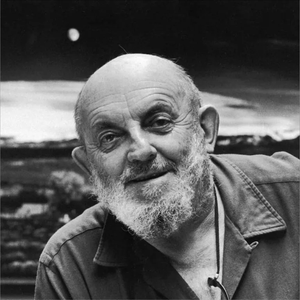
David Muench (born 1936) is an American landscape photographer. For more than seventy years he has photographed the wild places of the American West, many of them for Arizona Highways magazine. His “near-far” pictures, with a sharp detail close to the lens and a distant view behind it, have shaped the way many landscape photographers work.
The story
One morning in the 1960s, David Muench stood below the San Francisco Peaks in northern Arizona, waiting for sunrise. He watched the early light move down the eastern slope. Then he looked over his shoulder and caught the sun itself, just as it seemed to leap from a mountaintop into the sky. “I remember when the idea struck me, and it struck with the force of a blow,” he said. “For the first time I became aware of the sun itself as distinct from the light it throws.”
Light had been part of his life from the start. Born in Santa Barbara in 1936, he grew up with a writer mother and a photographer father, Josef Muench. At six he got his first camera from his father. For more than ten years he went along on his father’s field trips. As a teenager he printed his father’s black-and-white negatives. “I was expressing myself with them, putting my own stamp on them,” he remembered. In January 1955, at 18, he had his first cover in Arizona Highways.
Formal training came next, at the Rochester Institute of Technology and the Art Center School in Los Angeles. But he left the advertising and fashion styles he learned there behind and chose western landscapes. After army service, he began to test his own ideas. Patience became one of them. He learned the land road by road and came back to places again and again.
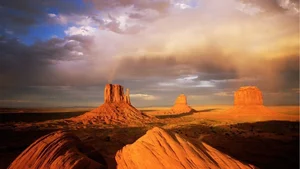
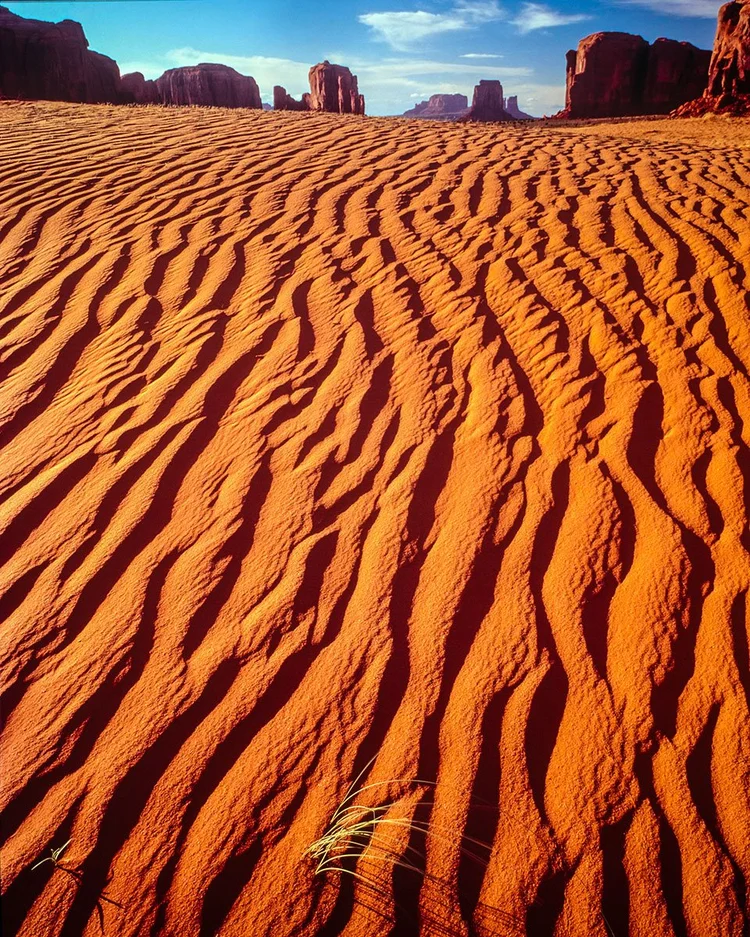
The idea he is best known for is the “near-far” picture. A rock, a flower or a ripple of sand fills the foreground, and a mountain far away is sharp too. “It gives a feel for the complete community of the Earth,” he said. In Monument Valley it helped him find his own way. “We’ve all seen Monument Valley,” he said. “So how do you do it differently?” In one answer, sand ripples climb the frame from a small tuft of grass to the buttes on the horizon.
On that morning below the peaks, the sun stopped being only a lamp for the land. It became something to wait for. Seventy years after his first cover, Arizona Highways named him to the first class of its Hall of Fame in 2025. “To get it right, I would return again at different times,” he said. “I needed to be present in the image.”
The work


- 1936Born in Santa Barbara, California, on June 25
- 1955First Arizona Highways cover in January, at 18
- 1964Founds David Muench Photography Inc. with his wife Bonnie
- 1970California, the first of his books about single states
- 1979His 33 Lewis and Clark murals go on show at the Museum of Westward Expansion in St. Louis
- 2000Robin W. Winks Award of the National Parks Conservation Association
- 2015Arizona Highways gives its whole December issue to his work
- 2025Inducted into the Arizona Highways Hall of Fame
Lessons
Know the land. Muench learned the roads and paths so well that he could say on which day of the year the sun would rise in the right place behind a rock.
Give it time. If the light, the clouds or the wind are wrong, he waits it out or comes back later. Many of his pictures took several visits.
Connect near and far. A close detail, a middle ground of line or color, and a distant view. Together they lead the eye through the whole landscape.
Try this: find one strong detail close to your feet, like a rock, a plant or a pattern in sand. Use a wide lens and a small aperture so the far horizon is sharp too. Then come back at another time of day and compare.
Gear
Muench has spoken openly about his tools. The large-format camera was his main instrument for decades.
4x5 field camera: he settled on the 4x5 format in the early 1960s after trying larger ones. He used a Linhof field camera and carried it to the tops of more than 50 major western peaks.
Wide-angle and long lenses: super-wide lenses for his near-far views, but also telephoto lenses to press the buttes of Monument Valley against distant mesas.
Canon 35mm cameras: the mainstay of his small-format film work, which he explored in the 1990s.
Digital cameras: a project photographing World Heritage Sites for UNESCO and Panasonic led him to digital. From about 2006 he used digital cameras more and more, though he still loved 4x5 film.
In the 1980s and 1990s he also used fill flash and light painting to bring out foreground detail in low light.
Books
Desert Images (Rizzoli, 2025). A new edition of the classic 1979 book that paired Muench’s photographs with text by Edward Abbey, the author of Desert Solitaire. The 240-page large-format hardcover holds 150 photographs of the desert Southwest, with a new foreword by the writer Craig Childs. It is the best book to see how his pictures and the words of a great desert writer work together, and why the book is seen as a conservation classic.
David Muench’s Timeless Moments: Grand Canyon National Park (Farcountry Press, 2017). A 95-page book of his favorite Grand Canyon pictures, made over seven decades. It includes his best-known canyon images and others from his private collection, published for the first time. The foreword is by Jeff Kida, photo editor of Arizona Highways. A compact way to see his “timeless moment” idea in one place.
Wild America: A Personal Celebration of the National Parks (Interlink Publishing, 2016). Made with the British outdoor writer Roly Smith for the 100th anniversary of the U.S. National Park Service. It has chapters on 18 national parks and three other protected areas, among them Antelope Canyon, Monument Valley and the Mount Hood Wilderness, with 92 color photographs. Good for readers who want the parks and their history together.
Sandia: Seasons of a Mountain (University of New Mexico Press, 2018). A 104-page photo essay about Sandia, the mountain above Albuquerque, with 48 color photographs and an essay by his wife, the writer Ruth Rudner. It follows the mountain through the year: autumn aspens, winter snow, spring cactus blooms and summer wildflowers on the summit. A quiet book that shows how he works when he returns to one place many times.
In his words
“When I’m walking, I go on momentum, and I’m always looking for foregrounds.”