AT A GLANCE
- Known for
- Elephants at Twilight and long National Geographic stories on the Okavango Delta, Madagascar and Antarctica
- Works in
- Color, first on slide film, digital since the mid-2000s
- Camera
- Nikon SLRs with Nikkor zoom lenses
- Also
- Knight of the Order of the Golden Ark, WWF Netherlands ambassador, co-founder of NANPA
- Start with
- Eye to Eye: Intimate Encounters with the Animal World (Taschen, 1997)
- Links
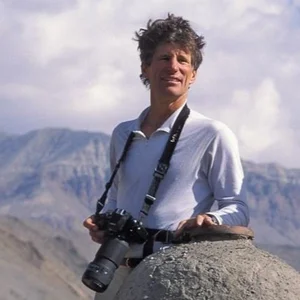
Frans Lanting (born 1951) is a Dutch wildlife photographer who lives in Santa Cruz, California. For more than three decades he has photographed animals and wild places for National Geographic, from the Amazon to Antarctica. He makes his books together with his wife and partner, the writer and editor Chris Eckstrom.
The story
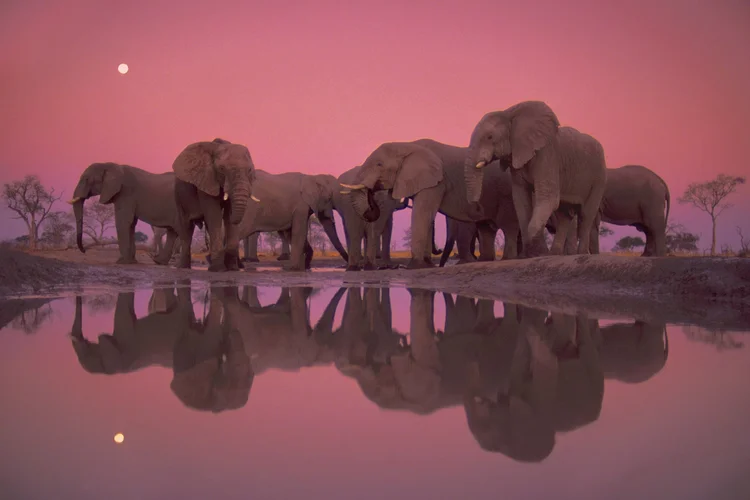
Botswana, 1989. It was an evening in the dry season. Elephants gathered at a water hole under a pink sky, and a full moon hung above them. Frans Lanting did not stay on the bank. “I waded into a water hole to capture a shimmering reflection of a gathering of elephants at twilight,” he said. From down in the water, the herd and the moon appear twice.
Photography came late. He was born in Rotterdam in 1951. As a boy he saw the petrochemical industry change the land around his home. Later he earned a master's degree in environmental economics at Erasmus University. In 1978 he moved to California to study environmental planning at the University of California, Santa Cruz. There he discovered the work of West Coast photographers like Ansel Adams, Edward Weston and Philip Hyde.
In his mid-twenties he picked up a camera and taught himself. His early subjects were sanderlings on the beaches of Santa Cruz. “I made all the mistakes myself. I just got better and better at it,” he says. In 1985 National Geographic sent him to Madagascar. In 1988 and 1989 he spent a year in northern Botswana for the magazine. He lived in vehicles and tents, crossed swamps and followed lions at night.
The elephant picture was made in that same year in Botswana. He calls it his “homage to the primeval qualities of southern Africa's wilderness.” Many honors followed his work. In 2001 he became National Geographic's photographer-in-residence. In 2018 he was the first photographer to receive the new Lifetime Achievement Award of Wildlife Photographer of the Year.
So stepping into the water hole was more than a trick for a better angle. It shows how he works. He does not watch from a car and wait. He works on foot, often lying on his stomach, close to the animals. “There's an interaction that goes on between animals and myself, and I'm working with them,” he says.
The work


- 1951Born on July 13 in Rotterdam, the Netherlands
- 1978Moves to California to study environmental planning at UC Santa Cruz
- 1985National Geographic sends him to Madagascar
- 1988Begins a year in northern Botswana and the Okavango Delta for National Geographic
- 1997Publishes Eye to Eye; receives the Sierra Club's Ansel Adams Award
- 2001Knighted in the Royal Order of the Golden Ark; becomes National Geographic photographer-in-residence
- 2006Publishes LIFE: A Journey Through Time
- 2018First winner of the Wildlife Photographer of the Year Lifetime Achievement Award
- 2023Bay of Life exhibition at the Santa Cruz Museum of Art and History
Lessons
Get down to their level. For Elephants at Twilight he waded into the water hole. From there the reflection fills half the frame.
Understand first. He says that if you do not understand what you photograph, you only see the surface of things.
Learn by doing. He had almost no teachers. He started with birds on his local beach and learned from his own mistakes.
Try this: find a pond or a large puddle at sunset. Bring your camera as close to the water as you safely can and photograph the scene together with its reflection.
Gear
Nikon digital SLR: he switched from film to digital while making LIFE, after the Nikon D1 and D2X convinced him. He has used the D100, D200 and, in Africa, the D3.
Nikkor zoom lenses: mainly 12-24mm, 28-70mm, 70-200mm and 200-400mm with extenders, plus a macro lens now and then.
Hasselblad panoramic camera: he kept using film with a Hasselblad for panoramic work.
His earlier African work was made on transparency film. African elephant at dawn was shot with a Nikon and a 24mm lens.
Books
Eye to Eye: Intimate Encounters with the Animal World (Taschen, 1997). Edited by Christine Eckstrom. A personal portfolio of more than 140 animal photographs from twenty years of work, on about 250 pages. Each picture comes with a short story from the field, from orangutans in Borneo to emperor penguins in Antarctica. In 2000 NPR-KQED named it one of the 50 most influential nonfiction books of the 20th century. It is the best first book for anyone who wants to see how he works with animals.
Okavango: Africa's Last Eden (first published 1993; updated Taschen edition, 2019). The book of his year in the wetlands and deserts of northern Botswana for National Geographic in 1988 and 1989. He lived in vehicles and tents and followed lions at night. The Taschen edition has 252 pages, new reproductions, dozens of photographs never published before and a new preface by Lanting. A good choice for readers who love African wildlife and want one long, deep story.
LIFE: A Journey Through Time (Taschen, 2006). A large book of about 300 pages that took him nearly a decade. It tells the history of life on Earth with pictures of creatures and landscapes that live today, from lava and fossils to the mammals of the African plains. All the images were new when it came out. The project also became an exhibition and a live show with music by Philip Glass. Taschen reissued it in 2018, edited by Christine Eckstrom. It is for readers who like big ideas as much as animals.
Into Africa (Earth Aware Editions, 2017). Edited by Chris Eckstrom, with a foreword by Wade Davis and a preface by Carter Roberts of WWF. It grew out of his exhibition at the Smithsonian's National Museum of Natural History, made with National Geographic and WWF, and has more images than the show. On 224 pages it covers three decades of his work in Africa, from the Serengeti to the Okavango Delta and Madagascar, with stories about conservation. A strong overview of his African photographs.
In his words
“You can't go to school for this kind of work. You have to learn by doing it.”
“If you don't understand what you are photographing, you are just looking at the surface of things.”
“And ultimately, you have to be able to express things in a way that is lyrical and poetical, or else it's just a record.”
“The key to this work is to pay respect to the animals, the places and the people you work with.”