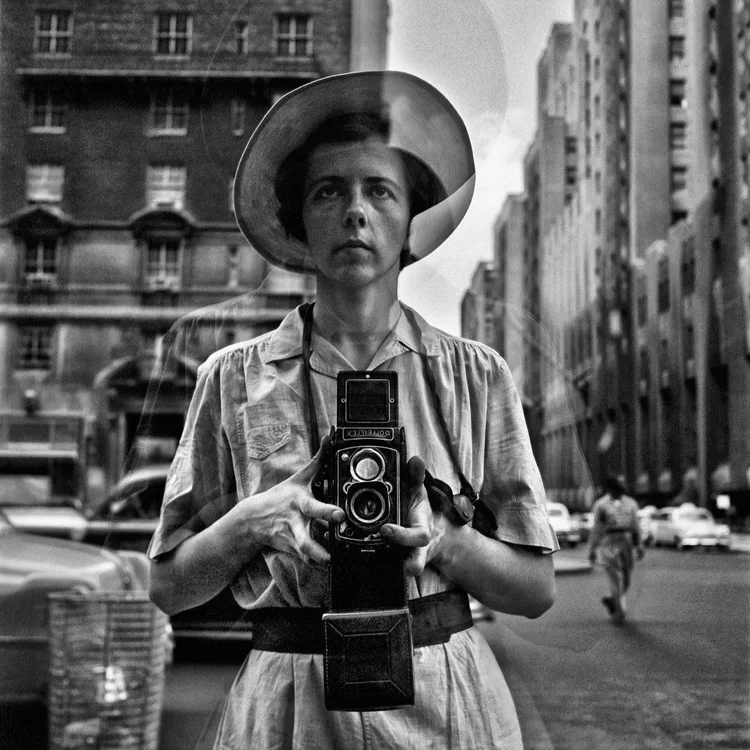
AT A GLANCE
- Known for
- Street photographs of New York and Chicago, and many self-portraits, found only after her death
- Worked in
- Black and white, and color from the 1950s; later mostly color slides
- Camera
- Rolleiflex twin-lens reflex; later a Leica IIIc and other 35mm cameras
- Also
- Worked as a nanny and caregiver for about 40 years; also made home movies and audio recordings
- Start with
- Vivian Maier: Street Photographer (powerHouse Books, 2011)
- Links
Vivian Maier (1926–2009) was an American street photographer who worked as a nanny in Chicago for most of her life. She made more than 100,000 negatives, mostly in New York and Chicago, and showed almost none of them to anyone. Her work became known only after a storage auction in 2007 and is now shown around the world.
The story
In 2007, a storage unit on Chicago's North Side went to auction. The woman who rented it had stopped paying. One of the buyers was John Maloof, a young real estate agent who was researching a book on the Portage Park neighborhood. For about $400 he took home a box of some 30,000 negatives. Nobody knew who had made them.
In April 2009 he found a name on an envelope: Vivian Maier. A Google search led him to her death notice in the Chicago Tribune. She had died that same month, at 83.
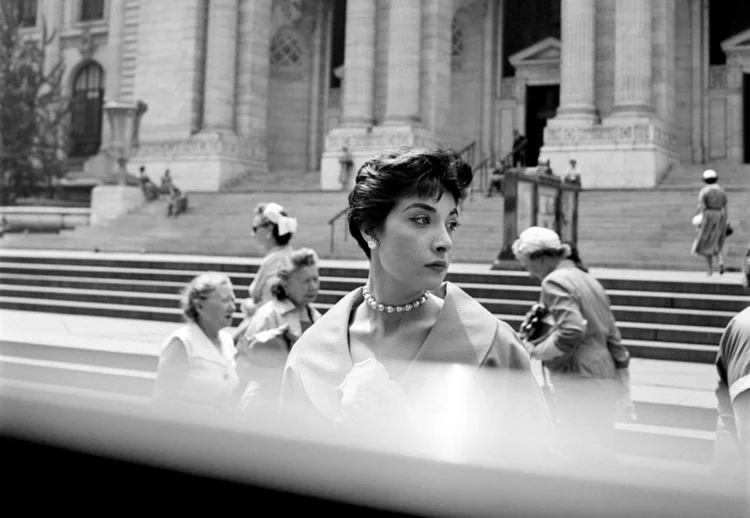
Maier was born in New York City in 1926. As a child she also lived in France, in Saint-Bonnet-en-Champsaur, an Alpine village near her mother's relatives. In 1951 she came back to New York, and the next year she bought her first Rolleiflex. In 1953 she photographed a young woman with a pearl necklace in front of the New York Public Library.
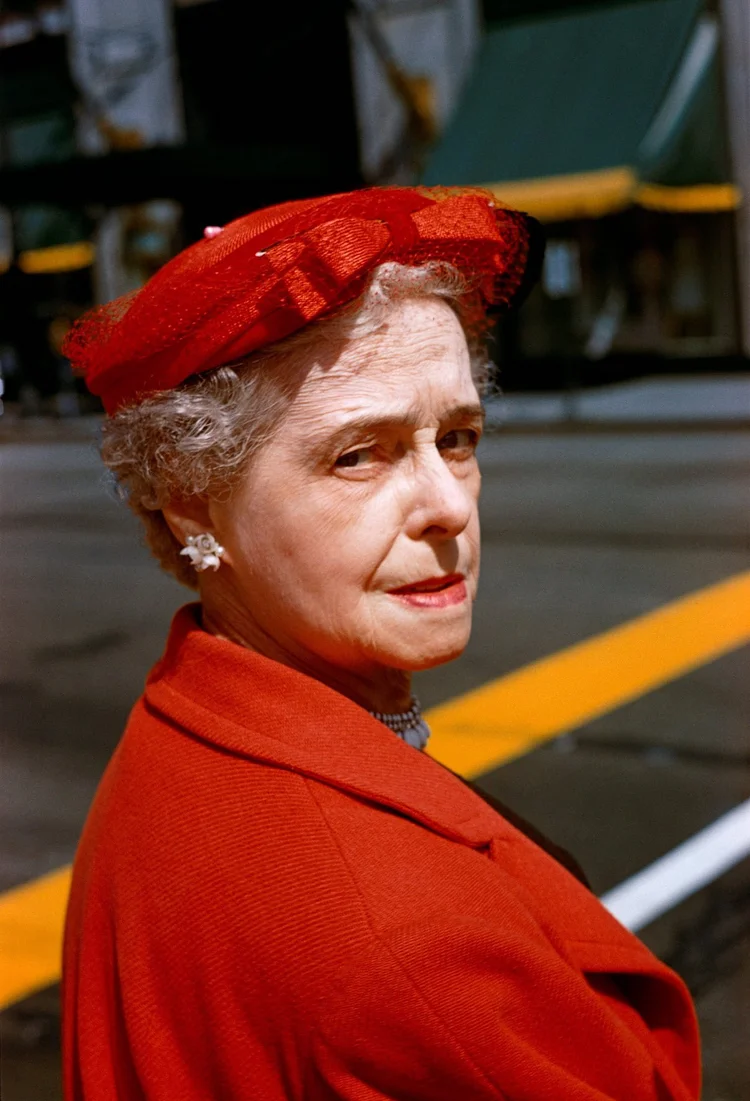
In 1956 she moved to Chicago's North Shore. For about 40 years she worked as a nanny and caregiver. From 1956 to 1972 she lived with the Gensburg family in Highland Park. One of the boys, Lane Gensburg, later called her a “real, live Mary Poppins.” On her days off she went out with her camera, often with the children beside her. Color came early, too. In May 1958 she photographed a woman in a red hat and a red coat on a Chicago street.
Still, she kept her work to herself. Boxes of prints, negatives and newspapers stayed in her rooms at her employers' homes. In 1959 and 1960 she traveled alone around the world, to the Philippines, India, Egypt, Italy and France. Much of her film was never developed.
In October 2009, Maloof put a selection of her pictures on Flickr, and they spread fast. Exhibitions followed in Denmark, Norway and Chicago. In 2013 his film Finding Vivian Maier, made with Charlie Siskel, came out and was later nominated for an Oscar.
The box from the auction had passed from one owner to the next, and now her pictures belong to everyone. On one of her own cassette tapes, she sounds calm about how things change hands. “Well, I suppose nothing is meant to last forever. We have to make room for other people. It's a wheel.”
The work


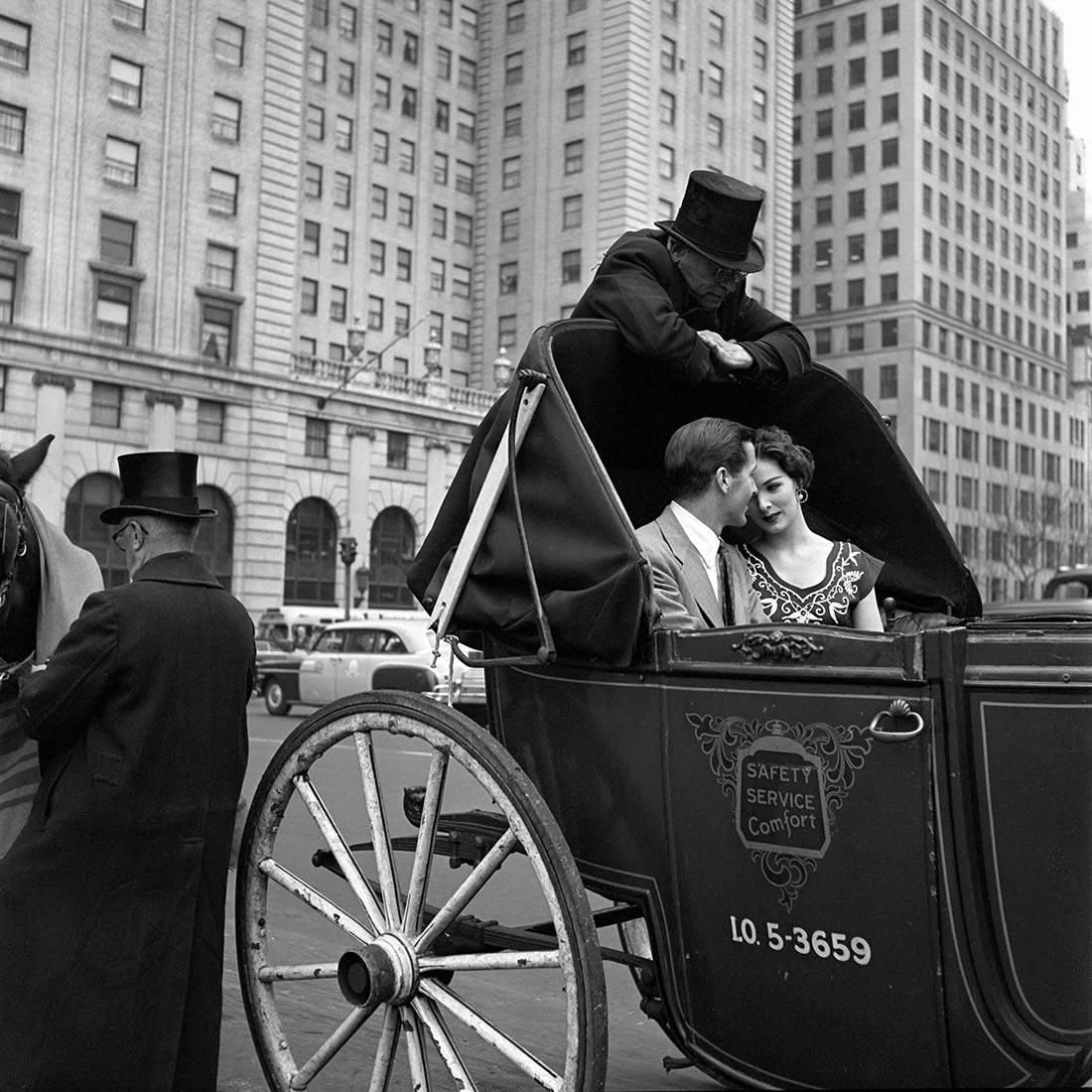
- 1926Born in New York City on February 1
- 1938Returns from France to New York with her mother
- 1951Moves back to New York from France
- 1952Buys her first Rolleiflex
- 1956Moves to Chicago's North Shore and starts work with the Gensburg family
- 1959Travels alone around the world, into 1960
- 2007Her storage unit is auctioned; John Maloof buys about 30,000 negatives
- 2009Dies in Oak Park, Illinois, in April
Lessons
Take the camera everywhere. She photographed on her days off, often while caring for children.
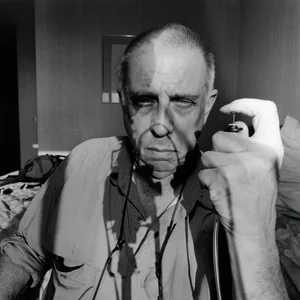
Turn the camera on yourself. She made many self-portraits. Critics often point to them as a key part of her work.
Try color early. She was already making color pictures in Chicago in the 1950s.
Try this: on your next free day, walk for one hour with your camera. Make one self-portrait in a reflection or with your shadow, and look for one stranger in strong color.
Gear
Maier left no notes about her equipment. What we know comes from her negatives and from researchers.
Kodak Brownie: a simple box camera. She used it for her first photographs in France in the late 1940s.
Rolleiflex twin-lens reflex camera: she bought her first one in 1952 and used several models for most of her career, until the late 1970s.
Leica IIIc rangefinder: one of the 35mm cameras she used later, along with an Exakta and a Zeiss Contarex.
Ektachrome slide film: in the 1980s and 1990s she worked mostly in color, on slide film.
Books
Vivian Maier: Street Photographer (powerHouse Books, 2011). The first book of her work, edited by John Maloof, with a foreword by the writer Geoff Dyer. It brings together black and white street photographs from New York and Chicago, chosen from the negatives Maloof bought at auction. A good first book for anyone who wants to see why her work caused such excitement.
Vivian Maier: A Photographer Found (Harper Design, 2014). A larger book edited by John Maloof, with texts by the writer and curator Marvin Heiferman and by Howard Greenberg, whose New York gallery represents her work. It looks at her life and work together and shows a wide range of pictures, from street scenes to portraits and self-portraits. A good choice if you want more than one first look.
Vivian Maier: The Color Work (HarperCollins, 2018). The first big collection of her color photographs, with more than 150 images, most of them never published in a book before. The text is by curator Colin Westerbeck, and the foreword is by the street photographer Joel Meyerowitz. It places her color work next to her black and white pictures and next to photographers such as Eugène Atget and Lee Friedlander. For readers who know only her black and white work.
Vivian Maier: A Photographer's Life and Afterlife (University of Chicago Press, 2017). A biography by Pamela Bannos, a professor at Northwestern University, in about 350 pages. It follows her from her early family years and first photographs in France to her Rolleiflex work in New York and her street photography in Chicago. The second part tells how her negatives were sold, shared online and made famous. For readers who want the full story, not only the pictures.






Unravel the captivating story of Vivian Maier, a seemingly ordinary nanny with a secret talent for street photography, whose work was discovered by chance and posthumously celebrated worldwide, securing her place as one of the most important photographers of the 20th century.