AT A GLANCE
- Known for
- About 30 years of pictures of old Paris: empty streets, courtyards, shop windows, street sellers, parks and gardens
- Works in
- Glass plate negatives, 18 x 24 cm; albumen and printing-out paper prints, made in sunlight and toned with gold
- Camera
- Wooden bellows view camera for 18 x 24 cm plates, on a tripod
- Also
- Sign on his door: Documents pour artistes · about 8,500 negatives · Abbott-Levy archive at MoMA since 1968
- Collections
- Musée Carnavalet · Bibliothèque nationale de France · Museum of Modern Art · J. Paul Getty Museum
- Start with
- Atget (The Museum of Modern Art, 2000)
Eugène Atget (1857–1927) was a French photographer. For about thirty years he photographed Paris and the towns and parks around it with a large wooden camera. He called his pictures “documents for artists” and sold them to painters, designers, libraries and museums. Today his roughly 8,500 negatives are seen as one of the great portraits of a city, and a starting point for documentary photography.
The story
On 12 November 1920, Eugène Atget wrote to Paul Léon, the director of Fine Arts in Paris. He was 63 years old. For more than twenty years he had carried a heavy wooden camera through the old streets of the city. Now he offered the state his glass negatives. “This enormous documentary and artistic collection is now finished,” he wrote. That year the French state bought 2,621 of them.
Photography was not his first life. Atget was born in Libourne, near Bordeaux, in 1857. He lost his parents early and was raised by an uncle. As a young man he went to sea. Then he came to Paris, studied acting at the national conservatory and played small roles on stage. He also tried painting. But by the late 1890s he had found his trade. Above his door hung a sign: Documents pour artistes. Painters, set designers and illustrators came to buy pictures they could copy from. Soon the Musée Carnavalet and the Bibliothèque nationale became his main clients.
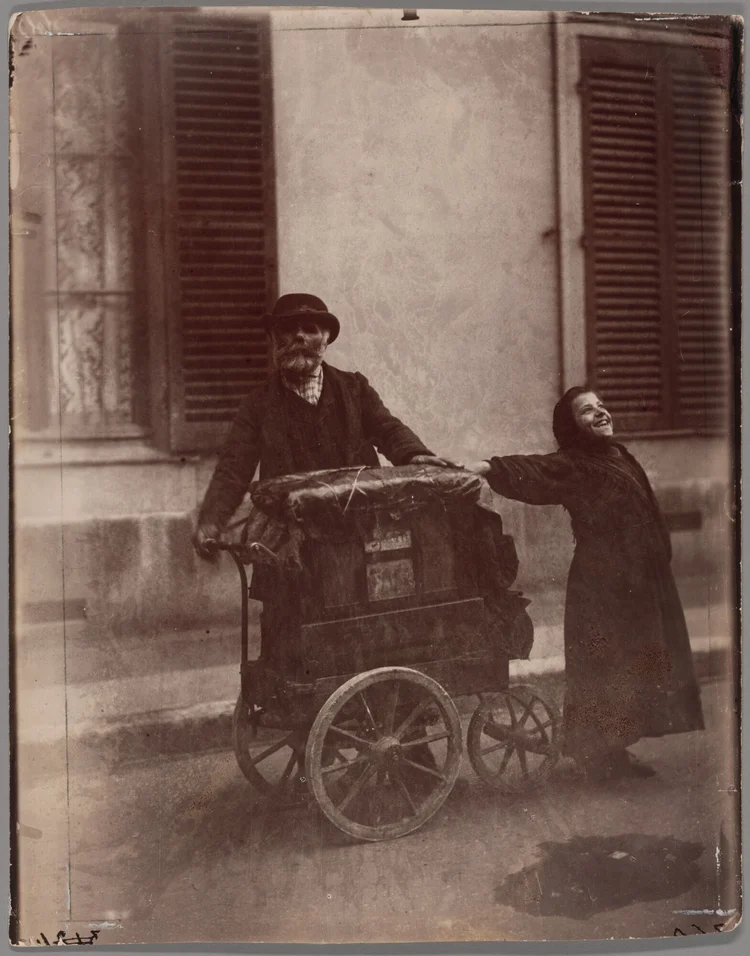
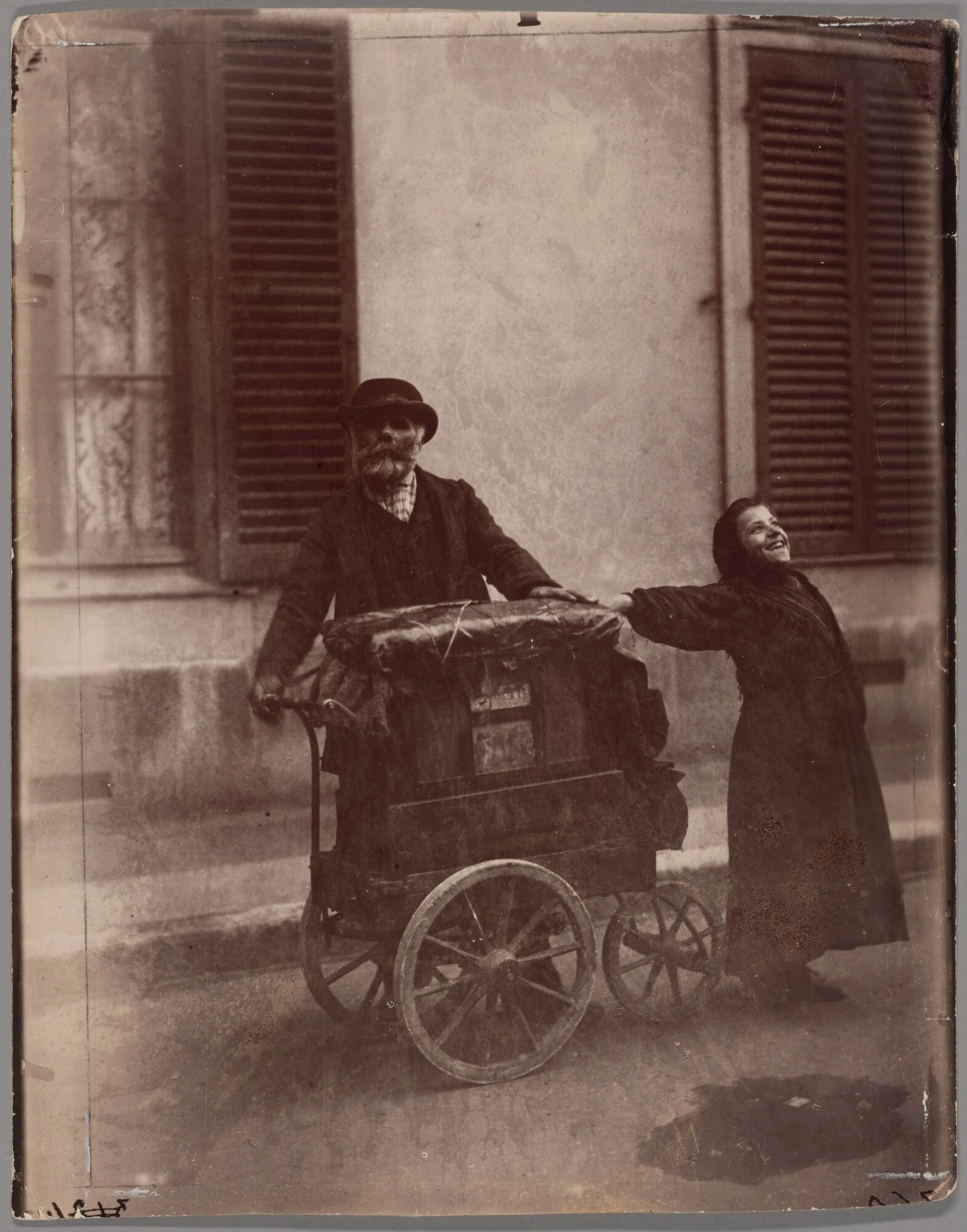
By 1899 he had started a series on the petits métiers, the small trades of the street. Knife grinders, sellers and musicians posed for him on the cobblestones with their tools. In Joueur d’orgue, an organ grinder stands behind his instrument, and a woman beside him tilts her head back.
The city around him was changing fast. Baron Haussmann’s new boulevards had already cut through many old quarters. Therefore Atget went where the old Paris still stood: narrow streets, courtyards, staircases, door knockers, shop signs. On some of his own titles he wrote that a building would soon disappear.
After the war he kept working. In 1925 he made a long series in the abandoned park at Sceaux, and he noted the time of day for some pictures. That same year Man Ray, who lived down the street in Montparnasse, bought photographs from him. Man Ray felt the pictures shared the spirit of his Surrealist friends. In 1926 four of the pictures appeared in the magazine La Révolution surréaliste. Atget asked that his name be left out.
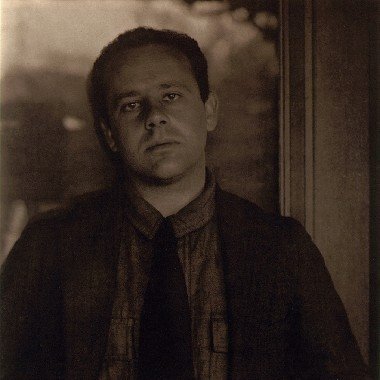
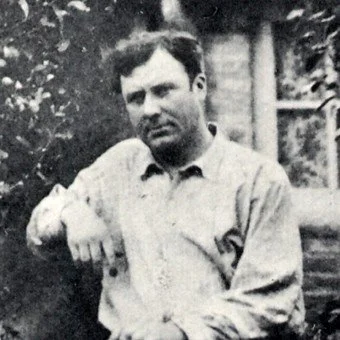
Man Ray’s young assistant, Berenice Abbott, began to visit his studio and buy prints. In 1927 she made his portrait. He died in Paris that August, before he could see it. Abbott then bought the rest of his archive with the dealer Julien Levy and spent decades showing it. Atget himself never claimed to be an artist. When Man Ray talked about Surrealism, he gave a plain answer: “These are simply documents I make.”
The work
Atget worked with old tools on purpose. His camera took 18 x 24 cm glass plates and stood on a tripod. He printed by laying each negative on light sensitive paper and putting it in the sun. The large plates hold every small detail. Long exposures turn moving people into ghosts, and many streets look empty. He sorted his pictures into series, such as small trades, vehicles, interiors, gardens and the Seine, so that clients could find what they needed.
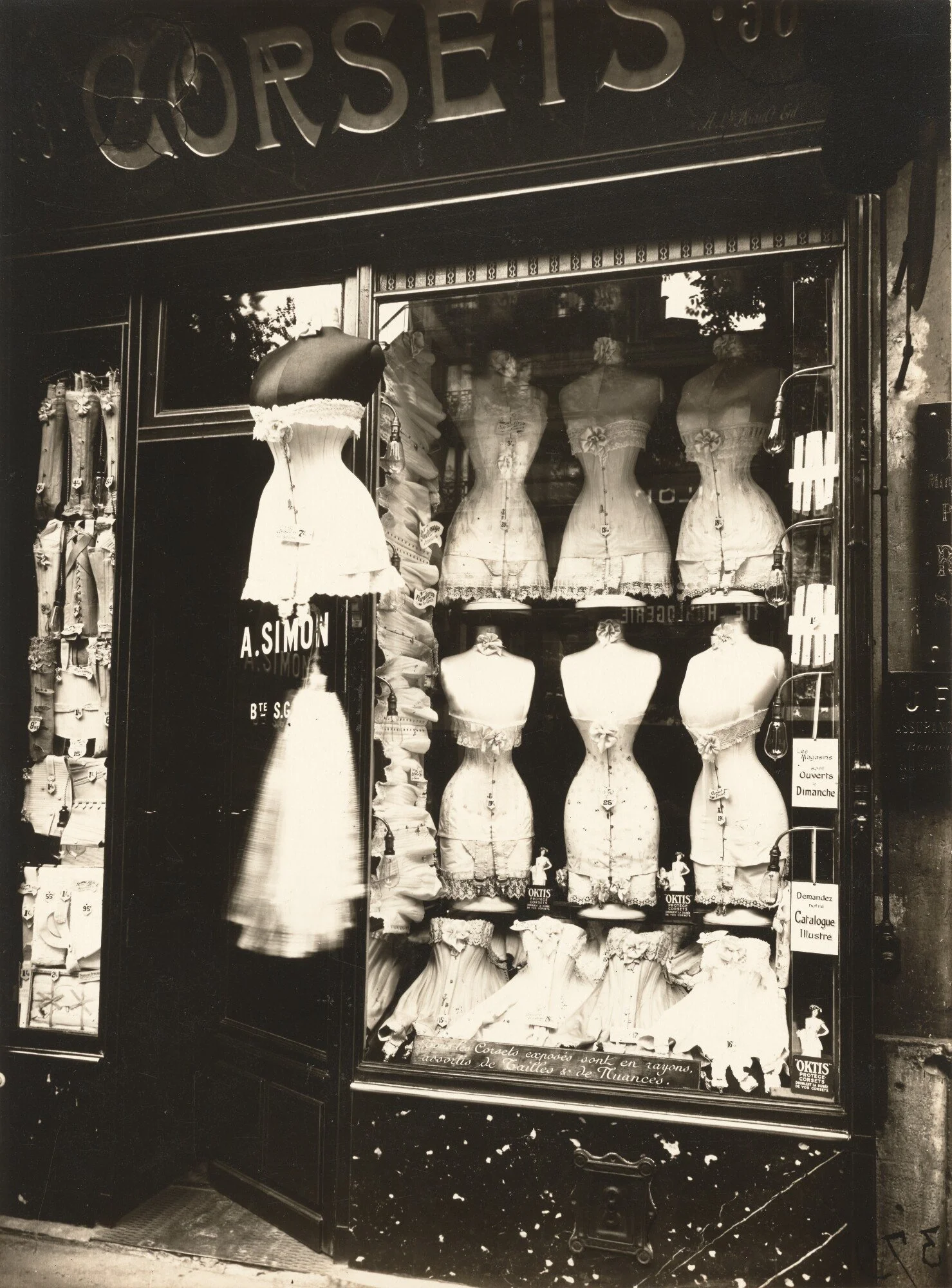
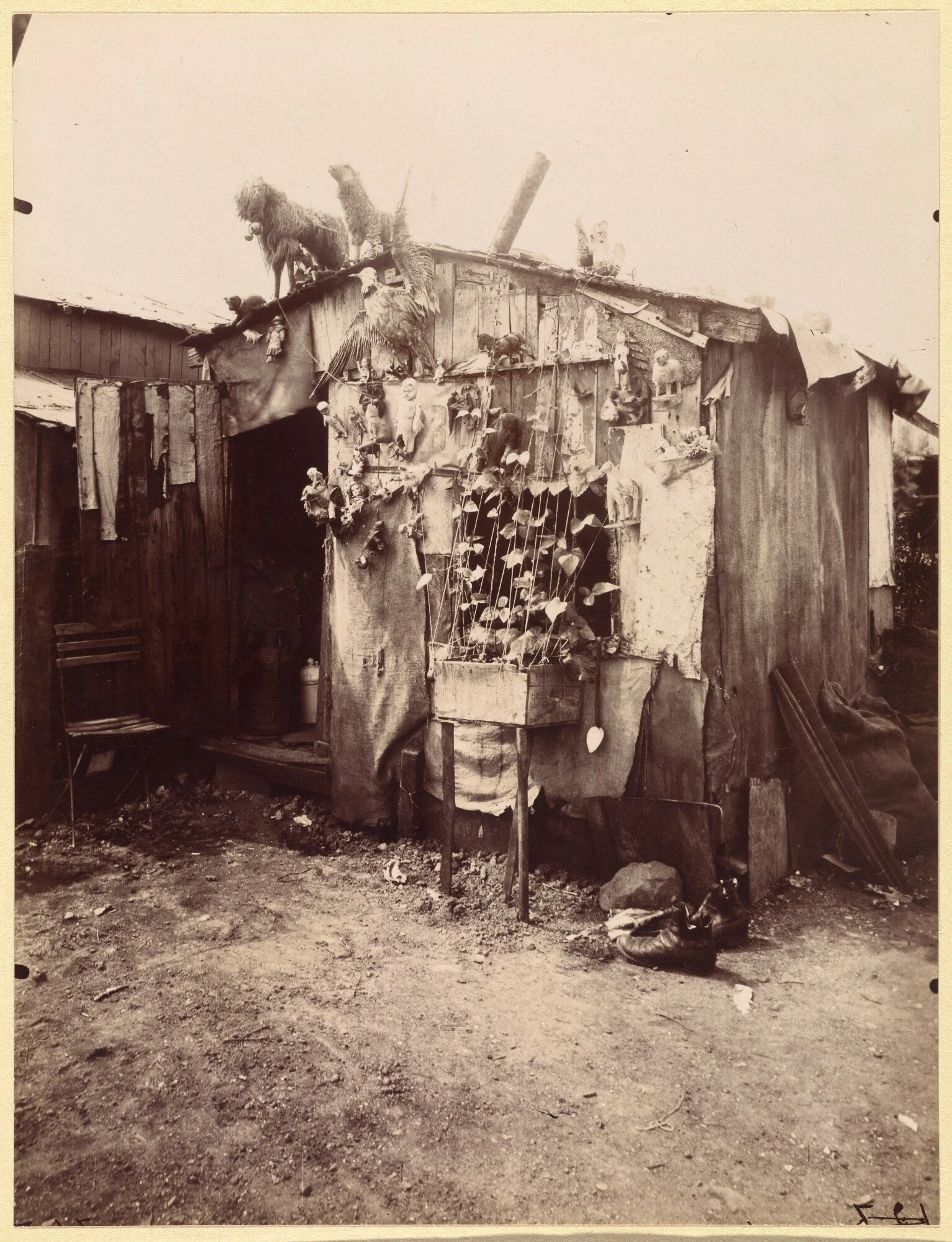
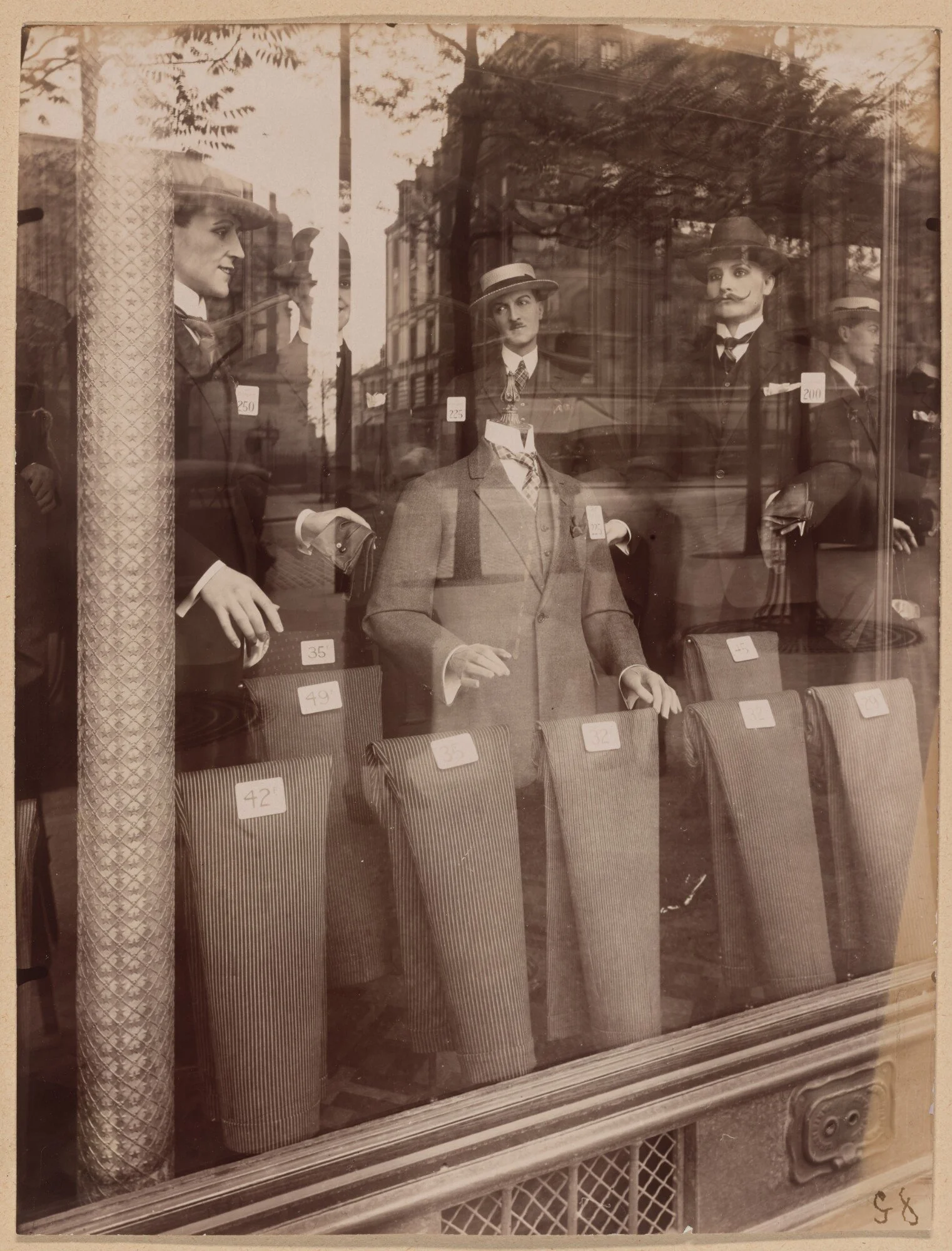
Shop windows are among his best known pictures. Boulevard de Strasbourg, Corsets (1912) shows a window full of corsets on dummies, with the word CORSETS in big letters above. In Avenue des Gobelins (1925) men’s suits on mannequins mix with reflections of the street, so the glass shows two worlds at once. The Surrealists found these windows dreamlike. Atget also went to the edge of the city, where ragpickers lived in huts made of boards, as in Villa d’un Chiffonnier (1912).
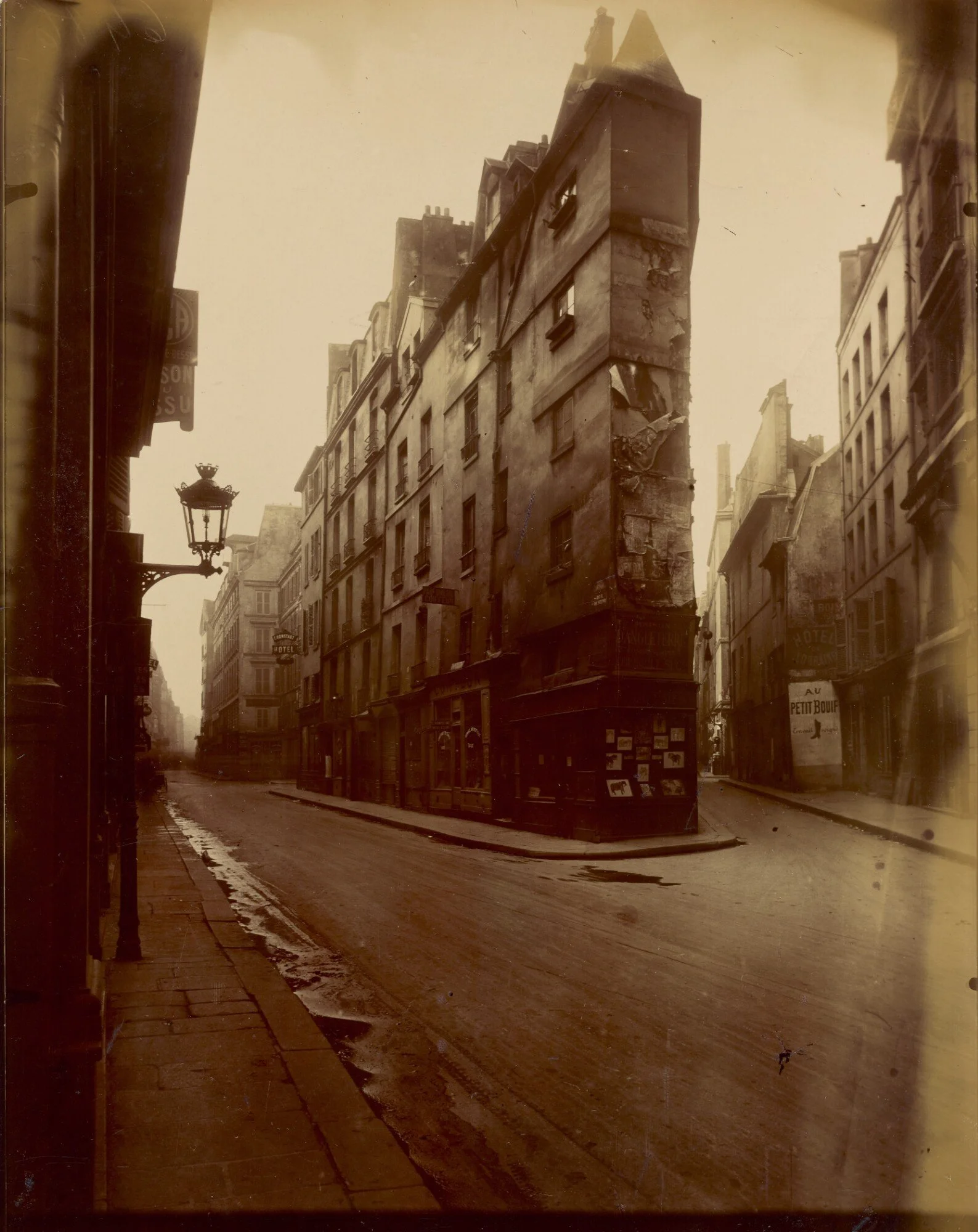
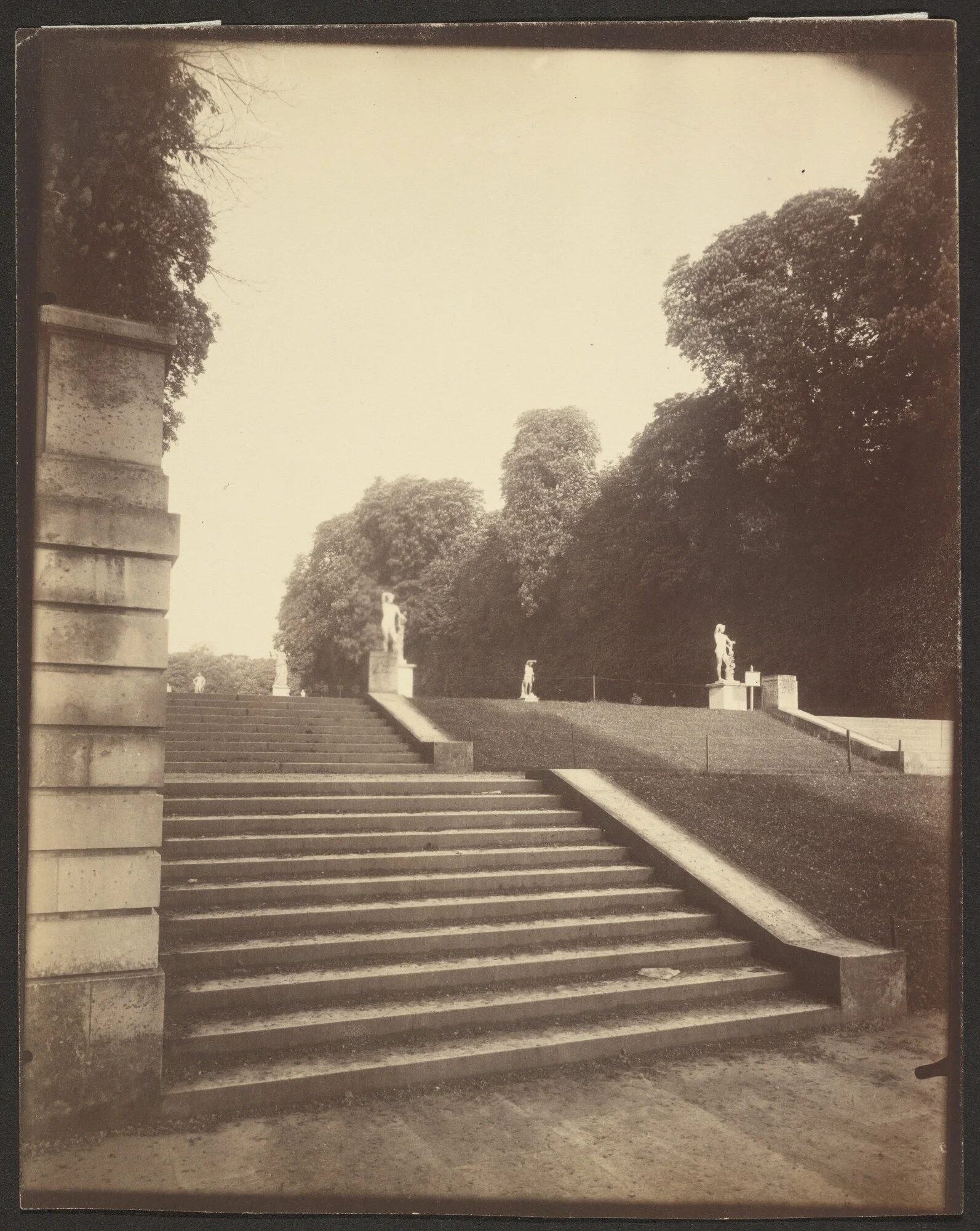
Late in life his pictures grew quieter. Coin rue de Seine (1924) is a simple street corner: a tall old building, a lamp and an empty road. In Saint-Cloud (1924) a stone staircase leads into the trees of the park. Museums in Paris kept thousands of his plates. In New York, the Museum of Modern Art bought the Abbott-Levy collection in 1968 and later showed his work in a four-part series. Walker Evans, Berenice Abbott and Lee Friedlander all learned from him.
- 1857Born on 12 February in Libourne, near Bordeaux
- 1878Moves to Paris after years at sea, to study acting
- 1898Photographs the streets of old Paris; his door sign reads Documents pour artistes
- 1899Has begun his series on the small trades of the Paris street
- 1920Writes to the director of Fine Arts; the state buys 2,621 negatives
- 1925Photographs the park at Sceaux; Man Ray buys prints from him
- 1926Four of his pictures appear in La Révolution surréaliste, without his name
- 1927Dies in Paris on 4 August
Lessons
Photograph what is about to disappear. Atget chose the old streets that Haussmann’s new Paris had not yet reached. On some titles he noted that a building would soon be gone.
Work in series. He sorted his pictures by theme, from small trades to shop signs and gardens. A series lets each picture talk to the next, and it made his archive easy for clients to use.
Come back at a different hour. At Sceaux he returned again and again in 1925 and noted the time of day for some pictures. The same place changed with the light.
Try this: pick one old street or courtyard near your home. Photograph it three times on one day: early morning, noon and evening. Stand in the same place each time and write the hour in the file name. Then put the three pictures side by side.
Gear
Atget used tools that were already old fashioned in his day. The sources describe them clearly.
Large format view camera: a heavy wooden bellows camera for 18 x 24 cm glass plates, always on a wooden tripod. Artbook also mentions rectilinear lenses and only a few plate holders.
Printing frame for contact prints: he made each print by contact with the negative on albumen or printing-out paper, exposed in daylight and then toned with gold.
Books
Atget (The Museum of Modern Art, 2000). John Szarkowski, head of photography at MoMA from 1962 to 1991, chose 100 pictures from the museum’s Atget collection and wrote a short text on each one. Together the texts form one long essay on how Atget saw. It covers the villages, the royal parks, the courtyards and the shop windows. MoMA reissued it in 2012, and it is the best first book for anyone new to Atget.
Atget: Photographe de Paris (Errata Editions, 2009). A study edition of the first Atget book, published in 1930 with 96 pictures chosen from Berenice Abbott’s collection. The reissue includes the original text by Pierre Mac Orlan, an essay by David Campany on Atget’s ‘intelligent documents’ and a text by Jeffrey Ladd. It is a good choice for readers who love photobooks and want to see how Atget was first presented to the world.
Eugène Atget’s Trees (D.A.P./Distributed Art Publishers, 2003). A large format book of 39 of Atget’s tree pictures, with a text by Sylvie Aubenas. It shows a quieter side of his work, far from the shop windows. It suits landscape photographers and readers who want to look slowly at one subject.
In his words
“These are simply documents I make.”
“I can say that I possess the whole of Old Paris.”
“This enormous documentary and artistic collection is now finished.”
“I have assembled photographic glass negatives… in all the old streets of Old Paris, artistic documents showing the beautiful civil architecture from the 16th to the 19th century.”