Black-and-White Street Photography Critique with Phil Penman
In this episode, New York street photographer Phil Penman joins me to critique a set of reader-submitted photos, most of them shot in black and white. We talk about what draws him to black and white over color, using landmarks as a background layer rather than the subject, and Phil closes by walking through one of his own recent shots from a workshop he taught.
Check out Phil's work: https://www.instagram.com/philpenman/
Black-and-White Street Photography Critique with Phil Penman
In this episode, New York street photographer Phil Penman joins me to critique a set of reader-submitted photos, most of them shot in black and white. We talk about what draws him to black and white over color, using landmarks as a background layer rather than the subject, and Phil closes by walking through one of his own recent shots from a workshop he taught.
Introduction
Hello everyone, welcome back to the channel. Today I am here with photographer Phil Penman, who is a New York based black and white photographer. Hello Phil, thank you for coming by mine.
Thanks, thanks for having me on the show.
So the idea behind this is that I would like to show you the photos of people from our community, and I would like to ask you to critique those, or maybe to look at those as if you would take those photos, or maybe as if someone during your workshop took those photos.
Sounds good to me.
Just a quick note, some photos are purposely picked not to be the best shots.
That's the best way, though, yeah, because you don't learn anything if it's only good ones.
Yeah, all right.
No, and there's nothing, the figures is, you might have five really great ones in your life, so the idea when you go out and shoot is you're just trying to become a more consistent photographer. It's not like you're going to go out there and bang out incredible images every day. It might be that you have a two-week stint where you get great images every day, and then it might be a two-, three-month period where you see nothing. So we're just trying to become more consistent, so you can go out there and just get good images every day, and you cut out the crap. So if you're not learning from the bad ones, then you're not learning anything.
All right, so let's take a look at the first one.
@e.e.corrigan
Okay, so what do we have here. It's nice, nice lighting. I like the shadow depth you've got there, but I don't know if I would have necessarily included the person, or if I did, I would like to see a little bit more of them, it's kind of like in between there. As far as editing, it looks nice, maybe a little bit of detail on the left, though, probably would have burnt out a little bit. I tend to do a lot of dodging and burning myself, so any little details I can see in the edit that I find distracting, I personally feel I would have maybe waited, it would have been nice to have had the person probably in the light a little bit earlier. But it all, is that shot through something? Yeah, I probably, you know what, I probably would have had it without the person, and just kept it a very abstract image, as a letter, which I believe that's an X or something like that, it looks like an X, I think. Really, you just needed to wait for a little different lighting scenario, it would have worked better if this was a little bit more lit, and we could actually see the full letter.
And is it a scene that would naturally catch your eye if you'd be out shooting?
I don't really have any one discipline that I go out and shoot for. I feel like, you know, it's just photography at the end of the day, and if you see an interesting abstract image, then you shoot it, if you see a good street scene, shoot it. It's very important not to pigeonhole yourself too much as a photographer, because you need to learn different disciplines, and you can take things you learn from each discipline and apply them to your own creative style. But I like the edit, it's a nice image.
And do you have any advice, because I know you run one-to-one workshops, maybe you can tell me a little more about your workshops, and also what it usually looks like when you take your client out shooting?
Phil and his 1 to 1 workshop
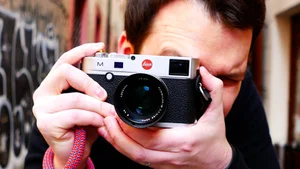
I get them up really bloody early, that's what I do. So, I've been shooting since I was like 15 years old, started in the darkroom, and then worked for agencies, news work, so I've acquired a lot of knowledge over my time. Primarily these days I shoot everything with Leica cameras, and I actually teach a lot for the Leica Academy, so I do different workshops around the world for them, but I also do one-to-one teaching in New York City, and also other countries, like if I'm visiting London for a while and I have a workshop there, I'll do some one-to-ones. But generally, people from all over the world, if they're coming to New York City, they reach out to me, I take them out, typically we go out very early in the morning, shoot for about, we go out for about 12 hours, and we incorporate what they want to learn. So it's not me trying to tell them what to shoot, it's what they want to improve, and then we go to certain locations based on that, and then we work on the edit together as well, so taking it from the street right to the final image.
And is there something different about black and white photography, compared to, let's say, general color photography?
I have to shoot color as well, so obviously you wouldn't go very far in photography, especially commercially, if all you shot was black and white. So I shoot color, I help people with color as well, but personally, for my work, I like black and white, it's just the way I started in the darkroom, and it's the one thing that brings me the most happiness when I shoot it.
So what's the difference for you, in terms of, I don't know, design maybe, or information?
It's simplicity. You focus, there's not the distraction of color, and it kind of strips away a lot of things. It's also a lot of fun to shoot black and white when you're out on the street as well. So I typically use an electronic viewfinder that I put on top of my M cameras, and I use a Leica M10 Monochrom, and I have an M11, but you can actually set the viewfinder up so that you see the world in black and white, and it's just a nice fun experience. And also, for those of you looking to learn, practice composition, it's an easy way of just helping yourself see lighting, work on composition, because you're taking away the distraction of color, the raw file, still, if you're shooting with a color camera, the raw file is still color, but it just helps you see things clearly.
So you decide later in post whether the picture is working in black and white or in color, or do you know right away when you take a shot?
A monochrome doesn't give me a choice. But, yeah, no, sometimes, you know, I like to go out in really foul weather conditions, and sometimes that can look a lot better in color, so you can play, you know, when it's very, I like, it's weird, because even my color street stuff looks very black and white, it's like it's never really truly full-on, in-your-face, Instagram style.
Ah, okay. All right, so moving on to the next shot.
@tylerkornheisl
What do we have here, looks like a street sign, I'm not sure where this was taken, but I know it's, again, I almost feel like if you're going to use people, then you've got to use them, you know. Right now we're not really getting anything from this, it would have worked better without the people, and just be like a texture shot. Yeah, I just, it's not really doing anything for me with the people, to be honest. If, like I said, if you're going to see them, you want to see them, so this one needs a little bit of work, but I would have, yeah, I think the place itself is enough.
You also shoot a lot of silhouettes, right? Do you think the position of the people is important in this one, maybe the gestures or something like that?
If you're going to do a silhouette, then you'd have to use it, so you wouldn't use either, you know, normally if you're doing silhouette stuff, with silhouette stuff it's tough, because you never want it just to be the focal point of an image, because then it just looks like everything else that's out there on social media. So the hard part is, how do you incorporate that as just part of the larger scene, so maybe using it as a layer in an image. The key to it is, always watch your bright spot behind, to create isolation, so something like this, if you had one lone subject, maybe over here, and you were shooting lower to the ground, and you had this behind you, that would create some kind of silhouette, or maybe this bright spot over here, but you always need that isolation if you're going to shoot silhouette stuff. So you're positioning your body in relation to the person and what is behind them, so even little things like this would cause distraction, it interferes. But this is, yeah, it's just not working, in my opinion.
@callie_eh
Moving on to the next one, okay, that's a nice little street scene, yeah, very nice, got a lot going on, I love all the different expressions you've got. I'm almost thinking, like, this obviously is very difficult, because when you're shooting stuff like this, it's all about the flow of movement, as you're shooting, these people are moving, right, so you're looking for that perfect composition where everything kind of flows together, like this pattern. And I almost feel like this head here coming out of the top, I almost feel like she needs to be a little bit further over, and that would just require you moving, or, you know what I would have done, I would have not included her, and tried to have gotten maybe on the right, this girl, not this one, because it's always kind of nice if you can use people in the foreground to frame something, but it's just, it's almost there, it's just not quite balanced, because I think it requires a little bit of moving. So it's nice, but maybe you would have needed to come down a little bit lower, I probably would have just lost this girl altogether, and just knelt down a little bit lower, usually you never try to crop someone's feet off if you're going to show them like that, usually you try to show the full body. I probably would have knelt down a little bit more, tried to lose this girl by coming down, so that all you see is this head, but it's lower in the frame, so she would be more up here, framing this, I think that probably would have worked a little bit better, because this negative space isn't quite working for me. It's a very nice image, it's just not, it's nearly there.
@nicolasbastiani_photography
Moving on to the next one, this looks like my old country, small little details. One of my old mentors, Larry Schwartzwald, who unfortunately passed away, used to hammer this home with me, verticals and horizontal lines, if you're going to use it for effect, just make sure you rotate it so that it is straight, this isn't quite straight. Also, I probably would have centered this up a little bit more, brought my crop in, edit-wise, it needs a little bit more, you need to see a little bit more detail here, you could go in and dodge the light spots. Picture-wise, though, it needs more expression, like, I'm not really seeing any faces, I would have wanted to see more of this, it might have been hanging around and shooting a few more images to get maybe an expression of the man looking up at them, or it needs to be tighter, or you would have to move your body position. But it needs that little bit more, or maybe a crop, because this is obviously a shot from the other side of the street, right, and if you have a fixed focal length, if you've made this maybe a full-length, sorry, not full-length, a vertical, where you crop in the middle and make it more about the guy in the middle, and crop to the right and the left, and make it a vertical image, and cut the guy out over here on the right hand side, lose him altogether, that might work as a stronger image, but I'd still want to see some more facial expression from the guy. But yeah, it needs, obviously, the closer in you can get, obviously with the police, that's easier said than done, especially in England.
I remember covering many protests and many things, and I had my picture taken by the police more than I did of them.
Really? Yeah, that used to be how they used to do the surveillance, anyone they considered a troublemaker, they would have a police photographer going around with the police, and they would point out to members of the public, or photographers, to take their picture, so they had it on record. This is before CCTV was everywhere.
All right, and you mentioned it briefly, the aspect ratio, how you would crop it, maybe vertically instead of horizontal, is there like a rule of thumb you use for your images, or for the scene, on whether to approach it and take it horizontal or vertical?
@sankardeep_chakraborty
The key, as a press photographer, if you were doing this, you'd have to shoot both, the client, all the paper you were working for, would want to see both, so that's just rule of thumb, you shoot wide landscape, vertical, that's just a given that you do that, because the layout of the page in the paper is usually preset, so the copy is already put on, just, you know, for example, obviously the photographer who took this might not be thinking about this, but if any of you are out there shooting for publication, usually what would happen is the layout is pre-done, and the copy is laid down, and there's a space for the picture, and it could be a landscape or a vertical, your job is to have both covered, so that they can choose, use, have the picture to go in that space, so you don't get to dictate the layout of the paper for them. So if you were shooting something like this, you would cover your bases by shooting both the landscape and the vertical, and I just think maybe a vertical would have worked better on this. Anyway, usually I keep my crops to aspect ratio, I don't like to do any strange cropping, and there's many different reasons for that. But yeah, I just think this needs more work.
Moving on to the next one, so we've got a guy clinging onto a pole, and a guy clinging onto a woman, that's pretty good, the position there. Yeah, I quite like that, there's a nice little bit of isolation because you've used good depth of focus, so that your background is out of focus and we concentrate on what's going on. Here on my screen it looks fairly gray, I probably would have liked to have seen a little bit more contrast in it, it just needs a little bit more pop, but no, I like the scene, it's nice.
@oms1959
Moving on to the next one, it's like a portrait of a guy, yeah, a nice, nice portrait, nice, patch light in the eye, as we say, a good intense look, yeah nice, um, yeah, not really too much you can say, I don't know about the pose, that's the only thing, so this is where you can cheat a variety, I almost feel like a different pose, and cutting out this pole on the right, so that it's more about him with this background, you see what I mean, I think that might have been a little bit more powerful, or maybe I would have incorporated a little bit more of this, but yeah, it's a very nice shot.
@robshum
Moving on to the next one, this looks like, yeah, nice emotional scene, subway. Again, I think the edit needs a little bit of work, a little bit more pop to it, like a little bit more detail here, in the faces of the couple. You know what, it almost doesn't need this guy, because you've got the motion blur of the train, I'm presuming that's a train in the background, you almost don't need this, it's almost just this little moment, the couple, it's nice enough, but yeah, it just needs a little bit of work on the edit, I'd say. And probably what I would have done, if I was incorporating another person into the frame, I would have used yet another person on the right hand side, okay, so I would have framed them and had one person on the right, one person on the left, so your eye is drawn into the middle, rather than, you know, this is kind of very heavy weighted to the left at the moment. Okay, yeah, it adds a layer, but here you are, right, it feels a little too left heavy. Yeah, you're basically adding layers to an image, that's the way you work out, so you're physically having to move around, what's going on around you, but you have to have that idea of the image in your head, so you might move a little bit further back, and it might be that you want a little bit more depth of focus as well, so you would open up your aperture pretty wide, open, because even the fact is that he's fairly close to them, by the looks of it there's not quite enough depth of focus as well to really lead you into them. But I would have moved around a bit more, shot a little bit more, and incorporated something on the right, just made it a little bit maybe a little bit wider.
All right, thank you.
No worries.
@lacuna_josh_bw
Okay, on to the next one, moving on to the next, so same thing, weird guy kind of almost silhouetted down in the stairwell, oh, I don't know if I, I probably would have cropped out this light, I would have brought this down, brought this down a little bit, usually when you have light spots either in a corner or a top, it's leading your eye away from the image, so I would have probably brought the crop in maybe a little bit tighter, it almost needs it, this is like, the guy down here is like an extra layer, I would have probably liked to have waited there a little bit longer, and added something else coming, even coming down the stairwell, so it could have been like another person coming down the stairs, but they don't need to be crisp, I probably would have maybe tried a little bit of motion blur, or someone coming down there, it just needs something else there to get the weight of this person here, that's probably what I would have done. But it's a nice idea, it's just, it's one of those moments where you just have to wait and try different things, so you're basically waiting for that moment, like you're trying to put many things together at once, so you have an idea for an image, and then you're basically sitting there waiting for the timing, the perfect timing of someone here, in the spot that you want, something here that works, and if you want to get even more cocky, you could try and get someone here as well, but it's just, it's a waiting game.
Is this the way you take photos, finding a good spot and waiting for subjects to enter the scene, or are you more like a run and gun?
Both, don't limit yourself, you're missing pictures. I there's occasions where I have to run and gun it, but if you can become a photographer where you, you could do everything, like you can pre-envision pictures, you can shoot candid moments on the street, you can, like if you saw an image like this and you pre-visualize something, you're trying to create this image where someone's going, how the hell did he get there. I don't like to edit, I don't like to add people to images, or just take people out of images, it has to be taken in shot when you're shooting, but it might be that you're starting with one layer, right, the image, and then slowly you're trying to make it more and more complex, so the person that's looking at it goes, wow, how the hell did he manage to get that, and that, and that, at the same time, and you're waiting for all these small moments to happen, and then you might try something else, where you might try it with a slow shutter speed, it's just experimenting really.
My shot
Moving on to the next one, yeah, so it's okay, I like the use of the lines, it probably would have been better if he was turning and facing, but eating the pizza at the camera, it's okay, edit-wise, not too bad, managed to keep the midtones, you know, this, I don't like it when you go too contrasty and you lose all the midtones as well, but I just feel like it needs, you know, you set up your composition, but this needs to be more like, it needs that, if you're going to incorporate the person, it needs to be some kind of wow moment, right, okay, so looking at the frame, giving, you know, with the pizza, maybe something a little bit more intense might have worked better.
@mlin_photography
Okay, so yeah, I like stuff like this, you know, a little bit of motion blur, got kind of a grainy image. Edit-wise, I probably would have gone and brightened up certain areas at the stairwell, yeah, nice, something different, you know, a little bit of movement, not afraid of experimenting with something, so yeah, nice effort.
@stefankurzeja
Yeah, it's nice, a little contrasty for my liking, but that's all personal preference, some people like very contrasty images. This, I almost feel like the doorway here is too bright, so I would have toned this down a little bit, because it's like it's competing with a person, this is much brighter than this, so I probably would have toned this all down more. You know, you've got to think, whenever you shoot anything, you're thinking about what's the point of interest that you're trying to draw the subject into, and I'm guessing when the photographer took this, that it wasn't this doorway, so if it's this person, you know, the only reason I can imagine that you've added all this on the right is because you wanted to show the architecture and location, because otherwise this image could have worked well just as a vertical, with just this person behind the window, and you would use just this frame, the image could have worked just like that as a vertical, where you crop out all the right altogether. Or, if you are going to incorporate all the right, I would have probably gone out and shot it wider, so that you saw more of both of the windows, so you didn't have this weird crop, and I would have toned down this in the middle, so that you could have shot this many different ways to make it easier.
Chapter 15
Okay, so, couple looking at each other, kind of like a similar shot we had previously, in front of the train. Yeah, you know, it just needs, basically your positioning, I think, where you're holding the camera, really, so if you're trying to catch an emotional response, you want to see a bit more of her face, so the camera would have needed to be higher to see her, or you would have needed to move around to the right to catch that, and maybe you get the response of him looking at her as well. Edit-wise, it needs a little bit of work, it's just a little bit flat, like, you could have always shot it from the other side over here as well, because you can see that this light is picking up the face this side, so you could have used that light if you'd come around to the left and shot it. But should have, coulda, woulda, you know, it could have been a quick moment just like that, and it's all very nice in hindsight, us telling you how to do it, but for all we know it could have been a split-second moment that you saw. So I'm not going to rip it to shreds, any of the images completely, because I realize, given the circumstances, but yeah, it needs a little bit more work.
@amith_kadasur
Okay, next up we have an artist, by the looks of it, yeah, I'm not sure if it's just my screen, or it's very flat, it's a very different edit, I would say. Yeah, he's stripped out all the blacks, and the whites are blown out, from what I can see, so you can see, like, on the easel, the whites are completely, they're kind of like a murky gray, right. The same for the light on the background, so, you know, it might be that that editing style is your personal preference, you know, you like stripping out all the blacks and all the whites, and it's just a very black image. Personally, you know, I like stuff with a deep black, but the idea behind the image, yeah, it's a nice idea, and I think the edit itself is very personal, whether you like it or not.
@hijodelpulque
Moving on, where is this taken, this looks like Rome or something like that, it looks like Italy to me, from the fashion, and it's, I don't know, it's just, it's this stuff with a pole here and everything, it's kind of distracting, it's not adding anything, we're not really seeing, we're not really seeing any expression, you know, there's nice light on the side of the building, but we need more than that. And this guy, what looks like laundry or something, it's not really adding anything to the frame, I would have cropped all of that out, if I was, or I would have shot it differently. I think you have a little bit of light on the wall here, I'm not sure if that's light there. Yeah, it's just, you know, it needs more work, when you're shooting it really, start looking at all these details, like, you have this beautiful architecture, right, and then you've got this horrible pole here, and it's not even incorporating that into the frame, so if anything, to me, you know, if you want to show off this beautiful architecture, then you've got to look at all the details in the frame and strip away all the stuff that doesn't work, and that pole is not really doing anything to add to the frame, so, and it probably would have been nicer if you'd seen somebody's face. But yeah, needs some work.
I have one last picture for you.
@philpenman
Oh, wow, no, I really like it, this was actually me doing a one-to-one class for somebody, so this was us, we had it out early together, and I could see that there was fog on the water. So, usually I'll start in a general area, and then I'll look at what the light's doing, and then I'll look at what the weather's doing, so I could see that there was clearly fog on the water, and you know it's going to go quickly, so you're almost running, because you're trying to pre-visualize the picture that you want. So, mine was, I was trying to use the weather as atmosphere in the background with the bridge, and then just, we were basically working on how you can use iconic structures as just part of a layer in an image, so the image isn't about the Brooklyn Bridge, that's just an element of the bridge. This was just something I did quickly when we were out walking about.
So what's important if you want to incorporate something like that, like a Brooklyn Bridge, or I don't know, Statue of Liberty, something like that, because I know you take a lot of shots with those in the background?
How to photograph iconic places?
Yeah, it's just using it as a layer to give location, that's all, it's not the center point of an image, it's something that you can learn, it's a good way to learn, experimenting with different places, so you know, you can go out anywhere where you live, and you know what the kind of iconic spots are, and I'm sure you've all seen what the iconic images are of where you live, right. Just go out, stand there for a while, and try to think about what hasn't been done, and there's always something that hasn't been done, okay, it's just you haven't seen it yet. So really try to push yourself, go out one day, and just go to that local location where you are, and look at every little thing around, that angle, it might be that the image is a block away, or that there's always something that hasn't been done. All right, it's a good little test, I do it all the time whenever I'm lacking some inspiration, it's a way to force yourself to go and think outside the box.
Perfect. No worries. So thank you for joining me today.
Closing
No problem at all, man, I hope you got what you need from it, and I tried to be as nice as I could.
Now, it was very insightful, thank you for your insight.
No worries. I'm not going to go and say people's work is rubbish, that does absolutely nothing and doesn't help anybody.
No, I think it was constructive critique. So thank you very much, and have a great day.
No problem, man, you stay well.
Okay, yeah, thank you, thank you.
Bye.