Welcome to this edition of Photography Stories. Today, we look at the story behind the photograph JM Simpson made in Tacoma, Washington in 2026. We’d love to read your comments below about these insights and ideas behind the artist’s work.
Content note: this story describes a moment when a gun was pointed at the photographer. The photographs do not show violence.
For months, JM Simpson asked Romeo for a photograph, and Romeo always said no.
Simpson photographs unhoused people in Tacoma, Washington. He builds trust slowly. He listens more than he talks, and when someone asks him not to take a picture, he respects it. Then, on a cool and damp Sunday morning in October 2026, everything changed in a few seconds.
What follows is Simpson’s own account of that morning.
Trust Works
Mark Seymour once said “most of the best documentary photography out there doesn’t happen by chance. It’s about more than just showing up with a camera. Trust takes time, and the relationships we build can be every bit as important as our technical abilities.”
No truer words, these. I witnessed their meaning numerous times as an embedded photojournalist with American combat forces in Iraq and Afghanistan. Gaining the trust of informants and combatant forces took time and effort. Those efforts paid off.
The same notion applies to homeless individuals; I earn their trust before taking a photograph.
And so it was with one photograph of Romeo.
I first photographed him under a bridge on a garbage strewn section of South Tacoma Way in Tacoma, WA. The area is near a rescue mission and is a haunt for homeless individuals. It was a Sunday morning, October 11th.
I had begun the work of building trust in the area in April, and for the next several months I made my presence and camera known to the homeless on the street. I walked around and talked with a number of them; I did this because I knew some unhoused individuals would observe how I interacted with them. Perceptions matter.
My actions yielded results; I began to take photographs. But not Romeo: he declined my requests for an image.
While engaging with the unhoused, I listen rather than talk, and I answer questions put to me. I seek permission to take a photograph; if I am asked not to, I respect the request. Sometimes I am asked why I do what I do; at other times I am asked what I will do with the photographs. In most instances, I learn the first name of the individual and how long they have been unhoused. In Romeo’s case, he consistently declined to allow me to make a photograph; however, he once asked me if I wanted a hit from a joint. I just smiled and wondered if maybe he was beginning to trust me.
My instincts were right.
Walking up South Tacoma Way on that aforementioned cool and damp Sunday morning, I spotted Romeo 10 feet in front of me and to my right. I carried an Olympus OM-D E-M5 Mark III with a 12-40mm f/2.8 lens. I had ISO at 1000, aperture at 8.0 and lens at 12mm.
Approaching I said, “Hey, what’s up, Romeo?” That is when his head snapped up, and in his right hand he pointed a Glock 9mm at me. Recognizing me (he appeared to be disoriented), he quickly lowered the weapon and said, “Sorry man, I didn’t see you comin’. There’s been some gang problems here,” he added as he handed the gun off to another homeless individual who quickly walked away.
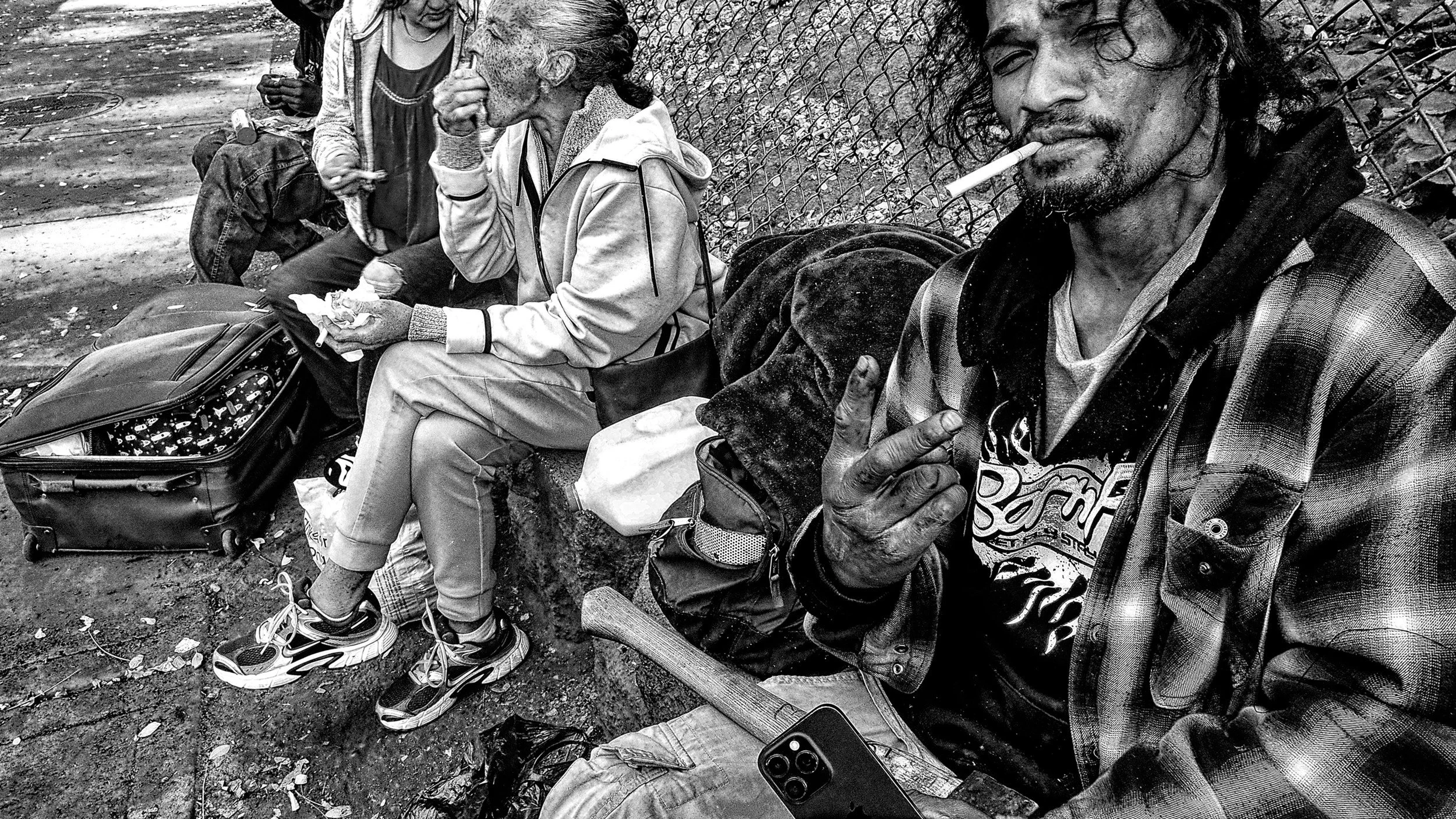
Surprised but not shocked, I told him not to worry. I asked if he needed any help; he declined the offer. I then asked if I could take a photograph; to my surprise he consented. I took one. I worked quickly; trust can be fleeting.
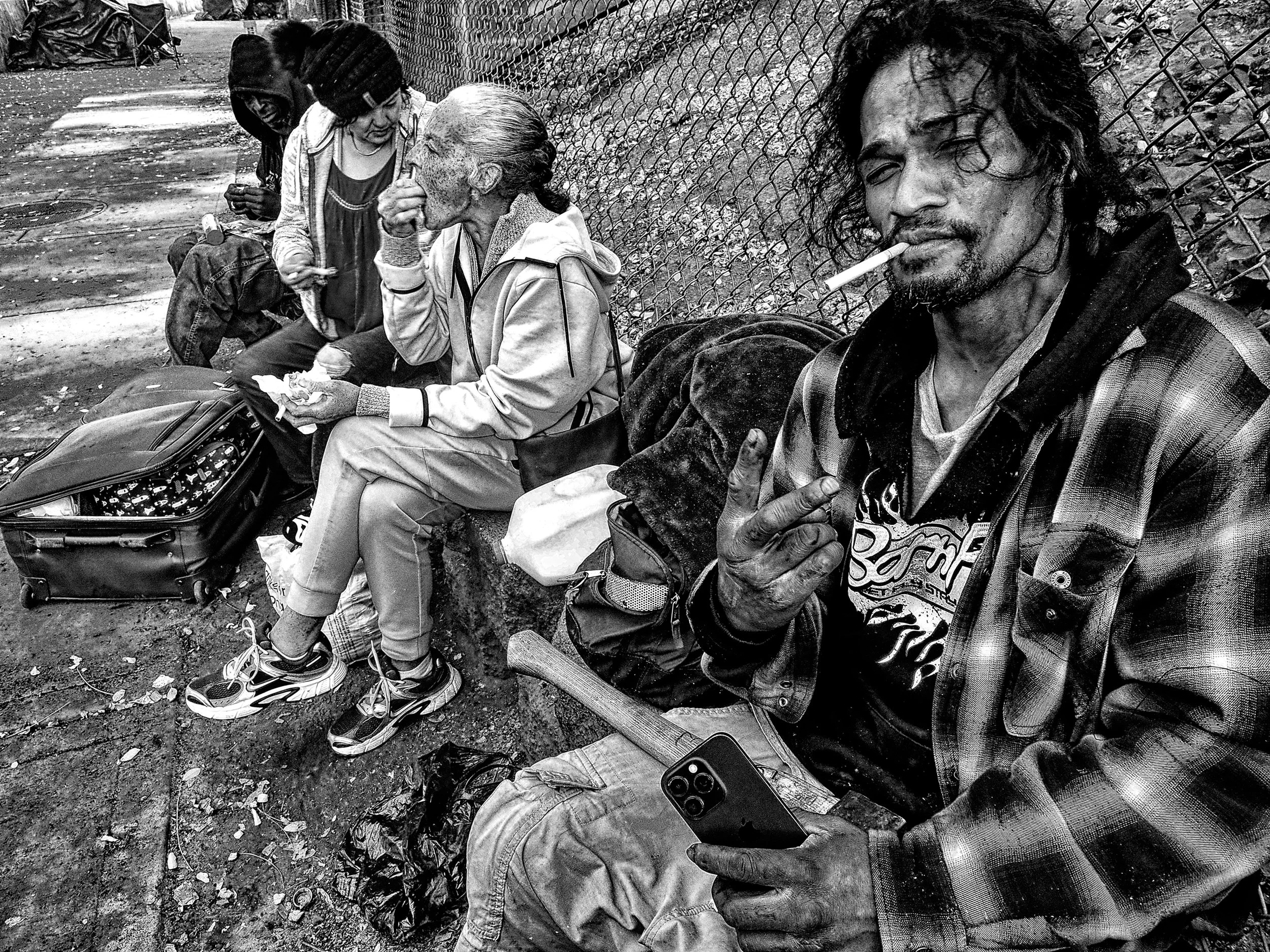
As a documentary photographer whose goal it is to further efforts to end homelessness in this country, I sought to capture something, a sense of what had just happened. After taking the photograph, I thanked Romeo and told him to take care. “Thanks man,” he replied.
Only later did I realize that perhaps I had captured something of the moment that could have ended badly. While I had been very aware of the Glock, I had not seen the hatchet in his lap.
Upon reflection, I reacted to a situation, one based on my past experiences and on the semblance of trust that I had over several months built with Romeo, and took one photograph of a man who lives on streets that can be dangerous and, perhaps, lethal.
I believe this happened due to what Seymour stated above. It is good advice.
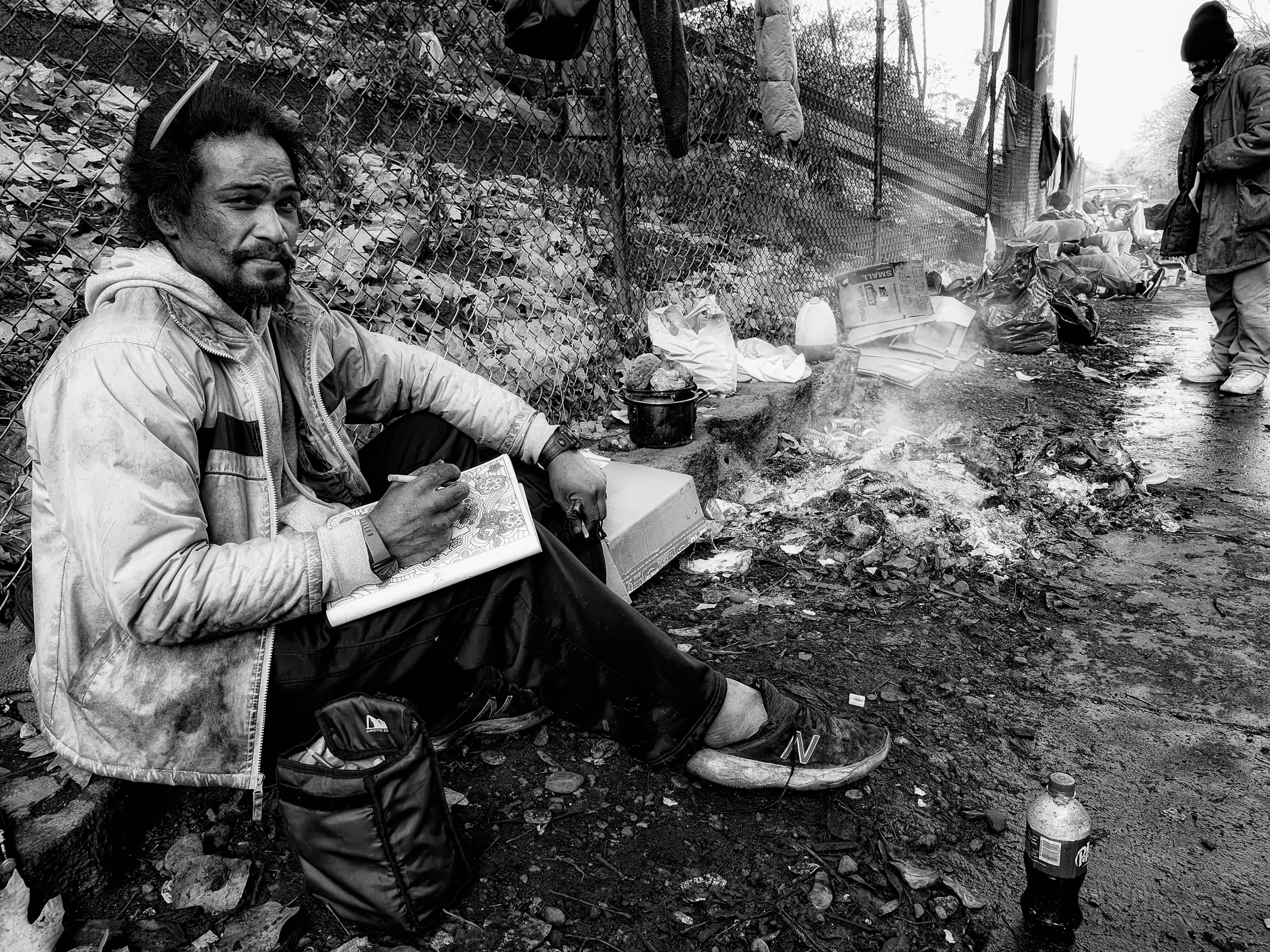
For months, JM Simpson asked Romeo for a photograph, and Romeo always said no. Simpson listens more than he talks, and he respects every refusal. Then one Sunday morning in October 2026, Romeo pointed a gun at him, recognised him and lowered it. When Simpson asked again, Romeo said yes. Trust built over many days can come down to one frame.
“I asked if I could take a photograph; to my surprise he consented. I took one. I worked quickly; trust can be fleeting.”JM Simpson
More stories:

The alley in this photograph no longer exists. Bandits’ Roost, 1888, carries Jacob Riis’s name, but the person who pressed the shutter may have been someone else.