Welcome to this edition of Photography Stories. Today, we look at the story behind the photograph by Jacob Riis, Bandits' Roost, made in New York in 1888. We’d love to read your comments below.
(This is the story behind the photograph.)
The alley in this photograph no longer exists.
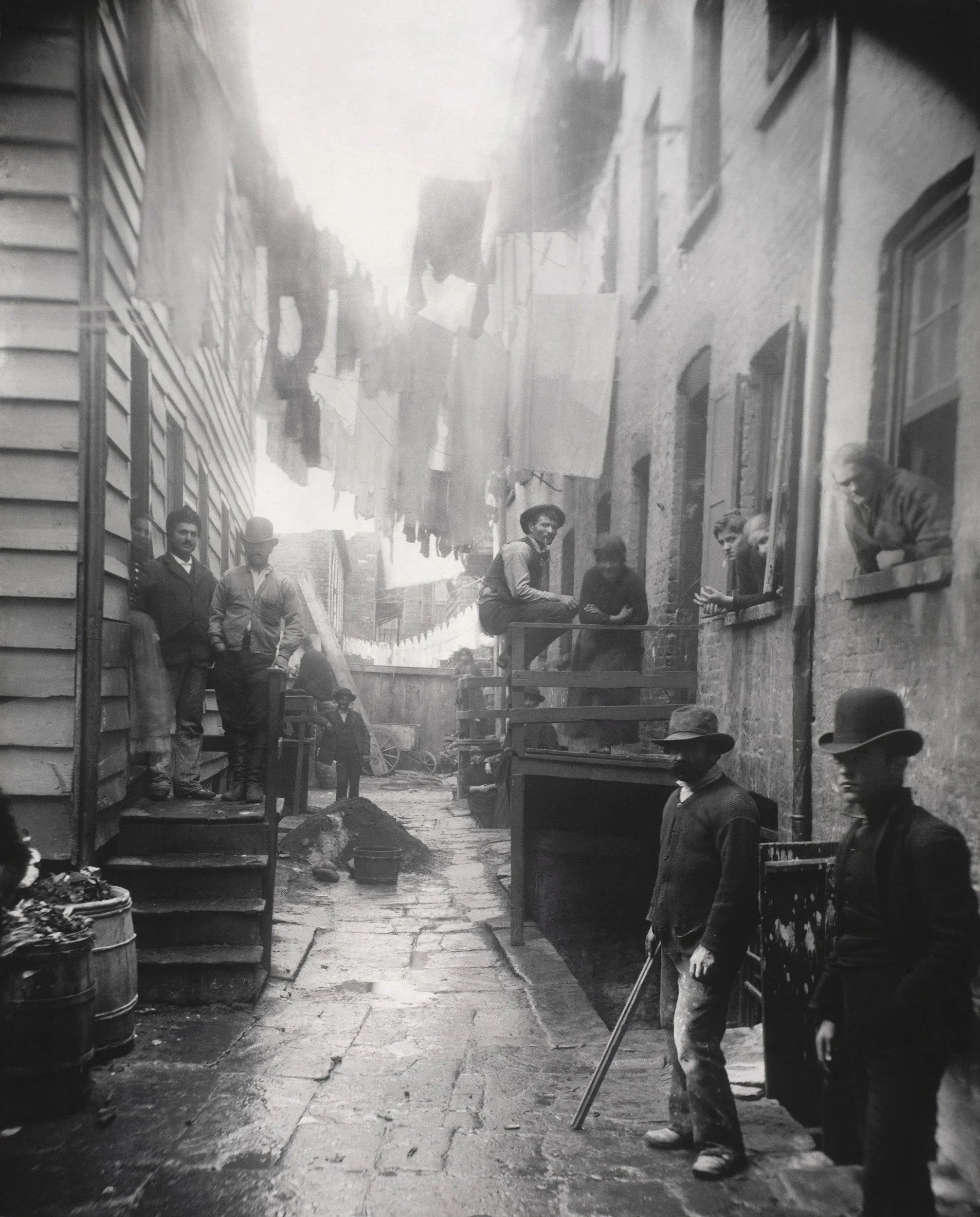
It was called Bandits’ Roost, a narrow passage at 59½ Mulberry Street, in a part of Manhattan known as the Bend. The picture was made in 1888 and carries the name of Jacob Riis, a police reporter who showed New Yorkers how their poorest neighbours lived. Nine years later, the city tore the whole block down.
The picture outlived the place it shows.
The name on the photograph may not belong to the person who pressed the shutter.
Riis worked with amateur photographers, and the Museum of the City of New York, which holds his collection, lists two of them next to him. He used the picture in How the Other Half Lives, his 1890 book about the tenements. One of its readers was Theodore Roosevelt.
This story follows the alley, the people who photographed it and what happened to the Bend.
The foul core of New York’s slums
In the 1880s, Mulberry Street made a sharp turn near the old Five Points neighbourhood in Lower Manhattan. The crowded tenements on this curve were known as the Bend. Many of the people who lived there were poor immigrants, most of them from Italy.
Jacob Riis knew the place well. In How the Other Half Lives he described it like this: “Where Mulberry Street crooks like an elbow within hail of the old depravity of the Five Points, is ‘the Bend,’ foul core of New York’s slums.”
Bandits’ Roost was an alley in the Bend. Riis called it one of the most notorious.
A reporter with a frying pan
Riis came to the United States from Denmark in 1870, when he was 21. He became a police reporter, with an office on Mulberry Street across from police headquarters. His work took him into the poorest streets of the Lower East Side, often at night.
In early 1887 he read in the newspaper about a new German invention: flash powder, a mix of magnesium and other chemicals that burned in a bright burst of light. With it, a camera could work in dark rooms and at night. Riis started to work with amateur photographers, among them Henry G. Piffard and Richard Hoe Lawrence, and with Dr. John T. Nagle of the city health department.
At first they fired the powder from a device that looked like a pistol. It looked threatening, so Riis began to burn the powder in a frying pan instead.
Faces in the alley
Bandits’ Roost did not need the flash. It was made outdoors, in daylight, in a narrow alley between the tenements.
Men and women stand along the walls and on the wooden steps. Near the entrance, two men in hats look straight into the camera, and one of them holds a long piece of wood. A woman and a child lean out of a window on the right. Above the alley, washing hangs on lines.
Who pressed the shutter?
The photograph carries Riis’s name. But Riis was not a trained photographer, and he often worked with others. The Museum of the City of New York lists Henry G. Piffard and Richard Hoe Lawrence as creators of Bandits’ Roost together with Riis. One glass lantern slide of the picture in the museum is credited to Lawrence alone.
We may never know for sure who pressed the shutter.
Five baby funerals
Riis did not show the Bend only in pictures. He also used numbers from city records. About the house next to the alley, he wrote:
“Here, in this tenement, No. 59½, next to Bandits’ Roost, fourteen persons died that year, and eleven of them were children.”
According to the Bureau of Vital Statistics, only 39 people lived in that house in 1888, nine of them small children. “There were five baby funerals in that house the same year,” Riis wrote.
A book, a card and a park
How the Other Half Lives was published in 1890 by Charles Scribner’s Sons. It put Riis’s text next to pictures from the tenements, and Bandits’ Roost was one of them.
One reader was Theodore Roosevelt. He went to Riis’s office, did not find him there and left a card saying he had read the book and had come to help. Years later Roosevelt wrote that the book “had been to me both an enlightenment and an inspiration.” In 1895 he became head of the New York Police Board, and the two men worked together.
In 1897, partly because of Riis’s campaign, the city tore down the Bend. Mulberry Bend Park, designed by Calvert Vaux, opened in its place. It was later renamed Columbus Park. A few old tenements from that time still stand on the east side of Mulberry Street.
A picture of a place that is gone
Today, prints of Bandits’ Roost are kept at the Museum of Modern Art, the Museum of the City of New York and the International Center of Photography. TIME chose it for its list of 100 photographs that changed the way people see the world.
The alley itself is gone. The photograph is what remains of it. In 1902, in The Battle with the Slum, Riis wrote: “In the battle with the slum we win or we perish. There is no middle way.”
This story was partly inspired by 100 Photographs: The Most Influential Images of All Time, TIME.
The Book
100 Photographs
Time Inc. Books · 2016 · By the editors of TIME · Foreword by Geoff Dyer
The editors of TIME picked 100 photographs that changed the way people see the world. The book tells the story behind each one, from the earliest surviving photograph by Nicéphore Niépce to a selfie taken at the 2014 Oscars.
Bandits’ Roost is one of the 100. It is a companion to TIME's digital project 100 Photos. The foreword is by the writer Geoff Dyer.

More stories:

The alley in this photograph no longer exists. Bandits’ Roost, 1888, carries Jacob Riis’s name, but the person who pressed the shutter may have been someone else.