Welcome to this edition of Photography Stories. Today, we look at the story behind the photograph Raf Lopes made in Brooklyn. We’d love to read your comments below.
(This is the story behind the photograph.)
A red light gave Raf Lopes three frames.
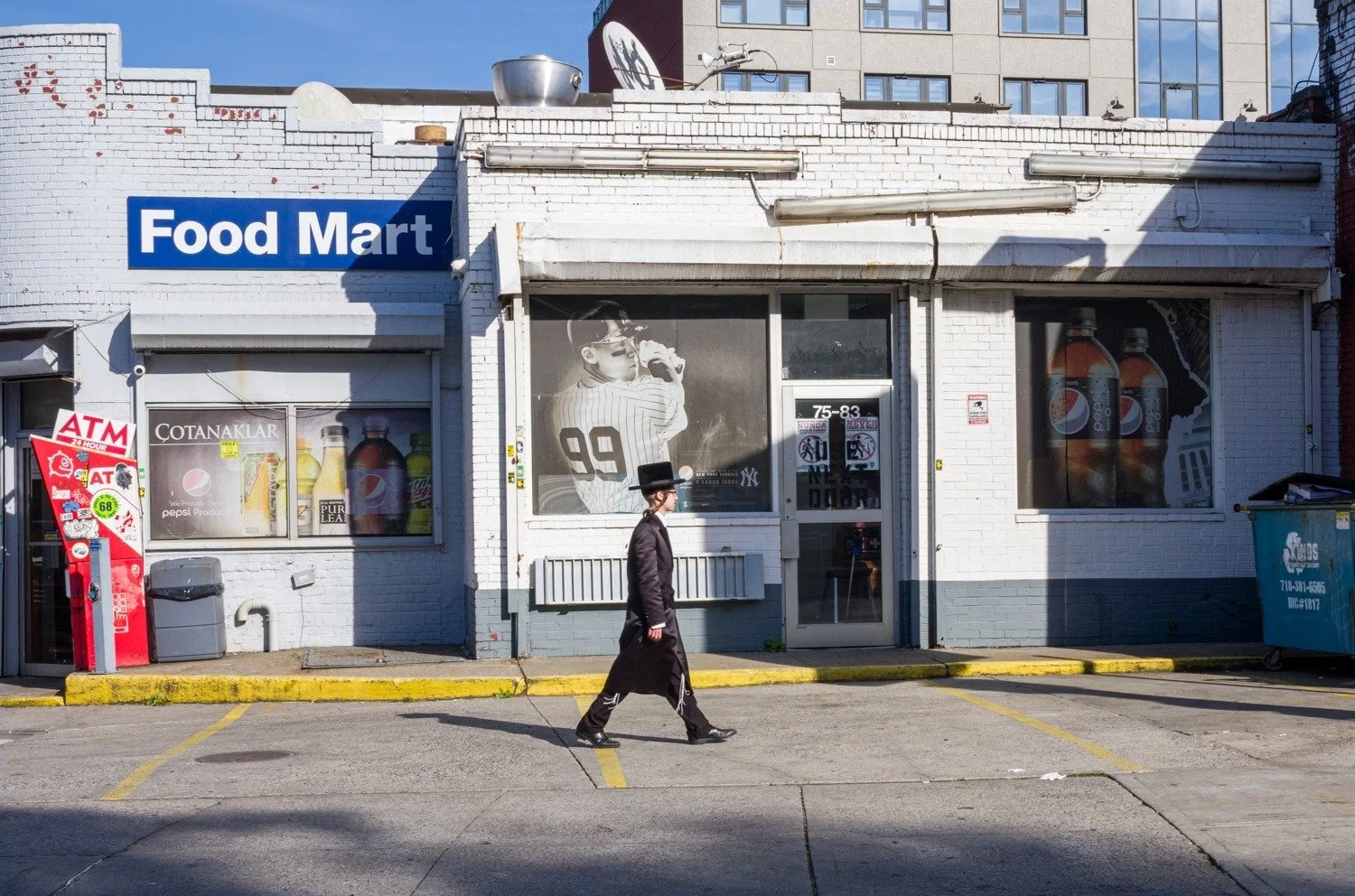
Lopes opened the car window and composed quickly with a 50 mm lens. A man in a black hat and a long black coat walked past a corner shop full of signs. At first, Lopes made the picture black and white.
Then Steve McCurry asked about the yellow curb.
At a workshop critique, McCurry wanted to see the colour version. Lopes went back to the original file from his Leica M10-R. He found yellow, red and blue all through the frame.
Today he prints it in colour.
In this story, Lopes explains how he composed the frame from a car, what McCurry said after twenty seconds, and how the picture taught him to appreciate colour.
At a red light
Raf Lopes was in an Uber with his friend Brian. They were on their way to a photography event in Brooklyn.
The car drove through a neighbourhood with a large Jewish community. Then it stopped at a red light.
Lopes opened the window and composed quickly. He had a 50 mm lens on his camera. It was not very close and not very far.
“I saw the elements facing me. They were very frontal. The composition was good out of the window.”
On the wall of a corner shop there were many things to read. A poster of a baseball player in a shirt with the number 99. A Pepsi sign on the right. An ATM. The words Food Mart. And an advertisement for Cotanaklar.
In front of all this, a man in a black hat and a long black coat walked along the pavement.
Lopes took three frames.
At first, he made the picture black and white.
“The black and white version is interesting,” he says.
The colour version
Later, he showed it at a workshop with Steve McCurry, during the photo critique.
“I know Steve loves colour. He asked me if I had the colour version, because he knew the curb was yellow. Curbs are yellow. Even when he looks at something in black and white, he can guess the colour of some elements. He said he was interested to see the colour of the ATM and the other elements in the photo.”
The camera was a Leica M10-R. It is not a monochrome camera, so the colour was still there in the original file. Lopes went back to his archive.
“When I restored the colours, I was like, holy cow. I didn’t see that we have primary colours. We have the yellow, we have the red, the blue.”
The yellow is on the curb and on drinks in the shop window. The blue is on the Food Mart sign and on a trash can on the far right. The red is on the warning signs and the ATM.
“There are three things communicating in the composition. The shadow of the man is not in conflict with anything.”
At the workshop, McCurry looked at the photograph for about twenty seconds.
“He said, this is perfect. And someone even joked, oh, you got the first perfect of the day.”
Printed in colour
Today the photograph exists in colour. Lopes had sold prints of it in black and white. Now he prints it in colour, in A3 on matte fine art paper.
He also sees another detail. The baseball player on the poster and the man on the street face the same direction.
“They are almost looking at the same point. It gives the impression that they have the same goals.”
The picture changed how he thinks about colour.
“I still haven’t found my visual identity. This photo was in black and white, and all my other photos were in colour. This taught me how to appreciate colours in a photo.”
He is also glad he made more than one frame. There is one before and one after.
“It is like a little time capsule that only you can go back to. The reality behind the perfection. I’m not saying my photo is perfect, far from that. But you get the idea.”
At a red light in Brooklyn, Raf Lopes had time for three frames through the car window.
He first made the picture black and white. When he went back to the original file, he found yellow, red and blue spread across the frame.
“When I restored the colours, I was like, holy cow. I didn’t see that we have primary colours.”Raf Lopes
Black and white can hide the colours that hold a picture together. Which of your black-and-white pictures would you look at in colour?
More stories:
A red light gave Raf Lopes three frames. Lopes opened the car window and composed quickly with a 50 mm lens.