(This is the story behind the photograph, a glimpse into the moment, the process, and the vision that brought it to life.)
Thousands of years of climate history survive inside this ice.
Scientists can read layers in glacier ice almost like the rings of a tree. Small bubbles trapped inside can preserve information about the atmosphere from thousands of years ago. For climate scientists, ice cores have become an important way to study the planet’s past. For Tristan Duke, they also became material for making photographs.
But one piece of ice was different.
It came from the Northern Ice Field of Mount Kilimanjaro and contained a layer of dust connected to a major drought around 4,200 years ago. Duke placed this ice directly onto photographic paper inside a freezer kept at about -40°C and exposed it with a flash. What appeared on the paper was not only the shape of the ice, but also some of the layers hidden inside it.
This is how Duke turned a climate record into a photograph.
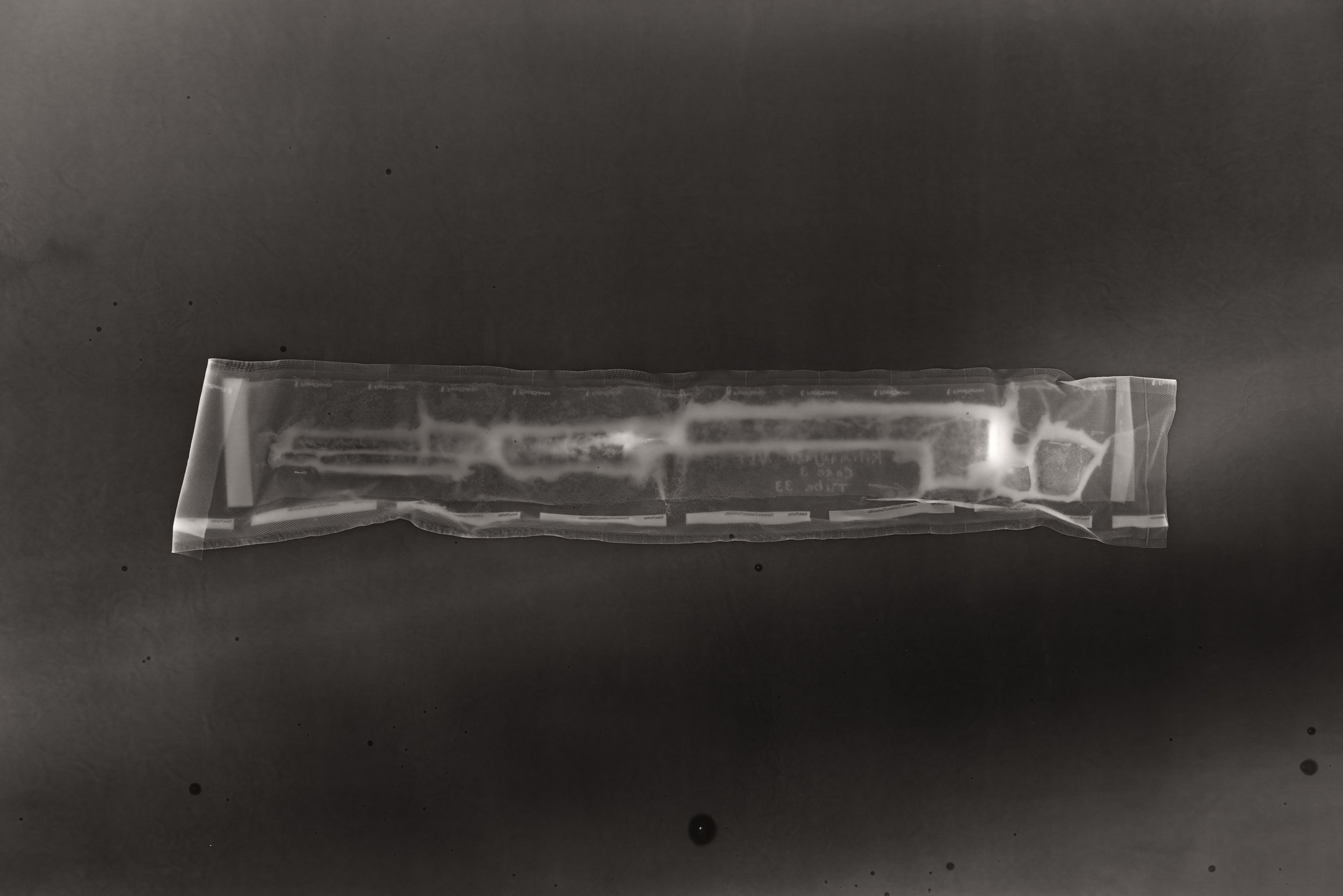
In 2024, Tristan Duke made a photograph without a camera.
The image, titled Ice Core Study 11 (Negative): Byrd Polar, Kilimanjaro Northern Ice Field Core (Detail), was made by placing sections of glacier ice directly onto a large sheet of photographic paper. The final gelatin silver photogram measures 42 by 100 inches.
Duke began working with ice cores after photographing the effects of wildfires. His interest in climate change took him into climate science laboratories, where researchers study ancient glacier ice to understand how the Earth’s climate has changed over hundreds of thousands of years.
“After the wildfire work, I started visiting climate science laboratories, places where people are studying, particularly glacier ice, to try to understand our planet’s climate past in order to build the kind of predictive models that they use to predict our climate future.”
Glaciers form slowly as new snow falls on top of older snow. Over time, these layers become compressed into ice. Scientists can drill deep into a glacier and remove long cylinders called ice cores. The layers inside them can be counted and studied in a similar way to the rings of a tree.
Some ice cores contain a record reaching back hundreds of thousands of years.
“In these cores, when they drill through the Greenland ice sheet, for example, a single cross section of the entire glacier can be maybe two miles long. so this span, this cross section with all of its layers represents about 850,000 years of accumulation.”
Small bubbles of air remain trapped inside the ice. Scientists can analyse them to find information about the atmosphere at different moments in the past, including the amount of carbon dioxide it contained.
Duke wanted to make photographs from this material itself.
To do that, he had to bring the darkroom into the place where the ice was stored.
“And I have to actually build a darkroom in the freezer laboratory, in the storage facility where they keep these ice cores. And by the way, it’s very cold. They maintain these freezers at about negative 40 degrees Celsius. So quite cold.”
Inside the freezer, Duke created a temporary space protected from light. He placed a large sheet of photographic paper on the floor. Sections of ice core were then arranged directly on its surface.
There was no camera between the ice and the image.
“And then I held my camera flash, my strobe up above the, you know, the paper and flashed the whole thing. So it’s a camera-less image. It’s a photogram.”
A photogram is made by exposing light-sensitive paper while an object sits directly on or close to its surface. Opaque objects normally block the light and leave their shape behind.
Ice behaves differently.
Because it is transparent and translucent, some of the flash travels through it before reaching the paper. The resulting image therefore records more than the outer shape of the core.
“But what’s really fascinating is that it doesn’t just record the silhouette of the cores because the ice is transparent, translucent. You actually get also light moving through the ice and you actually can see the annual layers, those strata that I was talking about that the scientists are studying.”
In Ice Core Study 11, one section came from the Northern Ice Field of Mount Kilimanjaro in Africa.
Inside it was something unusual.
A dark band of dust, about an inch thick, ran through the ice. In Duke’s negative photogram, this dark material appears as a lighter band.
The layer represents around one hundred years of dust accumulation. According to Duke, scientists connect it to a long drought that happened around 4,200 years ago, known as the 4.2 kiloyear event.
“So this is a record of this terrible, period of like a hundred year drought that occurred about 4,200 years ago. scientists now connect this event, it’s called the 4.2 kilo year event. They now believe that it was this drought that caused the collapse of the old kingdom in Egypt and the sort of desertification.”
For Duke, the history contained in this small piece of ice became even more significant because of what had happened since scientists collected it.
The glacier it came from was no longer there.
“And to make matters even more sort of poignant, that particular ice core that I was working with, which was collected by scientists from the northern ice field, the Kilimanjaro northern ice field, is in fact the only surviving ice core sample from that entire glacier because since they collected it, that glacier has melted completely. It’s gone now.”
What had begun as scientific material had become something else as well. A piece of the glacier now survived inside a laboratory freezer in Ohio.
Duke began to think of it as a glacier being kept alive.
“And so, you have this, I kind of think of it almost like a glacier on life support in a way. This little sliver of ice that’s kept in this laboratory freezer in Ohio, which of course these freezers are running on fossil fuel, right? To keep it alive is the last vestige, the last piece of this once massive glacier.”
The photograph holds several periods of time on the same sheet of paper. The dust inside the ice records a climate event from thousands of years ago. The ice itself comes from a glacier that, according to Duke, has since disappeared. The photogram records the physical object that remains.
A flash of light lasted only a moment.
The material placed beneath it had been forming for thousands of years.
“And the fact that it records this ancient fall of civilization in ancient times due to a climate crisis just makes it all the more relevant.”

Sometimes the best project begins when the first idea fails. You arrive with a plan, but what you find does not fit it. Story Behind The Photograph