Speed Graphic


This page shows a 3D model of a press camera for sheet film. It needs WebGL. Here is a picture instead.
Two shots at the news
The Pacemaker Speed Graphic is a press camera for 4 by 5 inch sheet film. It was made in Rochester, New York, from 1947 to 1970.
Its makers did not start with cameras. In 1887 William F. Folmer and William E. Schwing went into business together in New York City. By the 1890s their catalogue showed cameras. In 1905 George Eastman bought the company and moved it to Rochester.
The first Speed Graphic came out in 1912. The word Speed stood for its second shutter, a curtain in the back of the body that could give 1/1000 of a second.
From the 1930s through the 1950s this was the main camera of press photographers. A film holder carries two sheets, so a photographer had two pictures before reaching for the next holder. Sam Shere photographed the burning Hindenburg in 1937 with one. “I had two shots in my big Speed Graphic,” he said later.
The Pacemaker of 1947 made the work shorter. The release moved to the body of the camera. The back shutter got six speeds that you read directly, where older models had 24. The lenses were coated.
Nothing in the camera was automatic, and every picture took several steps by hand. In the 1960s press photographers moved to the Rolleiflex and then to 35 mm cameras.
Two shutters, four ways to look
The front of the body is a door. It folds down and becomes a bed with a track. The lens stands on the track, joined to the body by a bellows. Two knobs move it forward and back to focus.
There are two shutters. One sits in the lens and gives 1 second to 1/400. The other is a curtain just in front of the film. It has openings of different widths and runs from top to bottom. A selector by the release picks which shutter fires.
You can look in four ways. A wire frame and a tube finder on top are for fast work. The rangefinder on the side shows two images that join when the focus is right. The ground glass at the back shows the exact picture, upside down.
The film sits in a holder with a sheet on each side. You pull out the dark slide, take the picture, push the slide back and turn the holder over. A flash bulb works once and then has to be changed.
- Made
- 1947 to 1970
- Maker
- Graflex, Rochester, New York
- Film
- 4 x 5 inch sheet film, two sheets in a holder
- Lens
- 135 mm f/4.7
- Front shutter
- Leaf shutter, 1 s to 1/400 s, B and T
- Back shutter
- Focal-plane curtain, 1/30 s to 1/1000 s and T
These photographers worked with a Speed Graphic. In most cases it was not this exact model, but a camera of this type.
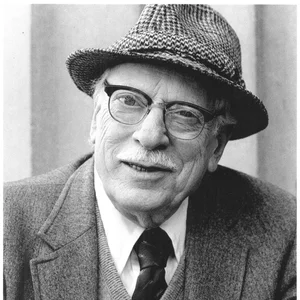 Joe RosenthalIwo Jima, 1945
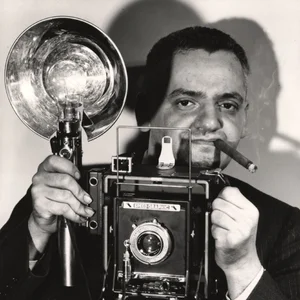 WeegeeNew York, 1930s and 1940s
262 parts, built only from code. The plates read About Photography, not the maker's name. Facts come from the maker's instruction books. Sizes are taken from public photographs. Parts inside are shown in a simple form, and the slit widths are worked out, not measured. The marks of use are invented. The scene is a drawing after the Old Town Square in Prague. Exposure values and the night are examples. Sounds are made by code, not recorded.