AT A GLANCE
- Known for
- Very large color photographs of stores, crowds, stock exchanges, buildings and landscapes, often seen from far away or from above
- Works in
- Color; since the early 1990s he edits and combines his images on the computer
- Camera
- Large-format cameras in his earlier work; today digital cameras, a computer, a tablet and a smartphone
- Also
- Student of Bernd Becher in Düsseldorf; solo show at MoMA (2001); auction record for a photograph (2011)
- Start with
- Andreas Gursky (Steidl / Hayward Gallery Publishing, 2018)
- Links
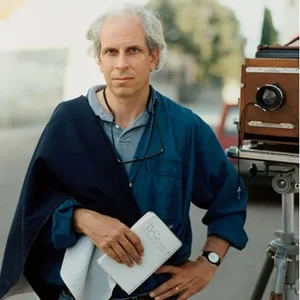
Andreas Gursky (born 1955) is a German photographer who grew up in Düsseldorf. He is known for very large color photographs of architecture, landscapes and contemporary life, often taken from a high viewpoint. In 2011 one of his prints, a photograph of the river Rhine, became the most expensive photograph ever sold at auction.
The story
In 1984 Andreas Gursky took a picture on a trip in the Swiss Alps. It showed a wide mountain slope. He did not think it was any good. In fact, he says, it was a photo he “initially wanted to reject.”
Months later the film was developed. Only then did he notice the tiny hikers spread across the mountainside. “It was surreal and bizarre how the people fitted into the landscape and the composition was so balanced,” he said. The picture had come about “more or less by accident on a trip.” Still, it gave him a new direction. “That’s when I began to think about people in their socially constructed environments.”
Photography was already part of the family. Born in Leipzig in 1955, Gursky is the son of the photographer Willy Gursky and the grandson of Hans Gursky, also a photographer. By the end of 1957 the family had moved west, and he grew up in Düsseldorf, where his father was a successful commercial photographer. From 1978 he studied photography at the Folkwang school in Essen. In 1981 he joined Bernd Becher’s class at the Kunstakademie Düsseldorf, and in 1987 he became a master student there.
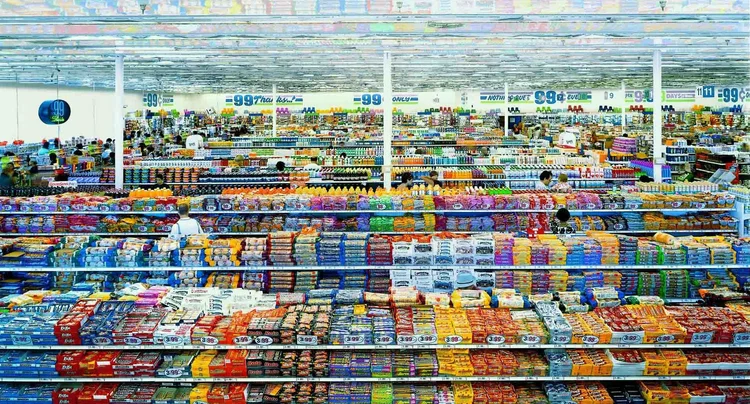
Those small figures in a big landscape became his subject. He kept his distance, often working from high above. From the early 1990s he also used the computer to edit his images. His 99 Cent pictures were made in a 99 Cents Only store on Sunset Boulevard in Los Angeles. In the two-part version from 2001, the image was digitally changed to reduce perspective, so the shelves of goods fill the frame like a plan.
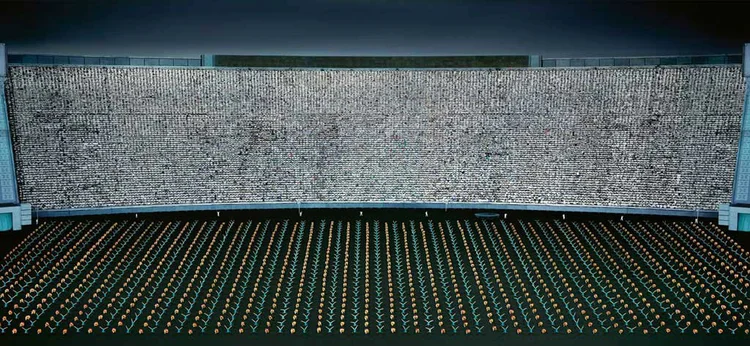
In 2007 he went to the Arirang Mass Games in Pyongyang, North Korea. More than 50,000 performers move in tight patterns. Behind them about 30,000 schoolchildren hold colored cards that form one huge, changing picture. Again, each person is tiny, and the whole is enormous.
Today his large pictures take great technical effort. Yet they still start the way that Alpine photo did, with something he saw and almost passed by. “The motifs are almost always based on visual experiences,” he says.
The work


- 1955Born on 15 January in Leipzig
- 1978Starts studying photography at the Folkwang school in Essen
- 1981Joins Bernd Becher’s class at the Kunstakademie Düsseldorf
- 1984Takes the Alpine photo with tiny hikers that changes his direction
- 1987Becomes a master student (Meisterschüler)
- 1988First solo exhibition, Galerie Johnen & Schöttle, Cologne
- 2001Solo exhibition at the Museum of Modern Art, New York
- 2011A print of his Rhine photograph sells for $4.3 million, an auction record
- 2018Retrospective at the Hayward Gallery, London
Lessons
Look again at your rejects. He wanted to throw away the 1984 Alpine picture. Months later he saw the tiny hikers, and it changed his work.
Step back. Many of his pictures are taken from far away or from above. From a distance, people and things become patterns.
Keep a visual memory bank. He collects pictures from print media as reminders, then decides which ones are worth turning into a photograph.
Try this: open your photos from one year ago and look only at the ones you skipped. Pick three. Look for small details you missed at the time, then go back to one of those places and photograph it from much farther away.
Gear
Gursky has never been tied to one camera. He says he wants to use the latest technology, but he has not lost sight of analog photography.
Large-format camera: his earlier pictures were made with large-format cameras, which record very fine detail for big prints.
Digital camera: today he works with digital cameras, together with a computer, a tablet and a smartphone.
High viewpoints: to get his views from above he has worked from elevated platforms and cranes. He made Bahrain I from a helicopter.
Digital editing: since the early 1990s he edits and combines images on the computer to build the final picture.
Books
Andreas Gursky (Steidl and Hayward Gallery Publishing, 2018). Made for his first big retrospective in the UK, at the Hayward Gallery in London in 2018. The large hardcover in a slipcase has 168 pages and about 100 color plates, from early pictures to well-known works such as Paris, Montparnasse, 99 Cent and Chicago Board of Trade III, plus photographs never published before. Gursky talks with the artist Jeff Wall about where his way of seeing comes from. There are essays by Ralph Rugoff, Gerald Schröder and Brian Sholis, and personal memories by the artist Katharina Fritsch, his colleague in Düsseldorf. The best single book to start with.
Andreas Gursky (The Museum of Modern Art, New York, 2001). The catalogue of his MoMA exhibition, organized by chief curator Peter Galassi, which then traveled to Madrid, Paris and Chicago. It is a large-format book with 59 color plates, full-page images and double-page details, so you can see how much happens inside each picture. Galassi’s long essay traces his path from Essen and the Becher class to the big pictures of the 1990s. It also has an exhibition history and a bibliography. Good for readers who want to understand the early and middle work.
Werke – Works 80-08 (Hatje Cantz, 2008). Edited by Martin Hentschel, who also wrote the texts, in German and English. The clothbound book has 272 pages and 174 illustrations. Gursky himself chose more than 150 works, from his student days in Essen and the Becher class in Düsseldorf to new pictures made for the book. It went with exhibitions in Krefeld, at the Moderna Museet in Stockholm and at the Vancouver Art Gallery. A wide overview for anyone who wants to follow his work over almost thirty years. It is out of print, so look for a used copy.
Bangkok (Steidl, 2012). A focused book on one series, edited by Beat Wismer, with texts by Hans Irrek, Beat Wismer and John Yau. Across 112 pages, the pictures show the water of the Chao Phraya River in Bangkok. At first the shiny surface looks like abstract painting. Then you start to see floating litter. For readers who like his quieter, more abstract side.