AT A GLANCE
- Known for
- Typologies: grids of water towers, blast furnaces, cooling towers, winding towers and gas holders, shot the same way, side by side
- Works in
- Black and white, large format negatives, gelatin silver prints
- Camera
- An old wooden 5x7 view camera at first; later two large format cameras, one for each
- Also
- Bernd was the first professor of photography at the Kunstakademie Düsseldorf (1976); their students became the Düsseldorf School; New Topographics (1975)
- Awards
- Golden Lion, Venice Biennale (1990) · Erasmus Prize (2002) · Hasselblad Award (2004)
- Start with
- Bernd & Hilla Becher (The Metropolitan Museum of Art, 2022)
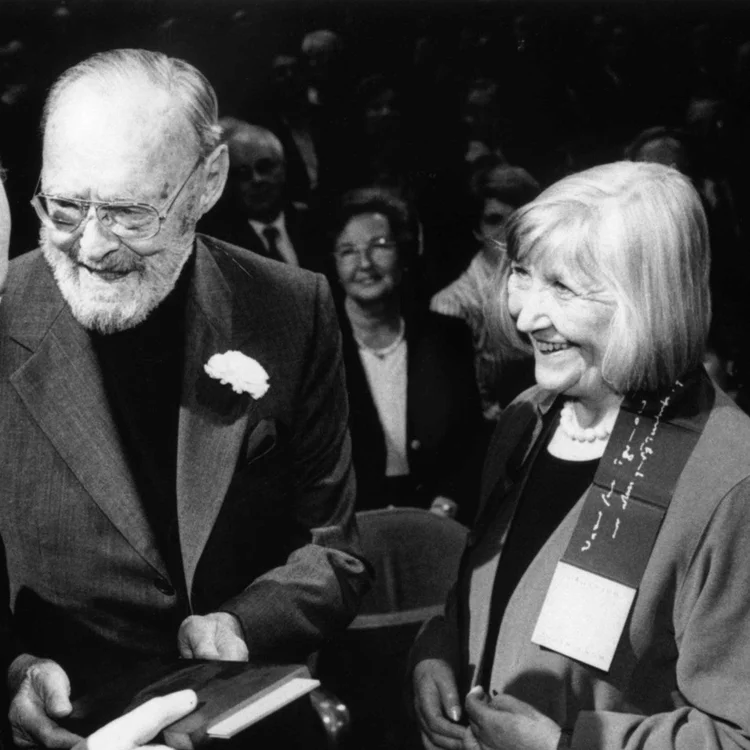
Bernd and Hilla Becher were a German artist couple. Bernd was born in Siegen in 1931, Hilla in Potsdam in 1934. From 1959 they worked together for almost fifty years. With a large camera they photographed old industrial buildings in Europe and North America: water towers, blast furnaces, cooling towers and gas holders. They showed the pictures in strict grids and called them typologies. Bernd also became the first professor of photography at the Kunstakademie Düsseldorf, and their students shaped a whole generation of German photography. The Met says they are widely considered the most influential German photographers of the postwar period. Bernd died in 2007, Hilla in 2015.
The story
The drawings were too slow. In the 1950s Bernd Becher sketched and painted the mines and blast furnaces of the Siegen region, where he grew up. His grandfather and his uncles had worked in these iron ore mines and furnace plants. But the industry was dying, and the plants were closing. While he drew, they tore them down. So he bought a small camera from a friend and took little pictures, just to remember. Later he decided that photography could do the job better than his pencil.
Hilla Wobeser came to the same buildings from another side. She grew up in Potsdam, among palaces and parks. Her mother was a photographer, and an uncle gave her his darkroom. She trained at the Lette-Verein in Berlin, and in 1951 she began an apprenticeship with the Berlin photographer Walter Eichgrün. Then she got a job in Düsseldorf. The Ruhr area amazed her. In her words, “The pot was still cooking.” Steel, she felt, was a wonderful subject for black and white.
In 1957 the two met in Düsseldorf. From 1959 they worked as a team, and in 1961 they married. They started near Siegen, because they could stay with Bernd's parents there. They photographed the miners' houses, and at the same time the blast furnaces, the preparation plants and the winding towers.
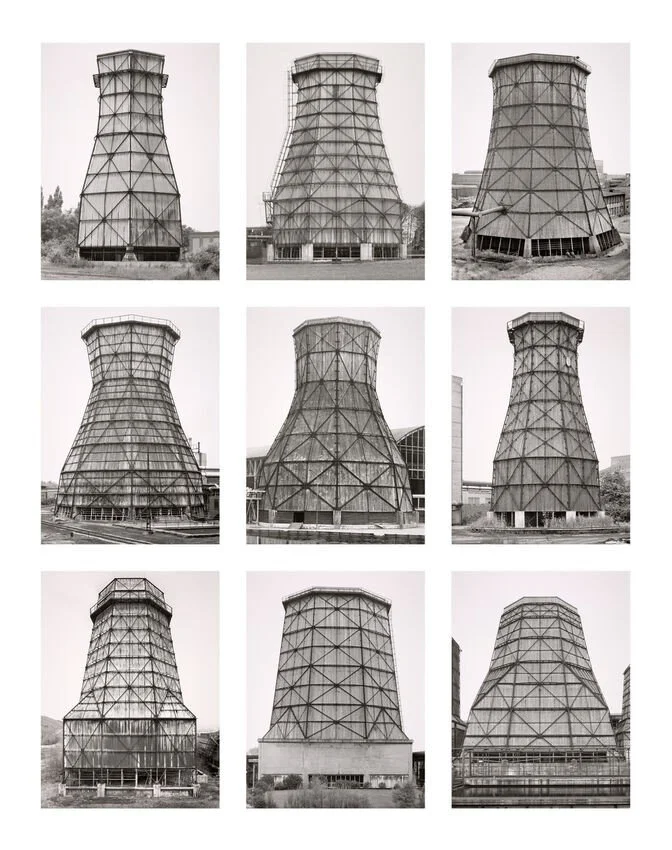
Then came a small moment on the floor. One day they laid out three pictures of cooling towers on their white floor. Hilla later remembered what happened: “They started to dance.” Something changed when the pictures lay side by side. That was the start of their grouping. Years later, grids like Cooling Towers, Germany grew out of that idea.
Money was short. For years they worked with an old wooden 5x7 camera and old lenses, and Hilla thinks they had only four film holders. Still, they kept going. In 1966 a stipend from the British Council took them to England and South Wales for six months. It was their most intense period of work so far. In 1972 Ileana Sonnabend showed them in her New York gallery, and she encouraged them to work in America too.
In a 2008 interview for the Getty Museum, Hilla put their way of working simply: “If you do what you’re really interested in, then nothing can go wrong.”
The work
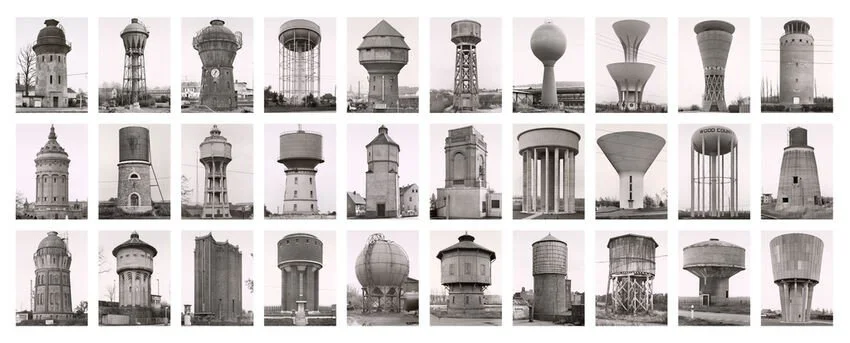
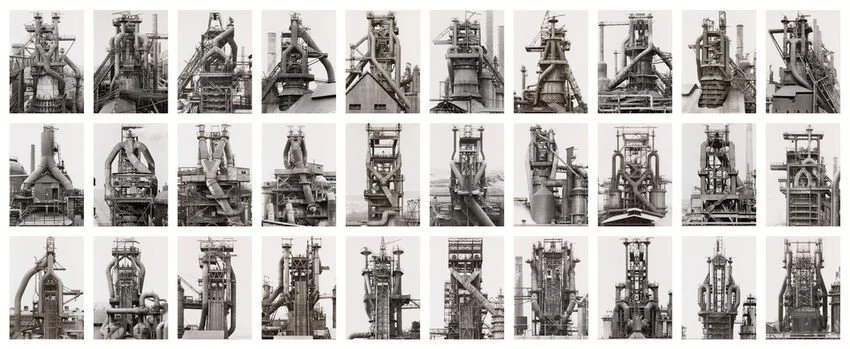
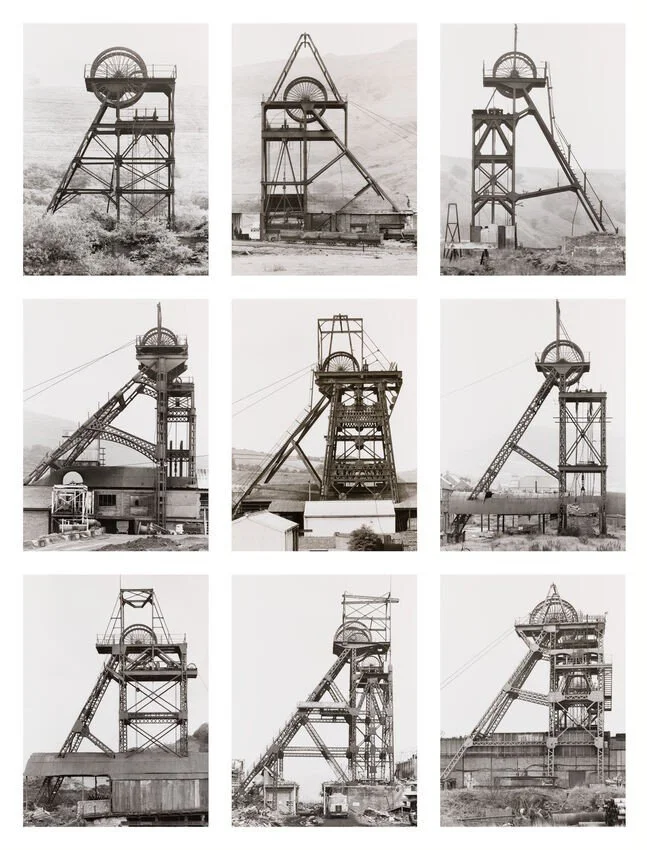
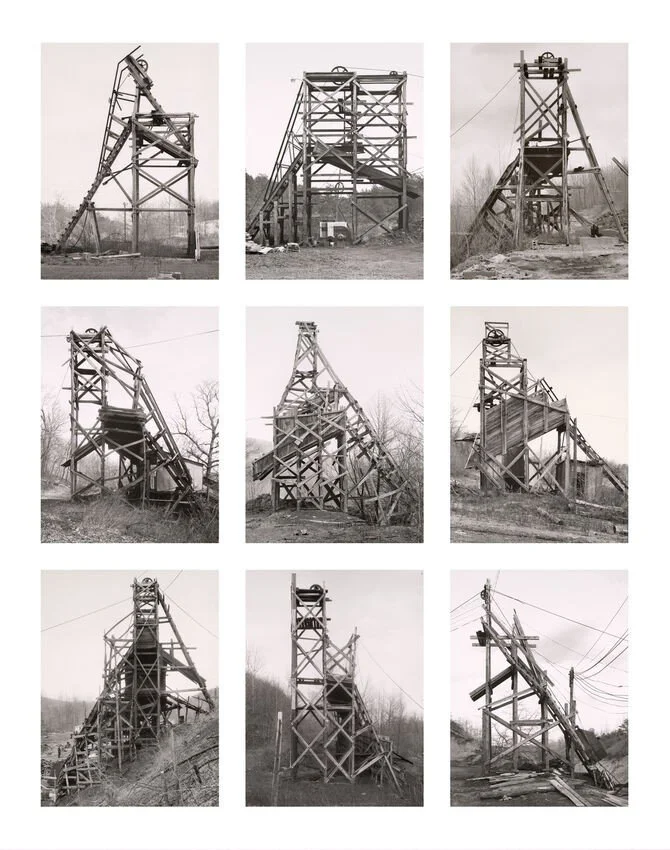
The rules were strict. Every building was framed the same way: from the front, alone, from a fair distance, under a gray sky, with no people. Hilla explained why. To compare pictures, they must be free from moods, so “no bright sunshine, no snow, no moonlight.” They hung the prints in grids of nine, twelve or sixteen and called them typologies. The buildings themselves they called anonymous sculpture, and their 1970 book carried that title.
Some subjects were easy. A water tower is round, so one view is enough, as in Water Towers, Germany, United States, France, Belgium, Luxembourg. Blast furnaces were Hilla's favorite, and the hardest. At first she wanted to give up, because she could not find order in the chaos. In the end they learned to see a front, a back and a side. Blast Furnaces, United States, Germany, France, Luxembourg, Belgium shows the result. Not every idea worked. Bernd wanted a series of thin chimneys, but Hilla felt they looked like pencils in the landscape, and they let it go.
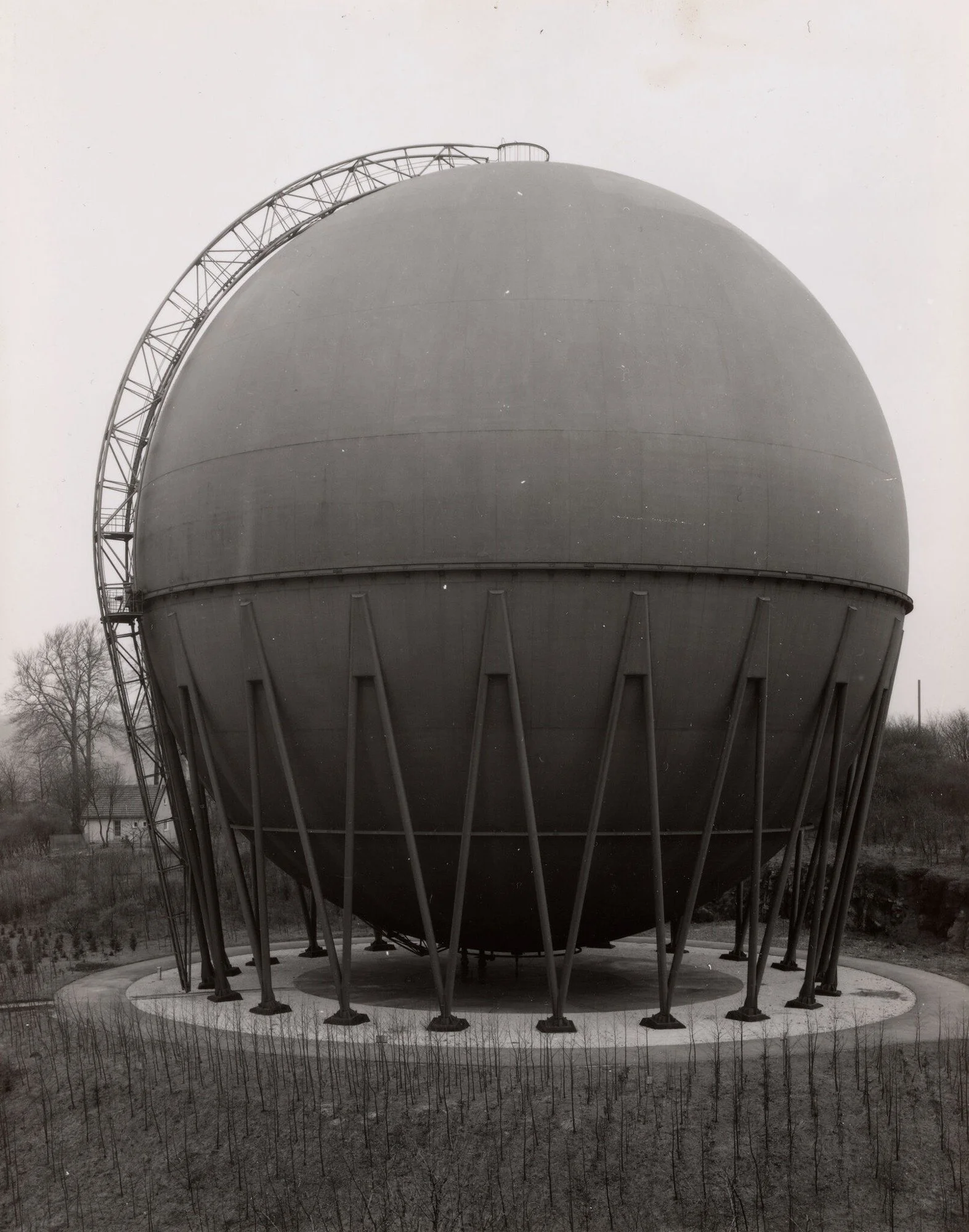
They travelled together and, as soon as they could, used two cameras. Each took a favorite view, and they helped each other climb the furnaces and fix the tripods. Hilla did most of the printing. Their early pictures include Gas Holder, Wuppertal, from the 1963 portfolio Industrial Buildings. The British trip led to Winding Towers, United Kingdom, and later trips to America to Coal Mine Tipples, Pennsylvania, United States.
In 1975 they were part of New Topographics at George Eastman House, next to Robert Adams and Stephen Shore. In 1976 Bernd became the first professor of photography at the Kunstakademie Düsseldorf, and he taught there until 1996. Students such as Andreas Gursky, Thomas Struth, Candida Höfer and Thomas Ruff became known as the Becher School or Düsseldorf School. Today the couple's print archive is kept by Die Photographische Sammlung/SK Stiftung Kultur in Cologne.
- 1931Bernd Becher is born in Siegen; Hilla Wobeser follows in 1934, in Potsdam
- 1959They start working together, two years after meeting in Düsseldorf
- 1963First gallery show, at Galerie Ruth Nohl in Siegen
- 1966Six months in England and South Wales with a British Council stipend
- 1975Part of New Topographics at George Eastman House
- 1976Bernd becomes the first professor of photography at the Kunstakademie Düsseldorf
- 1990Golden Lion at the Venice Biennale
- 2007Bernd dies in Rostock
- 2015Hilla dies in Düsseldorf
Lessons
Stay with one subject. The Bechers photographed industrial buildings for almost fifty years. Hilla believed you learn only by going deep: “If you just photograph around a little here and little there, you don’t learn anything.”
Take the mood out. They chose gray skies and the same frontal view every time. Without sunshine or snow, the pictures can be compared, and the shapes of the buildings become the story.
Put pictures side by side. Their typologies began with three cooling towers on the floor. A single picture shows one thing. A group shows what is the same and what is different.
Try this: choose one kind of object near your home, for example doors, bus stops or garages. On a cloudy day, photograph nine of them from the front, from the same distance and the same height. Print them small and lay them out on a table in a grid of three by three. Move them until the grid starts to work.
Gear
The Bechers never had much money for equipment. What the sources say is short.
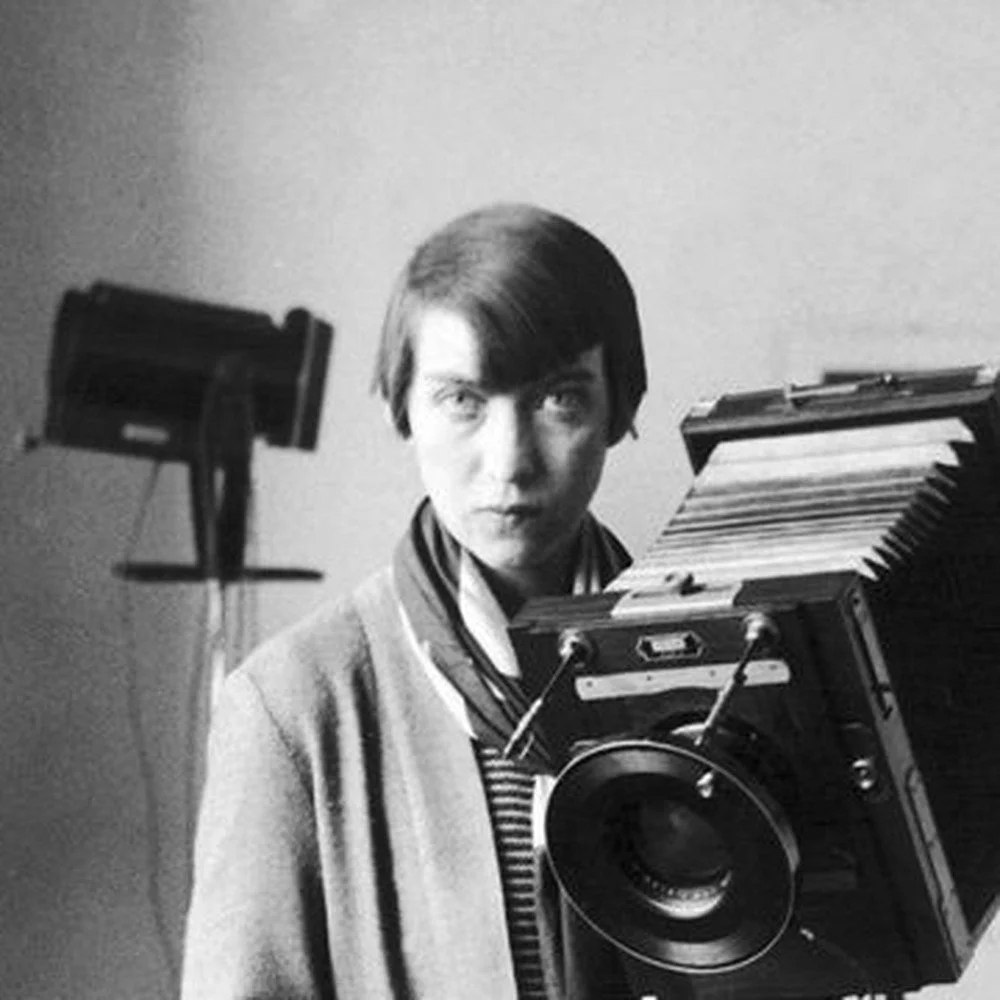
Large format view camera: In the early years they used an old wooden 5x7 camera with old lenses, maybe with only four film holders. The Met notes that they always preferred a large view camera to a handheld 35mm camera. Later they each had a camera.
Tripod: Hilla remembered helping Bernd climb the blast furnaces and fixing the tripod to whatever they could find.
Black and white film: They worked only in black and white. Hilla said metal, and steel above all, is a wonderful subject for black and white photography.
Books
Bernd & Hilla Becher (The Metropolitan Museum of Art, 2022). The first monograph published after both artists had died, made for the retrospective at The Met and SFMOMA and distributed by Yale University Press. Texts come from Gabriele Conrath-Scholl, Virginia Heckert and Lucy Sante, with an interview with their son Max Becher. Besides the typologies, it shows Bernd's early drawings, Hilla's own photographs and pages from their notebooks. The best start for anyone who wants the whole story.
Typologies of Industrial Buildings (MIT Press, 2004). Edited and introduced by Armin Zweite. The book holds more than 1,500 black and white pictures, arranged in grids as the Bechers wanted. Each chapter covers one type of building, such as winding towers, preparation plants or cooling towers, with dates and places on the facing page. It is a book for slow looking and for anyone interested in series and comparison.
Bernd & Hilla Becher: Life and Work (MIT Press, 2006). Written by Susanne Lange of Die Photographische Sammlung/SK Stiftung Kultur in Cologne, the institution that keeps the Bechers' archive. It tells how the couple worked and how their ideas grew. A good choice for readers who want to understand the method behind the grids.
In their words
“We didn’t really see it as artists, we saw it as something like natural history.”
“The Typology is nothing but comparing and giving it a shape, giving it some sort of possibility to be looked at.”
“We simply made a start, not knowing exactly where we would end up.”
“If you just photograph around a little here and little there, you don’t learn anything.”
“It has to swing. It has to work together in an almost dancing way.”