Welcome to this edition of [book spotlight]. Today, we uncover the layers of 'Counter Culture,' by Karla Murray and James Murray (published by Prestel Publishing). We'd love to read your comments below about these insights and ideas behind the artist's work.
New York’s diners are disappearing faster than we notice.
Rising rents, gentrification, and higher operating costs are forcing many of these places to close. For more than 30 years, Karla and James Murray have photographed the small businesses that give New York its character. Their new book, Counter Culture, focuses on 30 Manhattan diners and luncheonettes that are still holding on. It is a story about food, memory, community, and the places people often value only after they disappear.
A diner is more than a place to eat.
It can be a meeting point, a workspace, a refuge from loneliness, or a place where several generations build shared memories. In Counter Culture, the Murrays look beyond chrome counters, neon signs, and old menus to show why these spaces still matter to the life of the city. Their photographs preserve not only how the diners look, but also the role they continue to play in their neighbourhoods.
The interview shows how patience, timing, attention to small details, and a clear sense of what matters can turn a familiar interior into a stronger story. It offers practical ideas for anyone trying to photograph a place before its atmosphere, history, or identity is lost.
Remedy Diner, 245 East Houston Street, Lower East Side © James T. & Karla L. Murray, 2026
The Book
Counter Culture: New York City’s Greatest Diners and Luncheonettes by James T. and Karla L. Murray, with text by Emma Orlow, is published by Prestel. The book presents 30 of Manhattan’s most loved diners and luncheonettes through exterior photographs, intimate interiors, and small visual details that reveal the character of each place. Alongside the photographs, Orlow’s profiles share the stories of the owners and explain how these businesses became important parts of their neighbourhoods. The book also looks at the growing pressure of gentrification, rising rents, and operating costs, which continue to threaten many of these affordable and inclusive spaces. (Penguin Random House, Amazon)
Project Genesis: What made you choose Manhattan's diners and luncheonettes as the subject for your next book after bars and record stores?
We have been photographing small, independently owned shops, restaurants, and bars in New York for over 30 years, as we truly believe they are what makes each neighbourhood of the city unique, vibrant, and culturally diverse. However, one type of place we have photographed extensively, and which we have the most personal and deep connection to, are the diners and luncheonettes of New York City. Diners and luncheonettes are true New York neighbourhood institutions, just as essential and synonymous with the city's landscape as the Statue of Liberty, the Empire State Building, and the Brooklyn Bridge. They represent New York and its diverse areas and culture, and although often viewed as endangered, they somehow have survived as true inspirational success stories.
New York City diners and luncheonettes act as community centres, gathering places, and “third spaces” outside of home or work, where the avenue of affordability intersects with the street of convenience. Like the bars and vinyl record shops we featured in our Great Bars of New York City and VINYL NYC books, they foster a sense of belonging and are true melting pots. They’re also open whenever you need them: Luncheonettes start the day, while diners are the last stop before bed late at night. Just like the city outside, something is always happening, or about to happen, among their Formica counters and tabletops. Neighbours or friends who haven’t seen each other in a while can catch up over bottomless mugs of hot coffee along with stacks of butter and syrup-soaked pancakes, thick-cut French toast, waffles, or eggs of any style. Diets don’t matter, dismissed by concerns of speed, value, and taste.
The people at the next booth or stool are as diverse as the city’s crowded 5 train. Construction workers sidle up alongside attorneys, writers, cabbies, doctors, fashion models, and CEOs. Young, old, rich, poor, cheerful, grumpy, all join in the spectacle of the breakfast, lunch, or dinner rush that takes place each and every day, sometimes twenty-four hours a day.
Despite their importance, many traditional diners and luncheonettes are disappearing due to gentrification, rising rents, coupled with the increasing costs of staples such as eggs, sugar, and milk, as well as the low profit margins they typically operate on. As an endangered species in New York, our photographs speak to the importance of supporting such affordable and inclusive spots before they vanish.
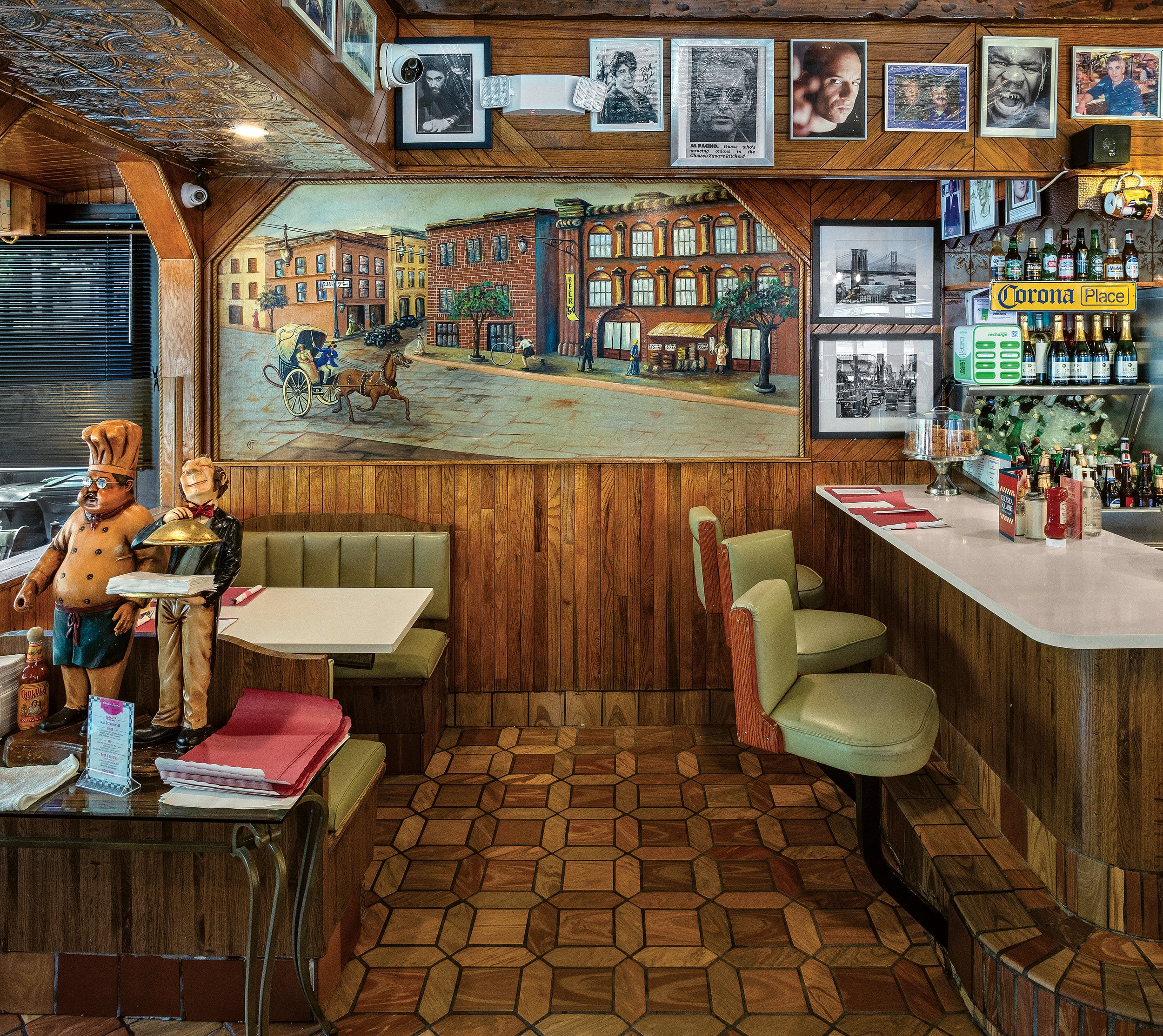
Chelsea Square Diner (interior), 368 West 23rd Street, Chelsea © James T. & Karla L. Murray, 2026
Access and trust: How do you convince a busy diner owner to let you photograph during work hours without disturbing customers?
When we first compiled a list of diners and luncheonettes to include in our book, we thought about the difficulties we would face when photographing the spaces which are very busy as well as the ones which are open 24 hours a day, as we knew from the start that we did not want to include customers in any of our photos. This was for two reasons: not only did we not want to interrupt the flow of business or the customer experience, we also wanted to highlight the beauty of the interior itself and not have customers obscure any of the details.
We also knew we wanted to take our interior photos during the day, as one of the stylistic hallmarks of our photography is that we don’t bring any lighting equipment with us, but instead use existing and/or natural light. This was particularly important in the diners and luncheonettes which have numerous window seats or counters facing the street.
Luckily, having spent lots of time as customers in many of these diners, we knew that there were specific days as well as certain times of the day when the business may be generally less busy, but also that luck would play a huge role as far as timing. We also knew that we could work very fast. Many of the diner owners already knew us and respected our work and our mission to help raise awareness of the importance of small neighbourhood businesses.
After speaking with the owners to obtain permission to photograph the interior, we would explain that we needed only a very short period of time to take our photos (between 10-30 minutes depending on how large the space was) and always specifically asked if they had a preferred day/time when the diner would be less busy. Every single owner had their own suggestion, which we took into account when scheduling our shoot. Some owners and managers even went above and beyond and politely asked customers to move to a different “out of frame” seat so that we could take our photos. On a number of occasions, patience was an absolute necessity as we would wait for tables and counters to empty (sometimes even clearing the tables ourselves) and then quickly take our photographs.
Exterior technique: What is your approach to shooting a storefront so the neon signs and daylight both look balanced in one photo?
We always love to capture the glow of a storefront with a neon sign just after sunset as this is when there is still enough daylight so that you can see the details of the surrounding facade and street but provide enough contrast to allow the neon to pop and the colours to shine brightly.
Interior light: Diners often have mixed lighting, like neon, fluorescent tubes, and window light. How do you handle colour and exposure in these tricky conditions?
As we do not bring any of our own lighting equipment with us for our interior photography and instead only rely on existing and natural light, we took every interior photograph using our DSLR on a tripod, which allowed us to shoot with a lower ISO. We would adjust the shutter speed and aperture manually depending on the lighting conditions in the various parts of the space to achieve the best exposure. Many of the details as well as the colour correction were brought out in post-production using Photoshop.
Thai Diner, 186 Mott Street, Nolita © James, T. & Karla L. Murray, 2026
Composing details: You always look for small details like a menu board or a chrome stool. How do you decide which small object tells the bigger story of a place?
Karla has a natural eye for details and immediately upon entering a room, finds the unique items which capture the essence of the space, whether it is the vintage menu boards and full-service soda fountain with chrome taps at Lexington Candy Shop, or the framed poster of the Seinfeld character Kramer surrounded by a collection of badges by the front window at Tom’s Restaurant, or the yesteryear painting which hangs on the wood-panelled wall adjacent to the dining counter at Chelsea Square Diner. Many small details of these spaces can easily be overlooked by even regular customers, so it was important for us to highlight them in telling the story of each individual diner or luncheonette.
Working as a duo: You and Karla shoot together as partners. How do you divide tasks on location, and how does that teamwork change the final images?
Karla always takes the exterior photography of every storefront as she is very steady and does not mind stepping out into traffic to capture the shot. James generally shoots the overview interior photographs as he has a great eye for symmetry and alignment and since he is tall, can also capture a higher point of view. Karla is responsible for selecting and shooting the interior details as well as the low-angle shots. Having two people or as we like to say, four eyes, helps tremendously especially when having to work quickly.
Waverly Diner, 385 Sixth Avenue, West Village © James T. & Karla L. Murray, 2026
Documenting change: Many of these places face pressure from rising rents and gentrification. How does knowing a place might close soon affect the way you photograph it?
Knowing something may soon close due to rising rents and gentrification does not really affect the way we photograph it, but it does place more of an immediacy to our documentation as it is often a race against time to try and capture these special places before they disappear.
Building the archive: After 30 years of shooting New York storefronts, how do you keep your visual style consistent while still making each new book feel fresh?
We always want our photographs to tell a story, to be immersive and immediately transport you to a certain place and time as well as conjure up a certain mood or emotion. With each new book project, we have strived to not only push ourselves technically but to also make sure that we are capturing the different moods and emotions which properly represent the subject matter, whether it's a colourful storefront on the streets of New York City, a dimly lit corner of a neighbourhood bar or a shiny stainless steel stool at a vintage lunch counter of a beloved diner.
Bigger meaning: Beyond nice pictures of diners, what do you hope people understand about community and memory when they look through Counter Culture?
Diners and luncheonettes have always been melting pots; they’re places where people from all backgrounds and cultures can mingle at the counter and share stories while enjoying a coffee or a meal, and where relationships often start. Above all, in New York City, where millions of people are crowded into a relatively small amount of land but often live in small, isolating apartments, the diner serves as a home away from home, an antidote to loneliness, or even a workspace.
Diners and luncheonettes also act as a kind of safe deposit box for locals, containing memories of first-and last-dates, time spent with friends and family, or hours passed joyously alone, living an Edward Hopper’s Nighthawks dream, each individual’s own version of the city.
Despite their importance to their patrons’ collective memory as well as the community as a whole, diners are becoming increasingly endangered. We hope our book encourages you to support and spend some time at your neighbourhood diner or luncheonette so that they continue to stay in business for many more generations to come. More often than not, they are taken for granted and not seen as integral and vital to both the community and the city’s landscape - until they have disappeared.
And remember, as the late film director David Lynch famously said, “A poet could write volumes about diners, because they're so beautiful. They're brightly lit, with chrome and booths and Naugahyde and great waitresses.”




To discover more about this intriguing body of work and how you can acquire your own copy, you can find and purchase the book here. (Penguin Random House, Amazon)
More photography books?

We'd love to read your comments below, sharing your thoughts and insights on the artist's work. Looking forward to welcoming you back for our next [book spotlight]. See you then!
Catherine DeLattre’s photographs begin with something worth stopping for. Driving through Wayne County, Pennsylvania, she notices isolated houses, trees, and open fields. Photography Book Spotlight