AT A GLANCE
- Known for
- Fashion photographs for Vogue, portraits, and the Big Nudes series (1980)
- Worked in
- Black and white, and color
- Camera
- A small kit: two cameras, each with three lenses, and a flash; Polaroid film for tests
- Also
- Set up the Helmut Newton Foundation in Berlin in 2003; married to the photographer June Newton (Alice Springs)
- Start with
- Autobiography (Nan A. Talese, 2003)
- Links
Helmut Newton (1920–2004) was a fashion and portrait photographer. Born in Berlin, he built his career in Australia, London and Paris, and worked for Vogue for decades. His carefully staged pictures of strong, confident women changed the way fashion looked in magazines.
The story
In 1932 a twelve-year-old Berlin boy took his pocket money to a cheap department store. Helmut Neustädter came out with his first camera. “It was a Zeiss Box Tengor and it cost 3.50 Marks, a roll of film included,” he later wrote.
He went straight down into the underground. Inside the station and the train, he took one picture after another. At Witzleben Station he got out with one frame left and pointed the camera at the Funkturm, the radio tower he had loved as a child. The corner drugstore developed the roll. Only the tower came out. The seven frames from the dark metro were blank, but that did not bother him.
At sixteen he left school to work for Yva, a well-known Berlin photographer. “There followed two exciting years of apprenticeship in her studio at 45 Schlüterstraße,” he wrote. But the family was Jewish, and in 1938 Yva was banned from working. In early December that year, Helmut left Berlin by train from Zoo station, with a ticket to Trieste and a ship bound for China.
The ship stopped in Singapore, and so did he. There he worked for the Straits Times. In 1940 the British authorities sent him to Australia as an enemy alien, to a camp at Tatura. Two years later he joined the Australian army. In 1946 he became Helmut Newton and rented a small studio on Flinders Lane in Melbourne. Soon after, he married June Browne, an actress.
Vogue came next: Australian Vogue in 1956, London in 1957, Paris in 1961. In 1964 French Vogue let him go after he photographed the Courrèges collection for Queen magazine. Five years later he was back, under the editor Francine Crescent, and stayed for many years.
One evening in 1975 he took Yves Saint Laurent’s tuxedo for women, Le Smoking, into Rue Aubriot, a Paris street where he had lived for years. He used no flash, only the street lamps. The model stands with slicked-back hair and a cigarette. It looks like a moment caught by chance, but every detail was planned.
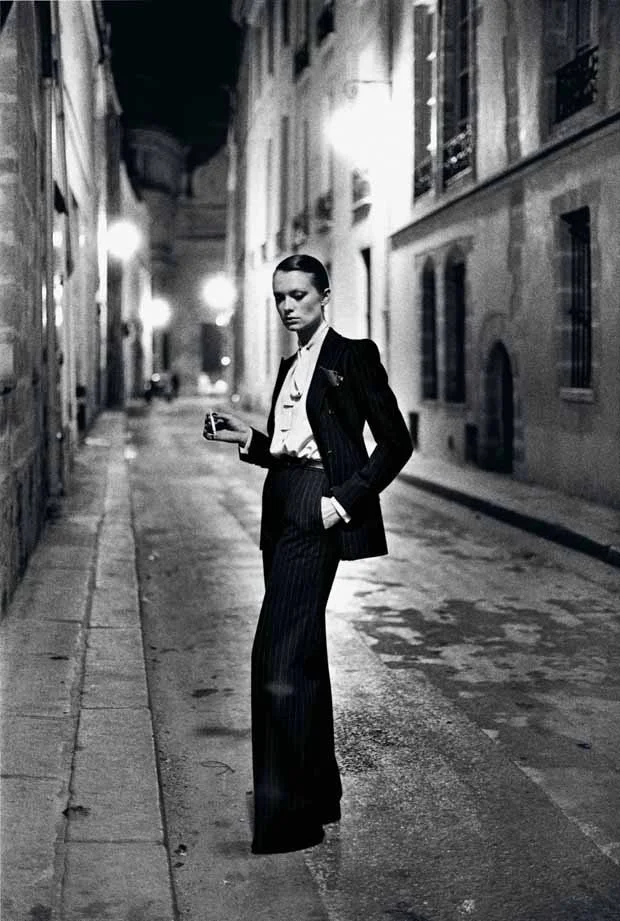
The boy whose metro pictures came out black had learned to make the night work for him. “Even today I love photographing by the light of street lamps or in the hard glare of my flash,” he wrote in 1999.
The work


- 1920Born Helmut Neustädter in Berlin
- 1932Buys his first camera, a Zeiss Box Tengor
- 1936Starts a two-year apprenticeship with Yva
- 1938Leaves Berlin from Zoo station and goes to Singapore
- 1946Takes the name Newton and opens a studio in Melbourne
- 1961Settles in Paris with June and works for French Vogue
- 1975Photographs Le Smoking in Rue Aubriot, Paris
- 2003Sets up the Helmut Newton Foundation in Berlin
- 2004Dies in Los Angeles
Lessons
Keep your gear simple. He worked with two cameras, each with three lenses, and a flash. He did not want to spend time thinking about hardware.
Use the light you find. Rue Aubriot was shot at night with only the street lamps, no flash.
Take the picture outside. He wrote that he did not work well in the studio. Streets, hotels and terraces became his sets.
Try this: make one portrait at night, lit only by a street lamp. Plan the pose and the clothes, then let the street do the rest.
Gear
Newton kept his equipment small and rarely talked about brands. In his own words, he used two cameras, each with three lenses, and a flash.
Box camera: his first camera was a Zeiss Box Tengor, bought in Berlin in 1932 for 3.50 Marks.
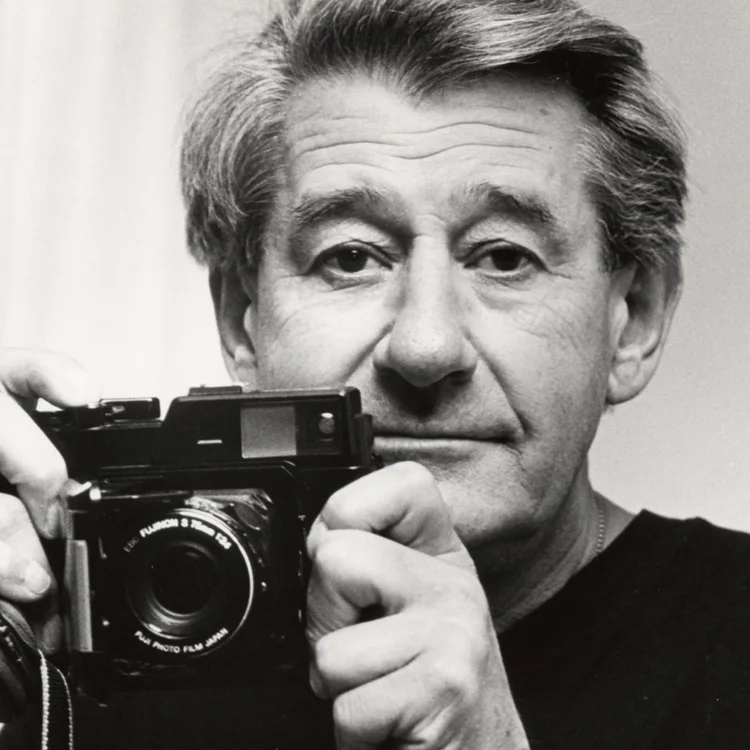
Rangefinder camera: the Helmut Newton Foundation in Berlin shows his favourite cameras, including rangefinders made by Plaubel and Fuji.
Polaroid instant camera: from the 1970s he used Polaroid film to test composition and light before the final picture.
Books
Autobiography (Nan A. Talese, 2003). His own life story, in about 320 pages, published shortly before his death. He writes about growing up in a wealthy Jewish family in Berlin, buying his first camera at twelve and learning from Yva. Then come the flight from Germany after Kristallnacht, the years in Singapore, the internment camp and the Australian army, his marriage to June and the long road to Vogue. He is frank about his life, including the less glamorous parts. The best place to start for anyone who wants to know the person behind the pictures.
Sumo (Taschen, 1999). Newton wrote the foreword himself, signed in Monte Carlo in 1999. In it he tells the story of his first roll of film in the Berlin metro, his apprenticeship with Yva, his early years with magazines and his move into advertising. He also explains that the Big Nudes began with German police photographs. For collectors and for readers who want to see his work at full scale.
Legacy (Taschen, 2020). A 424-page book made for the Legacy retrospective at the Helmut Newton Foundation in Berlin. The show was planned for his 100th birthday and opened in 2021 after a delay caused by the pandemic. Curated by Matthias Harder, it brings together about 300 works, half of them never shown before, together with Polaroids, contact sheets and archive material. A good modern overview for readers new to his work.
In his words
“I had found out earlier that I did not function well in the studio”
“I did not want to spend time thinking about hardware.”
“To the question: “What people do you like to photograph?” my answer is: “Those I love, those I admire and those I hate”.”