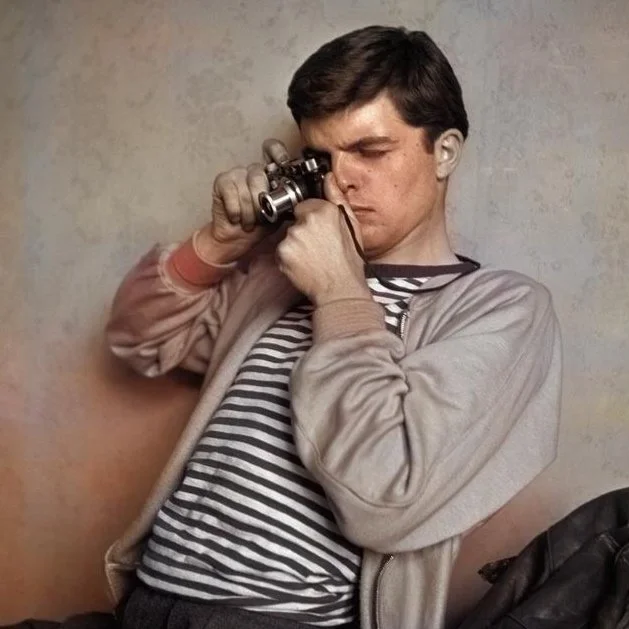
AT A GLANCE
- Known for
- Surreal, story-like fashion pictures for French Vogue and the shoe brand Charles Jourdan
- Worked in
- Mostly color with strong, hyper-real tones; black and white in his early years
- Camera
- Leica in the early 1950s; Polaroids to plan his pictures
- Also
- Painted and drew all his life; protégé of Man Ray; turned down France’s Grand Prix National de la Photographie in 1985
- Start with
- Guy Bourdin: A Message for You (Steidl, 2013)
- Links
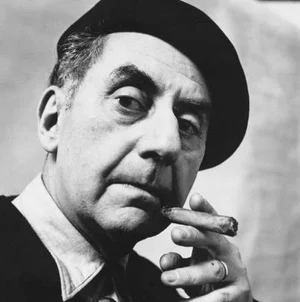
Guy Bourdin (1928–1991) was a French fashion photographer. For more than thirty years he worked for Vogue Paris and for brands like Charles Jourdan. His bold, colorful and often strange pictures tell stories in which the image matters more than the product.
The story
In the winter of 1954, Vogue Paris gave a young photographer his first fashion job. The subject was hats by the milliner Claude Saint-Cyr. Guy Bourdin did not stay in a studio. He took the models to a butcher shop in Les Halles, the big Paris meat market. In one picture a model in gloves stands under three skinned calves’ heads. The pictures ran in February 1955. Some readers sent angry letters and cancelled their subscriptions. Yet it was the start of about thirty years with Vogue.
Bourdin was born in Paris in 1928 and grew up mostly with his grandparents in Normandy. During military service in Dakar, in 1948 and 1949, the Air Force trained him in photography. Back in Paris he looked for his hero, Man Ray. At first he was turned away, but he kept coming back. In 1952 Man Ray wrote the introduction for his first photography show, at Galerie 29.
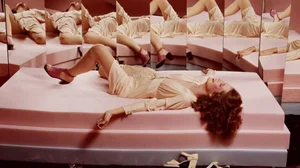
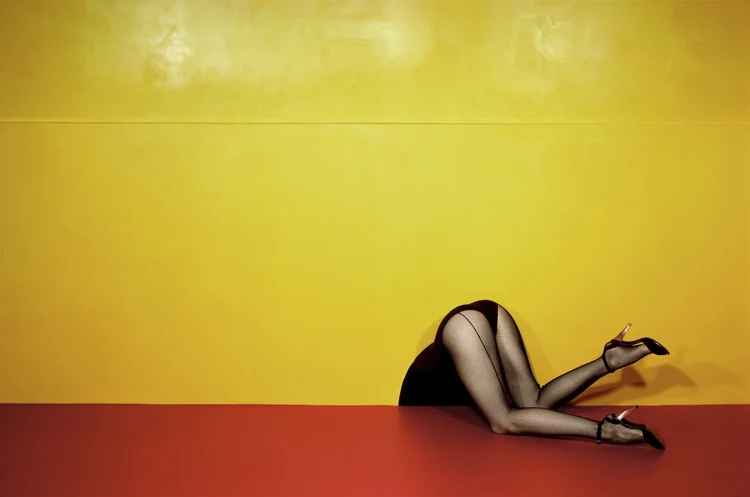
In the 1960s his work moved from shock toward stories. From 1967 he made the advertising pictures for the shoe brand Charles Jourdan. The shoes were often only a small detail in a strange scene. In 1979 he drove from London to Brighton in a Cadillac with a pair of mannequin legs in Charles Jourdan shoes, and photographed them on the way. In another picture from that spring, a body disappears into a yellow wall. Only the legs and shoes remain.
Nothing was left to chance. His Polaroids already showed the final picture. “You knew exactly what you were going to get because he was very precise,” said the fashion editor Marie-Amélie Sauvé. According to his son, Samuel, he could shoot 30 rolls of film for one image. On trips abroad he first needed time to look around. “I can’t start working right away like this, not without seeing the country first,” he told his team.
He cared little about fame. He rarely showed his photographs outside the printed page, and in 1985 he turned down a national photography prize. He died in Paris in 1991. Ten years later, Samuel published Exhibit A, the first book of his work.
Those butcher shop hats were not an accident. In the spring of 1955, the season of his first Vogue story, he put his rule into a few words: “Better five minutes of happiness than a lifetime of conformity.”
The work


- 1928Born in Paris, 2 December
- 1948Air Force service in Dakar; first training in photography
- 1952First photography exhibition, with an introduction by Man Ray
- 1955First fashion story in Vogue Paris, “Chapeaux-Choc”
- 1967Begins making advertising pictures for Charles Jourdan
- 1979Charles Jourdan campaign with mannequin legs, shot from London to Brighton
- 1985Turns down the Grand Prix National de la Photographie
- 1991Dies in Paris, 29 March
Lessons
Tell a story. The product can be a small clue. The picture is the main thing.
Plan with care. His Polaroids showed the final image before the real shoot began.
Look before you shoot. On trips he wanted to see the place first, even if it took days.
Try this: photograph a pair of shoes without showing the person’s face. Put them in a place where they do not belong. Make the picture ask a question.
Gear
Bourdin said very little about his equipment, so we know only a few things.
Leica 35mm camera: his camera for street scenes in Paris and landscapes in Normandy in the early 1950s.
Polaroid instant camera: he made Polaroids to test and plan his pictures. A book of 98 of them was published in 2010.
Super 8 film camera: he also filmed his shoots on Super 8. Some of this footage was shown in the Somerset House exhibition in 2014.
Books
Guy Bourdin: A Message for You (Steidl, 2006; one-volume edition 2013). Edited by Nicolle Meyer and Shelly Verthime, 320 pages. The 2013 edition joins the two volumes of the 2006 book. It looks at the late 1970s, the high point of his career. Part one shows rarely seen pictures of Nicolle Meyer, who modeled in more than thirty of his Charles Jourdan campaigns and in French Vogue stories, with her own memories. Part two is a collage of Polaroids, poems, sketches and contact sheets. A good first book for anyone who wants to see how he worked.
Guy Bourdin: Untouched (Steidl, 2017). Edited by Shelly Verthime, curator of the Bourdin estate, about 300 pages. It shows his early black-and-white photographs from 1950 to 1955, most never seen before. Verthime found the negatives, contact prints and cropping notes in a yellow Kodak box in his archive. The pictures show the influence of Man Ray and his interest in the strange side of everyday Paris. For readers who want to see where his style began.
Guy Bourdin: Polaroids (Éditions Xavier Barral, 2010). A 128-page book with 98 color Polaroids, most of them never published before, and a text by Oliviero Toscani. The small instant pictures go beyond fashion into quiet, strange little scenes. Good for photographers interested in sketching and planning with an instant camera.
Guy Bourdin for Charles Jourdan (Rizzoli, 2024). Text by the Paris writer and editor Patrick Remy, 216 pages. More than 150 images, many unpublished, from his long work for the shoe brand that began in the late 1960s. Mannequin legs and shoes appear in funny, erotic and unsettling settings. The book for anyone who loves his advertising work.
In his words
“I can’t start working right away like this, not without seeing the country first.”
“I’m not feeling inspired today, I don’t feel like working.”