AT A GLANCE
- Known for
- Immediate Family (1992), photographs of her three children, and haunting landscapes of the American South
- Works in
- Mostly black and white, often with wet-plate collodion; recently also digital and color
- Camera
- An old 8x10 bellows view camera (a Deardorff) since 1983; a digital camera since about 2025
- Also
- Memoir Hold Still (2015), a National Book Award finalist; Prix Pictet 2021 for Blackwater
- Start with
- Hold Still: A Memoir with Photographs (Little, Brown, 2015)
- Links
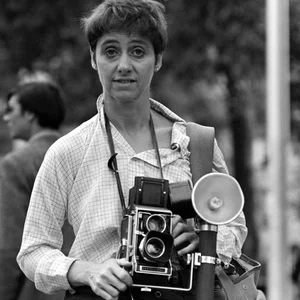
Sally Mann (born 1951) is an American photographer from Lexington, Virginia, where she still lives and works. She is best known for Immediate Family (1992), black-and-white pictures of her three children growing up. She also photographs the land and history of the American South, often with old cameras and antique processes.
The story
In 1984 Jessie Mann’s face was swollen with hives from insect bites. Her mother photographed her with the old 8x10 view camera she had started using the year before. When Sally Mann printed the picture, the battered, defiant little face reminded her of a Dorothea Lange photograph. She later called it her “first good family picture.”
Soon Jessie was well again, twirling around the house in a pink tutu. Strangely, the picture comforted her mother. It felt like a kind of protection against worse things that might never come.
Photography had come to her through her father, Robert Munger, a doctor in Lexington, Virginia. As a teenager at the Putney School in Vermont she began to take pictures, and later she studied writing at Hollins College. Now her three children, Emmett, Jessie and Virginia, became her subject.
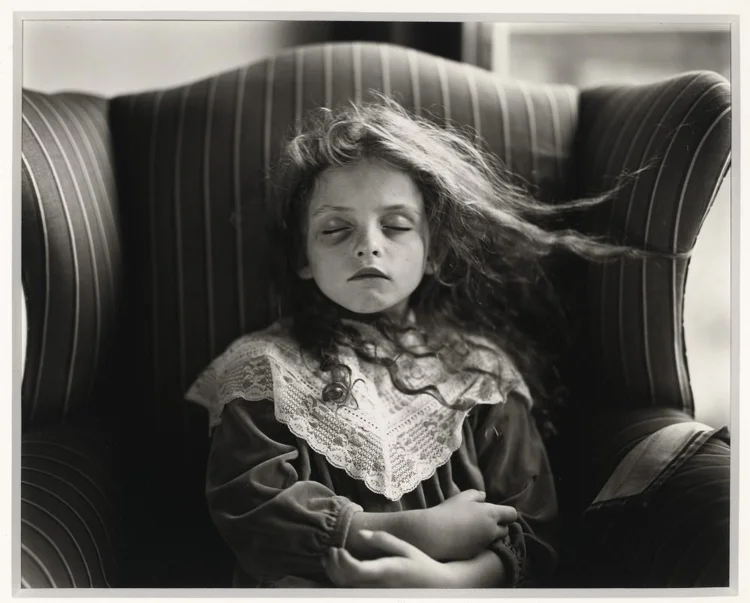
Summers were spent at a cabin by the river on the family farm. No one else lived nearby for miles, and the children were in the water all day and deep into the night. The camera was always set up. “I take pictures when they are bloodied or sick or naked or angry,” she wrote in the introduction to her book. In 1991 a hammock mishap gave Virginia a bruised eye. Her mother photographed her dozing in a wing chair, a lace collar on her shoulders.
Immediate Family came out from Aperture in 1992. Mann expected it to sell like her earlier book, At Twelve: a small print run, bought mostly by friends. Instead, a huge number of people saw it. In Candy Cigarette, Jessie stares straight at the camera with tousled hair and a candy cigarette in her hand.
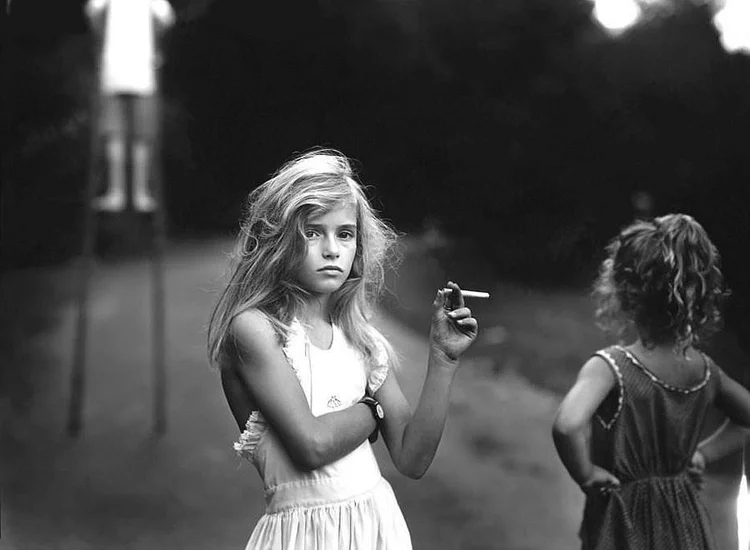
Letters arrived, many of them angry. What surprised Mann most was how certain the writers were that they knew her children. The contact sheets told a fuller story. Around each famous frame were others where the same kids giggled, punched each other and simply played.
The picture of Jessie’s swollen face had once felt like protection. Years later it carried a different lesson: a photograph is never the whole person. “Those aren’t my children. Those are photographs of my children,” she told NPR in 2015. “They’re just a tiny, tiny moment slivered out of time, a 30th of a second.”
The work


- 1951Born in Lexington, Virginia
- 1969Starts photographing at the Putney School in Vermont
- 1977First solo show, at the Corcoran Gallery of Art in Washington
- 1984Begins photographing her children for Immediate Family
- 1992Immediate Family is published by Aperture
- 2015Publishes her memoir Hold Still
- 2018Survey A Thousand Crossings opens at the National Gallery of Art
- 2021Wins the Prix Pictet for her Blackwater series
- 2025Says on BBC Radio 4 that she now also shoots digital
Lessons
Photograph what is closest. Her children, her husband and the land around her home became her main subjects. She did not need to travel to find them.
Keep the camera ready. At the river cabin the big view camera was always set up, so ordinary moments, even a bruise or an illness, could become pictures.
Let accidents in. She works with cranky wet-plate collodion and damaged old lenses. Dust, streaks and flaws often stay in the final picture.
Try this: photograph one person close to you for a week, including the bad moments: a scrape, a sulk, a nap. Then look at all the frames together and notice how different each one makes the same person look.
Gear
Mann rarely talks about brands. We list only what she or reliable reports have described.
8x10 view camera: since 1983 she has worked with an old 8x10 bellows camera, reported to be a Deardorff. She works under a hood over her head, which she calls tricky and complicated. Exposures are long.
Wet-plate collodion: she began using this 19th-century process in the mid-1990s. The plate must be coated, exposed and developed while still wet, and she keeps the flaws it leaves.
Old lenses: she likes old lenses that are out of order. Her most prized one has a piece of glass askew, which changes how the light comes in.
5x7 view camera: a smaller view camera, also part of her studio equipment.
Digital camera: in 2025 she said on BBC Radio 4 that she now also shoots digital, because 8x10 film has become so expensive. She pairs the camera with a lens from the 1940s. The camera model is not known.
She has also made prints with the platinum and bromoil processes.
Books
Hold Still: A Memoir with Photographs (Little, Brown, 2015). A 496-page memoir that grew out of her 2011 Massey Lectures at Harvard. Mann builds it from family papers she found in the attic: letters, school reports and old photographs, mixed with her own pictures. She writes about her wild childhood in Rockbridge County, her marriage to Larry Mann, the storm around Immediate Family and her family’s history in the South. It was a finalist for the National Book Award and won the 2016 Andrew Carnegie Medal for nonfiction. The best place to start for anyone who wants the stories behind the pictures.
Immediate Family (Aperture, 1992). The book that made her famous, with an afterword by the novelist Reynolds Price. The black-and-white pictures show her children Emmett, Jessie and Virginia at the family’s summer cabin on the Maury River in Virginia, made with an 8x10 view camera between 1984 and 1991. They show swimming, sleeping, play and small injuries, but also loneliness and growing up. Aperture reissued it in 2015 with 60 duotone plates and new scans made from her original prints. Essential for anyone interested in family photography.
Sally Mann: A Thousand Crossings (National Gallery of Art, Peabody Essex Museum and Abrams, 2018). The catalogue of her large survey, which opened at the National Gallery of Art in Washington. Edited by Sarah Greenough and Sarah Kennel, with essays by Drew Gilpin Faust, Hilton Als and Malcolm Daniel. Its 320 pages hold more than 100 photographs, some never published before: family pictures, Southern landscapes, Civil War battlefields, churches and portraits of her husband Larry. The best overview of her whole career and of how the South shaped her work.
Proud Flesh (Aperture, 2009). A slim, large-format book of 64 pages with a text by the poet C. D. Wright. Over six years Mann photographed her husband of 39 years, Larry, whose late-onset muscular dystrophy was weakening his body. The nude studies are close, honest and tender. She has called the series one of her favorite bodies of work. A rare book about a long marriage, seen from the inside.
In her words
“I call it the ‘angel of uncertainty.’ She just comes down and deposits something glorious on my picture.”