
AT A GLANCE
- Known for
- Large-format color portraits of people and places, from the Mississippi River to Niagara Falls
- Works in
- Color, mostly. Songbook in black and white
- Camera
- 8x10 view camera on a tripod
- Also
- Magnum member since 2008, founder of the publisher Little Brown Mushroom
- Start with
- Sleeping by the Mississippi (Steidl, 2004)
- Links
Alec Soth (born 1969) is an American photographer from Minneapolis. On long road trips he photographs the people he meets, with a big view camera that makes everyone slow down. His first book, Sleeping by the Mississippi, began as 50 copies he made himself. More than thirty books have followed.
The story
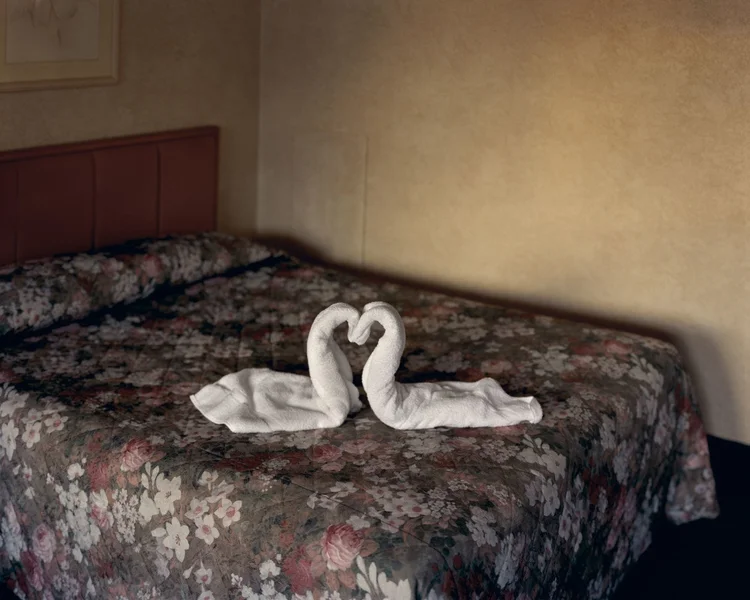
In 2004 Alec Soth was working on a project in Niagara Falls. One evening he opened the door of yet another motel room and found two towels folded on the bed. “I was taken aback by the flourish of the towel decoration,” he said. The sun was going down and the room was golden.
It had been a long day, and he was exhausted. Without the picture, he said, “I’m sure I would have filled up my ice bucket and downed a glass of whiskey.” Instead he set up his large-format camera and worked fast. To him the towels made a heart. Many people see two swans.
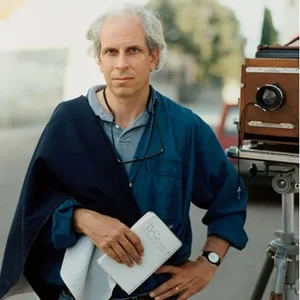
That slow camera was part of how he worked with people, too. As a young man he was painfully shy. After Sarah Lawrence College he went to parks and taught himself to talk to strangers. Then came the 8x10 view camera: big, old-fashioned, his head under a dark cloth. People had to wait while he set it up, and they settled.
Sleeping by the Mississippi began in 2003 as 50 inkjet books he made and gave away. Steidl published it in 2004. That same year his portrait of Charles, a man holding two model airplanes, was on the poster of the Whitney Biennial.

Niagara was supposed to be about romance. “But when I got there my view of the place totally changed,” he said. “The longer I spent there, the darker it got.”
Critics often called his pictures sad or lonely. Then, on a work trip to Helsinki in 2016, he sat by a lake and had what he called a transcendental experience. “There were tears running down my face,” he said. Feeling that happy, why keep making “sad, mopey pictures”?
After one last assignment for The New York Times Magazine, he stopped photographing people. For most of a year he stayed in an old farmhouse near Minneapolis. There he swept dust into shapes and watched light move across a wall.
In 2017 the choreographer Anna Halprin invited him to photograph her at home in California. “It felt like coming home to photography,” he said.
The new portraits are slower. Often one person is alone at home, for a few hours, in natural light.
“I’m still leading the dance,” he said, “but I’m not pushing people around the dance floor.”
The work


- 1969Born in Minneapolis, Minnesota
- 2004Steidl publishes Sleeping by the Mississippi. His portrait of Charles is on the Whitney Biennial poster
- 2004Becomes a nominee of Magnum Photos
- 2006Niagara. Finalist for the Deutsche Börse Photography Prize
- 2008Full member of Magnum. Founds the publisher Little Brown Mushroom
- 2013Receives a Guggenheim Fellowship
- 2017Returns to portraits after a year away, starting with Anna Halprin
- 2019I Know How Furiously Your Heart Is Beating
- 2024Advice for Young Artists, made during visits to 25 undergraduate art programs
- 2026Exhibitions at the Jeu de Paume in Paris, the Art Gallery of Ontario and the National Gallery of Art
Lessons
Let the camera slow everyone down. The 8x10 on a tripod takes time to set up, and his subjects wait long enough to relax.
Follow your wandering. Sleeping by the Mississippi started as a project called From Here to There, where each picture led to the next. Only later did the river become the link.
Use your shyness. Even now he sweats when he photographs people. “My own awkwardness comforts people, I think.”
Try this: on road trips he kept a list of things to look for taped to his steering wheel, like beards, tents and tree lines. Write your own list of five things, keep it where you can see it, and spend one day photographing only those.
Gear
8x10 view camera: his main camera for Sleeping by the Mississippi and Niagara, on a tripod, with a 300mm lens. Among the 8x10 photographers he admired were Stephen Shore, Joel Sternfeld and Sally Mann.
Each sheet of 8x10 film cost him about $20, so he often made only two frames of a person.
For some years he worked digitally, then went back. “Returning to the 8x10 was such a joy,” he said in 2019.
Books
Sleeping by the Mississippi (Steidl, 2004; MACK, 2017). His first book. Large-format color photographs from car trips along the river, from Minnesota down to Louisiana, made over about five years: people, landscapes and rooms. The Steidl edition has essays by Patricia Hampl and Anne Wilkes Tucker. The MACK reissue is a linen hardback with 48 color plates. The mood is lonely and dreamy, more poem than report. Start here.
Niagara (Steidl, 2006; MACK, 2018). Made over two years on the American and Canadian sides of the falls, the old honeymoon capital. Newlyweds, motel rooms, parking lots and pawn shop wedding rings, mixed with real love letters that people gave him, about crushes, affairs and heartbreak. Essays by Philip Brookman and the novelist Richard Ford. For readers who want to see how a place full of romance can look dark and tender at the same time.
Songbook (MACK, 2015). Black-and-white pictures from the LBM Dispatch, a newspaper-style series he made with the writer Brad Zellar while they toured American states. Here the pictures stand alone, without the reporting. For readers who know only his color work.
I Know How Furiously Your Heart Is Beating (MACK, 2019). The portraits he made after his year away, in 2017 and 2018. Large-format color pictures of people in their homes, in places like Odessa, Berlin, Los Angeles and Minneapolis. The title is a line from the Wallace Stevens poem The Gray Room. For readers interested in quiet, intimate portraits.
Advice for Young Artists (MACK, 2024). Work he made between 2022 and 2024 while visiting 25 undergraduate art programs across the United States. Portraits of students, staged scenes, interiors and still lifes, mixed with handwritten Post-it notes. Shot entirely digitally, and Soth appears in several of the pictures. For readers who want to see his playful side.

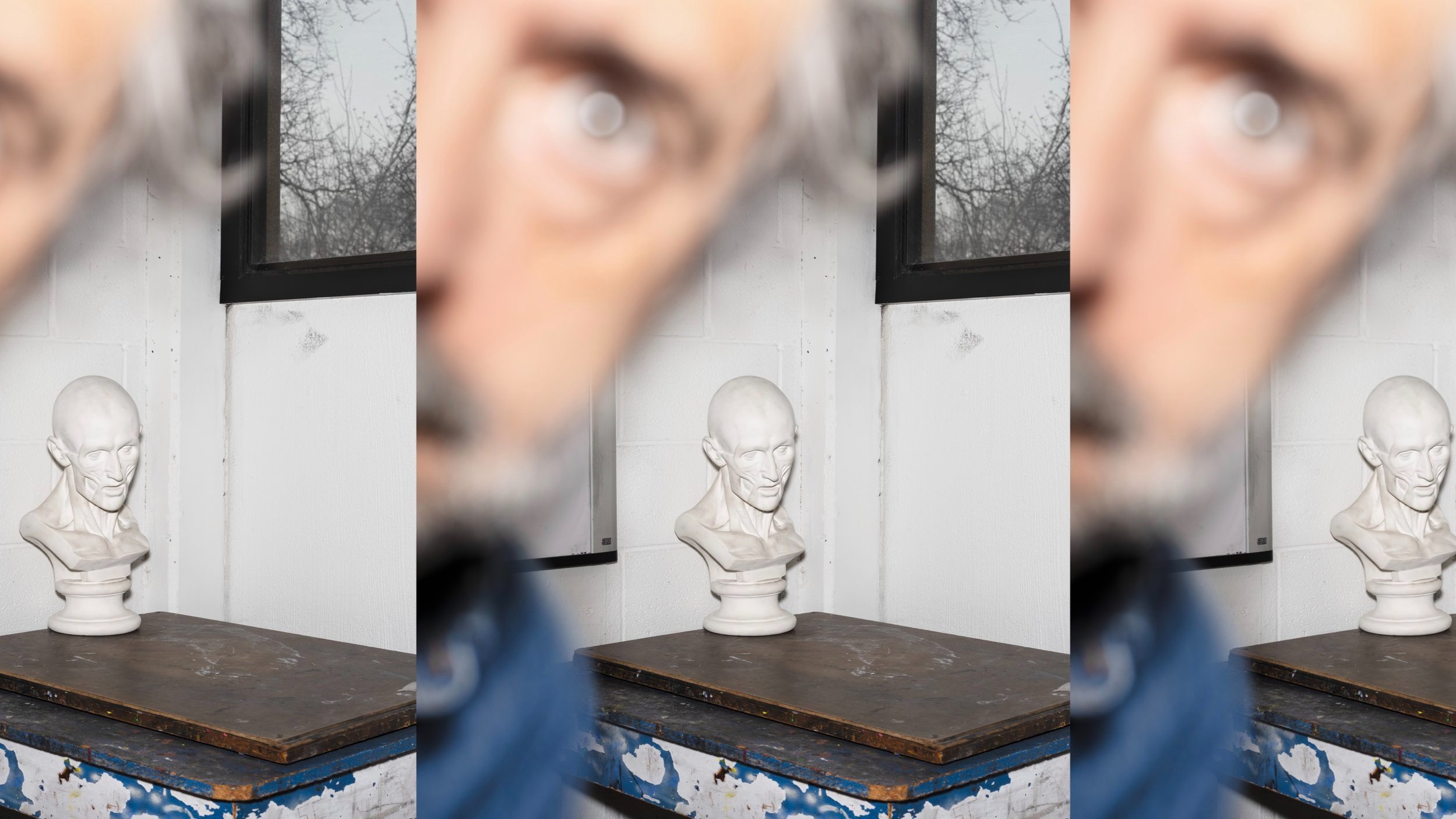

Between 2022 and 2024, Alec Soth visited 25 undergraduate art programs across the United States. Advice for Young Artists, published by MACK in 2024, is made from the work he made during those visits.