AT A GLANCE
- Known for
- Suburban houses photographed at night, lit by their own windows; later foggy landscapes and portraits
- Works in
- Color, printed by hand in the darkroom
- Camera
- Pentax 6x7 medium format on a tripod, with long exposures; later also digital
- Also
- Teaches at California College of the Arts; has published many books, most with Nazraeli Press
- Start with
- Intimate Distance: Twenty-Five Years of Photographs, A Chronological Album (Aperture, 2016)
- Links
Todd Hido (born 1968) is an American photographer based in the San Francisco Bay Area. He is best known for color pictures of suburban houses at night, made with long exposures and lit only by the windows. His later work adds foggy landscapes, interiors and portraits, and he has published many books.
The story
One day in the mid-1990s, Todd Hido drove up a hill into a neighborhood south of San Francisco. The whole place was lost in fog. “I found this completely fogbound neighborhood that very much reminded me of the place I grew up in Ohio,” he remembered. He made his first pictures there that same night. Then he kept coming back to the suburbs for years.
The place he grew up was Kent, Ohio. Art was not part of family life. As a teenager he raced BMX bikes and was a three-time state champion by sixteen, and his first photographs were of his racing friends. “In college, I took my parents on their first trip to a museum,” he said. Later, at the California College of Arts and Crafts in Oakland, one of his teachers was the photographer Larry Sultan, known for photographing his own parents at home.
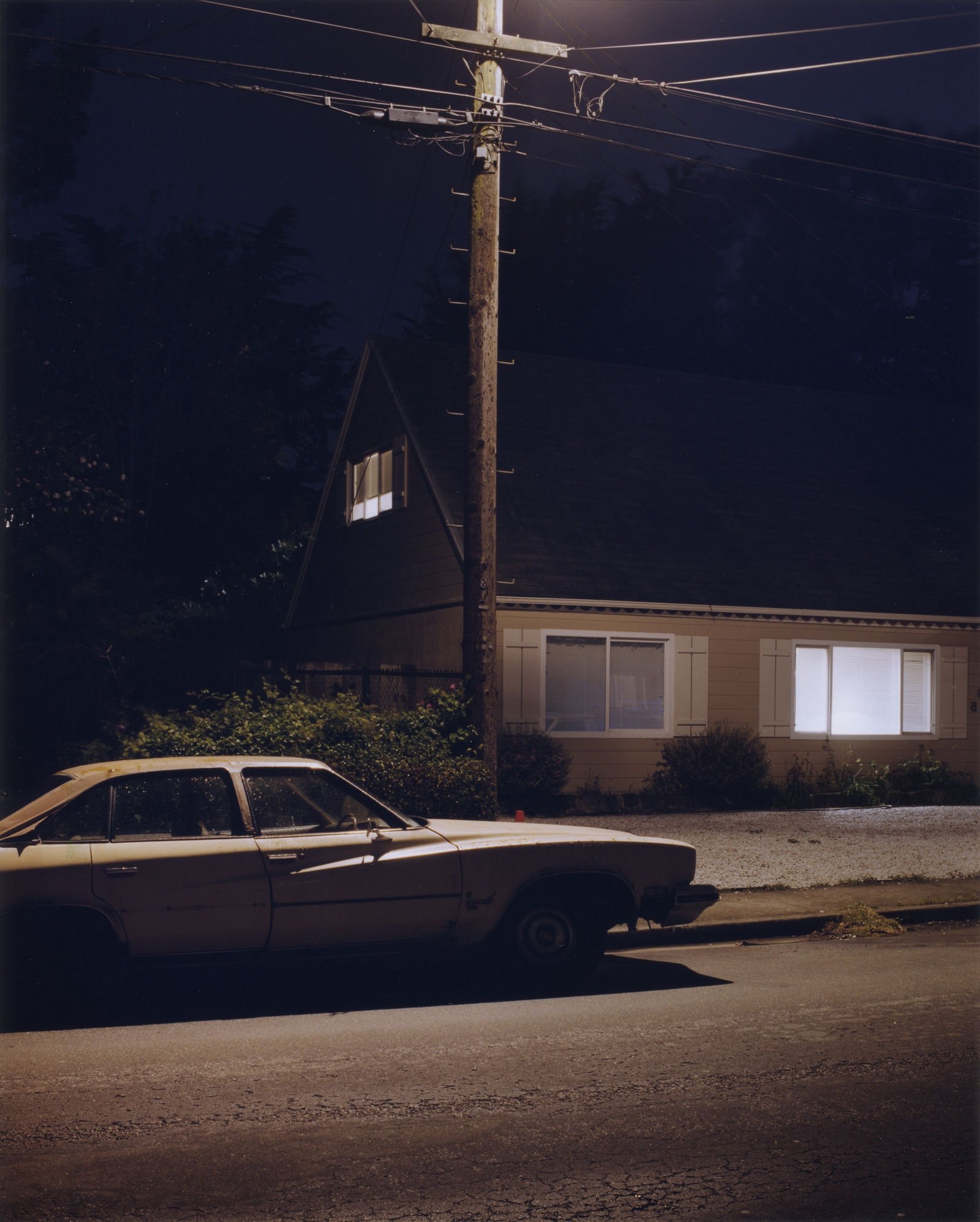
Hido did not photograph his own home. He photographed the homes of strangers, from the street, at night. A reporter once went out with him in Pacifica. Hido set his medium-format camera on a tripod about twenty meters from a house and timed an exposure of around four minutes. During that time, lights inside could change. “Sometimes you can watch the people move through their house,” he said. He never knocks on the door. The prints have numbers, not addresses. These pictures became his first book, House Hunting, in 2001.
A long exposure collects more light than the eye can see. Streetlights, snow and windows mix into strange colors. In #7373, from 2008, a pale green light falls on tire tracks in the snow, while one window glows yellow above a parked car.
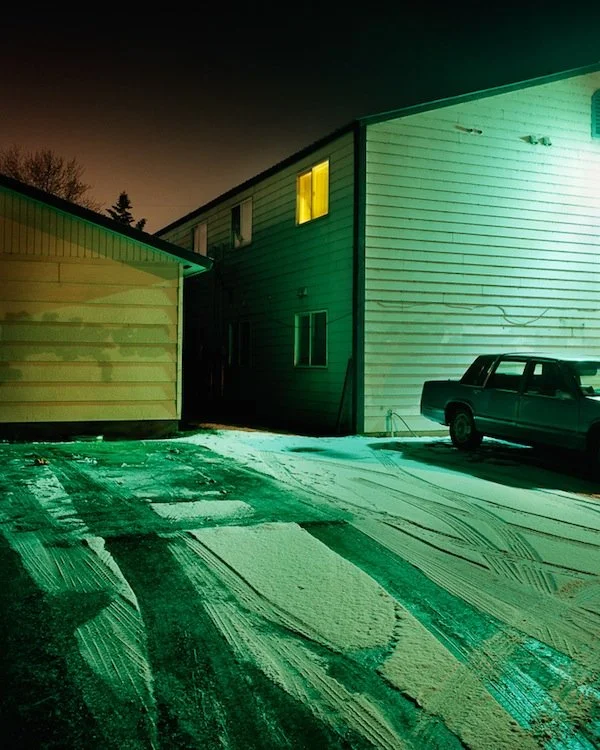
The darkroom does the rest. Hido prints his own pictures and often makes them darker, to make them more dramatic. He wants a mood, not a record. “I shoot like a documentarian, but I print like a painter,” he has said.
So the foggy street in California was really a road back to Ohio. The houses are empty of people, and the viewer stands where he stood, outside, looking at a warm window. “I guess I’ve always sort of felt like I was that kid, the one on the outside looking in,” he said.
The work


- 1968Born in Kent, Ohio
- 1991BFA from Tufts University and the School of the Museum of Fine Arts, Boston
- 1996MFA from California College of Arts and Crafts, Oakland
- 2001House Hunting is published by Nazraeli Press
- 2002House Hunting named Best First Monograph of 2001 by Photo-Eye
- 2014Todd Hido on Landscapes, Interiors, and the Nude (Aperture)
- 2016Career survey Intimate Distance (Aperture)
- 2018Bright Black World, his first major project outside North America
- 2023The End Sends Advance Warning (Nazraeli Press)
Lessons
Go back to what moves you. A foggy street that reminded him of Ohio started work he has followed for decades.
Let time do the work. Exposures of several minutes let the camera see more than the eye, especially at night.
Finish the picture in the print. He prints his own work and makes it darker and more dramatic to find the mood.
Try this: go out after dark with a tripod. Find one lit window in an ordinary street. Make a long exposure, then a darker print or edit than feels safe.
Gear
Hido has spoken about his tools in interviews. He works slowly, mostly on film, and prints himself.
Pentax 6x7 medium-format camera: in 2010 he said he had used the same Pentax 6x7 for twenty years.
Tripod and timer: for night houses he sets the camera on a tripod and times exposures of several minutes, around four minutes in one reported shoot.
Darkroom printing: he said he went to the darkroom a couple of times a week and that printing himself is a main reason his work looks the way it does.
Digital camera: later he found a digital camera that made pictures he could mix with his Pentax 6x7 images.
Books
House Hunting (Nazraeli Press, 2001). His first monograph and the book that made his name. It shows suburban houses at night, photographed from the street and lit from inside. It won Photo-Eye's award for best first monograph of 2001. Early copies became very scarce, so Nazraeli made a remastered 20th-anniversary edition in 2019, 56 pages, large format, with the original design. The place to start if you want the night houses.
Intimate Distance: Twenty-Five Years of Photographs, A Chronological Album (Aperture, 2016). A 272-page career survey with an introduction by the writer and curator David Campany. It mixes his best-known images with many unpublished ones and is arranged in time order, so you can see how his series overlap. Each earlier book is introduced with a short interview with Hido about how it was made. The best single overview of his work.
Todd Hido on Landscapes, Interiors, and the Nude (Aperture, 2014). Part of Aperture's Photography Workshop Series, 128 pages, with an introduction by his former student Gregory Halpern. Hido writes about using memory as a source, about light, texture and detail, and about sequencing pictures to tell a story. Written for photographers of all levels who want to improve their own work.
Bright Black World (Nazraeli Press, 2018). His first major project made outside North America, with landscapes from northern Europe and Japan. The 104-page large-format book has 48 photographs, including gatefolds and a fold-out poster, and a text by the art historian Alexander Nemerov. The quiet, dark landscapes carry an environmental mood. Good for readers who know the houses and want to see where he went next.
In his words
“I simply shoot the things that I find resonate with me on a personal level.”
“One of the main reasons that my work looks the way it does is because I’ve printed in the darkroom myself.”