Welcome to this edition of Photography Stories. Today, we look at the story behind the photograph by Jacques Henri Lartigue, made at the Grand Prix of the Automobile Club de France in 1912. We’d love to read your comments below.
(This is the story behind the photograph.)
The wheel of the racing car looks like an egg.
The spectators on the side of the road lean to the left, as if a strong wind were blowing. Jacques Henri Lartigue made the picture at the French Grand Prix in Normandy when he was 18. It became one of the best known images of speed ever made. Its caption may be wrong.
Its strange shapes, at least, have a simple explanation.
This story looks at how the picture was made and why it looks so strange. You will read what Lartigue wrote in his diary on the day of the race. You will also learn why one expert thinks the car is not the one Lartigue named.
The boy behind the camera loved cars.
Jacques Henri Lartigue, labelled in his album as a Delage at the Grand Prix de l’Automobile-Club de France, 26 June 1912. According to David E. Junker, the car is a Théophile Schneider at the Grand Prix of 1913.
A boy who loved cars
Lartigue grew up in a wealthy French family and began taking photographs as a small child. His father and his older brother Zissou took him to motor races. He photographed the cars, then drew them, then made sketches from his own photographs.
His first try at panning
In June 1912 the Grand Prix of the Automobile Club de France was held on public roads near Dieppe, over two days, the 25th and the 26th. Lartigue was near Le Tréport. He wrote in his diary: "The second one is coming. It's Boillot with Peugeot. I shoot as it speeds by at 180 and pan the camera to keep it in view. It's the first time I've tried this!"
Why the crowd leans and the wheel stretches
Panning means moving the camera with the subject. It explains the leaning people. Lartigue turned his camera to follow the car, so the background slid sideways during the exposure. The stretched wheel has another cause. According to the book 50 Photo Icons, his camera had a focal plane shutter. This kind of shutter does not open all at once. A thin slit moves across the film, so the top and the bottom of the picture are recorded at slightly different moments. The fast car moved while the slit travelled, and the round wheel came out stretched.
A car with the wrong name?
Lartigue glued the print into his album for 1912. He wrote under it: "Automobile Delage, Grand Prix de l'Automobile-Club de France, Le Tréport, 26 juin 1912." But according to David E. Junker, quoted by the Donation Jacques Henri Lartigue in Paris, the car is a Théophile Schneider, and it raced at the Grand Prix of 1913. No explanation has been found in Lartigue's diaries. The book 50 Photo Icons also notes that the sources do not agree on the exact day.
Fifty years in an album
For half a century almost nobody saw the picture. Lartigue trained as a painter and kept photographing for himself. In 1962, when he was in his late sixties, the agent Charles Rado showed his work to John Szarkowski, the new photography curator at the Museum of Modern Art in New York. Szarkowski gave him a show at the museum in 1963, and Life magazine published his photographs the same year.
Suddenly the old album of a rich boy from Paris became part of photography history. The leaning crowd and the egg shaped wheel were no longer mistakes. They were the speed itself.
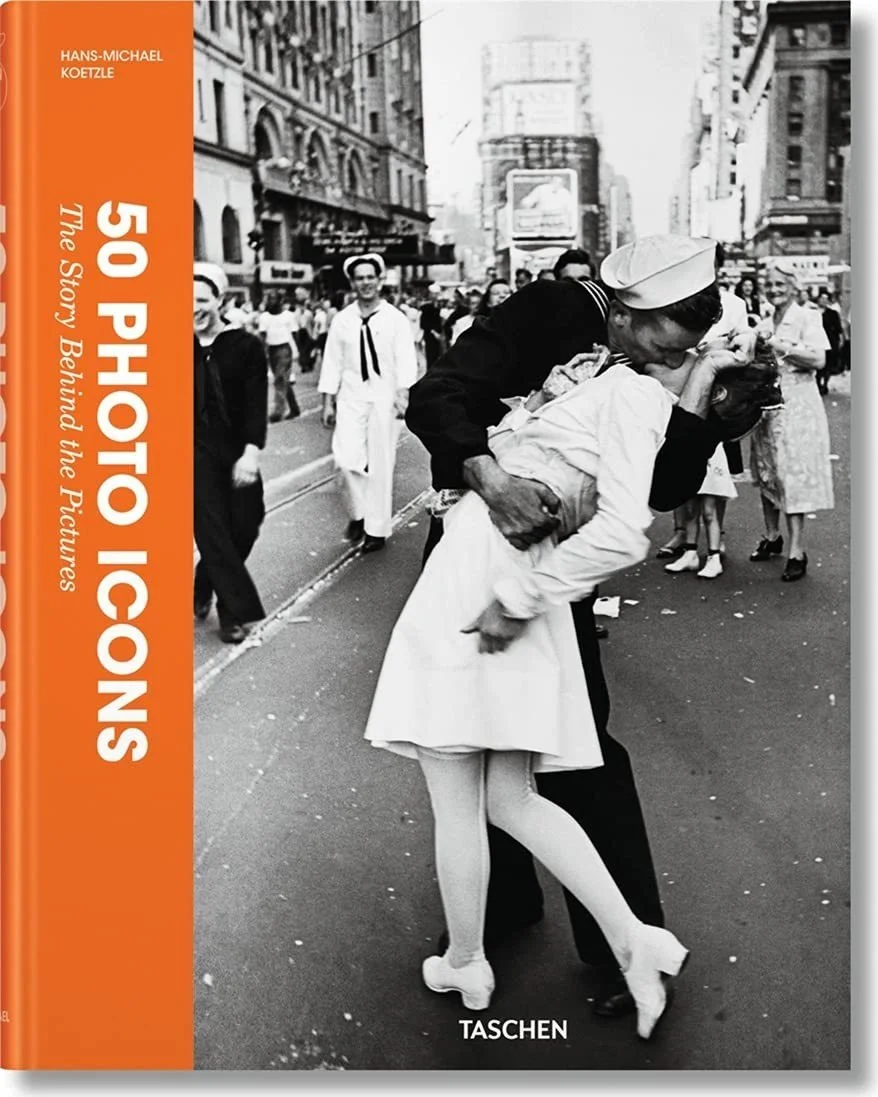
This story was partly inspired by 50 Photo Icons, Hans-Michael Koetzle, Taschen.
The Book
50 Photo Icons
Taschen · 2011 · By Hans-Michael Koetzle
Hans-Michael Koetzle tells the stories behind 50 famous photographs, from Nicéphore Niépce's view from his window in 1827 to Thomas Hoepker's picture of Manhattan on 11 September 2001. For each picture he explains who made it, how it was made and why it became an icon.
Koetzle is a Munich-based author and journalist who writes about the history of photography.
Jacques Henri Lartigue was 18 when he photographed a racing car at the 1912 Grand Prix. His shutter stretched the wheel into an egg, and the crowd behind the car leaned sideways. He glued the print into his album, and it stayed there for almost fifty years. After his 1963 show at the Museum of Modern Art, those flaws were seen as the speed itself. Some of the pictures people remember began as an experiment.
“I shoot as it speeds by at 180 and pan the camera to keep it in view. It's the first time I've tried this!”Jacques Henri Lartigue
More stories:


Leaning spectators and an egg shaped wheel. How 18-year-old Jacques Henri Lartigue photographed speed in 1912, and why his caption may be wrong.