AT A GLANCE
- Known for
- Flower Power, made at the March on the Pentagon on 21 October 1967
- Works in
- News photography for the Dayton Daily News, The Washington Star and the Los Angeles Times; for many years a White House photographer
- Camera
- A 35mm Leica, his preferred camera, according to History.com
- Also
- Director of photography of The Washington Star until 1981 · later published the Bryce Mountain Courier in Virginia
- Awards
- Pulitzer Prize finalist twice (1967 and 1987) · Hall of Fame of the Society of Professional Journalists (1996)
- Start with
- Bernie Boston: American Photojournalist (RIT Cary Graphic Arts Press, 2006)
- Links
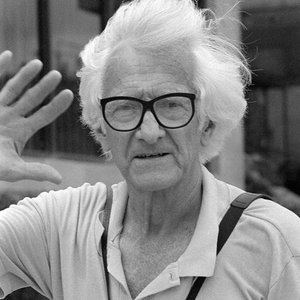
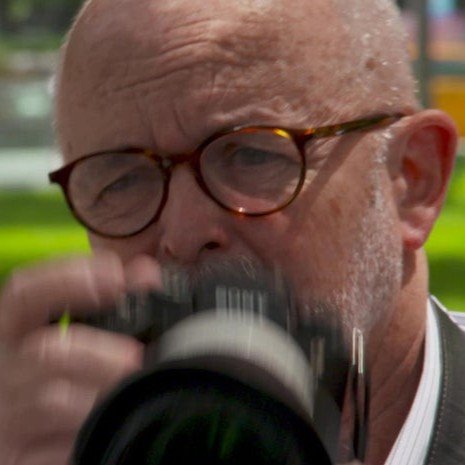
Bernie Boston (1933 to 2008) was an American news photographer. He worked for The Washington Star and the Los Angeles Times and photographed every president from Harry Truman to Bill Clinton. He is best known for Flower Power, made in 1967 at a protest against the Vietnam War outside the Pentagon.
The story
On 21 October 1967, about 100,000 people marched against the Vietnam War in Washington. Many went on to the Pentagon, where military police stood guard with rifles. Bernie Boston, then 34, was there for The Washington Star. He climbed onto a wall near an entrance to get a view over the crowd.
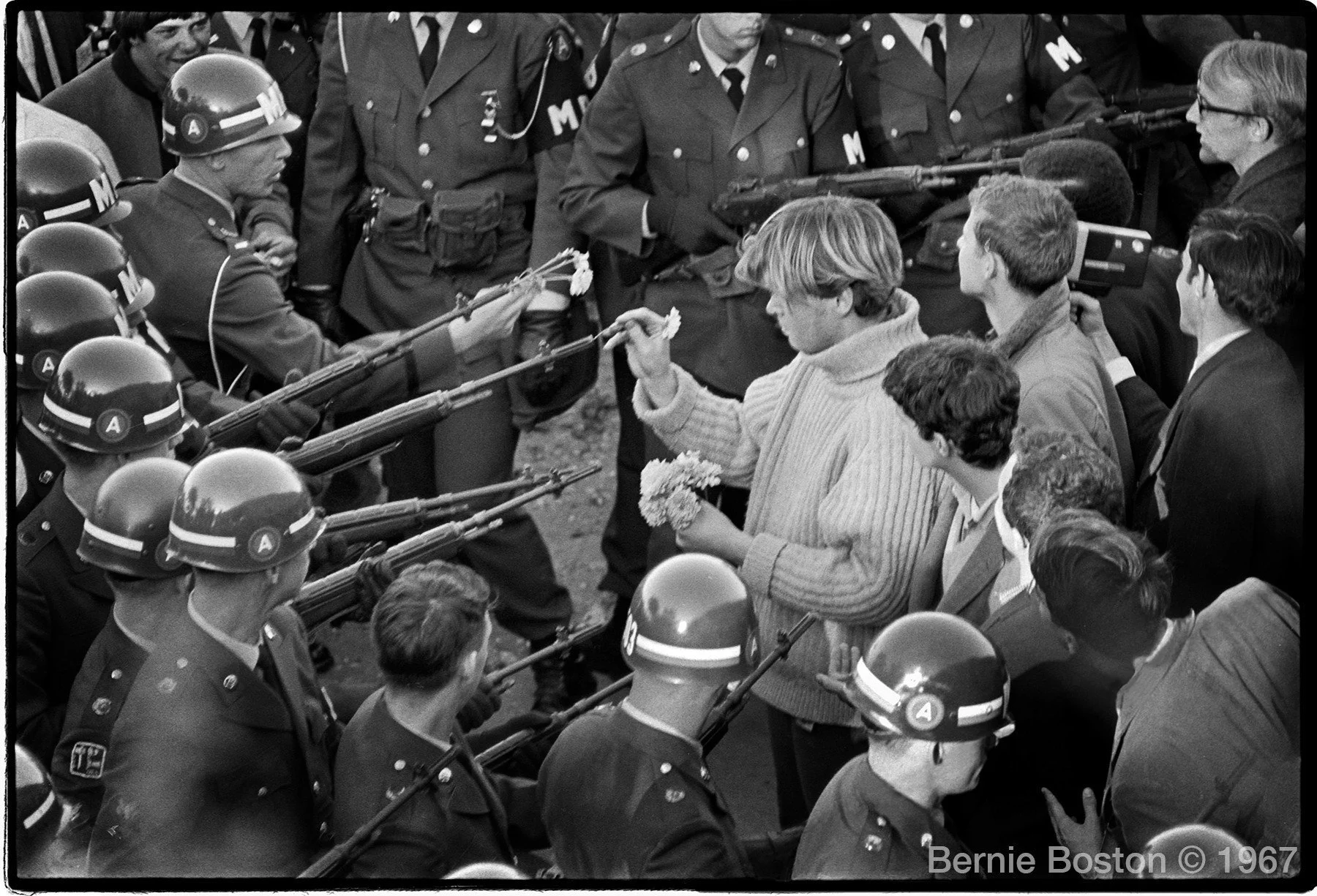
Below him, a young man stepped up to the line of soldiers with a handful of carnations. He slid one flower into the barrel of a rifle, then another. Boston pressed the shutter. History.com says he most likely used a 35mm Leica, his preferred camera. “I knew I had a good picture,” he later said.
His editor did not agree. The next day the Star ran the picture on page 10, not on the front page. “The editor didn’t see the importance of the picture,” Boston said in an interview.
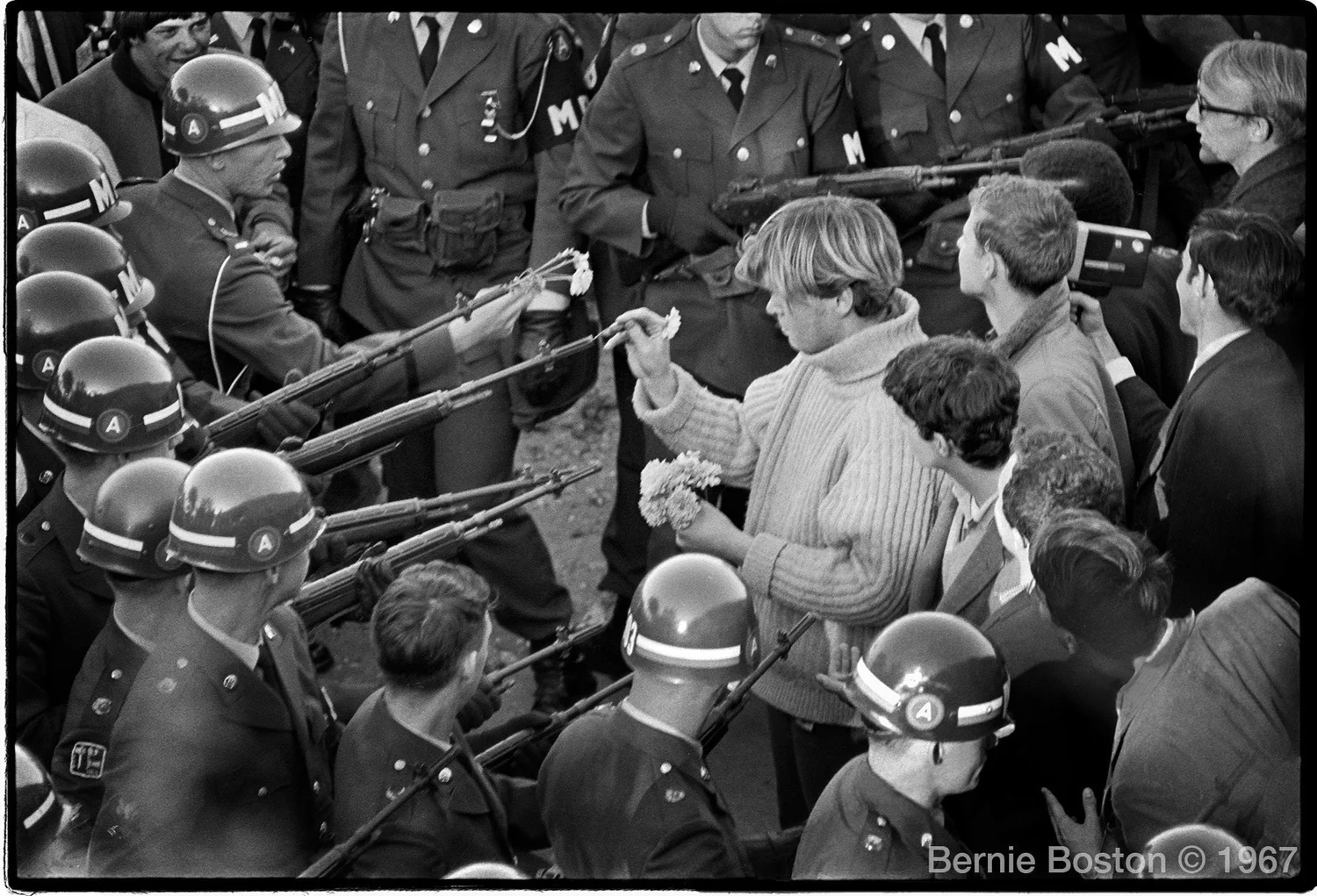
So Boston entered it in contests himself. Flower Power was a finalist for the Pulitzer Prize in 1967. Over the years it became a symbol of the protests of the 1960s. “I entered it in contests, and it started winning everything and being recognized.”
The young man in the picture is generally believed to be George Edgerly Harris III, an actor from New York who had turned 18 a month earlier. On the same day, the Magnum photographer Marc Riboud photographed a girl holding a flower in front of the soldiers.
Boston kept working in Washington for another 25 years. In 1981 he joined the Los Angeles Times to build its photo operation in the capital. His picture of Coretta Scott King unveiling a bust of Martin Luther King Jr. in the Capitol made him a Pulitzer finalist again in 1987.
The work
Boston was born in Washington in 1933 and grew up in McLean, Virginia. In high school he photographed for the school newspaper and yearbook. He studied photography at the Rochester Institute of Technology and graduated in 1955. After service in the Army in Germany he worked in a photo lab in Washington.
In 1963 he moved to the Dayton Daily News in Ohio. Three years later he returned to The Washington Star, and two years after that he became its director of photography. He covered the civil rights movement and the protests against the war, with portraits of Martin Luther King Jr., Coretta Scott King and the marchers of the Poor People’s Campaign.
For much of his career he worked as a White House photographer. After he retired from the Los Angeles Times in 1993, he and his wife Peggy bought the Bryce Mountain Courier, a small newspaper in the Shenandoah Mountains, and he photographed local life there. In 2006 they founded an archive of his work at RIT. It holds the original negative of Flower Power.
- 1933Born in Washington, D.C.; grows up in McLean, Virginia
- 1955Graduates in photography from the Rochester Institute of Technology
- 1963Joins the Dayton Daily News in Ohio
- 1966Returns to Washington to work for The Washington Star
- 1967Makes Flower Power at the March on the Pentagon; a Pulitzer Prize finalist
- 1981Joins the Los Angeles Times in Washington after the Star closes
- 1987Pulitzer finalist again for his picture of Coretta Scott King
- 1993Retires and with his wife Peggy runs the Bryce Mountain Courier
- 2008Dies at his home in Basye, Virginia
In his words
“I knew I had a good picture.”
“The editor didn’t see the importance of the picture.”
“I entered it in contests, and it started winning everything and being recognized.”
Gear
35mm Leica: History.com writes that Boston most likely took Flower Power with a 35mm Leica, his preferred camera.
Books
Bernie Boston: American Photojournalist (RIT Cary Graphic Arts Press, 2006). The catalogue of his retrospective at RIT. It has more than seventy black and white plates, an essay by the curator Therese Mulligan and a chronology by Peggy Boston. It covers his work in Dayton, at the Star and for the Los Angeles Times. The best place to see more than Flower Power.