AT A GLANCE
- Known for
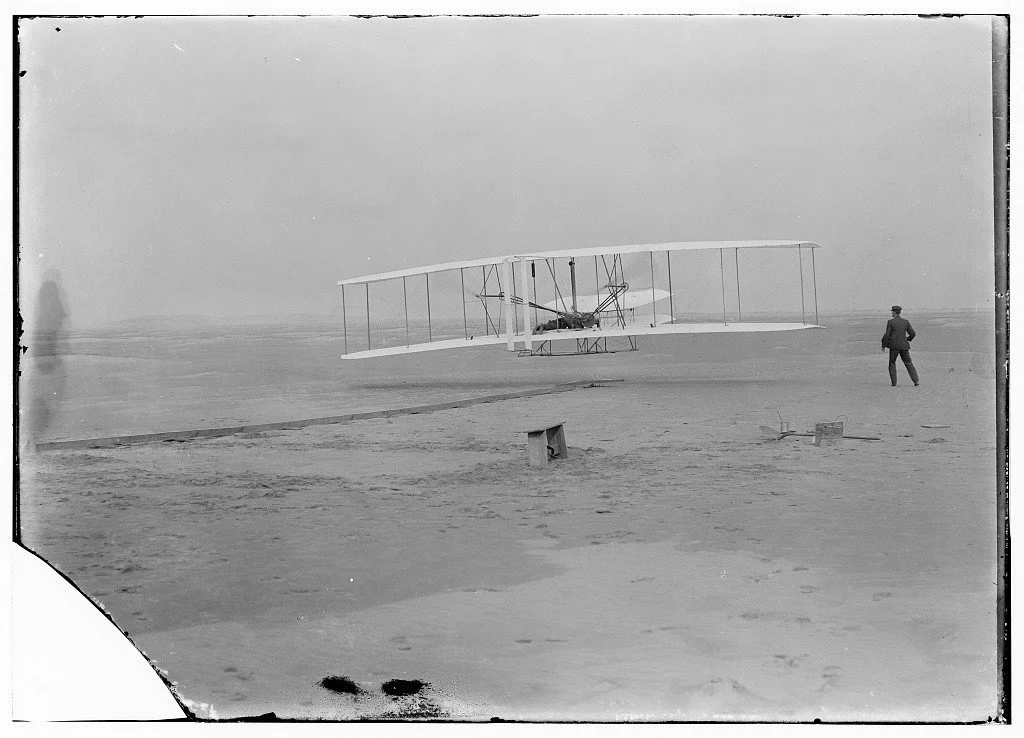
- The only photograph of the first powered flight, Kitty Hawk, North Carolina, 17 December 1903
- Works in
- He was not a photographer. He was a surfman at the Kill Devil Hills Life-Saving Station
- Camera
- The Wright brothers’ glass plate camera on a stand, fired with a rubber bulb
- Also
- Helped move the Wright Flyer to its launching rail that morning · survived when a gust wrecked the machine after the fourth flight
- Start with
- The Wright Brothers (Simon & Schuster, 2015)
- Links
John T. Daniels (1873 to 1948) was a surfman at the Life-Saving Station in Kill Devil Hills, North Carolina. He was not a photographer. On 17 December 1903 he squeezed the rubber bulb of the Wright brothers’ camera and made the only photograph of the first powered flight.
The story
On the morning of 17 December 1903, Daniels and two colleagues came over from their ocean rescue jobs at the Kill Devil Hills Life-Saving Station. They had come to help the Wright brothers. Daniels began the day by helping them move the Wright Flyer to its starting position on the sand.
Then he got a new job. Orville Wright had set up the camera on its stand and aimed it at the spot where the machine should leave the ground. Daniels had never used a camera before. He was told what to do: if the machine rose, squeeze the rubber bulb that fired the shutter.
At 10:35 a.m. the machine moved along its rail and lifted into the air. Daniels later said he was so excited that he nearly forgot to squeeze the bulb. He did squeeze it. The flight lasted 12 seconds and covered 120 feet.
The day was not over for him. The brothers flew four times. During the fourth flight, a gust of wind caught the parked machine. Daniels was caught in it as it was wrecked, but he came out without injury. The Wright Flyer never flew again.
He kept a souvenir. His granddaughter told the Associated Press that he kept a broken piece of wood from the machine in his desk. When visitors came, he whittled a small piece from it to give to them.
In 1927 he talked about the Wrights in an interview with Collier’s Weekly. He remembered how carefully the brothers had worked on the beach for several years. “We knew that they were going to fly, but we didn’t know what was going to happen when they did.”
The work
There is only one picture. Daniels made one exposure, with someone else’s camera, and the Wright brothers had planned the frame. What he added was the moment. The glass plate shows the machine just above the sand, with Wilbur Wright on the ground beside the wing.
That moment is the whole value of the picture. It is the only known photograph of the first powered flight. The Library of Congress keeps the negative among the 303 glass plate negatives of the Wright brothers. Its caption says that Orville preset the camera and Daniels squeezed the rubber bulb to trip the shutter.
Today a figure of Daniels at the camera is part of the sculpture of the first flight at the Wright Brothers National Memorial in Kill Devil Hills. A historical marker there invites visitors to stand beside him and try to make the same picture.
- 1873Born
- 1903Serves as a surfman at the Kill Devil Hills Life-Saving Station near the Wright brothers’ camp
- 1903On 17 December squeezes the camera bulb at 10:35 a.m. and records the first powered flight
- 1903Survives when a gust wrecks the Wright Flyer after its fourth flight
- 1927Talks about the Wrights in an interview with Collier’s Weekly
- 1938Attends the dedication of the Wright home and cycle shop at Greenfield Village, Dearborn
- 1948Dies
In his words
“We knew that they were going to fly, but we didn’t know what was going to happen when they did.”
“We had watched them for several years and seen how they figured everything out before they attempted it.”
Gear
Glass plate camera on a stand: The Wright brothers’ camera stood on a stand in the sand near the launching rail. The shutter was fired with a rubber bulb. The exact model is not named in the sources used for this profile.
Books
The Wright Brothers (Simon & Schuster, 2015). The historian David McCullough tells the story of Wilbur and Orville Wright from Dayton to Kitty Hawk. It describes the days on the Outer Banks and the local men who helped. Written for general readers.
The Bishop’s Boys: A Life of Wilbur and Orville Wright (W. W. Norton, 1989). Tom D. Crouch, a curator at the Smithsonian, wrote this full biography of the brothers. It is for readers who want the detailed history behind the first flight.
A Dream of Wings: Americans and the Airplane, 1875 to 1905 (W. W. Norton, 2002). Also by Tom D. Crouch. It tells how Americans tried to fly before and up to the Wrights’ success, and it includes the morning at Kill Devil Hills. For readers interested in the early history of aviation.