AT A GLANCE
- Known for
- Psychological portraits, 101 Life covers, jump pictures and a 37-year collaboration with Salvador Dalí
- Worked in
- Mostly black and white
- Camera
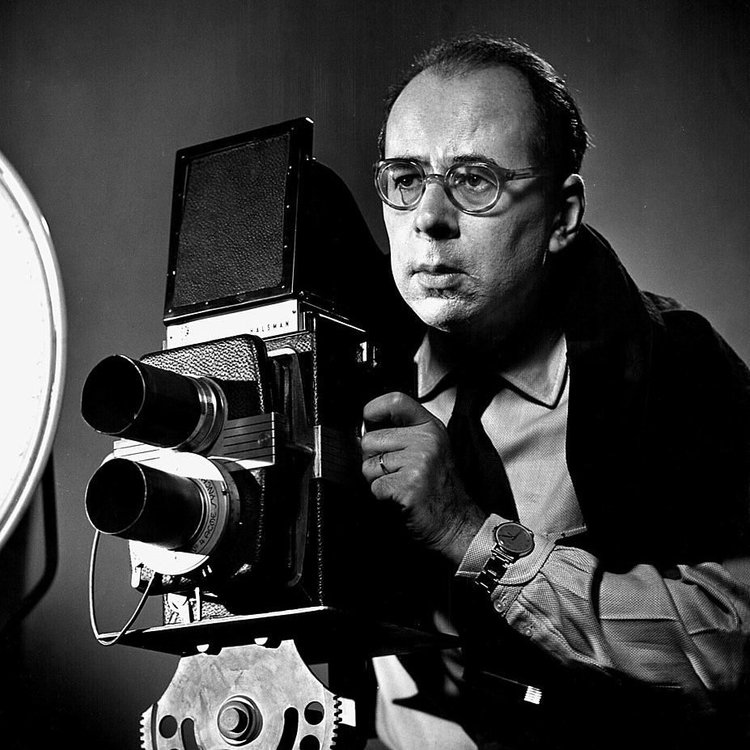
- Twin-lens reflex cameras he designed himself, including a 4x5 model
- Also
- First president of the American Society of Magazine Photographers (1945); Magnum contributor from 1951
- Start with
- Philippe Halsman: Astonish Me! (Prestel, 2014)
- Links
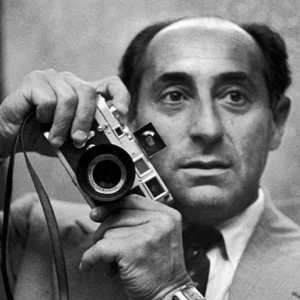
Philippe Halsman (1906–1979) was a portrait photographer born in Riga. He worked in Paris in the 1930s and in New York from 1940, where his pictures appeared on 101 covers of Life magazine. He is remembered for his work with Salvador Dalí and for asking famous people to jump.
The story
In 1952 Philippe Halsman was hired to photograph the Ford family for the company’s 50th anniversary. After the session, over a drink with Mrs. Edsel Ford, he had a sudden idea. He asked her to jump. “With my high heels?” she asked. She took off her shoes and jumped. Then her daughter-in-law, Mrs. Henry Ford II, wanted to jump too.
By then he had been making portraits for more than twenty years. Born in Riga in 1906, he studied electrical engineering in Dresden. In the 1930s he worked in Paris, with a studio in Montparnasse and pictures in Vogue and Vu. When Germany invaded France, Albert Einstein helped him get an emergency visa, and in 1940 he reached New York.
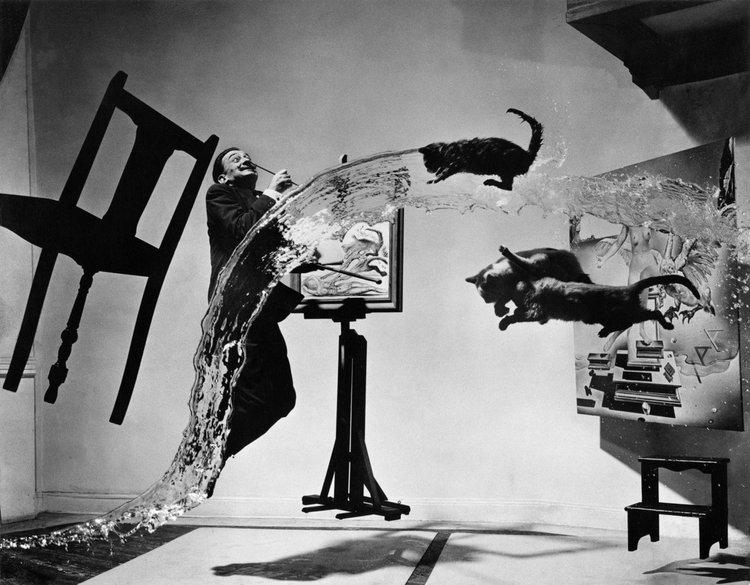
American magazines soon wanted him. His first Life cover, in 1942, showed a model in a Lilly Daché hat. A year earlier he had met Salvador Dalí, and they kept working together for 37 years. In 1948 they made Dalí Atomicus. On a count of three, assistants threw cats and water into the air. On four, Dalí jumped. After every try, Halsman went into the darkroom to check the film. It took 28 attempts and about six hours.
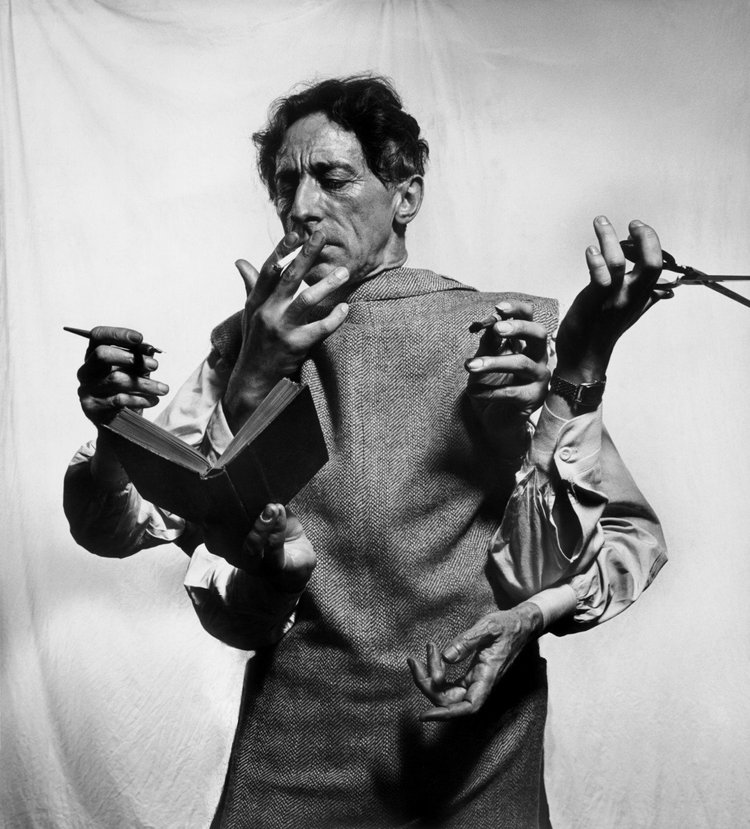
Not every famous sitter was easy. In 1949 Life asked him to show what goes on inside the mind of the poet Jean Cocteau. Cocteau came to the New York studio half an hour late and at first did not want to cooperate. Then things turned. Halsman “saw that instead of my becoming the instrument of his imagination, he was ready to be the instrument of mine.”
After the Ford session, the jump became a habit. For the next six years he ended his portrait sessions the same way. Richard Nixon jumped. So did the Duke and Duchess of Windsor, and Judge Learned Hand in his mid-80s. In 1959 the pictures became a book, Philippe Halsman’s Jump Book, and he gave the idea a name: jumpology.
What began as a joke with Mrs. Ford turned into a serious tool for a photographer who wanted to see the person behind the pose. “When you ask a person to jump, his attention is mostly directed toward the act of jumping and the mask falls so that the real person appears.”
The work


- 1906Born in Riga on May 2
- 1930Moves to Paris and starts working as a portrait photographer
- 1940Reaches New York with a visa obtained with Einstein’s help
- 1942First Life cover
- 1948Makes Dalí Atomicus; becomes a US citizen
- 1951Joins Magnum Photos as a contributor
- 1959Publishes Philippe Halsman’s Jump Book
- 1970100th Life cover, more than any other photographer
- 1979Dies in New York on June 25
Lessons
Break the pose. Halsman asked his sitters to jump because their attention moved away from the camera. A small surprise can do the same.
Build what you need. He designed his own twin-lens cameras, in Paris in 1936 and in New York in 1947, so he could work faster with his sitters.
Take the time it takes. Dalí Atomicus needed 28 attempts. He checked the film after every one.
Try this: at the end of a portrait session, ask your subject to jump. Make ten frames and compare them with the posed pictures.
Gear
Halsman was trained as an engineer, and he built cameras to suit the way he worked.
Twin-lens reflex camera: in Paris in 1936 he designed his own twin-lens reflex. He did not want to lose seconds loading film holders while a sitter’s expression changed.
4x5 twin-lens reflex camera: in 1947 he designed a 4x5 camera and used it for the rest of his career. Dalí Atomicus was made with a 4x5 twin-lens reflex of his own design.
He said: “The camera I have constructed for myself is a very important part of my technique.”
Books
Philippe Halsman: Astonish Me! (Prestel, 2014). Edited by Sam Stourdzé and Anne Lacoste with the Halsman Archive, this large book of about 300 pages went with the 2014 retrospective at the Musée de l’Elysée in Lausanne, the first study of his whole career. It covers his early years in Paris, his work for Life, his portraits of Marilyn Monroe, jumpology and his work with Dalí, and adds contact sheets, marked prints and photomontages that show how he worked. The best single book for a full picture of Halsman.
Philippe Halsman’s Jump Book (first published 1959; Abrams reissue, 1986). A small, funny book of famous people caught in the air, with Halsman’s own text on jumpology. The reissue adds an introduction by Mike Wallace. Inside you find Robert Oppenheimer, the Duke and Duchess of Windsor, Salvador Dalí and Peter Ustinov. Only one person in the book, the pianist Van Cliburn, does not jump. A light book, but also a short lesson in how to make people relax in front of a camera.
Dali’s Mustache: A Photographic Interview (Simon & Schuster, 1954; French edition Flammarion, 1995). Made together with Salvador Dalí. Each page asks Dalí a short question, and the answer comes on the next page, with a black-and-white photograph of Dalí in which his mustache plays the main role. Dalí wrote a preface, and Halsman wrote an afterword about how the pictures were made. An absurd and very funny little book, and a cult object for fans of both men.
Philippe Halsman: A Retrospective (Bulfinch, 1998). Photographs from the Halsman family collection, edited by his daughter Jane Halsman Bello and Steve Bello, with an introduction by Mary Panzer, then curator of photographs at the National Portrait Gallery in Washington. Its 212 pages cover more than forty years of portraits of artists, writers and world leaders, including the Einstein portrait and pictures of Marilyn Monroe and Audrey Hepburn not published before. It also has excerpts from his writing and an illustrated chronology.
In his words
“In my serious work I am striving for the essence of things and for goals which are possibly unobtainable.”
“Capturing this revelation became the goal and passion of my life.”





Dalí Atomicus is a remarkable photograph that blends art, science, and the surreal in a captivating and unforgettable way. Taken by Philippe Halsman using his unique “Jumpology” technique, this iconic image features the legendary Salvador Dalí suspended in mid-air …