Catching the Tide: How Colin McPherson Earned “Free Reign” to Photograph a Disappearing Trade
Welcome to this edition of [book spotlight]. Today, we uncover the layers of 'Catching the Tide,' by Colin McPherson (published by Dewi Lewis Publishing). We'd love to read your comments below about these insights and ideas behind the artist's work.
Catching the Tide is currently in a Kickstarter campaign. If you want this book to exist in the format Colin McPherson designed, you can support the project there and help fund the printing and production.
You cannot fake trust in a long-term project.
Colin McPherson spent 30 years with Scotland’s salmon net fishermen. He kept returning to the same shores until the men gave him free reign. That patience is why the work feels real, not performed. If you care about long-term documentary practice, this is for you.
Trust also shaped every choice he made with the camera.
He stayed an observer, used no long lenses, and never tried to steer a scene. He worked to the tide and the fishermen’s routine, and finished the images in the darkroom. In the end, the project shows how access is earned, and why it matters.
CATCHING THE TIDE
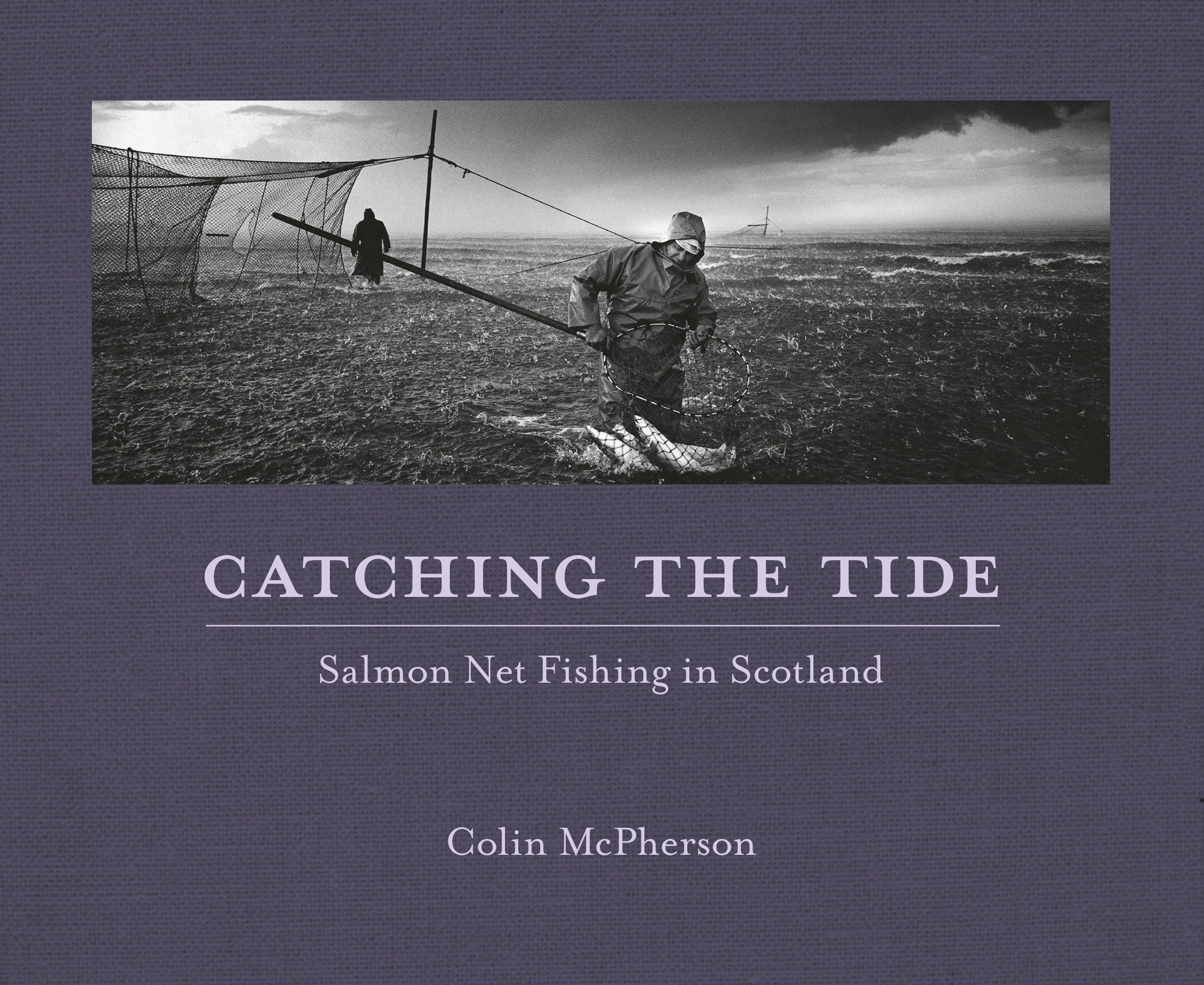
Catching the Tide: Salmon Net Fishing in Scotland by Colin McPherson is a lyrical, 30-year portrait of Scotland’s salmon net fishermen, made as the industry slid into steep decline and coastal stations fell silent.
The book brings together 97 tri-tone monochrome photographs, balancing wide “figures in a landscape” scenes with close, unforced moments of work shaped by tides, weather, and routine.
Designed by McPherson as a clothbound hardback in a large format (300 mm x 245 mm) and printed by EBS in Verona, it is built to feel like a lasting record of a craft that has nearly disappeared from Scotland’s shoreline communities. (colinmcpherson.com, Dewi Lewis Publishing)
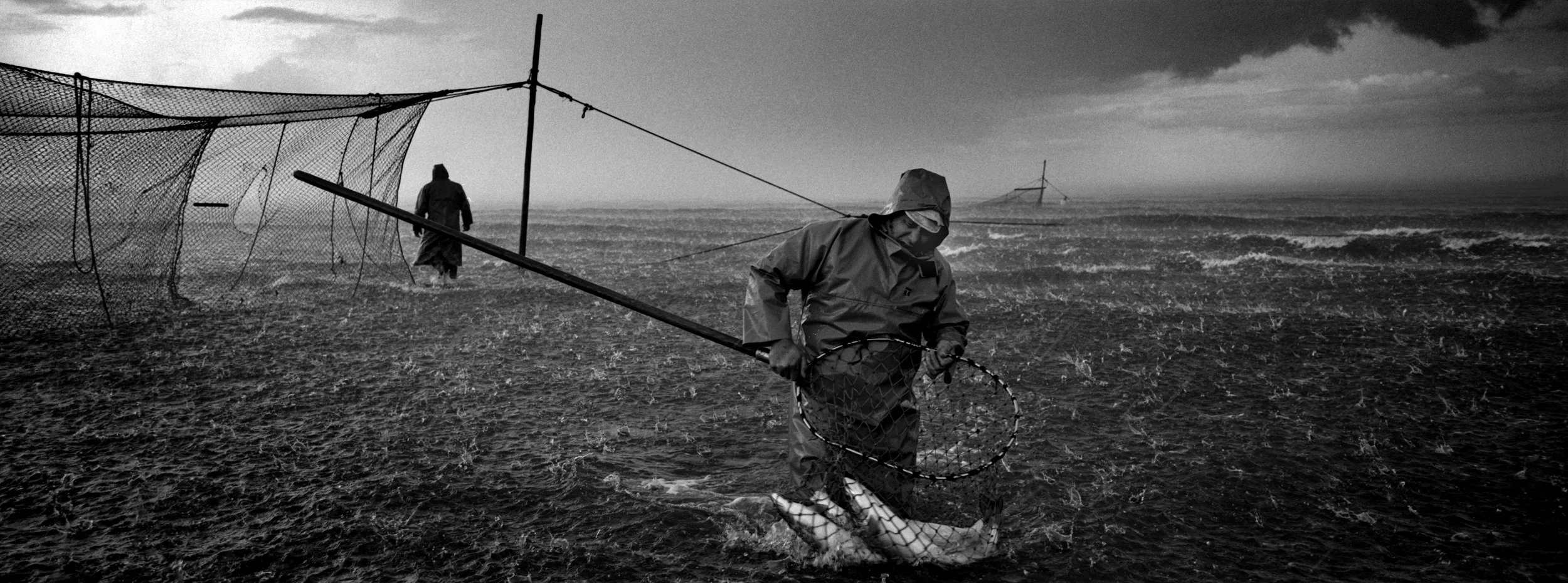
Project Genesis: In 1996, you were walking along St. Cyrus beach when you saw a solitary fisherman silhouetted against the sea, about to harvest salmon from a fly net. Can you describe what made that moment so powerful that you knew you had to start this project?
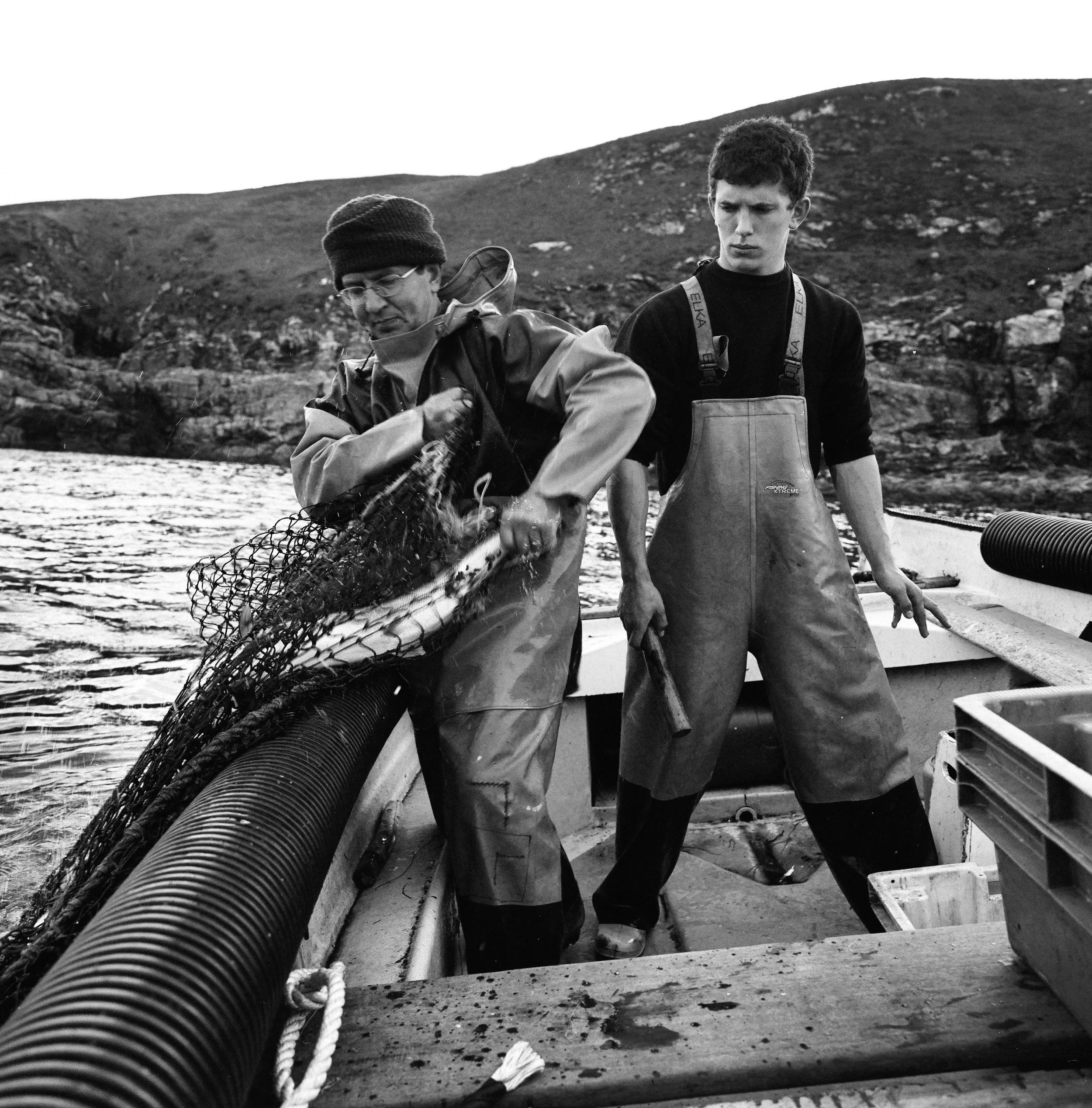
By 1996, I had been working as a professional photographer in newspapers for nearly seven years. At that time, I was living in Edinburgh and starting my freelance career with the Independent in Scotland, who were renowned for their focus on brilliant photography. Therefore, my antennae were always on high alert for images which were visually interesting, had a story element and gave a sense of place. As well as single images, the Independent were always on the lookout for features. I was just blown away by what I saw the salmon net fishermen doing on the beach and decided to try to find more about it. In those days, the fishings at St. Cyrus were operated by a company, Joseph Johnston and Sons. I got in contact with them and was put in touch with Bob Ritchie whose job was as the Wild Superintendent. With a title like that, I just had to start working with him. Bob, quite literally, showed me the ropes, and I became great friends with him over the next few years. After Johnston’s sold their interest in the fishings, Bob took over some of the nets and worked them for himself. Going to see him and photograph what he, and his men, were doing, never felt like work. It was an opportunity to follow my instincts with the camera and document faithfully what I was seeing. Through Bob, I met other fishermen and slowly made my way around the coast, meeting a number of men with whom I would collaborate for over a decade.
Building Trust: Instead of documenting every fishing station, you chose to work closely with fewer fishermen over many years until they gave you "free reign" to photograph. How did you earn that level of trust and why was this approach better for the work?
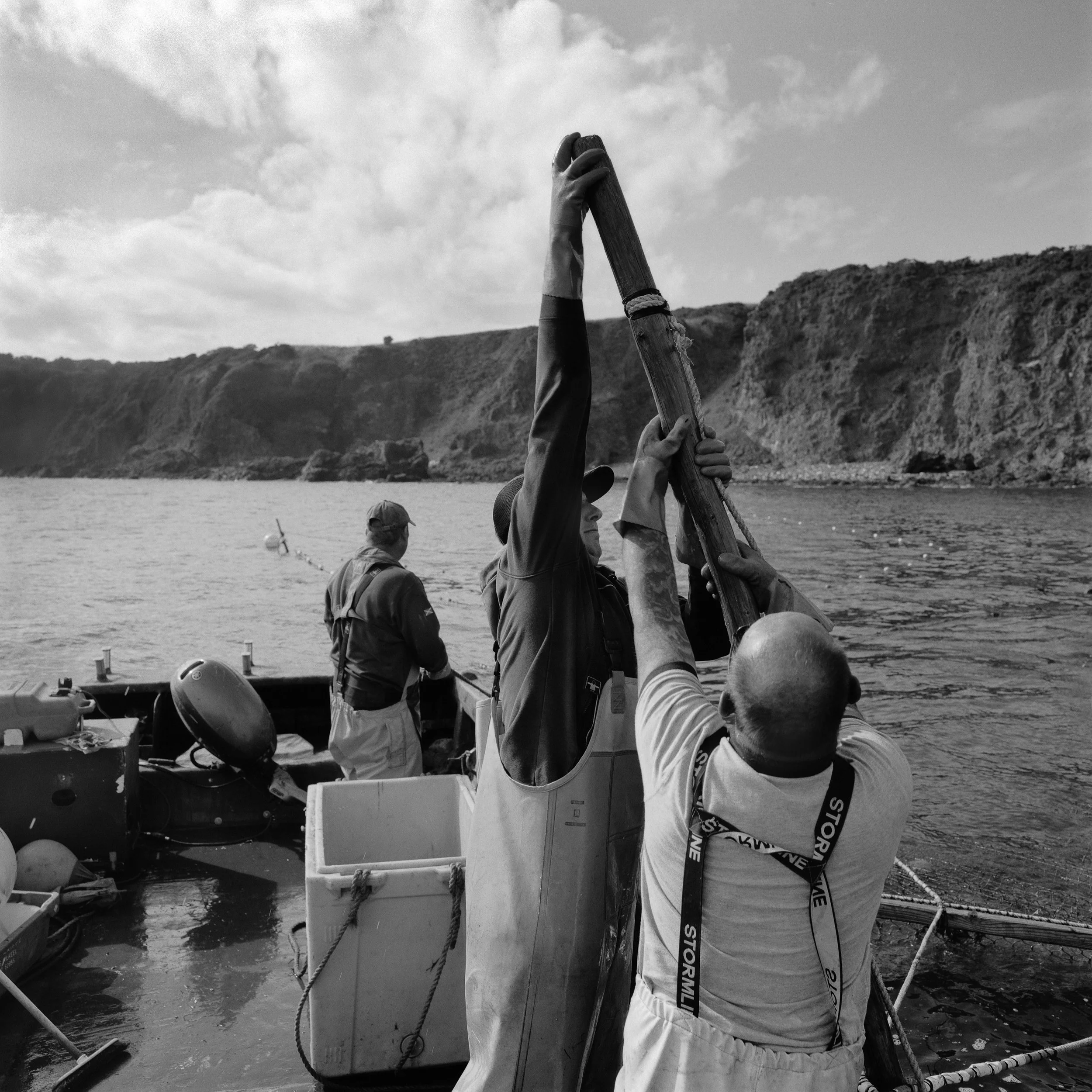
By the mid-1990s, the number of fishing stations was in sharp decline. Therefore, rather than chasing around trying to do something at a great number of locations, I decided to keep returning to the places I loved and found a warm welcome. Initially, distance had a lot to do with it. I was based in Edinburgh and although the Montrose area, where I began working, was only a couple of hours away, my preference was to be able to work without too many restrictions in terms of my time. Having said that, the early trips were all concluded in one day, albeit long days. I would often have to fit into the fishermen’s routine, as the nets were fished twice in every 24-hour cycle (excluding weekends when no fishing was permitted). This meant I had to liaise with the men as to when they were fishing the nets, or doing other activities such as net mending, maintenance, or changing the nets, which they did approximately every fortnight. It did require quite a bit of organisation, especially in an era before mobile phones or email. But when I turned up at the appointed time, I could be guaranteed that the men would just get on with their work and I would do the same. My role was always as an observer. I never tried even once to influence what I saw. Over time, the fishermen could see how dedicated I was to the subject and how much care I took photographing them in an honest and faithful way. There was, and still is, a lot of ‘politics’ around salmon net fishing. Although I didn’t set out to become an advocate for what they do, I firmly believe that they have been dealt a bad hand and that the pressure they felt to accept buy-outs and bans has meant my photography does have a resonance and value beyond history or heritage. I have always tried to be open and honest with anyone I have photographed. Building trust depends on you and your attitude, not just to photography, but to other humans and life in general. If I had gone in with any sort of ‘agenda’ or taken what I needed and left, there’s no way I could have got to the heart of salmon net fishing and what it meant to the men and coastal communities across Scotland.
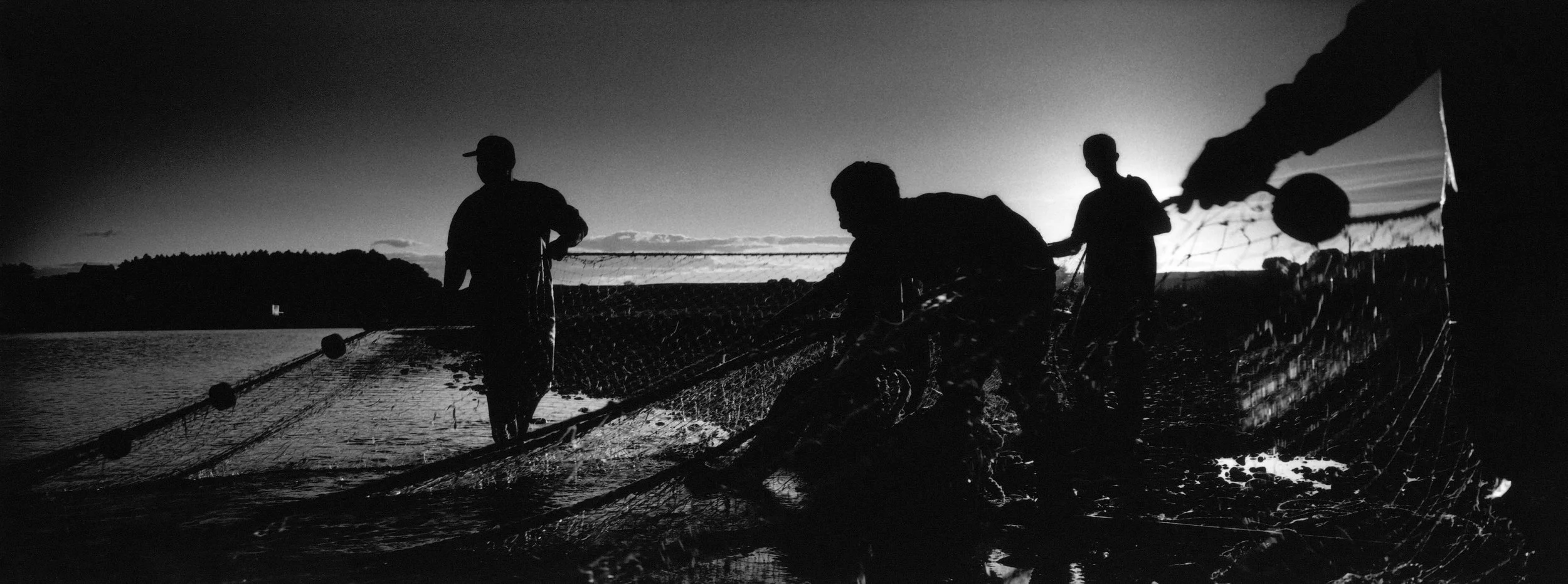
Technical Choice: The book will feature 97 tri-tone monochrome images. Why did black and white feel like the right way to photograph these fishermen and the Scottish coast?
It was more a personal choice based on the fact that I loved the process of using black-and-white photography, which I had grown up with. I had a number of great influences on my photography, but the biggest of all was my maternal uncle, the late German photographer Henning Langenheim (1950-2004). He taught me not only how to use a camera, but how to take photographs, which are two very different things. He refused to work professionally because he believed it would restrict his practice. Therefore, he was a school teacher who also dedicated himself to chronicling the world around him with a specific interest in well-researched long-term projects. More than that, he taught me how to live. How to interact with the people you wanted to photograph and how to make the most of situations you got yourself into.
The other great influence in terms of salmon net fishing was a man called Werner Kissling, who was, like my uncle and me, German. Kissling was a diplomat who came to Scotland in the 1930s to get away from Nazi Germany. His passion was photography, and he documented the salmon fisheries on the Solway Firth, which were published by the School of Scottish Studies. His methodical, almost scientific approach interested me; however, I developed my project to be something more lyrical and creative. I never saw Catching the Tide as being strictly documentary. Through a three-stage process of identifying a subject, making an image, and interpreting the results in the darkroom, I view the final images more as ‘art’ than photography.
Working with Tides: The fishermen worked with "the flow of the tides and the rhythms of the seasons." How did you learn to read these natural patterns yourself, and how did it change your shooting schedule?
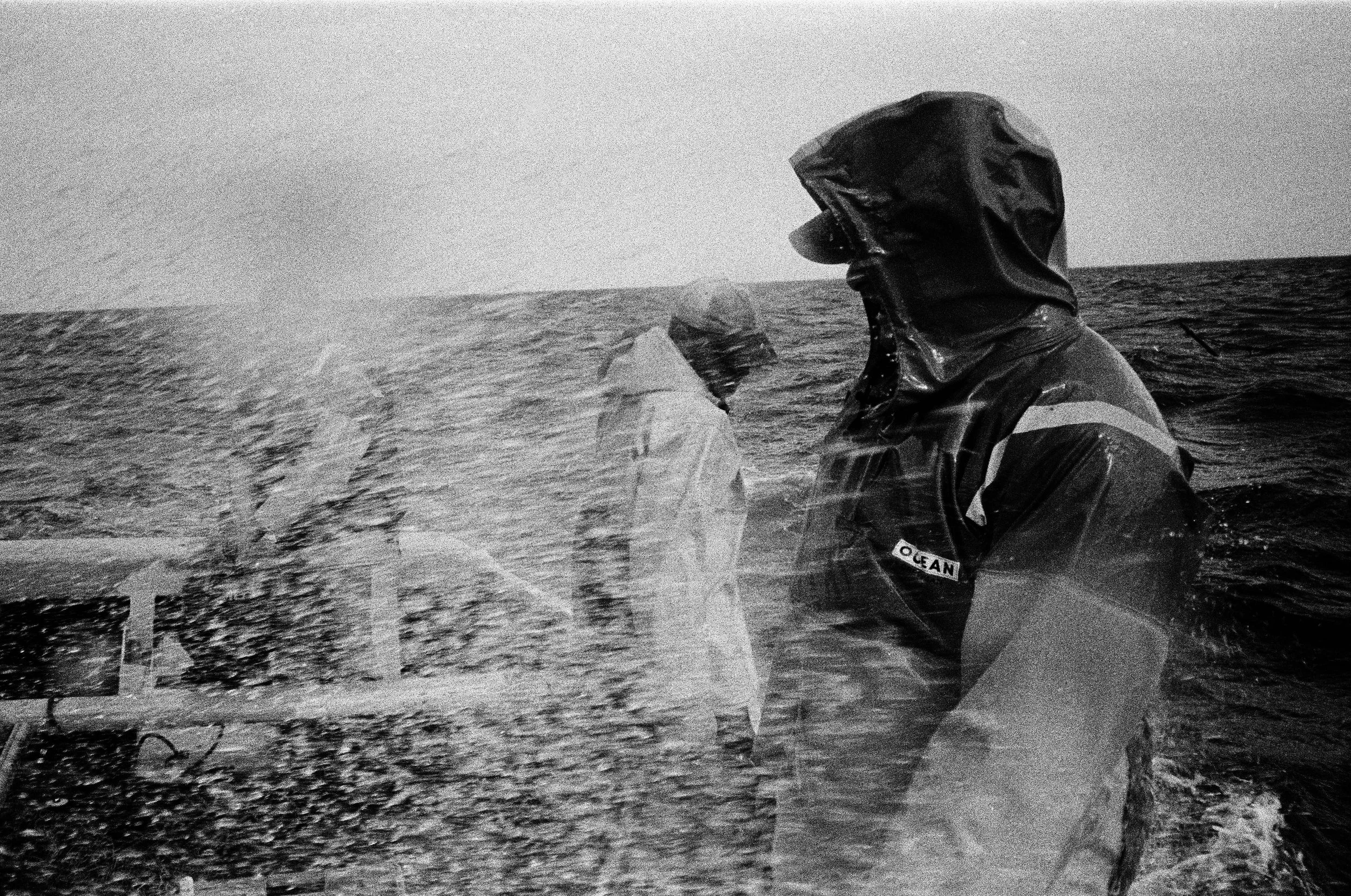
The tide places a central role in deciding the rhythm of the fishing day. I always take my lead from the fishermen, who can read the weather and sea conditions far better than me. I used to love it on a clear blue day when the fishermen would climb into their waterproofs and announce that rain was on its way despite there not being a cloud in the sky. Invariably, the skies would darken and we’d get a soaking at some point thereafter. The fishermen have such a knowledge about and respect for the sky and sea, and even though salmon net fishing takes place on the coast, in-river, and in estuaries, they are always in tune with the conditions around them. And so am I when I am with them. It’s all about them and not me, and I try to work in tune with their song.
Different Methods: You photographed various techniques like fly nets at Boddin, bag nets at Armadale, jumper nets off Kinnaber, and sweep nets on the river North Esk. Did each method require a different way of photographing?
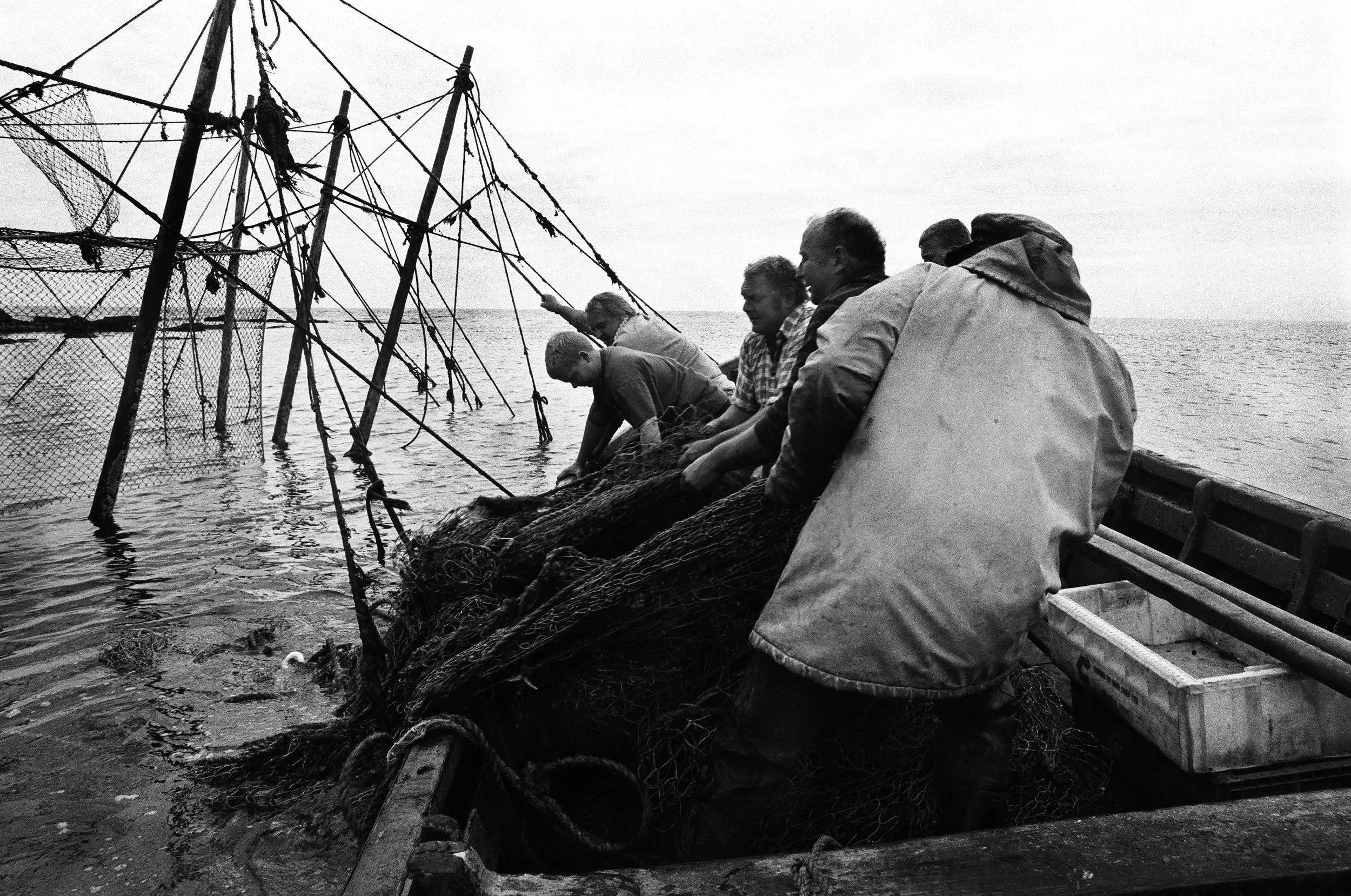
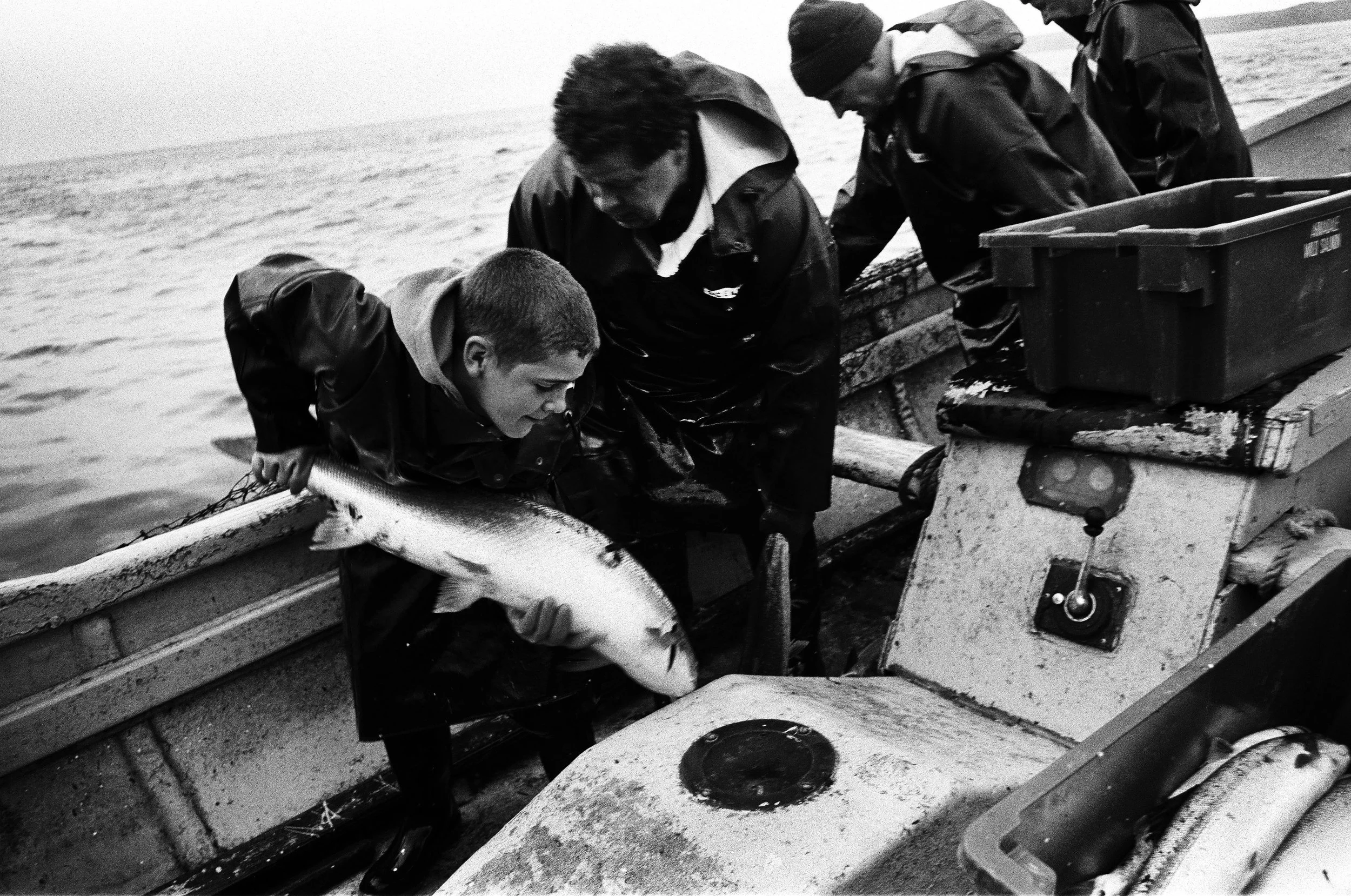
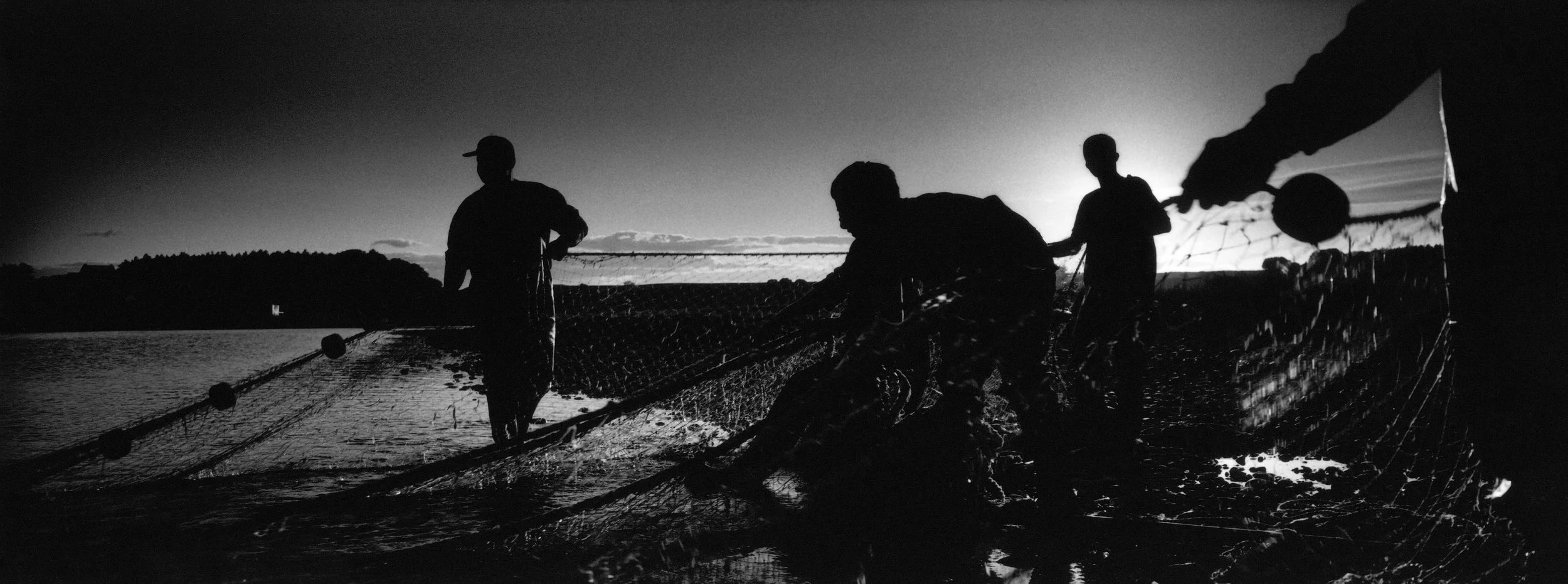
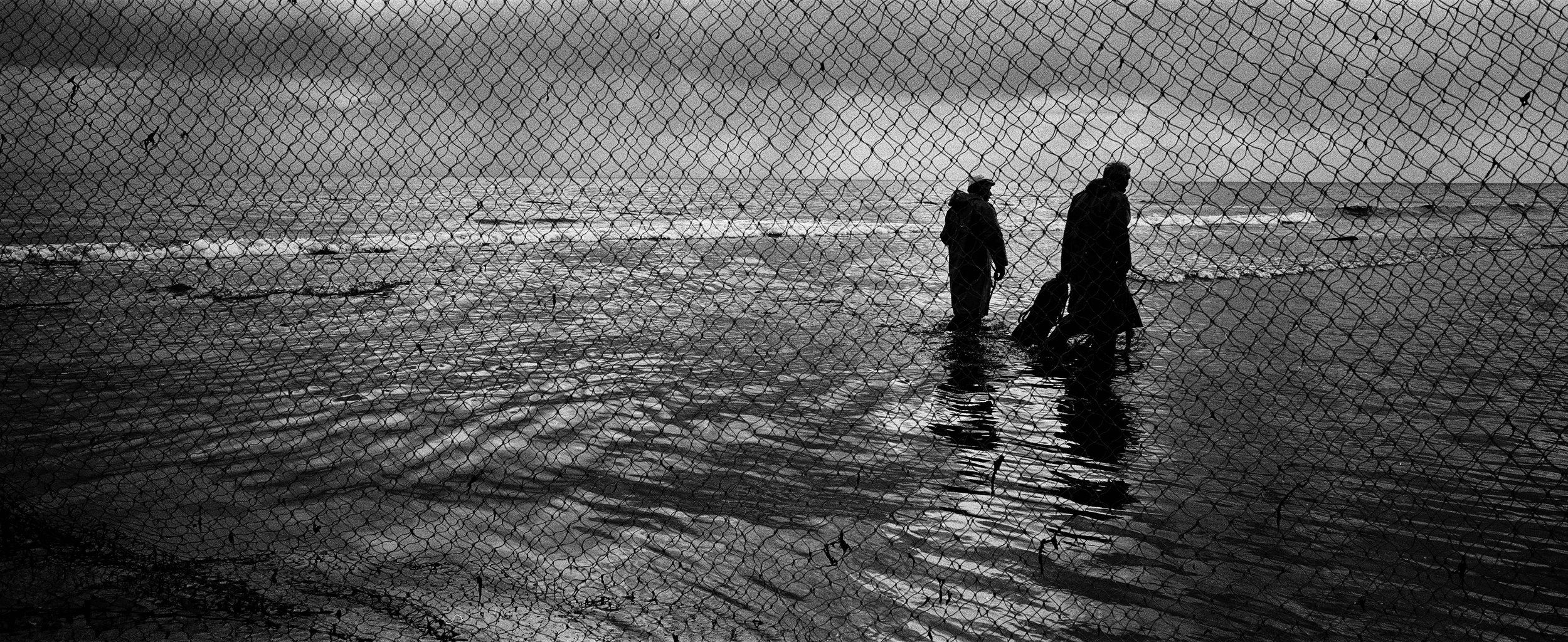
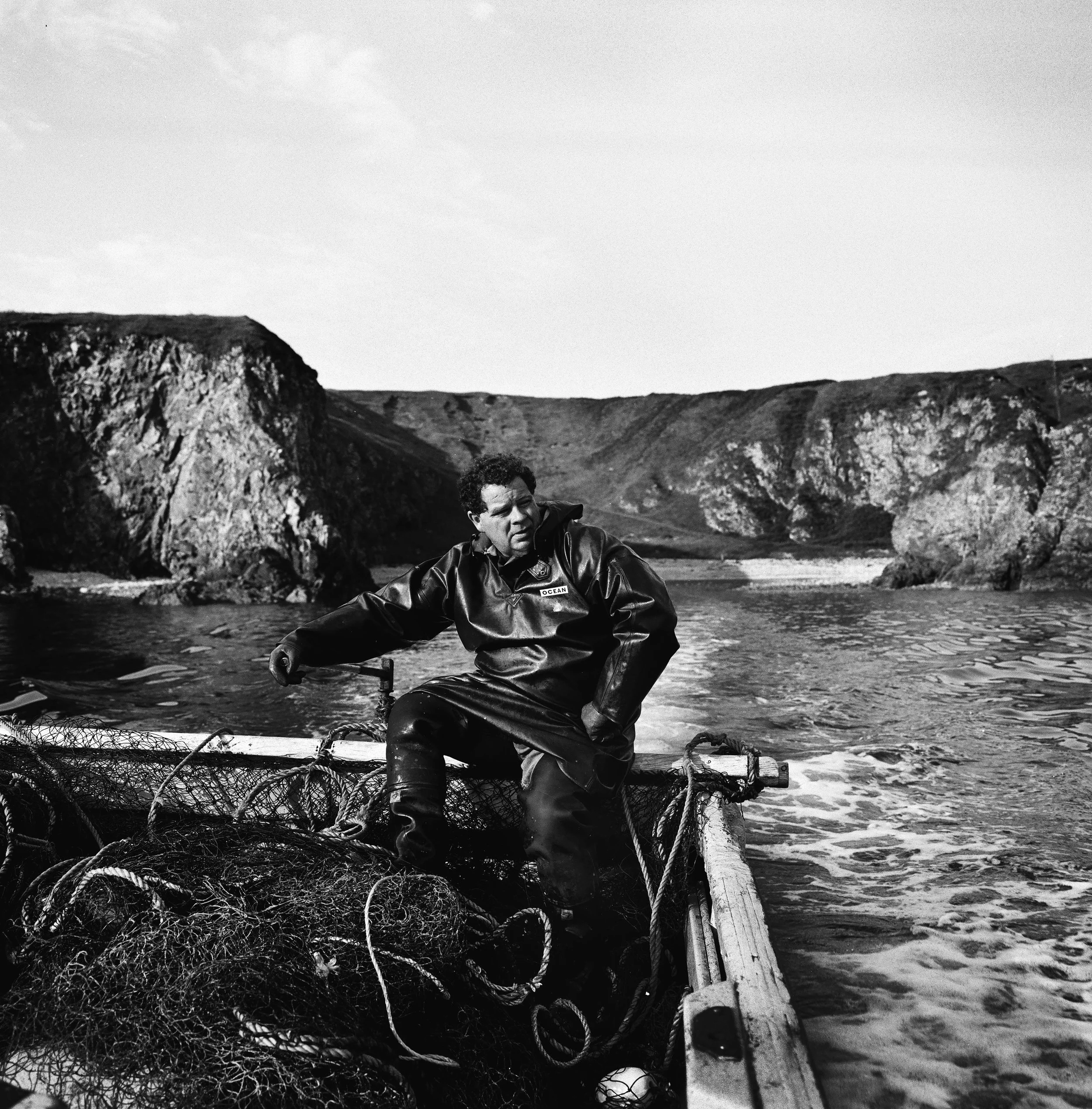
The different types of nets were in many diverse locations, which did require a slightly different approach. For example, I could find myself in a boat when we were fishing a bag net, which is quite restricting. On the other hand, beach-based jumper nets allow me greater freedom of movement and opportunity. I do like to be close to the men as they work, rather than staying too far back and being dislocated from the situation. I never use long lenses because they are too impersonal for situations like these and give an aesthetic which makes images look more like news photographs rather than something more considered. What I like most about working on Catching the Tide is slowing the pace down, taking my time, and not chasing situations. Having said that, in some situations, the action moves quickly: when a net is brought aboard a coble (one of the flat-bottomed boats used at the fishing), it can be quite a frenzied scene, with ropes having to be hauled, nets lifted, and fish harvested, all while the boat is bobbing around. I have become very philosophical about what I do or don’t manage to capture in a particular situation. I never dwell on ‘the one that got away’ as a fisherman might. I am delighted with what I can get and enjoy the experience of being with the men as they work.
Racing Against Time: By the mid-1990s, the industry was already in sharp decline from economic and environmental pressures. How did knowing this way of life was disappearing affect the urgency and emotion of your work?
I took a break from photographing salmon net fishing after 2007, essentially as I had moved to England and was bringing up a family. By that point, I felt I had photographed as much as I wanted to; however, I did keep in touch with the fishermen I worked with and continued to work on the project, which led to further publication of the material in newspapers, magazines, and books internationally, as well as exhibitions and the opportunity to have the work included in a number of important archives and collections such as the National Galleries of Scotland and the University of St Andrews Library’s Special Collections. I would always attend the AGM of the Salmon Net Fishing Association of Scotland and talk publicly about the work. In the background, I had the knowledge that the industry was in sharp decline and under constant threat from angling interests and scientific research, which was determined to point the finger at this ancient tradition as being principally to blame for falling fish stocks in Scotland’s rivers (the reality is much more complicated than that). The salmon net fishermen’s collective voice grew more and more faint, and I suppose I felt a degree of empathy for and affinity with the fishermen’s cause. I realised that my work must not be seen as merely a chronicle of something passing into antiquity, but rather an embodiment of a practice which still has resonance and relevance to coastal life in Scotland. The 2018 government ban on fishing for wild Atlantic salmon (but not sea trout) has further diminished the number of men who can be accurately described as being active; however, this gives my work even more relevance, I believe, and it is something I am developing with a number of the men at present. In 2021, I made the decision to start another chapter of the project. This involves interviewing and filming current and former fishermen to create a living archive of oral testimonies and material as a legacy project. Photography is playing a central role in this latest work and will be included in Catching the Tide when it is published.
Composition Decisions: Your images often show men small against vast beaches and seascapes. How do you decide when to make the landscape dominate versus when to move in close on the fishermen?
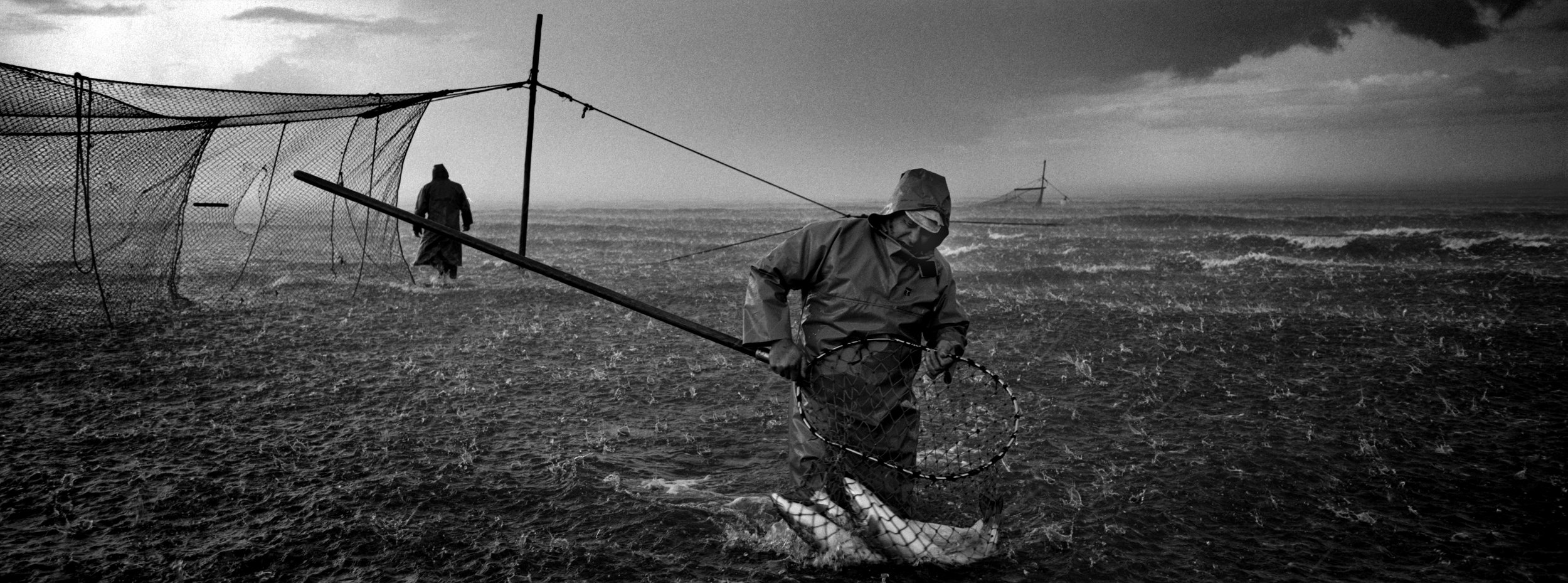
The project evolved in terms of content but also as I grew and developed as a photographer. I started with a conventional 35mm camera, but expanded the visual repertoire to secondly include a Hasselblad XPan and then in 2000 I bought a Mamiya 6. These were all aesthetic choices. The XPan was the favoured camera of Henning Langenheim and when I bought mine, it was the first one sold in Scotland. I loved the feel and format of it and allowed me to explore the subject in a visually different and interesting way. It leant itself to the narrative of ‘figures in a landscape’ which is very much one of my trademarks, not just with Catching the Tide. I added the medium format so I could do some portraiture, but again my way of doing this is not static or posed, but rather dynamic and reflecting the movement in the men’s work. The 35mm still has a place, it covers the basics. I am very comfortable using all three formats and would usually go out with the three different cameras - they are all rangefinders - to photograph the fishing. A long-term project allows you to develop your creative practice without limits of time and constraints on what you are exploring. I loved the freedom of choosing which format to use, but quite often I would photograph the same scene with the different cameras and compare which one spoke loudest to me. Printing my own material in the darkroom is still a vital component of the process and again the three formats allow me to experiment with what works best, although it should be noted that no image is ever cropped! When taking photographs, I have in my mind’s eye what the final print will look like. I don’t exclusively rely on prints, however, as the entire edited collection of images has been scanned and these are perfectly good, quality-wise, for publishing and use online. If I am exhibiting the work, I do prefer to use handmade prints wherever possible.
Book Design: The book will be 300mm x 245mm on Gardapat Kiara paper with a cloth cover, printed by EBS in Verona. How involved were you in these physical choices, and what feeling do you want readers to have when they hold it?
With the exception of the choice of paper stock, something I don’t know much about, I made all the decisions around the design and presentation of the book myself. At present, we are still in the Kickstarter fundraising phase, so the final look and feel of the book will be determined by how successful we are at raising the money required to produce a book which matches my ambition and expectations. As I am so close to the work, I felt I should be the one to design the book. I wanted to explore the narrative arc of the contents and match that with an appropriate layout. I did a lot of research and talked to many photographers about different aspects of the whole publishing cycle. It will be for others to decide whether the choices and decisions I have made are effective, but I really enjoyed the designing and sequencing of the photography, and those who have had a preview have responded favourably. I have designed my own self-published books in the past, so I have the confidence to try what I think works and express myself in the design.
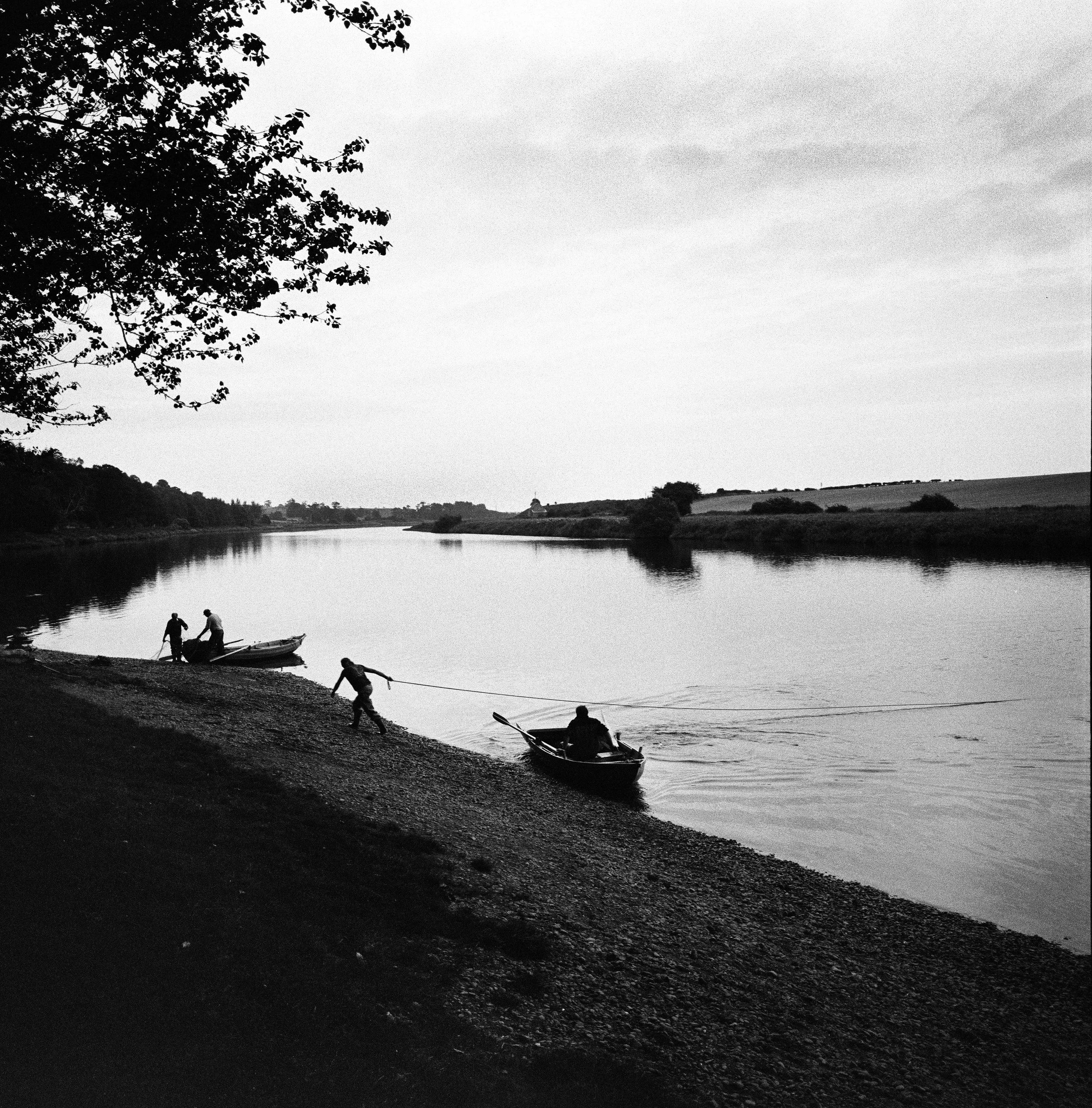

Personal Connection: You became an Associate Member of the Salmon Net Fishing Association of Scotland. After thirty years with these communities, what have the fishermen taught you beyond photography?
I was delighted to be accepted as an Associate member of the Salmon Net Fishing Association of Scotland a few years back. It is a very small organisation, and I felt that by joining them, I wanted to give something back to the many people who have helped me over the years and do what I can for them in whatever way I am able to. Almost all of the fishermen I worked with at the beginning have passed away now. It is a hard, physical job, and very few survive into old age. Those that do remain are still friends, and their sons are friends of mine too. Working with the fishermen gave me a great appreciation of Scotland’s coastal communities, of the balance that humanity and nature have to strike to co-exist (something we are not managing well globally), and above all, patience. You cannot rush or hurry the natural environment, and the people who work with nature have a way about them. They understand the rhythm of life and work with, not against, it. They also taught me that to do something well, you have to put time, effort, skill, and knowledge into it. And be prepared to learn. Not just from the people you are working with, but from the wider world that surrounds us. That leads back to those figures in the landscape. I am intrigued by our place in the world.
To discover more about this intriguing body of work and how you can acquire your own copy, you can find and purchase the book here. (Kickstarter, Dewi Lewis Publishing)
More photography books?
We'd love to read your comments below, sharing your thoughts and insights on the artist's work. Looking forward to welcoming you back for our next [book spotlight]. See you then!
Gosbert Gottmann wanted war photographs that resisted easy reading. In Freiheit Freedom Воля, he works with images connected to the war in Ukraine and changes them through abstraction, distortion and deformation. Photography Book Spotlight