Welcome to this edition of [book spotlight]. Today, we uncover the layers of 'Locations from a Movie I Never Made,' by David Graham (published by Kehrer Verlag). We'd love to read your comments below about these insights and ideas behind the artist's work.
What makes a photo feel like a film you’ve already seen?
Maybe it’s the light that looks borrowed from a dream or a person who seems to be acting without knowing it. For David Graham, those moments appear while he is doing his job as a Hollywood location scout. He spends his days searching for settings that can hold a story, working for directors like Spielberg and Ang Lee. But over time, he began to notice that the most cinematic moments were already happening around him, inside the real places he was hired to find. That thought changed the way he looked at every scene.
He started saving the photos he took while scouting, not just as references but as images that stood on their own. A quiet hallway, a diner in the afternoon, a child passing through a beam of light, they all looked like movie scenes that no one would ever film. The more he worked, the more he saw that light, space, and coincidence could create stories without scripts. Those images became his book Locations from a Movie I Never Made, a collection of real places that look as if a film is about to begin.
The Book
Locations From a Movie I Never Made is a captivating exploration of the cinematic possibilities hidden in everyday spaces. Created by renowned photographer and location scout David Graham, this collection blurs the line between reality and fiction, transforming quiet streets, empty diners, and forgotten corners into evocative scenes that feel pulled straight from a film.
With decades of experience scouting for directors like Steven Spielberg and Ang Lee, Graham’s work reflects his keen eye for mood, mystery, and storytelling. Each image in this collection invites the viewer to imagine the untold stories waiting to unfold within these striking locations.
Featuring 70 color photographs captured across five continents, Locations From a Movie I Never Made is both a visual journey and a meditation on the power of setting. Accompanied by essays from Graham and cultural commentator Leah Modigliani, the book delves into the artistic process and the ways in which photography intersects with storytelling. (Kehrer Verlag, Amazon)
Martin: How did you first get into photography?
David: It was through a backdoor method, actually, by being a location scout. That career came before photography. You need to have photographic skills to be a location scout, but it's more about having an eye for locations and recording them so the head creatives can take your frame and fill it with their ideas to satisfy their narrative needs.
I started scouting in 1995 in New York City. About ten years later, I became more interested in diving into my own creative interests. I had a degree in film production, and had written some screenplays, but no luck getting them optioned. That's when I decided to pursue my love for photography more seriously.
Since I was already taking so many pictures as a scout, I started exploring my own creative vision through photography. Around 2005, I took a workshop with Alex Webb and his wife Rebecca in Barcelona, and that really jump-started my dive into photography, particularly street photography.
You were interested in film before that. Is that why you attended film school at Austin?
Correct. I went to the University of Texas in Austin and got a degree in film production, graduating in 1989. At that point, it was either New York or LA as the two film centers. I opted for New York and started freelancing in film production as a production assistant, working from the bottom up. Eventually, I found my way into locations. I love New York City and exploring it, and I love photography, so I forced myself to learn the basics. Back then, we were shooting on negative film, so you had to actually understand exposure and technical aspects that people don't have to worry about now. I was essentially self-taught in photography, combining that with my love of film.
How did your screenwriting and storytelling background influence your visual eye?
When I work on a feature film, I get a screenplay that's usually 120 to 150 pages, with about a page per minute of screen time. I have to take these written words and create visual images that the director or photographer can then turn into photographed or filmed images. Screenplays are narratives with creative arcs, and the title of my last book was "Locations from a Movie I Never Made." It reflects this desire to tell a story. A single photograph can tell a story just as powerfully as an entire screenplay or movie.
My desire to tell stories was inspired by reading screenplays and scouting for films, and that naturally transferred to my photography. I prefer working by myself, actually. Film is a very collaborative effort with giant crews, but I'm more of an individual person who likes working on creative issues independently.
Can you explain how you discovered location scouting and what the process involves? I understand you often get the script before everyone else, even when directors are secretive about projects. How does that work for you?
Yes, I sign a lot of NDAs. I'm sometimes the very first person hired on a movie, so I get the first copy of the script aside from the director and above-the-line people. Sometimes I'm the first person hired on a movie after its green lit, getting an early copy of the script. Once they get the funding, they start the scout immediately because it takes time to find locations, consider them, clear them, and have them ready to present to the director.
It's a very niche industry with not many of us doing it. I discovered it when I was working on a film in Texas right after graduating from film school. I saw the location manager with these amazing panoramic folders of pictures taped together. For the first ten years, we shot on negative film, and we'd line up photographs in panoramic shots, taping each picture together to create a cinematic view of every location. It was like an arts and crafts class with manila folders, glue, and tape. This was way before iPhones.
When I asked her about her job, she explained she was the location manager who found all the locations. I thought it was incredibly cool. It took me about five years after moving to New York to find my way into it. I approached a location manager named Lauri Pitkus and offered to work as an unpaid intern. On day three, she put me on payroll. She's still a manager today, and friend this day. Most people do it for a few years and move on, but I really enjoyed it and stuck with it.
How do you know when a photo is good, balanced, and cinematic? What specific visual elements tell you a photo has crossed from documentation into cinematic territory?
As a location scout, I see things as settings for films or photo shoots, so it starts with the setting. I begin with what's either an extraordinary setting or an ordinary one; it's usually one extreme or the other. When something jumps out at me, I'll literally run to capture it.
This shot here is a wrestling ring in Cambodia. It's clearly something unusual and extraordinary: a guy in pink wrestling tights and boots with people climbing over the rope. It's something unique that I've had the privilege to see, and I knew I wanted to photograph that.
That's one example of the extraordinary. On the other hand, something can be completely ordinary, like this sidewalk in Poland. You have two people standing on opposite sides of the sidewalk, basically a very common setting. Two people waiting for what looks like a bus or a ride, positioned on opposite sides of this perfectly centered sidewalk down a tree-lined boulevard. It's something rather banal and not terribly interesting to most people, but there was symmetry in it.
After deciding whether the setting is unique and interesting, I move into the artistic qualities. Is it balanced? This particular photograph is, and while I don't always like things balanced, the symmetry works there and speaks to me in a graphic sense. Since I like to shoot cinematically, lighting is really important to me, so I hone in on that. If it's flat lighting, I'm just not going to respond. It won't have a cinematic feel.
If it's an interior, I look for something with dramatic lighting, contrast, and shadow. That speaks to me, and I'll respond to that. Composition-wise, I consider whether there's something interesting in the frame. For me, the most important element is the setting and location, with the subject coming in last, not that it's least important.
All these elements matter: what I like compositionally, what the subject is, whether the frame is pleasing, whether the lighting is interesting and dramatic. But I let the subject come in last.
This is the Souk in Marrakesh. Just the right angle, with light coming through beautifully at the top. There are lots of interesting details. They're incredibly rich and amazing to wander through, though not the easiest to photograph.
Then this 12-year-old kid comes zipping by on a moped, and he becomes my subject. That was the last element to fall into place. I basically sat there, pretended I was invisible, and waited for somebody to come into the frame. This kid on a moped zipping through was perfect to me. That's when I clicked the shutter. Those elements are what help me determine when to shoot.
How do you discover and recognize a scene that you want to photograph when you're walking with your camera, without taking any lights with you?
No, everything's natural light. If it's a setting that's inspirational for an entire scene, where one frame sets up everything that's about to happen, I'll respond and take the picture. When I'm scouting, I'll shoot on a lower file size because I can take 1,000 pictures a day, sometimes more. But I might switch to RAW when I realize this could actually work as a still image that conveys the idea of a setting.
Do you have the entire script in mind, or are you searching for specific scenes within it? How do you mentally go through the scenes to decide which locations might be suitable?
No, it's very specific. We take the script and break it down for every single location. There are movies with just one location, like a cabin in the woods with maybe an intro road shop. Very few are like that. But a movie could have a 100 locations.
We break it down systematically. I'll go out looking for one specific thing, like a rooftop in Manhattan. That might be my task for the week, and if it's a main location, it could take weeks. In 2023 worked on "Zero Day," a streaming series with Robert De Niro playing a former president of the United States. Much of the series was shot at this former president's home in upstate New York in the Hudson Valley. My colleague and I spent probably six weeks on that. We looked at so many properties. It takes considerable time to clear them, shoot them, present them, and get approval. Such a key location just requires extensive time to find and decide on.
I'll go out with one idea in mind. If I'm looking for an office building and also know we need an avenue for a car to drive by, I might grab a second or third idea if it's convenient, but generally I focus on one thing. The location manager, producer, designer, or sometimes the director will tell me specifically what they need: "David, this week we need a high-end office building in Manhattan with amazing views." It's quite specific.
How do you identify the best rooftop photo out of 10, 20, or 30 options? Is there a specific location or element that makes it stand out?
Sometimes I know immediately. I'll walk onto a location and think, "I found it." Other times, its tricky to figure out what the director might like.. There are many important elements to consider: which way the sun faces, the textures, the size. Then there are logistical practicalities like whether it's big enough for a film crew, which can be very large, often over 100 people.
I also need to know parameters within whatever municipality I'm scouting in, because many places aren't film-friendly or won't give us permits for trucks. They won't let you shoot at night. There's a lot of practicality involved. I have to vet all locations and ensure they're permittable, because if I show a location and the director falls in love with it, then we can't get the permit, my head's chopped off.
There's that technical side, and then visually, from a creative standpoint, if I have a really clear idea from the production designer about all the elements we're looking for, I might walk into a home and think, "This checks so many boxes on the list. I think this is going to be it." I'll get really excited and call the designer, producer, and location manager to get the director there to see if they like it. Sometimes I'm right on the nose. Sometimes I'm way off.
It's ultimately the director's creative decision, but I can usually know if it's going to be in the top five.
Your personal projects blend the film industry with fine art photography. How does this dual perspective influence your worldview?
I see everything as a setting for a movie, basically. I cannot drive by the most picture-perfect farm upstate where the split rail fence does the perfect thing, with the tree here and the farmhouse there, without thinking, "there it is" and take a picture of it.
I have the privilege to access amazing locations that many people cannot. Whether it's a $50 million penthouse in the city or the base of 9/11 after the towers fell, for a public service announcement I was hired to scout for. There are many fascinating, emotional, wonderful things I get to look at that most people do not have access to.
I definitely try to be an opportunist, and that's basically what's churned my creative mind to say, let me take advantage of the fact that I have access that a lot of people don't have. That's when I started to let people walk into a frame that normally I would want clear for the director to put their characters in. I started to let elements come into the frame, people, pets.
In this one we have the dog in the frame with the owner in the background. Normally I would want that frame clear. This was for Tommy Hilfiger, and they wanted to see an empty room so they could say, "We like the room." But the dog came in at the right moment, with the owner looking the other way. Suddenly there's a moment, and their story has become my story. I would snap it, put it on RAW, archive it, and it wound up being in my book.
Most photographers either document reality or stage scenes, but you do something different, something in between, would you say?
Very much so. I'm in that world between reality and something unreal, a kind of stepping stone between them. That was the purpose of the book, bridging the real and the unreal and how I shoot with verisimilitude in mind. I think it's a very small creative niche that I've tapped into that isn't common.
You have this ability to see locations as narrative spaces before they become narratives. Can you walk me through what that means for you?
I was shooting at a restaurant with a forest in the background called Clifton's in downtown Los Angeles. It was for something called the upfronts for NBC, where we promote all the upcoming shows. I needed to find a space with many different looks because we had numerous stars for that season's shows.
I walked into this restaurant with an amazing mural of trees and tables in front of it, busy at lunch. On the left side of the frame was a man, and it was Ash Wednesday, so he had the cross on his forehead. Suddenly, that became a setting, a scene. This amazing restaurant with this incredible wood mural and this man with the Ash Wednesday cross.
It felt like the start of a Hitchcock movie or something. It was evocative to me as the start of some sort of narrative. These are real people, but suddenly it's become my narrative. Again, I put my camera on RAW, captured that, saved it, thinking it could be something if I ever decided to do a book, which I did. I'm glad I saved it.
Do you only take photos while working or also during personal travels?
Yes, absolutely. I'd say half of the photographs in "Locations from a Movie I Never Made" are from travel, not scouting. Half are from actual scouting where it could be the frame, or maybe there's something interesting in the room and I turn and shoot what's behind me, though not pertinent to the project I'm scouting for.
It helps inspire my travel choices. There's a shot I took on the Isle of Skye of a sheep with the sun setting on this winding road. The light was so dim that I lit the sheep with my car lights and shot it from the car window. You get a ribbon of the road and the silhouette of the mountains.
I do some car commercials sometimes, and it's perfect for finding those lonely roads where a convertible could drive by. I think about where the car would be, where the crew would set up. I get a lot of satisfaction from finding those things. I took a trip to the Isle of Skye on my own. Some people asked what assignment I was on, who was paying me. Nobody was paying me; I wish they were. I just went because I really enjoy that sort of travel. My travel is sometimes inspired by car commercials, finding lonely roads for that convertible to drive by. I spent three days there, and the Isle of Skye is wonderful.
You mentioned you take around 1,000 photos a day. What is it like taking 1,000 photos a day for location scouting?
These days people want things so quick. But I still edit all my shots through Lightroom. People think I'm crazy. Although scouting shots are far from perfect, we scout really quick, i do like to make sure they are centered and formally framed, like a Kubrick film. Sometimes it can be a big day, usually between 200 and 500. Some days, zero. I might not find anything. I don't shoot on RAW because I would have so many hard drives.
I shoot on lower JPEG sizes, which became a bit of a curse because sometimes there are amazing pictures that I think could be perfect as an art piece or for a book, but they were shot on too small a file. When we did the final edit of my book, I had to cut about 10% of the shots because the file size was too small to print properly.
You mentioned directors and producers commenting on your photo quality. What were they responding to?
I suppose they're a bit different from standard location scout photos. Maybe it's because I try to make them more dramatic. The contrast, focusing on good lighting. I do a bit of editing in post, so maybe they see that and appreciate it.
Is there something you took from directors like Spielberg or Ang Lee that shaped your understanding of visual storytelling?
Sometimes I'll be with somebody, and everybody uses their iPhone now, so I can actually see how organically they work. I might take the director and the director of photography on a scout, and everyone's taking pictures of what I've discovered with their own cameras. But suddenly it's more loose and fluid, not squared off in that perfect frame. They're out of focus. The DP has his iPhone out the car window photographing this road I thought would be good for a car chase scene, which just happened in the Spielberg movie, taking these very loose, organic pictures that are fantastic. They're just very different from my formal approach as a location scout.
I like to see how people respond because nowadays, it used to be just my pictures that were the Bible for the film. Now the producer's taking pictures, the star's taking pictures. Everybody has copies of these locations I'm finding because everyone's a photographer with an iPhone.
At the beginning you mentioned you took a workshop with Alex and Rebecca Norris Webb. What did they teach you that changed how you approached photography as an art?
A lot. They're really fantastic to work with. I took three workshops with them. The first was in Barcelona, then Cuba, where we snuck in when it wasn't legal, and then Poland for the third workshop in Łódź. Not only did they teach me a lot, but "Locations from a Movie I Never Made" was based on a workshop I did with them to develop the book idea. They responded to my eye and thought maybe I could come up with something. Rebecca and Alex came up with that title, and I have immense gratitude to them for putting me on that path. It wound up being published by Kehrer Verlag, and I'm very thankful for them. They definitely helped shape my vision, encouraging me to embrace the formality in my shooting.
They also noted the distance in my work. I often catch people with a look right into the camera, and Rebecca called that out, saying maybe that's a bit of my signature: catching someone on the street with that dead-ahead gaze. I'm forever thankful to them.
You mentioned taking thousands of photos, but there are only 70 in the book. How do you recognize which scouting photos work as standalone art pieces?
It was hard. This isn't unique to me; I'm sure anybody who's made a book starts with a wide selection. My top selects folder had probably 300 shots in it. Then I just whittled it down. Alex and Rebecca had said to keep looking at it, keep reviewing, keep editing. I distinctly remember them saying, "You'll know when you're there. The strongest pictures keep speaking to you." They spoke the complete truth because I feel very comfortable with the final edit, how I got down to 70. There were plenty of amazing locations I've had access to, but I think 70 was a good number. It didn't need to be a book of 100 pictures or more.
You mentioned you shoot wide and as far back as possible. Is the distance what creates this cinematic quality?
Maybe you're right; I've never thought of that. But it's my job to show as much detail in a room as possible. So I'm not getting up close. I need to stand back to the farthest wall and shoot wide to capture the entire wall. Then I'll go to each side of the room. In theory, I could do four shots of a room and show all four angles to get all the details. Then I might do close-ups on a few angles. But yes, I think that does establish it as a cinematic frame, being far back and wide to capture that wide-screen aspect.
You explore how photographed spaces can feel staged even when they are completely real. What creates this effect?
If it's just so perfect, that was a final deciding factor for what made the cut in my book. It just looks staged. Like that previous picture with the man with the Ash Wednesday cross looking at the camera, everybody else having lunch, and the forest in the background. There's something surreal about it, and a lot of my photographs have a surreal feel. I could almost see an assistant director staging all these characters having lunch. There's a perfection in the balance, and it just seems staged to me.
What advice would you give your younger self about improving your photography?
I wish I had considered myself a photographer at a younger age and started saving images, shooting in bigger files, because I had the privilege of being in a lot of wonderful spaces. One of my first movies was "The Ice Storm" that Ang Lee directed. It's a period movie set in New York and Connecticut in the early 70s when those really hyper-modern glass homes were being developed, inspired by Philip Johnson's glass house. I was getting into these amazing iconic homes, and back then I took it for granted. I stopped doing that years ago. It would have been nice to have some quality imagery saved from back then.
How do you see the stories before they exist? Do you populate the space in your mind to kind of imagine the movie or is there some sort of trick you do?
They jump out at me. I don't look for them. If I see architecturally a space that inspires me, it might trigger my brain a little bit. And then I pay attention to the lighting. As I said, flat lighting doesn't work for me. And then if those two suddenly check off, I'm like, wow, OK.
I'm in Morocco. I'm on this alleyway, and the sun's coming down. And I'm like, the light's getting really nice right now at four o'clock. It's that kind of getting a nice angle. It's kind of dramatic, with shadows. I know it's hitting people coming this way. And then I might wait for a certain person to enter the frame. In the case of my book, it was probably an 11-year-old on a moped, as they are some kid racing through the alleyway with a big satchel or bag on his back, and then a woman right next to him in her beautiful Moroccan garb.
That's, I kind of waited for some interesting people to enter my frame because I had established that was a really cool alleyway in Marrakesh, and I waited for the correct people to kind of fill the frame, and I took it.
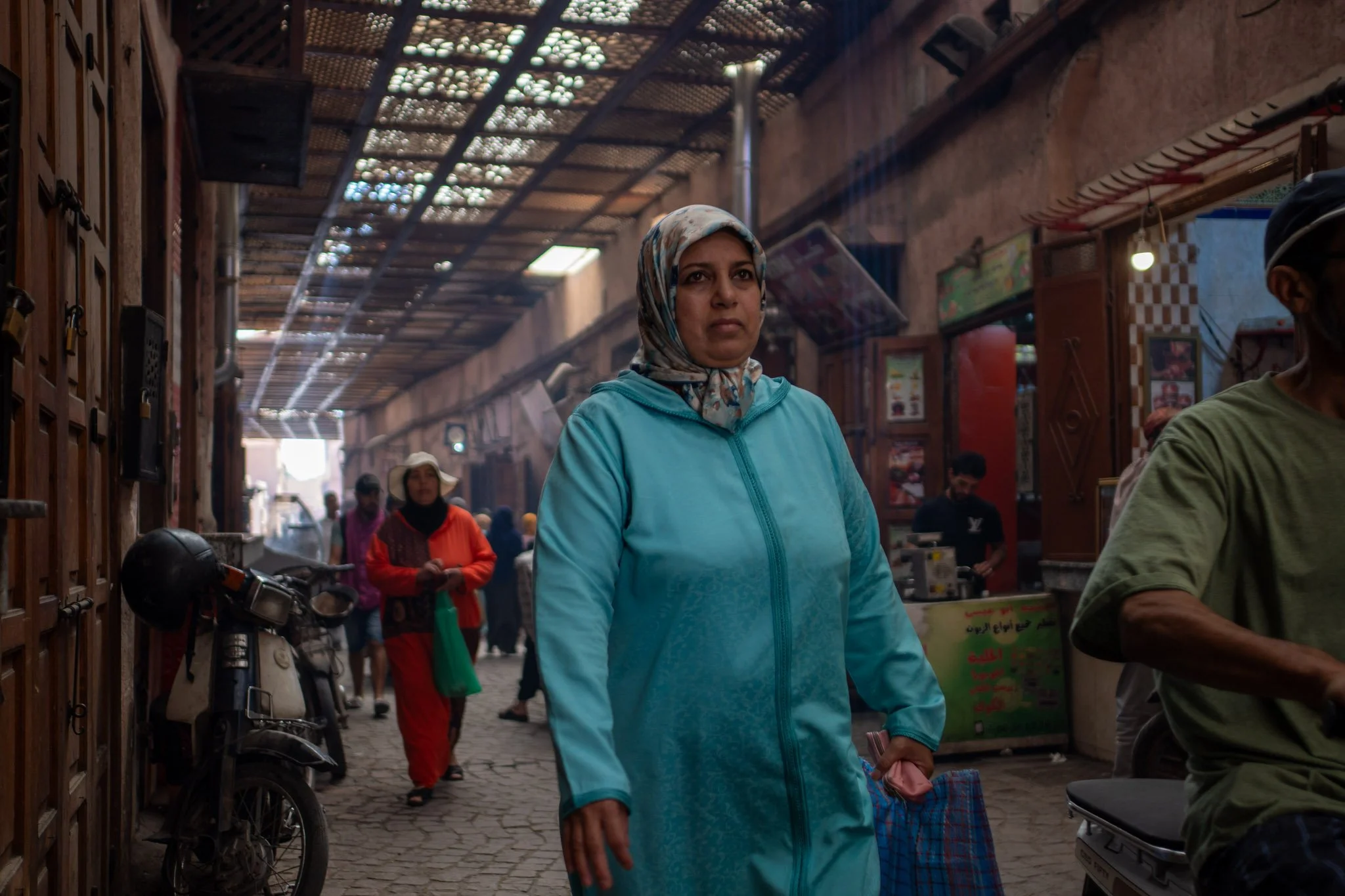
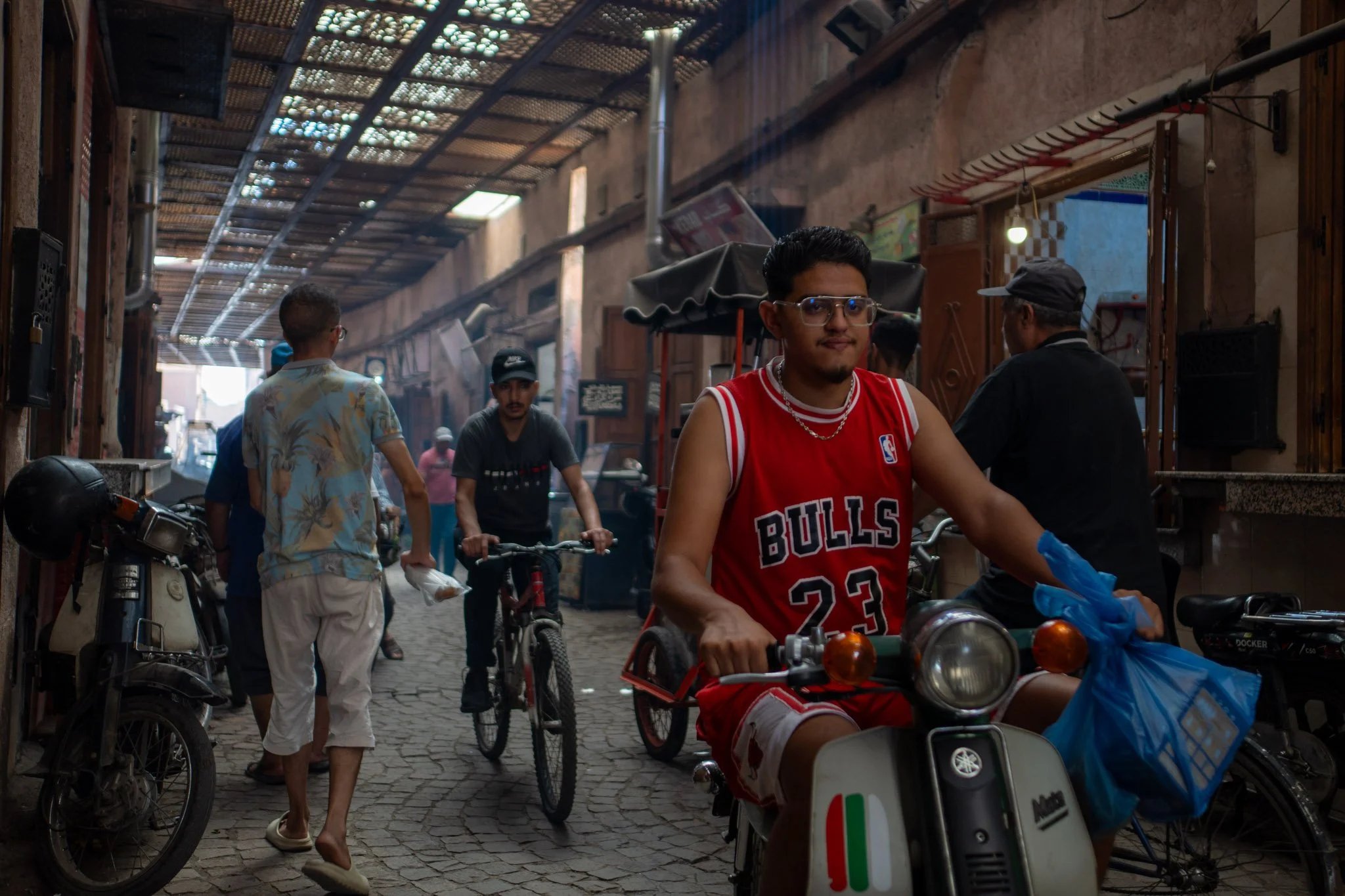
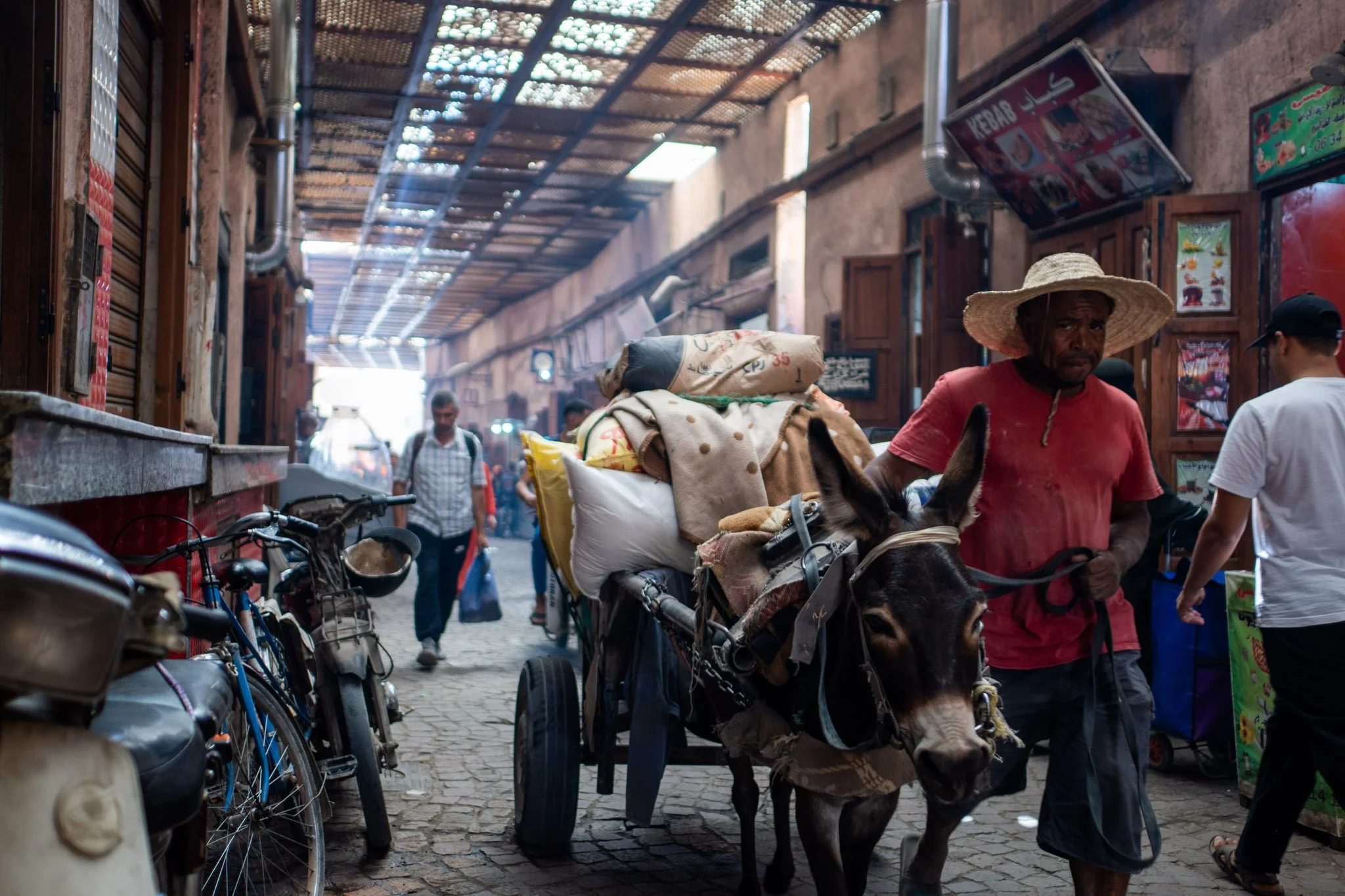

I'm inspired first when I see something architecturally that I think is unique, either beautiful or sets a mood. It could just be a dark alley in New York that's kind of scary that looks like you could throw a body at. So I'm like, wow, this is cinematic. What could this be? Or something beautiful, a beautiful restaurant, a beautiful living room. Every now and then, I'll be in someone's home, and it's like, wow, can I get a picture? Just because they have interesting taste that is unique to me. So the setting speaks to me first, and then the other parts kind of fall in place.
To discover more about this intriguing body of work and how you can acquire your own copy, you can find and purchase the book here. (Kehrer Verlag, Amazon)
More photography books?
We'd love to read your comments below, sharing your thoughts and insights on the artist's work. Looking forward to welcoming you back for our next [book spotlight]. See you then!
Color entered Janelle Lynch’s photographs through painting. In Another Way of Looking at Love, she photographed plants and trees on her property in the Catskills. Photography Book Spotlight