ONE: Hallway - Roy DeCarava by Sean Kernan
ONE is a series where photographers and visual thinkers reflect on a single photograph that deeply shaped how they see the medium, choosing an image they admire rather than their own. In a world of endless scrolling, the series is an invitation to slow down and consider how one photograph can stay with us, quietly and permanently.
In ONE, we slow down for a single photograph and let it work on us in its own time. This installment turns to Roy DeCarava’s Hallway, a picture that feels endlessly engaging and somehow purely photographic, even when you cannot explain why. Sean Kernan has shown it to students for years as a lesson in seeing, not because it offers a clean takeaway, but because it refuses one: it is moody, dark, strangely luminous, and more evocative than any list of words can hold. What stays with him is the way the image keeps opening into a whole world, and the quiet realization that the deepest encounters with art are often the ones we cannot translate, only return, with attention, with silence, and maybe, with something made in response.
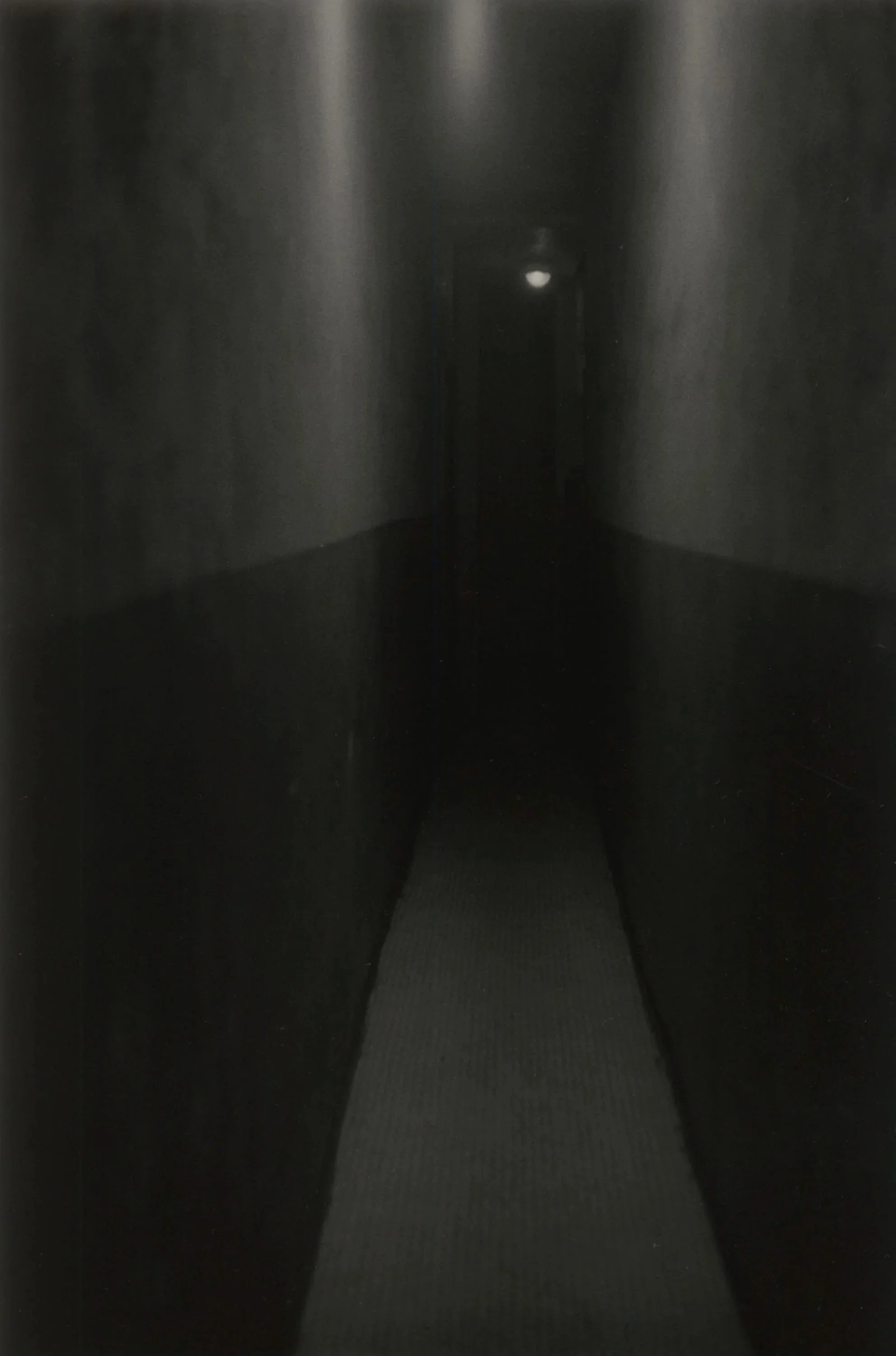
Hallway, Roy DeCarava
Hallway (1953) is one of Roy DeCarava’s most distilled images of everyday Harlem. Made as a gelatin silver print, it turns a simple tenement corridor into a study of quiet tension: deep shadow, a narrow passage, and light pulling you forward toward a distant doorway. The photograph captures what DeCarava did better than almost anyone, using darkness not to hide information, but to give ordinary spaces dignity, atmosphere, and emotional weight.
What is it about this photo?
I’ve shown it to countless people, students and photographers, just to point to a particular phenomenon of seeing. I think it is one of the most engaging photos ever…and one of the most “photographic”. And I can never say why. There is no thing I can point to that makes it so.
For one thing, it is preternaturally evocative. I look at it, and a world comes into my awareness. A list of descriptives might include:
moody
crepuscular
poignant
liminal
darkling
sad
strangely luminous
And yet no one of them is definitive, and even taken all together, they fail. There are things that language simply can't do. It can get toward certain things, but in the end, it doesn’t arrive.
Describing a visual can be like JPEGing, either adequately comprehensive or crude, but always leaving something out. There is a reason for this, and it lies in ways the brain functions. I won't go into it all here; I’ll just quote the French aphorist Paul Valéry, who summed up the phenomenon pungently when he said, “ Seeing is forgetting the name of the thing one sees.”
My first view of this photograph (in an exhibition at the Museum of Modern Art) left the museum with me, and over time, it ripened into an awareness that the deep experiences that art can give us are ones we cannot understand or explain. When this happens, the best thing we can do is just take it as it is, leave it as it is, and be quiet. (The worst thing we can do is read the wall label, something I do all the time.)
Once in a writing class, I was assigned to write a poem inspired by a photograph. Guess what I chose. Here it is:
Darkness drapes the eye, and a leaden gray
curdles from void black,
planes of silence strung
with strands of sound,
dark noises of
mumble drunk,
thump,
echoed yell
shuffles of the old,
a trudge on the stairs.
A halation from some elsewhere light
attempts a blessing.
And down at the end
behind a door must be
a death,
always
death.
Some world here,
a perfect world,
yes.
Maybe that’s a good way to respond to art that moves us: send something back.
I once wrote a book about creativity and photography called Looking into the Light. I wanted to include this photograph as a prime example of the sublime. So I went in search of DeCarava to get his permission. Finding him was easy. He was right there in the phone book. I called the number…and he picked up!
I explained my errand and he turned me down. He said that people had used his photographs to make points that had nothing to do with what he’d meant by them, so he had decided not to allow publication of his work anymore. He spoke calmly. But it made me sad. It still does.
Now, thanks to the Internet, the image is available everywhere. Out of respect for Mr. DeCarava, perhaps we shouldn’t publish it here). You'll get a sense of the mysterious complexity in the image. (The tonalities on screen differ wildly, and none of them convey the effect of one of DeCarava’s silver prints. His work has always defied reproduction.)
One thing I think this image clarified in me is this: I want my best photographs to be as effective in an inexplicable way as this one. I may have come close a few times.
So have a look, and if you find you can't say what it holds for you, don't worry. That means that you've got it.
To discover more about this intriguing body of work and how you can acquire your own copy, you can find and purchase the book here.
We'd love to read your comments below, sharing your thoughts and insights on the artist's work. Looking forward to welcoming you back for our next [book spotlight]. See you then!