Today, we uncover the layers of photography by Eric Davidove. We'd love to read your comments below about these insights and ideas behind the artist's work.
Can you capture humor and beauty in public without interfering?
Eric Davidove has spent years trying to do exactly that. He walks through American cities with a camera, looking for small moments that feel surprising, human, or quietly funny. Nothing is staged. He doesn’t ask people to pose or perform. He just waits for real life to give him something worth photographing.
Eric works on instinct, not scripts.
He doesn’t always know what he’s looking for, but he knows it when he sees it. In this interview we discuss two ongoing projects, Hidden in Plain Sight and King of the Streets, which show different sides of public life. One focuses on the overlooked characters of the city. The other celebrates lowrider culture in San Francisco. Together, they show how much you can see when you slow down and pay attention.
Hidden in Plain Sight
This project began without a plan. While reviewing his street photos, Eric noticed that many of his favorite images showed people who stood out: those who dressed differently, acted freely, or simply refused to blend in. Some of these people may be experiencing homelessness, but Davidove doesn’t label them. He doesn’t ask questions or make assumptions. What connects these images is not a social category but a shared honesty in how the subjects exist in public. The project became a way to see city life differently, not by looking for poverty or spectacle but by noticing people who are often ignored.
King of the Streets
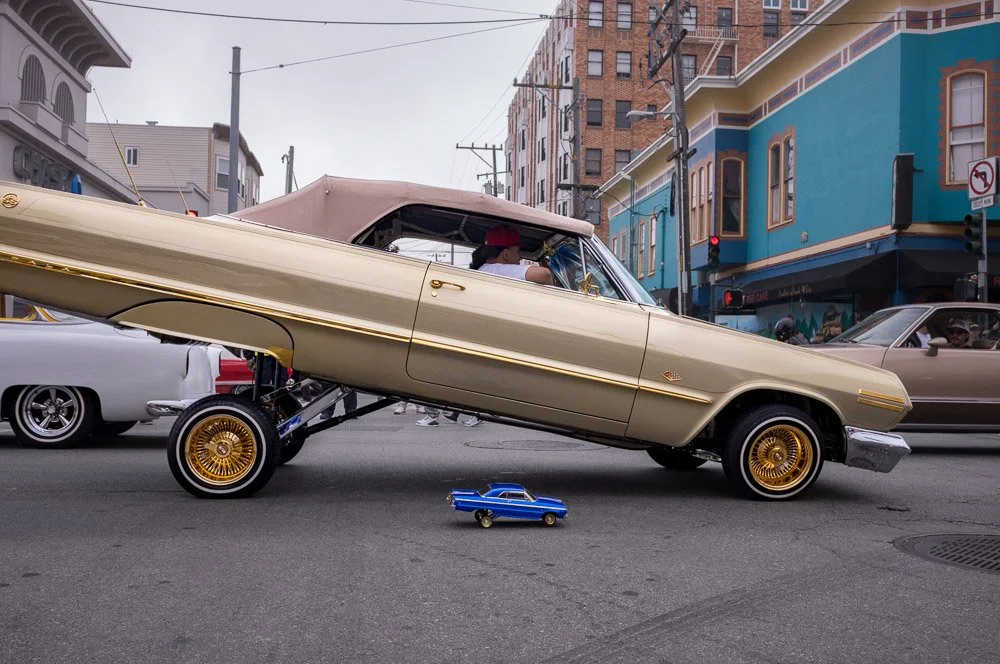
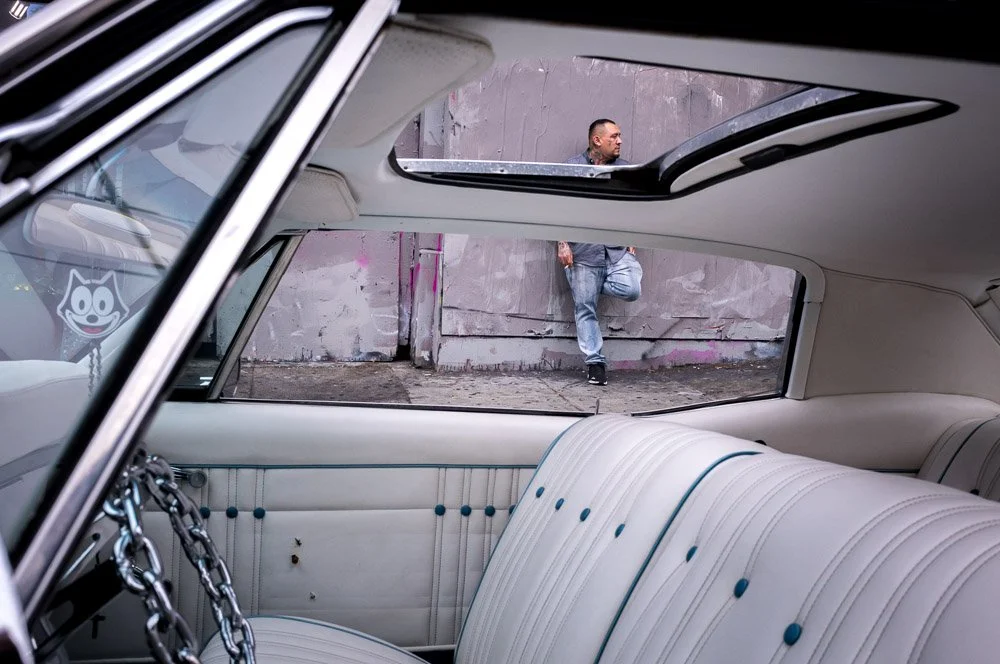
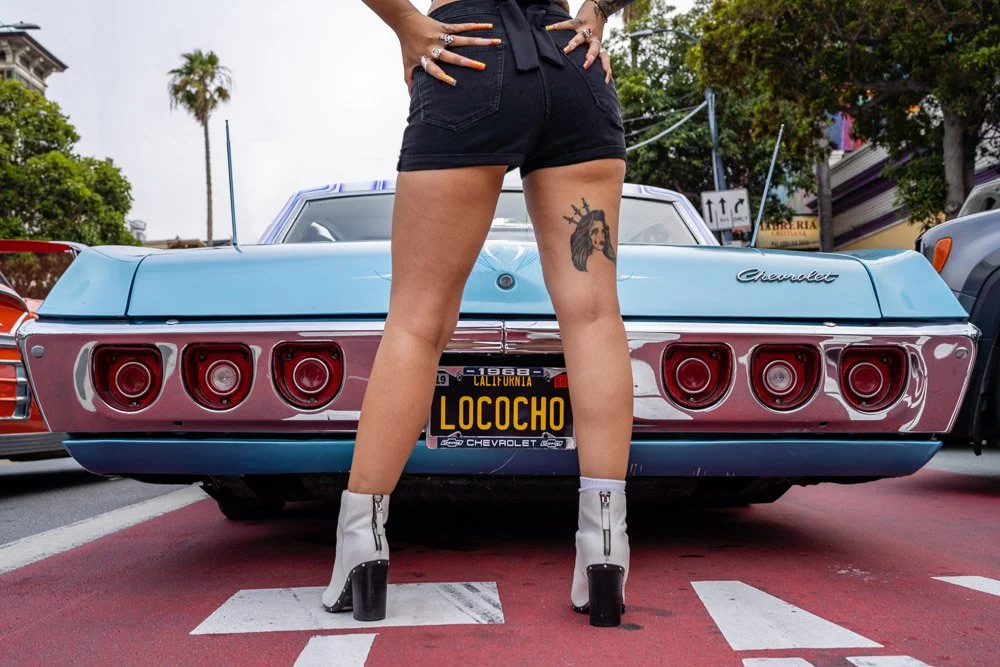
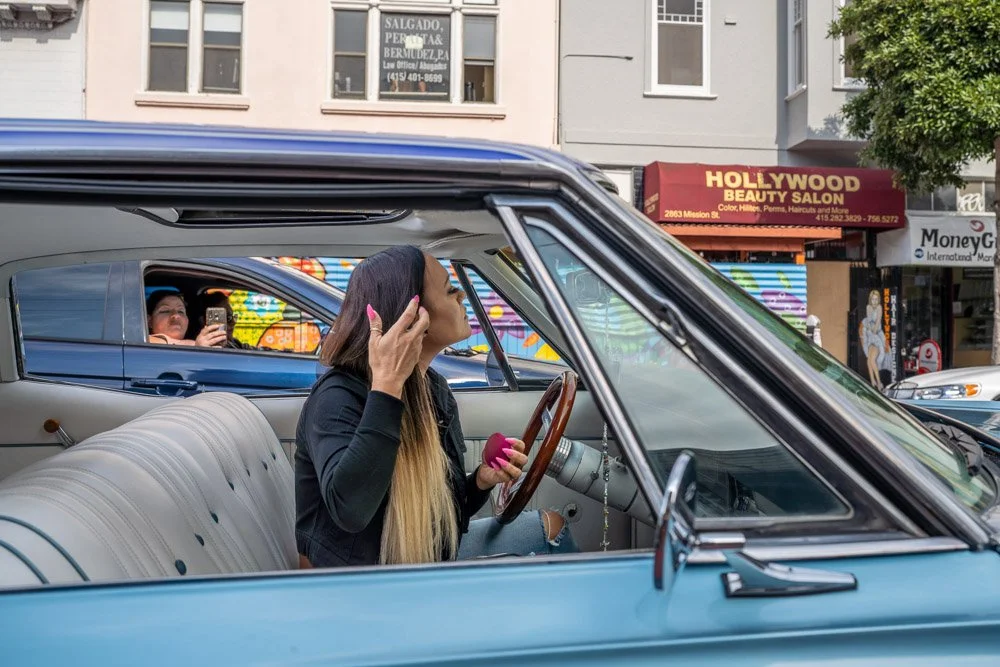
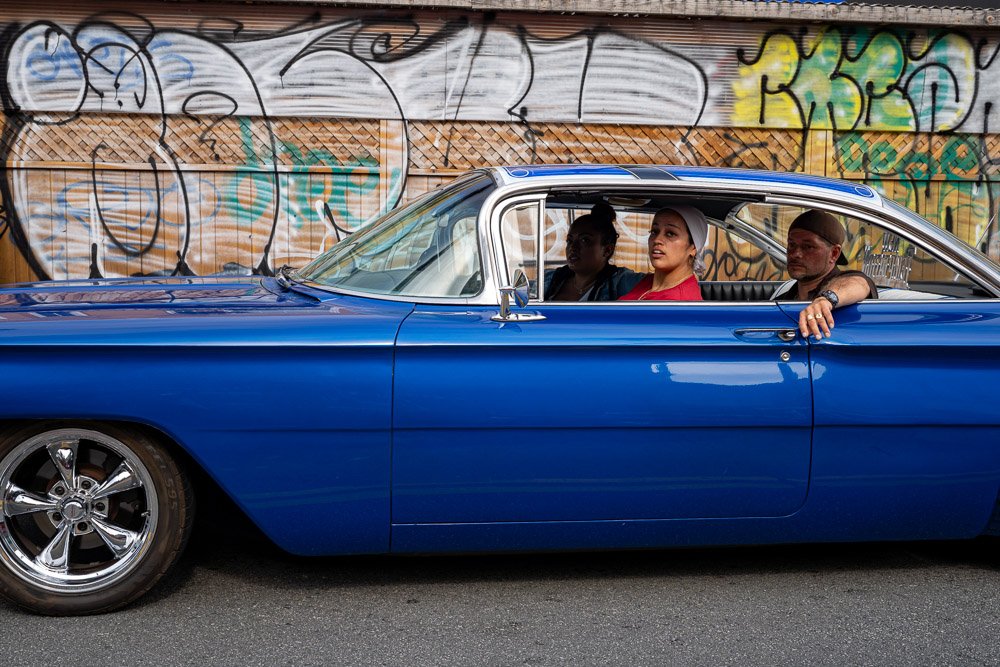
This series focuses on the lowrider community in San Francisco’s Mission District. Eric first connected with this culture during his teenage years in Southern California. Decades later he returned to it with a camera. The project is both personal and observational. He photographs the cars, the people, and the street gatherings with respect and curiosity. Unlike his more spontaneous work, King of the Streets is more focused. He looks for specific scenes that reflect pride, identity, and creativity. The goal is not just to capture movement or style but to show a community that continues to thrive in public with confidence and joy.
Approach to photography: What draws you to street photography as your main medium, and how do you decide where to focus your lens in a world so full of visual noise?
Before I even heard the term “street photography,” I was already drawn to walking through urban environments with a camera, observing and photographing human life as it unfolded. Photography had always been part of my life, mostly family and vacation photos, but about ten years ago, things shifted. I was unexpectedly laid off due to a corporate restructuring and suddenly had a lot of time on my hands. Job searching from home every day became stressful, so I started going into the city with my camera, not with a grand artistic plan, but simply to get some exercise, clear my mind, and reconnect with something creative.
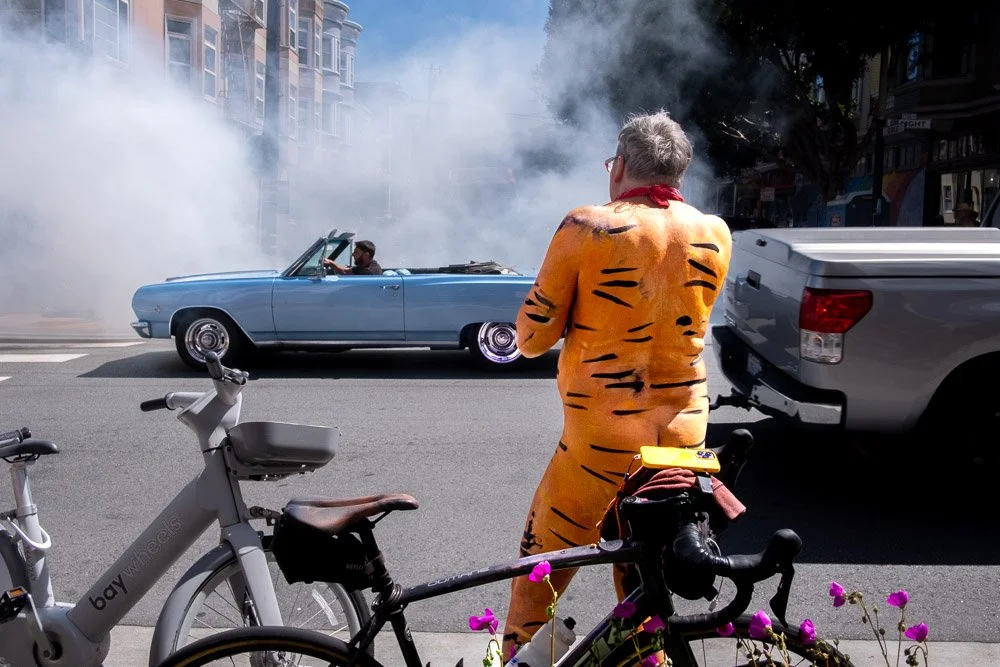
What keeps me coming back to the streets is the unpredictability of public life. No matter how many miles I walk or how many photos I take, the street is never the same twice. There's always a fleeting moment, an odd gesture, or an unexpected intersection of people and space that surprises me. I’m drawn to the challenge of capturing those moments in a way that feels both spontaneous and meaningful.
For me, walking the streets has become both a meditative practice and a kind of ongoing research. It grounds me in the real world while also encouraging me to see more deeply, to notice the subtle, the strange, the beautiful, and the contradictory.
I’ve realised that I’m naturally drawn to moments that feel a little offbeat or quietly humorous. Over time, that’s become part of my visual language. I lean into it more intentionally now, but it always has to come from the scene itself. Nothing’s staged. It’s about staying open, trusting that if I keep showing up, life will hand me something worth noticing.
Can you describe what it feels like when you find a scene like that? Is it something you recognise instantly, or does it slowly unfold as you observe?
I feel a surge of energy and heightened focus the moment I notice something worth photographing. It’s like a switch flips, I become fully present and alert. Sometimes I sense a moment before it actually happens, picking up on small cues that something interesting is about to unfold. Other times, I’m reacting in real time, responding instinctively as an unexpected scene reveals itself. Both experiences are exciting in different ways, one is about anticipation and patience, the other is about being quick and responsive.
If the situation allows, I’ll pause to consider how best to frame the scene, thinking about composition, light, and camera settings, but I try not to overthink it. I’ve learned to trust my instincts and experience. Once I’m ready, I commit to the shot. There’s a kind of quiet thrill in those moments, especially when I manage to capture something quirky, offbeat, or subtly humorous.
Overview of Hidden in Plain Sight: What inspired you to start Hidden in Plain Sight, and how did your perspective on homelessness and urban life evolve during the making of the project?
Hidden in Plain Sight wasn’t conceived from the outset, it emerged in retrospect. While reviewing my archive for a potential series submission, I began to notice a pattern: many of my photos featured people who exist outside the boundaries of conventional dress or behaviour. These were individuals who stood out in public space, often in striking ways.
I don’t set out to photograph people experiencing homelessness, and I rarely know for certain if someone in a photo is unhoused, I don’t ask. What I’m drawn to are people who express themselves openly in public, whether through fashion or presence. Some of those people may be homeless; others are simply living by their own codes, unconcerned with fitting in.
Over time, this project shifted how I see urban life. I’ve come to appreciate how fortunate I am to live in a place where people feel free to be themselves, where nonconformity is not just tolerated, but visible. That visibility, often taken for granted, carries its own kind of quiet power.
Overview of King of the Streets: Why did you decide to take these photos, and how is this project similar to or different from Hidden in Plain Sight?
King of the Streets is a series that explores the lowrider subculture and the Mission District, a San Francisco neighborhood with deep Latino roots. My interest in this world goes back to my high school years in Southern California during the mid to late ’70s, when students often identified with either the surfer or lowrider subcultures. While I primarily aligned with the surfers, I was always drawn to the style, attitude, and creativity of the lowrider scene.
My family’s synagogue was located in a Latino neighborhood where many lowriders lived. I worked at a fast food restaurant in that same area and had teammates on my high school wrestling team who came from the community. Those early experiences gave me a personal connection to the culture, one grounded in respect, familiarity, and curiosity.
That background is likely what drew me to photograph the lowriders of the Mission District decades later. This project is both a visual celebration and a personal reflection, an attempt to honour a culture that helped shape my youth and continues to thrive with pride and artistry in the heart of the city.
I approached photographing the lowrider community differently than I did with my Hidden in Plain Sight series. One of the main differences is intention. With King of the Streets, I set out to tell a more focused story, one that highlights the people, the cars they proudly own, and the neighborhood where they gather. I’m looking for specific situations that reflect that story, though I still avoid staging or interfering with the scene.
In contrast, Hidden in Plain Sight was more observational and spontaneous. I walked the streets with no particular agenda, photographing whatever caught my eye in the moment. With the lowrider project, there’s more purpose behind the lens. I’m still drawn to candid moments, but I’m seeking out elements that contribute to a broader narrative about culture, community, and identity.
How does your mindset or approach shift when you’re photographing with a project in mind compared to when you’re shooting more freely and spontaneously?
When I’m photographing with a project in mind, I approach it with a more holistic, story-driven mindset. I’m thinking about how each image might contribute to a larger narrative, so I’m more intentional about elements like subject placement, distance, depth of field, lighting, colour, and angles. I also pay close attention to visual variety, aiming to avoid too much repetition in composition or perspective.
In contrast, when I’m shooting without a defined project, my mind feels freer and more open. I let curiosity guide me, responding instinctively to whatever catches my eye without worrying about how it fits into a broader theme. Both approaches are valuable, one is more structured and deliberate, the other more spontaneous and exploratory.
When you’re editing a project like King of the Streets or Hidden in Plain Sight, how do you decide what belongs in the final series? Are you building toward a narrative, or are you more guided by mood and recurring motifs?
When deciding what belongs in the final series, I consider many factors beyond simply choosing my favourite images. I aim to create a visual rhythm and narrative flow that feels cohesive and engaging. Transitions from one photo to the next should feel natural, something the viewer can move through easily and enjoyably.
To shape an effective sequence, I pay close attention to colour, lighting, subject placement, movement within the frame, and overall mood. Each image needs to work both on its own and as part of a larger story. It’s about striking a balance between aesthetic harmony and narrative progression.
Advice for emerging street photographers: What’s one lesson you’ve learned from years of street photography that you wish you’d known when you started?
My advice is: walk more than you shoot, and look more than you post. Spend time just being present in the street, without the pressure to make a perfect photo. Your voice doesn’t come from your gear or editing style, it comes from what you notice, what you care about, and what you keep coming back to.
Be patient. At first, you may imitate others, and that’s okay, it’s part of learning. But over time, start asking yourself why you’re drawn to certain moments or people. What are you trying to understand about the world, or about yourself? Follow that thread.
More photography books and interviews?
We'd love to read your comments below, sharing your thoughts and insights on the artist's work. Looking forward to welcoming you back for our next [book spotlight]. See you then!
Color entered Janelle Lynch’s photographs through painting. In Another Way of Looking at Love, she photographed plants and trees on her property in the Catskills. Photography Book Spotlight