How Eight Years in the Arctic Shaped Marta Bevacqua’s Most Personal Project
Welcome to this edition of [book spotlight]. Today, we uncover the layers of 'Signs_,' by Marta Bevacqua (published by Setanta Books). We'd love to read your comments below about these insights and ideas behind the artist's work.
It started the moment she first stepped onto Svalbard.
Marta thought one visit would finally quiet a dream she carried since childhood, but the opposite happened. That first trip opened a feeling she could not explain, a feeling strong enough to pull her back again and again for eight years. This interview looks at how that long journey shaped her most personal project. And it shows what a photographer can discover when a place becomes more than a location.
Some stories grow slowly over many winters.
This is the story of how five winter trips to the Arctic became a body of work filled with cold, silence, and meaning. Marta shares how she worked in darkness, how a simple red sweater became a symbol, and how she learned to listen to signs that are not always visible.
This is a story about eight winters in the Arctic.
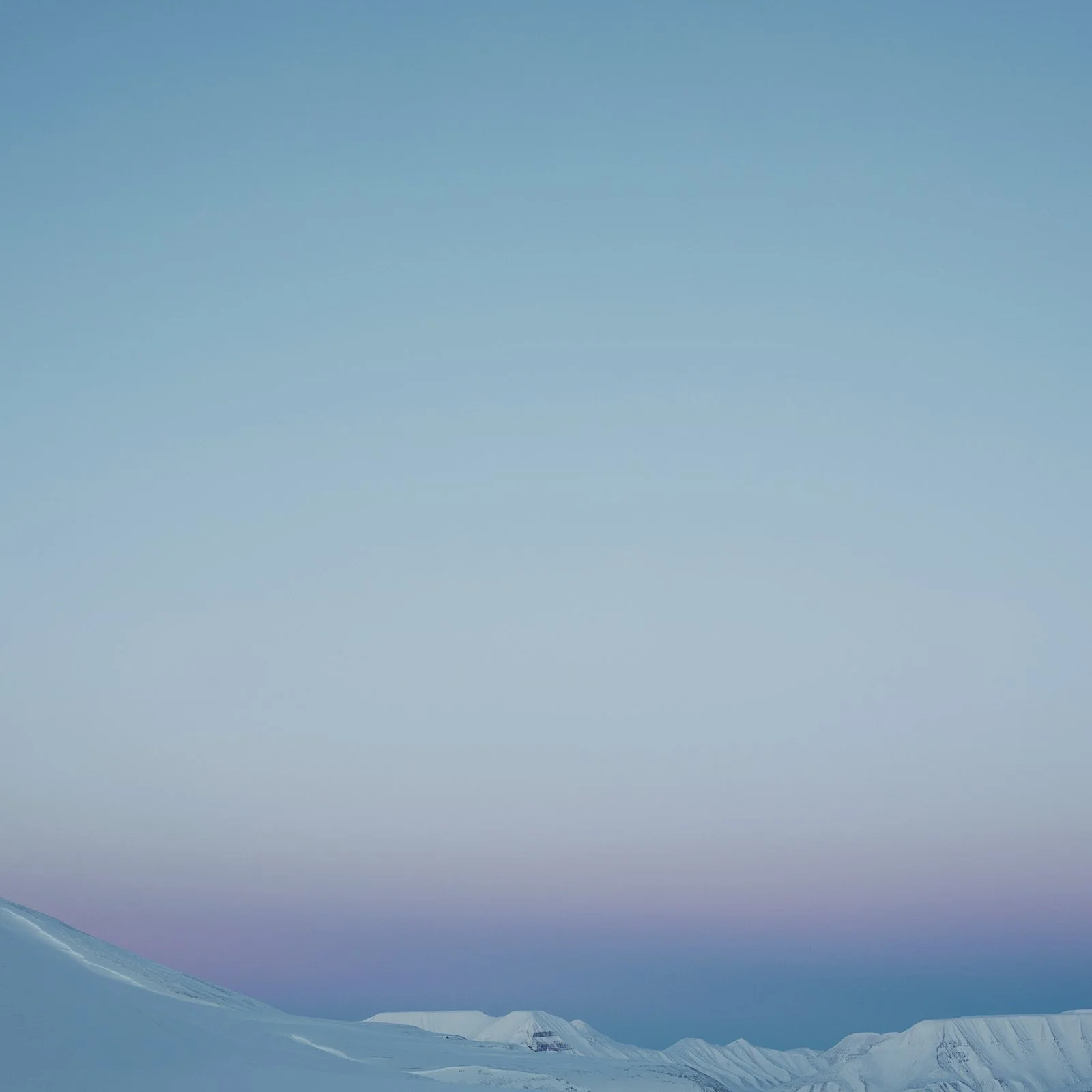
The Book
Signs_ is Marta Bevacqua’s long term photographic journey through Svalbard, created during five winter trips between 2016 and 2024. The project began with a childhood dream and slowly turned into a personal calling. Each visit took place in the coldest months of the year, when the light changes quickly and the landscape shifts from darkness to soft sun. The book brings together frozen seas, mountains, Arctic skies, quiet traces of wildlife, the recurring red sweater as a human symbol, and Polaroid experiments shaped by extreme cold.
Across its pages, Signs_ follows the idea that nature is always leaving messages. Some signs are clear, like tracks in the snow or cracks in the ice. Others can only be heard or felt in the silence of winter. Marta sees the Arctic as a thermometer of the planet, a place that shows both the strength of nature and its growing fragility. In the end, the book becomes the record of a dream that grew larger with every return. It is a story about time, patience, and the quiet power of a place that became a personal refuge for the artist. (Setanta Books)
Project Genesis: How did "Signs_" grow from a childhood dream into an eight-year photography project about Svalbard?
It happened in steps. At first, the dream was born: I had to go to Svalbard once in my life, I was just waiting for it and this waiting lasted for years and years. When I finally managed to go for the very first time, I thought I could put an end to this sort of obsession. Instead, the dream became bigger and bigger.
When the plane took off, I silently cried. I cried because I didn’t want to leave, because I needed to spend more time in those places, to breathe that freezing air, to gaze at the mountains, the snow, the starry sky. That first time, I didn’t even see the Northern Lights, and I almost used it as an excuse. I had to go back, as soon as possible.
I returned two years later, and for much longer. I needed to be tired of it, to want to return home. Instead, as the weeks passed, I realised that Svalbard was, in a way I still don’t fully understand, a bit like “home”.
The project was born in that moment, with the knowledge that I would return again and again, and that over time I would collect experiences and emotions that were worth collecting.
You said Svalbard felt like "home" in a way you still don't understand - have you figured out more about what that means to you now, after all these years?
I understood this more when I began to desire to settle in Svalbard permanently. I never did for a variety of reasons, and to this day I haven’t regretted it. Over time, I’ve realised it’s not my place, at least not in this life or for the life I’ve chosen. I reassure myself with the certainty of being able to return whenever I need to, and that’s enough for me. But when I say “home”, I mean precisely this: a place where you feel like yourself; where you could move to, without suffering separation; where you can find your own space and time, a whole dimension, without difficulty. For me, Svalbard is also this, among other things.
Return Visits: You went to the Arctic five times between 2016 and 2024 - why only in winter when it's so cold and dark?
It’s probably due to my love for winter, or, who knows, to the fact that the first time I set foot there was in that season. My childhood dream included snow, so it was inevitable. Even though I’ve always visited Svalbard in that season, I still have the feeling that it’s not enough.
I’ve chosen to return at different times of the same season and the differences are so drastic that they only heighten this feeling. The lights, the presence (or not) of the sun, the snow, the animals, the sounds or the silence… each time was a discovery.
Today, I feel like I have to go in summer as well, or spring too, but at some point the winter landscape of Svalbard will call me back, I have no doubt about that.
Polar Night Photography: How do you take photos during polar night when there's no sunlight at all for months?
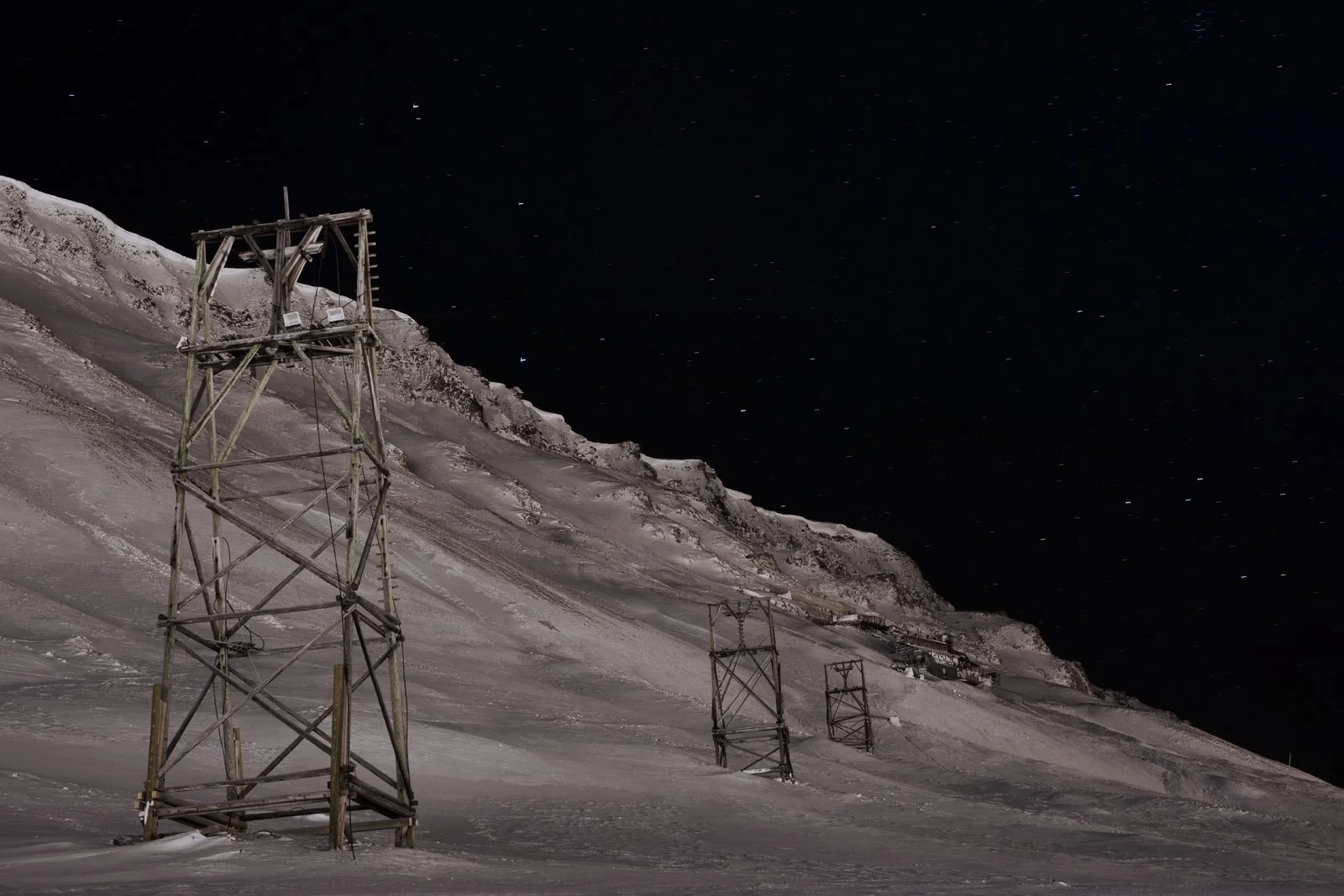
First of all, you need to observe for a long time, calmly and attentively. The camera doesn’t work exactly like our eyes; with long exposure times, you can capture details we can’t. This was the most interesting part of photographing the Arctic night.
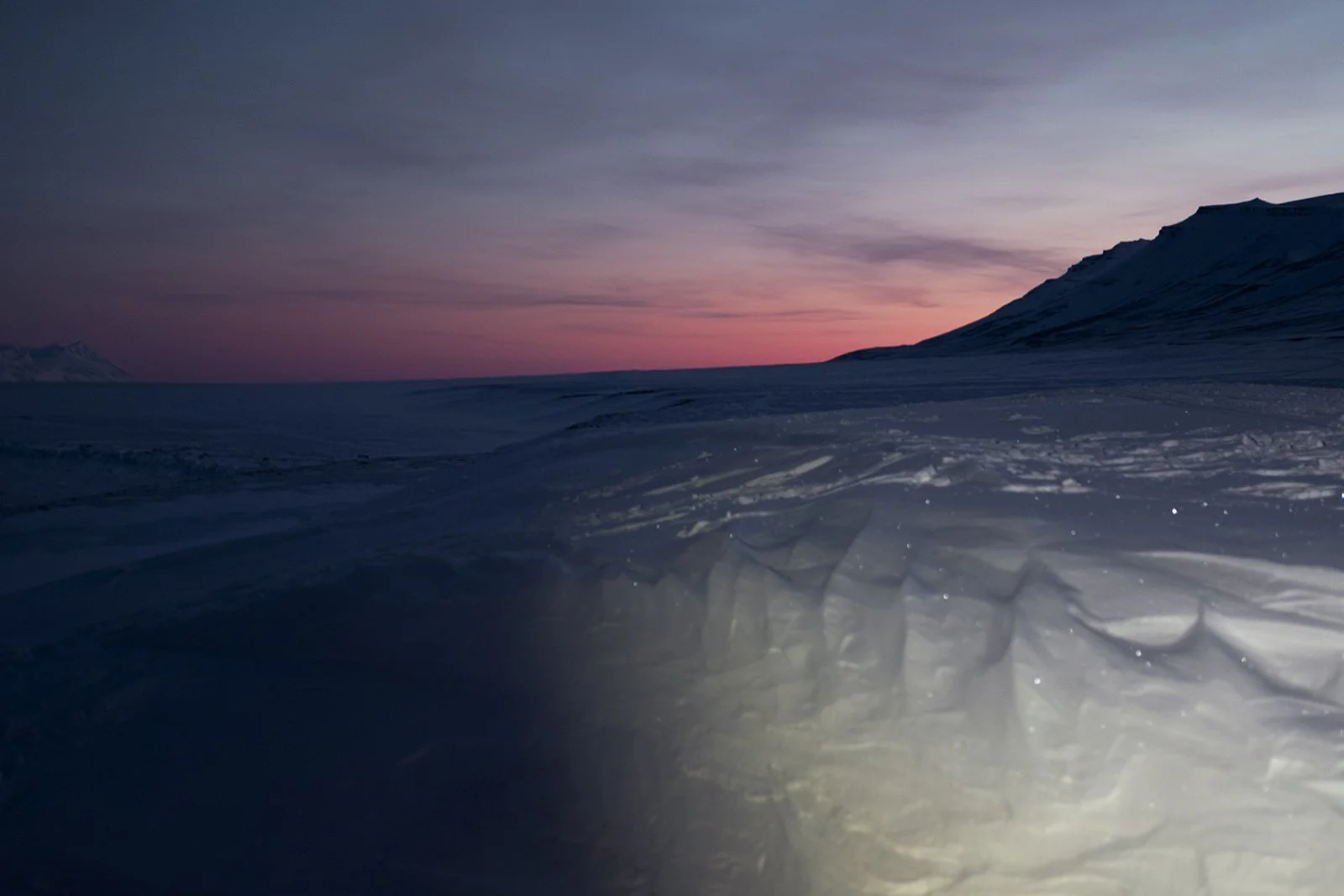
On a technical level, a tripod is a must. I found myself taking long walks with my equipment on my shoulder and a headlamp, only to turn it off and sink into an almost complete darkness. Incredible, such an amount of snow reflects even the light of the stars.
The exposure times need to be quite long, although less than you’d expect (depending on what you’re photographing). The process is very long, the cold penetrates to the bone, and removing gloves to handle the equipment is painful. But it’s part of the process. Creating in such a context becomes an adventure.
Red Sweater Symbol: Why did you choose a red sweater to show human presence in your white Arctic landscapes?
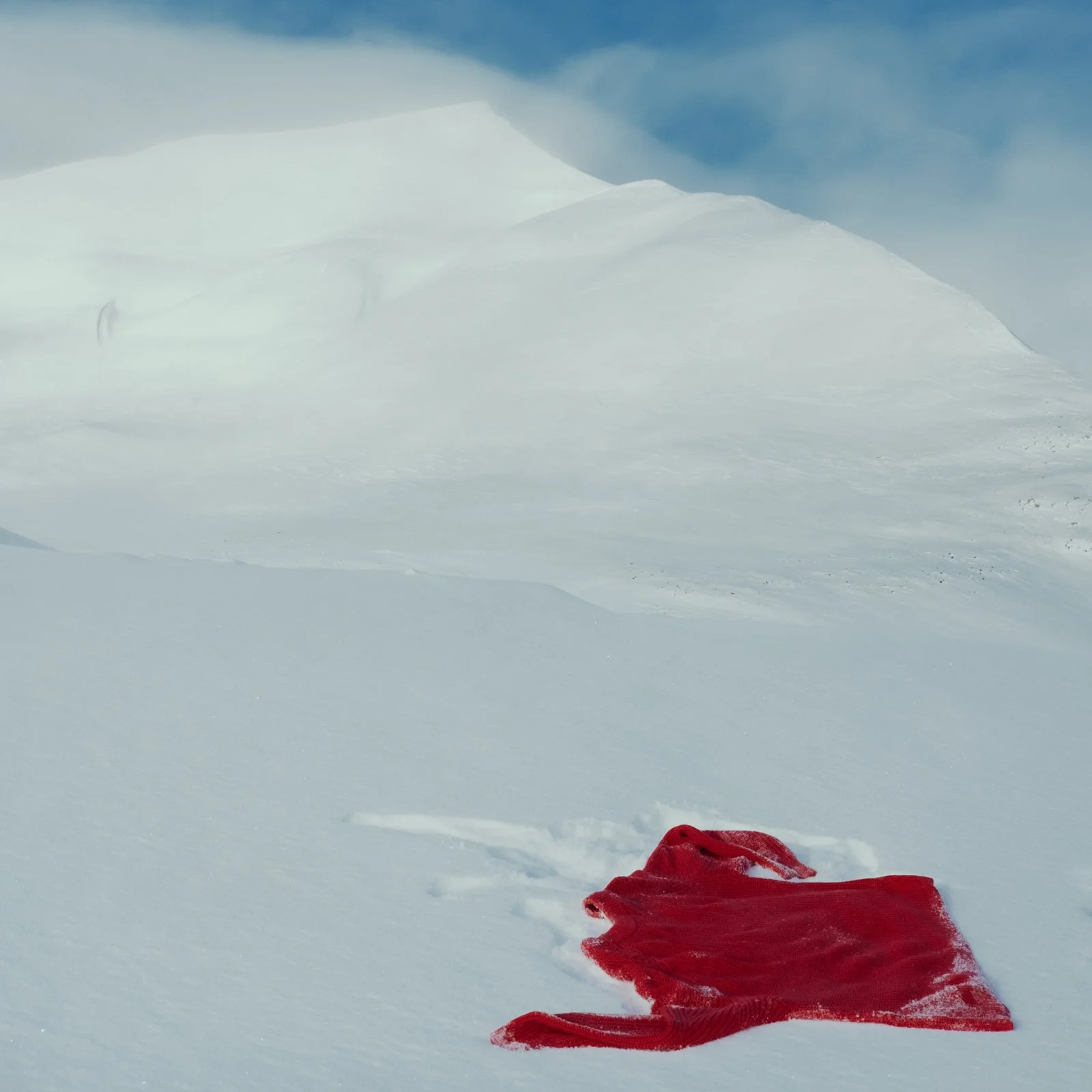
Because red is the colour of blood, because it’s visible in the snow the same way we humans are visible in nature, since we can’t help but leave a trail of signs, often ruins. Because it stands out in a way that hurts, that can be beautiful and terrible at the same time. A sweater? Because only a human being could wear one.
Polaroid Experiments: What made you bring instant film cameras to such extreme cold conditions, and did they work properly?
First of all, the desire to experiment and challenge myself. I’m not used to instant film cameras, but trying it for the first time in a similar situation seemed interesting.
I collaborated with Lomography on the equipment, from the camera to the films. Before leaving, I did a lot of research on how to handle the material in such temperatures.
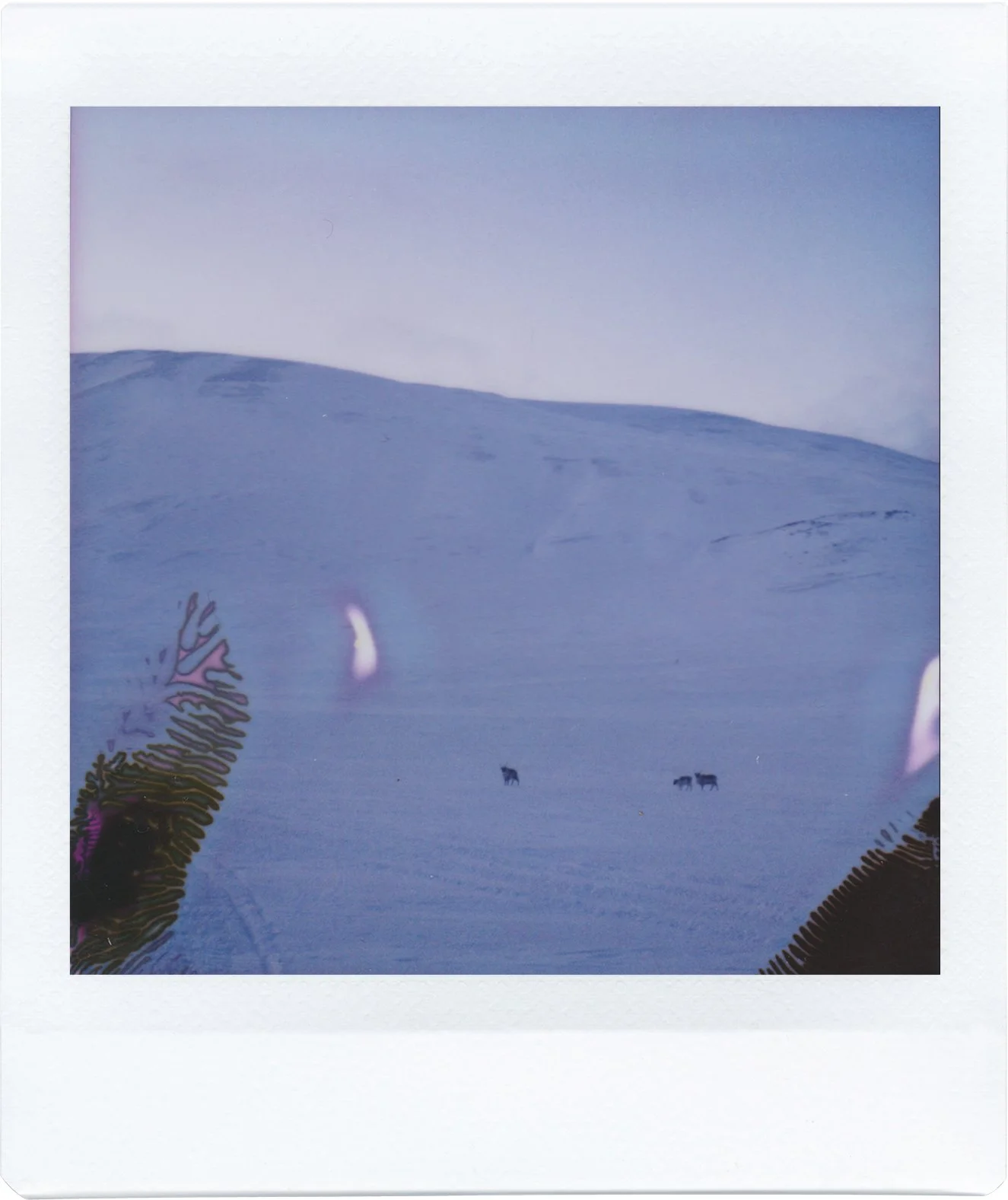
I kept the films, exposed and unexposed, in the inside pockets of my sweatshirt (the innermost layer I wore) to keep them warm. Loading the camera had to be as quick as possible. Then, after each shot, without waiting for the image to appear, I immediately placed the exposed film in the aforementioned pocket.
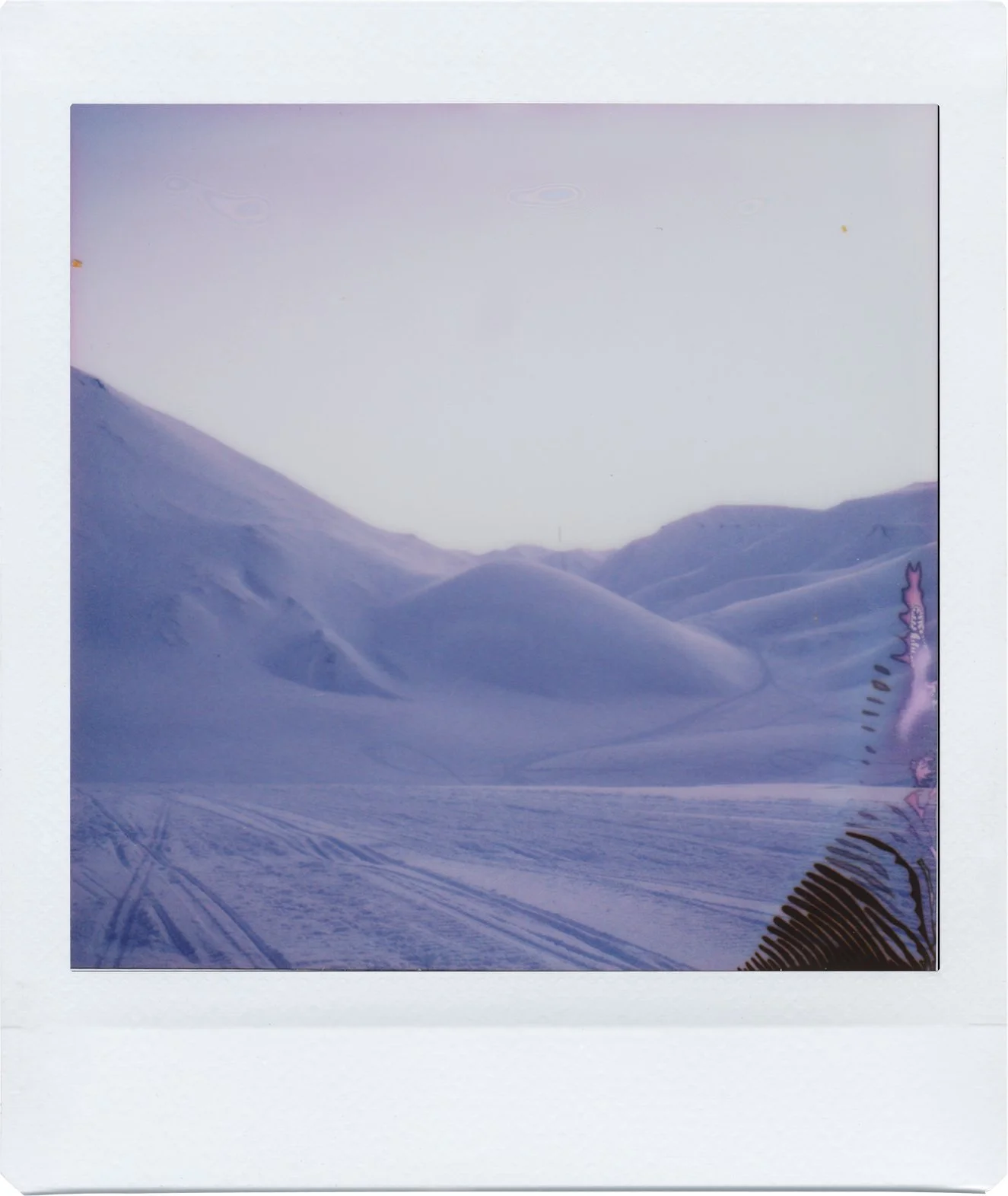
I only allowed myself to check the result once inside a building and I found it very beautiful, even if there are spots on many images that resemble algae. It’s the cold that compromises the emulsion, but rather than ruining the result, I believe it adds value. The photos wouldn’t be the same without the indelible imprint of the cold.
Those algae-like spots from the cold on your Polaroids - you say they add value... can you tell me more about embracing these "mistakes" in your work?
There are mistakes and mistakes. Some are obvious, making the image lack harmony; others fill it. Often, it’s the mistakes that, for me, connect me emotionally to the image. It could be something related to a mistake during the shoot, or an insurmountable difficulty. In any case, if the result is pleasing to the eye, then the mistake automatically plays a role in its own right, contributing to the success of the image. This is the case.
Changing Landscape: How did you capture the same places looking completely different each time you visited?
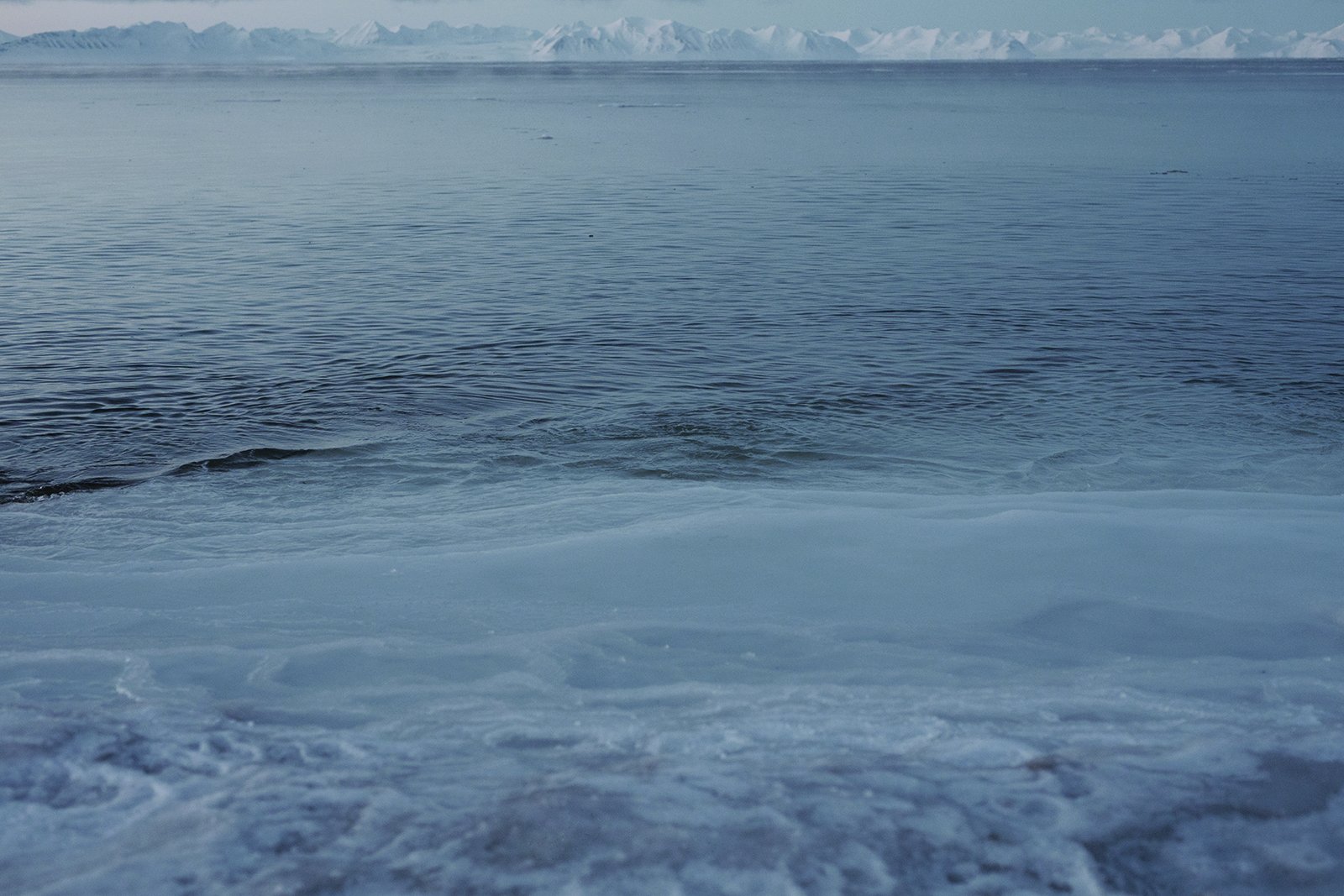
As I said before, the landscape and appearance of Svalbard changes considerably from week to week, if not from day to day. First of all, the light: every day adds (or removes) many minutes of brightness, which modifies the colors and with them the landscape itself. I’ve always been there in winter, it’s true, but between February and April it’s another world: the ice is more or less thick, the water of the ocean more or less visibile. The animals are hidden, or they begin to wander, or they are still repopulating the land after the icy grip of the dark season.
The sounds, consequently, change. The silence has a different weight. And with it, the sky, the light, the colors, the appearance of the snow, the sea, the glaciers…
The Arctic is a place of extremes, and you only need to be there for a few weeks (or return at different times even if it’s the same season) to realize that every day is different, every day a new place and a new discovery.
I just took pictures of what I saw, nothing easier…
Solitude and Silence: How does photographing alone in the Arctic silence affect your creative process?
It certainly gives you time to think, to savour the moment, to weigh every instant. Every click of the camera seems to resonate, lending a consistent importance to each individual shot.
There’s something special about performing routing tasks (for me and in this case: preparing the camera, holding it, looking through the viewfinder, and then shooting) in such difficult conditions. The solitude and silence simply help make the moment unforgettable, a moment to spend with yourself in creation.
Technical Challenges: What camera settings and equipment survive in Arctic temperatures when everything can freeze?
Nothing too difficult. Batteries shouldn’t be left in the camera, but always in a pocket under an inner layer. I always carried my camera in a backpack attached to the snowmobile, wrapped in a wool scarf and placed in a plastic bag to keep it dry.
Whenever I stopped and wanted (or needed) to take a picture, I’d take everything out. I wasn’t very convenient or fast (not to mention minutes spent without gloves), but at the same time it made the images I took as extremely necessary.
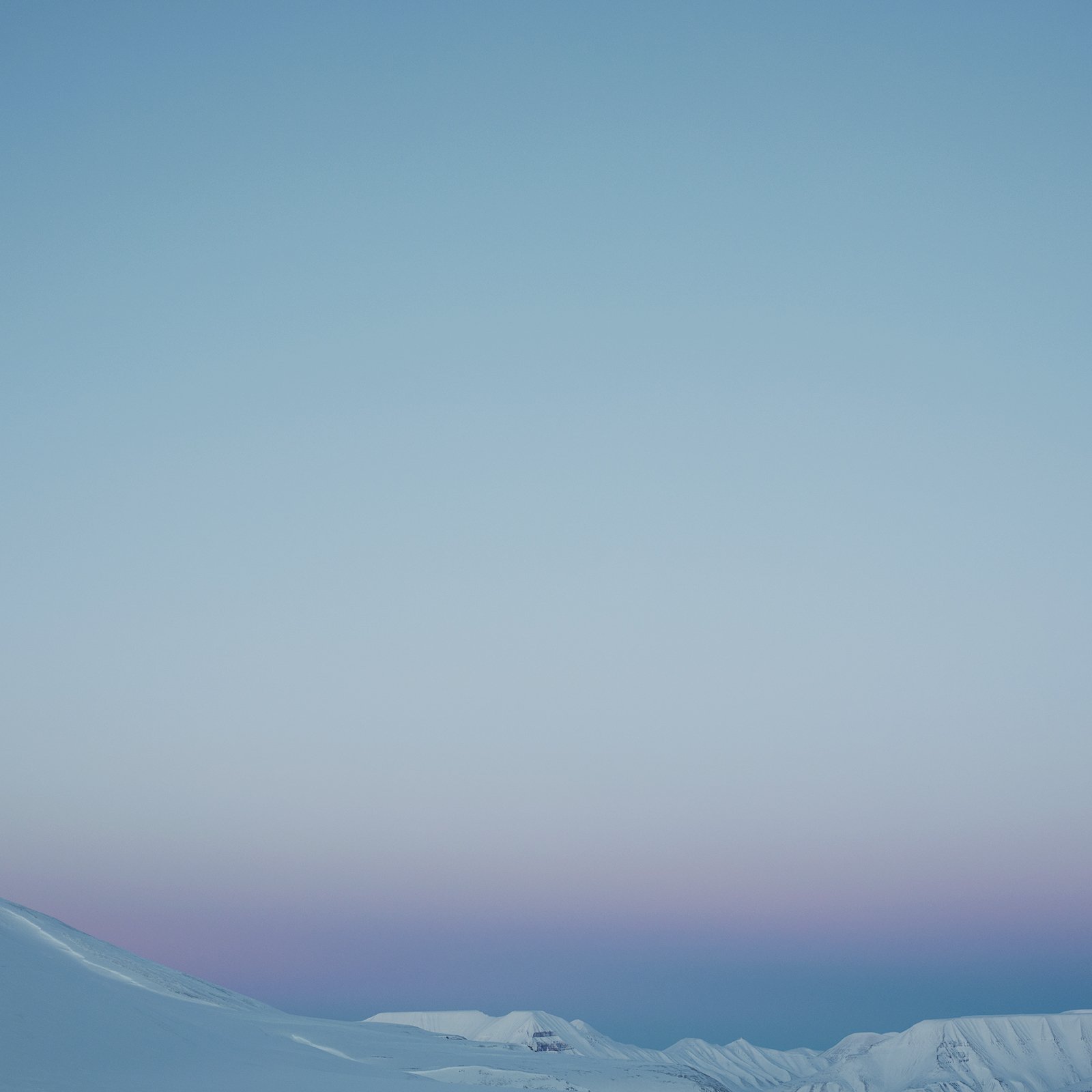
Nature's Signs: What "signs" did nature leave behind that became most important for your book's story?
The signs that nature leaves behind aren’t always visible. Sometimes, it’s necessary to listen.
What struck me most about Svalbard is the fact that Nature, despite everything, always manages to emerge and make its voice heard. In those places, respect for nature is fundamental.
You observe the tracks of animals but also of water or entire glaciers that constantly and slowly shift. You observe the changes, how nature itself adapts and adjusts to every situation. These are the same signs that have remained with me, the indelible ones of a planet that, unfortunately, we are ruining instead of caring for it.
You mentioned listening to nature's signs that aren't visible - what sounds from Svalbard still echo in your mind when you're back in Paris?
There are places where even silence has a sound. Svalbard is certainly one of them. Then there’s the wind, the rustling of snow, the dripping of melting ice, the cracking of glaciers, the murmuring of water fighting for space or being trapped little by little. They are simple sounds, which in many other places remain silent due to the surrounding noise, but here instead reverberate through the air.
To discover more about this intriguing body of work and how you can acquire your own copy, you can find and purchase the book here. (Setanta Books)
More photography books?
We'd love to read your comments below, sharing your thoughts and insights on the artist's work. Looking forward to welcoming you back for our next [book spotlight]. See you then!
Robin de Puy could no longer make this project alone. She first photographed Randy in Ely, Nevada, during a 2015 road trip and kept returning to him for more than ten years. Interviews