Discovering distinct worlds of people AT HOME - book by Susan Kandel - published by Stanley Barker
Hello fellow photographers. In this episode I am talking with American photographer Susan Kandel and we are talking about her new book AT HOME published by STANLEY/BARKER. It is a project Susan spent more than 10 years on and she photographed many families at their homes. My name is Martin and this is a Podcast about photography.

Thank you so much for joing me/us on this episode. Make sure you are subscribed if you want to be notified when I post a new episode. And also there is one thing I would love you to do. I would be very thankful if you could go and give this podcast five star rating and the review. If you like this content and you think other people might enjoy it as well feel free to take a screenshot and through it out on your instagram story or share it with your friends. all the information can be also found in the description.
The book: https://www.stanleybarker.co.uk/collections/frontpage/products/susan-kandel
YouTube Index:
00:00 - Hello There!
00:54 - Introduction
01:29 - Working and attending classes at MIT
05:24 - Workshop with Garry Winogrand
06:05 - Inspiration
07:07 - How Garry Winogrand got trampled during photographing of football game
07:25 - Adapting style
10:02 - Doing photography for living
12:11 - Stanley/Barker photography book AT HOME
17:41 - What was the most difficult part in the transition of photographing people outside and inside
18:39 - How can you get candid photographaps when you have the permission to photograph
19:52 - How did you imagine the project to work out
20:40 - When did you realise the project was done?
21:11 - Images and interesting stories
23:25 - Did you miss many shots?
23:46 - Images and interesting stories
30:45 - What is it like to revisit your work after quite some time
31:24 - Sequencing and other work with publisher
32:09 - AT HOME
32:52 - What about consent and giving prints away
34:48 - What about other project for future books?
36:29 - Future dream project?
37:57 - The end
#photographypodcast #aboutphotography #documentaryphotography
Let's start at the beginning. You got into photography when you received a camera as a graduation gift after college, and fast forward, you were attending classes at the Creative Photography Lab at MIT, where you also worked part time in exchange for those classes. How did that happen?
It's a bit of a story. The previous summer I'd done an introductory photography workshop in Idaho and gotten really excited about it, so when I came back to Boston I knew I had to find a way to keep doing this. I'd heard that Minor White was the head of the photography department at MIT, and I loved his work at the time, so I dropped in to see if there was any way I could take a class and get access to a darkroom.
It turned out he wasn't there anymore, or he was on leave. There were four photography instructors at the time, and one of them said she could take me into her class. That's how I came to work-study with Todd Papageorge at MIT. The Creative Photography Lab was part of the architecture department, an enclave that felt very different from the rest of MIT, as far as I could tell. I ended up spending about four years there, taking classes and using the darkroom. In exchange for working about eight hours a week, I'd paint walls, help hang shows in the gallery, mop floors, mix chemicals, and hand out equipment. I thought I got a very good deal, and it worked out well.
So you actually learned during the year while doing that part-time work, using the equipment and working in the darkroom?
Right, right. It was a big communal darkroom with these enormous vats of chemicals I'd have to mix up.
Did you also work in the darkroom for other photographers?
No, it was more of an informal arrangement. I was just allowed to stay on at MIT even after Todd Papageorge's year there ended and he moved to Harvard, where I then took his class as well. I kept the use of the MIT darkroom in exchange for those hours, so it worked out. It was something of a stroke of luck, and it was also lucky that Todd happened to be the one who spoke up and said I could be in his class, because I wouldn't have known the difference at that point.
I'd come to MIT looking for Minor White, and the kind of photography I was interested in doing was along those lines, something cosmic, spiritual, getting your interior state of mind onto a piece of paper. Todd's approach was entirely different. It was much more about the world out there, really capturing a piece of time and space within a frame. A few years later, John Szarkowski, the director of photography at the Museum of Modern Art in New York, published a book called Mirrors and Windows, and in a way those two tendencies are represented there. Minor White was very much a mirror kind of photographer, trying to express his own mental and emotional state, whereas Todd was much more in the windows camp, just seeing what was out there in the world. He used to say he photographed so we could fall in love with the visible surface of things. I really liked that, and I'm glad Todd was the one I ended up studying with.
So that's what pulled you into photography?
Very much so. Todd also arranged for me to take a workshop with Garry Winogrand, who was a friend of his. He'd brought Winogrand in to speak at MIT, and Brassaï as well, which was pretty amazing. Because I took that workshop, and Winogrand took a particular interest in my work, it was a big boost, and a lot of learning came out of it. It eventually led to me going to Mass Art, the Massachusetts College of Art, as a graduate student in 1978. Mass Art was where Winogrand had run that workshop, so that was my introduction to the place.
Does spending time in a workshop with someone like Winogrand boost you more than attending regular classes? Did you feel inspired, like something in your work changed after doing that?
I'm not sure it's about that so much, but it was a very energizing situation. It was a ten-day workshop where we met every night, and all day long you were photographing, developing film, printing. You were living and breathing photography. That, combined with Winogrand's take on things, made for an almost explosive situation, in a good way. There was a lot of energy. Motivation-wise, yes. Winogrand was there with a cast on his leg and crutches. He'd been photographing a football game, standing on the sidelines, and the players had run him over and broken his leg. But he still did the workshop.
Did you adapt some of his style?
I was already somewhat in that vein, coming from working with Todd Papageorge. Todd used to say he photographed to see what the world, this piece of time and space, looked like in a photograph. He had an enormous appetite and curiosity about the world. One day I came in and he asked how my shooting had gone, and I said I wasn't feeling very inspired. He told me inspiration has nothing to do with it. Just get out there and look around.
Do you think inspiration matters as much as that, or is it more important to just show up and do your thing over and over? Were you the type who waited for inspiration?
At that time, the point was just to get out there and look around. I photographed crowd scenes a lot, plenty of straight street photography, but I'd also seek out events where things were happening. Queen Elizabeth came to Boston at one point. There was the bicentennial of the American Revolution, with events happening all around the city. A tall ships parade came into the harbor, and tons of people showed up for that. I was always looking for some combination, some moment within the flow of all that, where you could grab something that meant something, where all the elements and details worked together to make a whole. I loved the chaos and commotion, and trying to grab pieces of it was very exciting to me at the time.
The reason I'm asking is that photography is art, and when you have a regular nine-to-five job, you show up and do your part, but it seems like it would be hard to force yourself to be creative on that kind of schedule. Producing a body of work takes a lot of time. Did you ever have moments where you thought you just weren't feeling it, weren't going outside, and wondered if a career in photography wasn't for you?
Actually, the hard part was making a living. For many years I worked as a waitress in a restaurant, working nights, which left my daytimes free. That worked well for a while, though it started wearing thin after a time. I went to Mass Art for a master's degree in photography so I could teach at the college level, and I did do some of that, part time, for two or three years, but I didn't really like it, and I wasn't all that good at it, so I had to switch out of that plan. More years of waitressing followed, along with occasionally photographing weddings or other photo jobs, but for the most part I kept photographing completely separate from earning a living. I kept trying to come up with ways to make a career out of it that paid, but it just never happened that way.
I'd avoided a nine-to-five job because I thought it would destroy my ability to do any of my own work, but I ended up getting an office job at Harvard, in the Graduate School of Education, which I only retired from a few weeks ago. I liked the job, I liked the people, I liked the students. It was a good situation, except that it was true that working nine to five made it much harder to photograph and get that work done. Now that I've finally retired, I'm hoping I can take the time to start looking through my camera again and pursue more projects. I do, for sure. After this year and a half of quarantining and being inside, I'm actually dying to get out into the world and see what's out there. That's the point I'm at right now.
Let's talk about your book, At Home. When Pope John Paul II came to Boston Common, you were there taking pictures, but unlike other photographers, you didn't want to photograph the Pope, but rather the people who'd come to see him. Did you already have this project in mind, or was it something you decided on the spot?
I had it in mind, though I didn't necessarily have the families-in-their-homes part of it worked out yet. I'd been photographing at Revere Beach, near Boston, for several years, and I'd started getting closer to the people there. Revere Beach was very much a family beach, or at least one big section of it was. Families would be in the same spots every day, year after year, this is where these people would be, and these people, and so on. I started wanting to move in closer.
In my early years photographing on the street and at events, I'd tried to stay as invisible as possible, a kind of stealth photographer. The minute people noticed me, I'd move on to the next scene. The pictures were more about elements within a scene, all working together to make a whole photograph that added up to something. But as I started wanting to get in closer, that meant not staying so invisible. It was a bit of a transition, where I'd actually talk with people, check in, ask if I could take some photos. That was the direction I was moving in when the summer ended and Revere Beach was no longer an option. I was trying to figure out another way to photograph families, and that's what brought me to Boston Common when the Pope came. I was just looking to photograph family groups there. It had nothing to do with the Pope, really. I'd photographed when Queen Elizabeth came, and other big events like that, so this was one more of those, except this time I was trying to find families to photograph.
I met two families there, two women who were good friends and lived around the corner from each other, with eight children between them. I got to chatting with them, and they said I should come to their house, since they had younger children at home too. I said I'd love to, and that's how it began. The fact that they invited me made it a lot easier, so I went on to photograph those families in their homes. That went on for maybe ten or twelve years, and it was an extremely productive relationship. The first time I photographed them, we did one of the homes, then went around the corner to the other family's house. Four of the pictures in my book came from that one day. It felt like it was all there, and I was hugely energized.
Then they invited me for Thanksgiving dinner, and it just continued. They'd stay in touch as much as I would, calling to say there was a new baby, a christening, a birthday, did I want to come and photograph.
So you made friends? You became close to the families you photographed?
I wouldn't say close, exactly, but there was a lot of mutual affection. A few things happened along the way. I hurt my back at one point and couldn't work for a couple of months. I think one of the mothers called to ask if I could photograph a birthday or something, and I told her I'd hurt my back and couldn't get out or do any of it, and that I wasn't working at my waitressing job either. She said if I lost my apartment because I couldn't work, I could move in with them. I was stunned by that, it's a small but very nice apartment they have, and that she'd offer that. There was a strong personal connection. I felt almost like part of their family, which was wonderful.
Alongside those ongoing photo sessions, I started looking for other families I might be able to photograph in their homes. That's when I started roaming around bowling alleys, supermarkets, the streets of my own neighborhood and others, looking for people who intrigued me in some way. I'd approach them, often with some photographs on hand that I'd taken of other families, to show them what I was after. Plenty of people said no, but enough said yes, and with a lot of those, there were repeat visits, or they'd refer me to friends who might also be interesting to photograph. It took on its own momentum, and I just kept at it.
As a photographer, you've photographed people both outside on the streets and inside their homes. What was the most difficult part of that transition, since people behave differently outside and especially inside their homes?
The hard part for me was always approaching people I didn't know and making this rather preposterous request. But once we'd agreed and I had permission, I was in their home, and unlike being outdoors, where you have to keep renegotiating that over and over, whether you can photograph these people, staying invisible or whatever, this was a situation where I already had permission. It was fine for me to be there, fine for me to go ahead and photograph. It became easier.
How difficult is it to get candid pictures when you actually have permission to photograph?
You'd think it wouldn't feel like a candid picture, but you blend into the environment, and you stay there for quite some time to get those moments. I was very much not interested in posed photographs, though there were times I'd ask someone to stand against a wall, so some pictures are a bit more posed. For the most part, though, I wanted the canvas, the flow that I could select moments out of. The people who were better at letting me blend in were the ones I went back to, over and over. They just got used to me being there, and it carried on, which was great.
Was there ever a situation where they told you not to photograph something, once you were actually inside?
No, I don't remember that ever happening. I had pretty much free rein. I might suggest moving into a different room, but apart from that, they seemed fine with my being there. Some people were a little more uncomfortable, a little more awkward, and I didn't stay very long with them. It just wasn't going to happen.
When you started the project, did you have an idea of how it would work out, and how did it actually turn out?
This project started as my thesis at Mass Art, my last semester there, so I expected that when the semester ended, I'd have completed it and moved on to something else. But when the semester ended, I felt like I'd barely begun. I never anticipated I'd keep at this for years, but that's how it turned out. I just kept being excited about who the next family would be, what their home would be like, what they'd be like. It kept fascinating me, so I kept going.
At what point did you decide this was enough, that the project was finished?
At some point I was doing it less and less, and it felt like it wound down naturally. I started feeling like I was done with it. I continued photographing my own family and my husband's family after that, but not so much these other families.
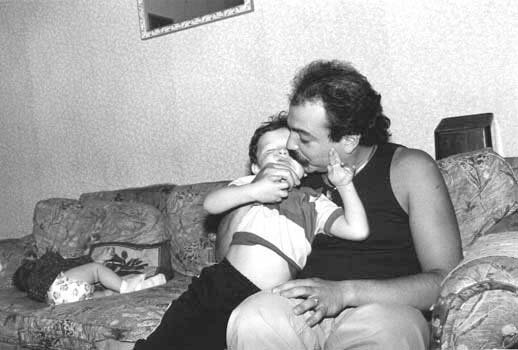
We were talking about some of your favorite or most interesting images, the ones with good stories behind them. I'd like to ask about the one with the boy and his father, the one that looks like a kiss. There are actually two boys in that picture: one lying asleep on the couch, and the other with his father. Why do you like this picture? Is there something important to you about it, or an interesting story?
In this picture, they're all on the couch. The father is embracing his son, who's about three or four years old, in a way that looks kind of rough. It looks like the child is trying to fend him off a little. I like this picture because it's two-sided. A lot of my pictures are both funny and maybe a little disturbing, and I like it when they feel like they're on that edge. This one is both: it's a loving embrace, and yet it's kind of scary. He always seems a little overwhelmed by it, almost mauled by his father. There's both things going on, and I like that tension, something like the pleasures and terrors of domestic comfort, which was actually the title of an exhibition and book from the Museum of Modern Art. It's both pleasure and terror, a little disturbing but also a little funny.
I imagine this was a fairly regular thing for them, not something staged for the camera. They probably did this kind of embrace often. I have memories myself of being squeezed or grabbed too hard by a loving parent or grandparent, so it might be a fairly common thing, and moments like that can happen pretty quickly.
Were there situations where you thought you'd just missed a nice moment, where you weren't fast enough to get there in time?
Sure, that happens. It's frustrating, but you can't dwell on it.
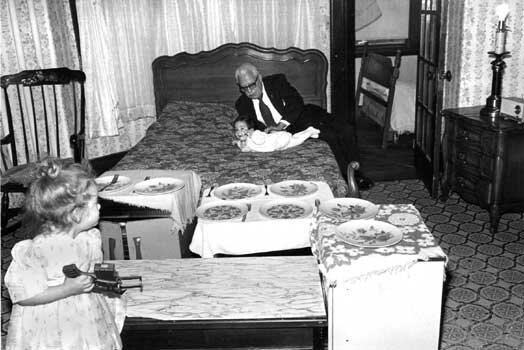
The other picture we briefly talked about is the dinner in the living room. There's a girl, and probably a grandfather or father, with another baby lying on a bed. What's so special about this picture, the dinner and the girl?
This picture was actually taken at Thanksgiving dinner, at the home of one of the original two families I photographed. I think it's kind of mysterious. You can see place settings near the bed, and it's unclear what's going on. The little girl in the corner, about two years old, is looking back at someone who appears to be a grandfather, on the bed with a baby. The little girl has a toy gun, held down at her side, and to me the story becomes that she was once her grandfather's favorite, but now she's been replaced by the baby on the bed, and she's got the gun pointed toward them, almost threateningly, which I find funny.
The reality is that this man isn't actually her grandfather, he's a family friend, but in the picture, the fiction is that he is. Photographs can tell a story that has nothing to do with the real situation, but if the elements work together to suggest a story, it becomes something separate from reality, its own reality. That's what fascinates me when it works.
It was Thanksgiving dinner, and though it doesn't look like it, there were place settings nearby in the kitchen for seven adults, and what's laid out here is more like the kids' table. The bed is there because this was actually the parents' bedroom, right next to the kitchen, in a room that would ordinarily have been a dining room. There were other bedrooms for the kids. I think that adds to the mystery, why these place settings are there, why the girl and the grandfather figure are dressed up. It was two families together, the two I'd originally met on Boston Common, plus some family friends, so it was a big gathering. The eight children between the two families ranged in age from about twelve down to a few months.
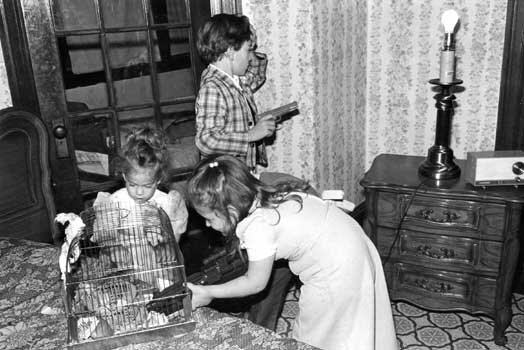
There's another picture with two girls and a boy, and the boy also has a gun in his hand, pointed at what looks like some kind of animal in a cage, while the girl has another gun. So this was a house full of guns?
Same evening, same bed, as a matter of fact. I don't know anything about guns, but it looks like some kind of toy assault rifle, pointed at a cage with what I think is a hamster, gerbil, or guinea pig, I can't tell one from the other. It looks like she's shooting the little animal, and the boy is standing there with a gun against his own head. I just think it's a funny scene.
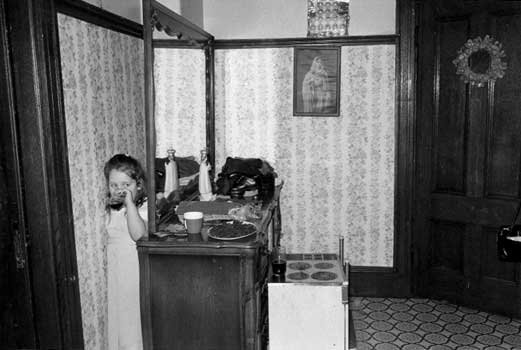
There's also another picture of a girl hiding behind the dresser. I think it's the same girl who was shooting the hamster in the other picture. There was a lot of commotion and mayhem going on, which I love, and this looks like her refuge, like she's pulling out of it for a few minutes to get something to drink, look around, separate herself a bit. A minute later she's out there running around again, but I like that it looks like that's her spot. I like how pictures can separate the moments, and sometimes say something completely different from what the situation actually was.
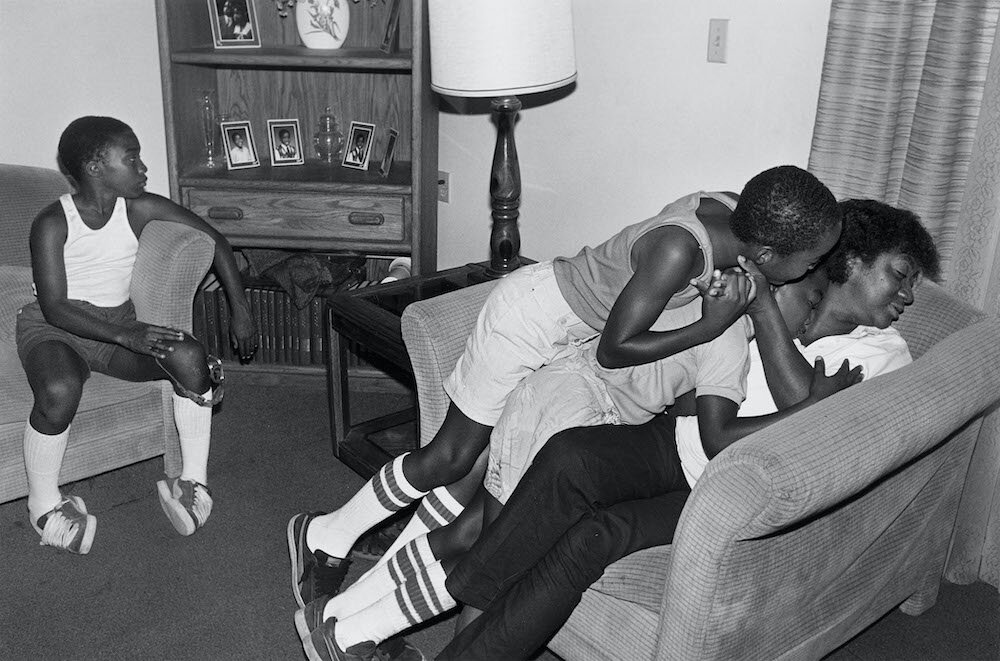
We also talked about the picture with three boys, two of them lying on their mother in a chair.
At first glance it looks like just one boy lying on top of the mother in the chair, but there's another one underneath him, and the mother looks like she's had it. There's another boy sitting in a chair on the left. This family was amazing. The first time I photographed them, there were six kids under the age of six, including one-and-a-half-year-old twins and two-and-a-half-year-old twins. Years later, when I went back to photograph them again, the mother and father had taken in some foster kids too. She just missed having babies in the house. So the mother probably does look kind of spent in that picture, with the boys lying across her, but in actuality she was a very devoted and loving mother. It's another one of those fictional kinds of situations.
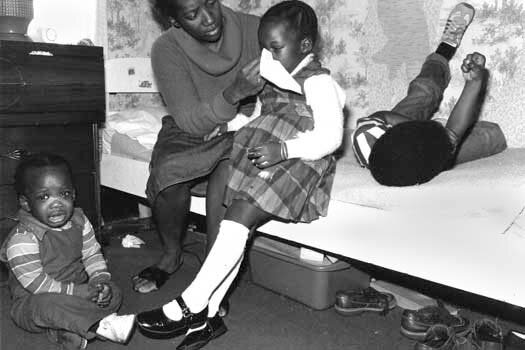
There's also another picture of her with three kids, one crying, one lying on the bed, and she's taking care of the third, who I believe is a girl. That's the same woman, a couple of years earlier. The boy lying on the bed is making a fist, and he looks angry. I like these things that are all going on simultaneously. I love it when there are a million things going on at once, and it's a challenge to make them all work within a frame, to make something happen that hangs together in the midst of all that flow and action, all the clutter, the various things in the background, on the walls, piled on the floor. I really like all of that, and the relationship between the things and the people in the picture.
Does revisiting your work after a long time bring back memories? Are there any pictures you didn't like at first, but after twenty or thirty years you look at them and think they're actually pretty good, or the other way around?
There might be a little bit of the other way around, some shifting in which ones are favorites, but a lot of them stay pretty constant. It was good to see them again after not really looking at them for some years. It reminds me of all that work, all those people, those homes. It's a good feeling.
Did you have someone to talk this through with, an advisor, or someone from the publisher who helped with the sequencing, who told you a particular picture should be added because it would help the overall book?
I left the sequencing to them, and I'm pleased with how it turned out. There are any number of possible configurations, and I think I would have gotten lost trying to work it out myself, so I'm glad they handled that. There were a few pictures they wanted to include that I said shouldn't be there, and I'd suggest others instead. There was a bit of back and forth like that, but not a huge amount.
Is there a special story about the girl on the cover of the book, or was she simply the one you thought would be best suited for it?
Again, it was the publishers who selected her for the cover. It's a funny picture, actually. The little girl was insisting on putting on her party dress, and her mother kept saying no, so she just grabbed it and put it on over whatever she was already wearing. She looks kind of defiant, like she'd won that battle. She had no idea she'd end up on the cover of a book one day. I wonder if she'll ever see it.
You mentioned, or I read somewhere, that you're not in touch with the families anymore, is that right?
I'm not. It's been a long time, and those kids are all grown up now. It's amazing.
When you photographed at their homes, did you give them prints, have them sign a consent form, or was none of that really a thing at the time?
I did give them prints. I'd always make sure to take a group family picture, everyone sitting or standing together, and get some good shots, because people want those, they like having them. Then, in some cases I'd bring the pictures to them, in others I'd mail them. There was that exchange, and they seemed to feel like they got something out of it. I felt like I got an enormous amount out of it myself.
One of the two original mothers said something, years later, about feeling like the Pope had brought me to them. They'd gotten all these family pictures over the years, and that amazed me. I remember thinking, I think the Pope brought you to me. I probably got the better end of the deal. The Pope himself wasn't really significant to me. I wasn't interested in him, and it wasn't specifically about it being a religious event, it just seemed like a good opportunity. I did become fascinated by how many of these homes had a lot of Catholic iconography around, pictures, little statues, and I loved having those in the backgrounds of the pictures. I didn't always know the significance of particular objects, but my husband is Catholic, and he could interpret things for me, telling me that's Our Lady of something or other, or that a certain pose meant something specific. I just liked them visually, a great deal.
As you went through the pictures for this project, did you come across another project you might be interested in publishing in the future, or did you feel there were other projects you'd rather publish instead of this one?
Definitely not instead of this one. When I was doing this work, mainly in the eighties and a little into the nineties, I felt it would make a good book, but I had no idea how I'd go about making that happen. This one sort of fell into my lap. As for other projects, I do have a number of photographs from party situations, high school proms, family celebrations, a ballroom dance hall in Revere, actually, where I saw some of the same people I'd seen on Revere Beach. There may be enough material like that for an interesting book, though I haven't made any decisions yet.
It's actually quite similar, in that you arrive at these parties or occasions with permission to photograph, and then you're trying to catch those more casual moments, while people are still accepting the photographer being there.
Although I didn't always get the permission I probably should have. I was occasionally asked to stop. That whole permission question does come up a bit.
Apart from your past projects, are there any you'd like to do in the future that you haven't started yet? Something you might dream about?
I'm not really sure at this point. I feel like I've been released, both from working a job and from quarantine, so I just want to get out into the world with my camera. It's funny, when I first started photographing, I realized that having a camera with me made me notice so many things I hadn't noticed before. I think I tend to be a bit oblivious in general, but when I have a camera with me, I start seeing a lot more. So that's what I'm ready to do now, get out there with the camera and see where I go.
Are you going to travel? Not just within the States, maybe Europe, other continents, Asia?
I'd love to go to Europe, I've been there a couple of brief times. No specific plans right now, other than getting to Cape Cod over the summer, in Massachusetts, where I go every year. I'm feeling pretty wide open, ready to see what's next.
I'd like to thank all the families who let me into their homes and shared that part of their lives with me, that personal, intimate space that a home is. I'm really grateful to those families.