Jeffrey Marqusee Returned to Mustang at 60 to Finish a Trek He Started at 25 - the Photos Became a Book About Tibetan Buddhism
Welcome to this edition of [book spotlight]. Today, we uncover the layers of 'The Last Refuge Of Tibetan Buddhism,' by Jeffrey Marqusee (published by Kozu Books). We'd love to read your comments below about these insights and ideas behind the artist's work.
At 25, he started a trek. At 60, he returned.
Jeffrey Marqusee went back to Mustang in Nepal to finish what he had left unfinished. The trip became a long photo project, with 2 bodies of work made 35 years apart. And it turned into a book that connects place, daily life, and Tibetan Buddhism.
Upper Mustang was once closed to foreigners, and even in 2014 it was still heavily restricted.
Marqusee talks about permits, guides, altitude, harsh light, and even a deadly snowstorm that hit the region. But the deeper challenge was respect: when to photograph, when to stop, and how to be present in living religious spaces. He also explains why he added poems by Jetsun Milarepa, and what text can do that images cannot.
If you care about long-term projects, meaning in documentary work, and how time changes a photographer, this is for you.
The Book
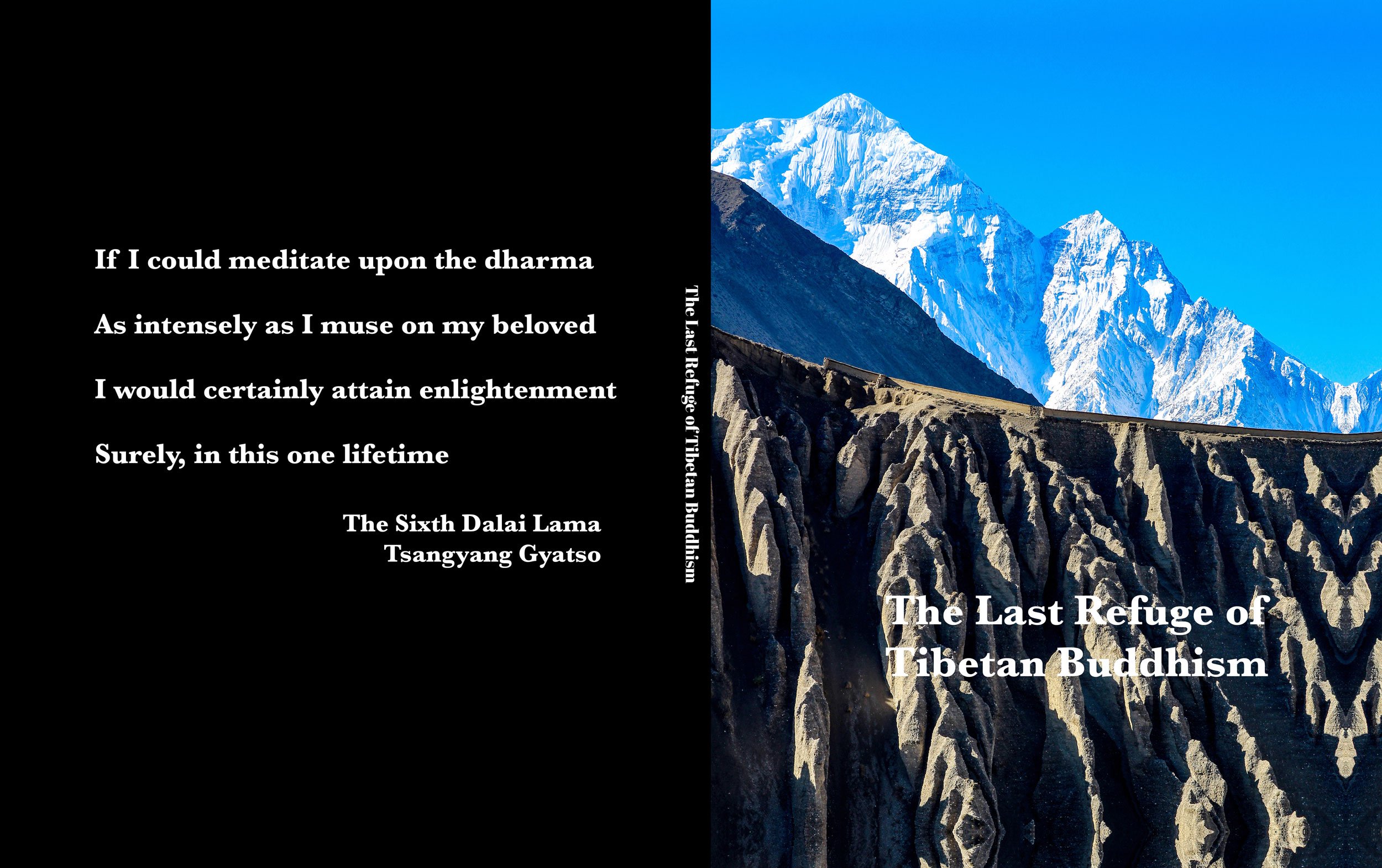
The Last Refuge of Tibetan Buddhism is a photobook by Jeffrey Marqusee, printed by Kozu Books in London. It grew out of photographs he made in Mustang, Nepal, first when he was 25 in 1979 and later when he returned at 60 in 2024. Looking back at the images helped him understand why both journeys shaped his life, and it led him deep into Tibetan Buddhism and the poetry of Jetsun Milarepa.
Set high in the Himalayas on the edge of the Tibetan Plateau, Mustang is home to around 15,000 people who often describe themselves as “historically from Tibet, but politically from Nepal.” With Tibetan culture suppressed after the Chinese occupation of Tibet, the Dalai Lama has called Mustang the “last bastion of living Tibetan Buddhism.” Marqusee’s photographs of people, monasteries, and the landscape are paired with Milarepa’s poems to offer insight that goes beyond history or travel writing, and to show how belief, place, and daily life are inseparable in Mustang. (Kozu Books, JeffreyMarqusee.com, Amazon)
Theme: Project Genesis: What first pushed you to photograph Mustang in 1979, and why did you feel the need to return in 2014 to finish this story?
I travelled extensively in my late teens and early 20s, always with my camera. So, there was never any question that I would bring my camera to Mustang. In 1979, I was 25, pursuing a PhD in physical chemistry at MIT. It was my third year, and I no longer knew why I was there. I reached out to my brother and said, "I need a break," and suggested we go to Nepal. Our goal was to get to Pokhara and start trekking to Jomsom, through the Kali Gandaki Gorge, between the high peaks of Dhaulagiri (26,795'), Annapurna (26,545'), and Nilgiri (23,165'), and onto Muktinath, a holy temple in Mustang sacred to both Hindus and Buddhists. Nepal was still a remote country with few tourists. Before 1950, Nepal was completely isolated from the international community. Although Nepal had opened to tourists in 1950, the lack of roads in Mustang and the Chinese invasion of Tibet that same year prevented Mustang from becoming a tourist destination. Goods were transported by mule or on foot, and travelling beyond Lower Mustang into Upper Mustang and the Kingdom of Lo, near the Tibetan border, was forbidden.
We returned to Pokhara after our trek and spent time sitting on the shores of Phewa Lake. I had a long conversation with a young Nepali named Chandra, who wanted to learn everything he could about the world. He made me realise what a unique and privileged opportunity it was to be paid to study and earn a PhD at MIT. I knew then I should either take it seriously or find something else to do with my life. I went back and finished my PhD at MIT. In the acknowledgment of my thesis, I wrote, "I wish to thank Chandra, although he will never know or understand why." That month-long trip set the course for my life.
I have travelled a lot, but given the time constraints of work and years as a single father, none of those trips were as intense as the trek through Lower Mustang in 1979. I often talked to my children about that adventure. So, it was no surprise when my daughter joined the Peace Corps; she arranged to be assigned to Nepal. It was her turn to experience the magic of Nepal and the Himalayas.
In 2014, I turned 60, and I knew I needed to return to Mustang and complete the trek through Upper Mustang I had begun 35 years earlier. With my daughter living in Nepal, there would never be a better time. Upper Mustang was opened to foreign travellers in 1992, but tourism grew slowly due to Nepal’s decade-long Maoist conflict (1996-2006). Entry to Upper Mustang in 2014 remained restricted by steep fees and the requirement of government-approved guides. Fewer than 3,000 tourists visited Upper Mustang in 2014. But I was driven to complete my trek to the capital of the Forbidden Kingdom of Lo in Upper Mustang, and I knew once again my camera was coming with me.
I’m not sure I really understand what was driving me then. I was at a point in my career where I either was going to take on one more major challenge or just slide through my 60s into retirement. I think I was looking for the clarity I had found in 1979 to guide my future.
Time and distance: This project spans more than 30 years between images. How did that long gap change the way you looked at your old photographs when editing the book?
When I turned 70, I started looking at the photographs I had taken in Mustang in 1979 and 2014. I began to think about why these two trips were so important. The passage of time allowed me to see them from a broader perspective. I could see in them the themes that have run through my life. I realised that these two trips showed me the world's beauty and the importance of protecting it. I felt that tying these two sets of photographs offered me the opportunity to explore my experiences in Mustang and to better understand Tibetan Buddhism.
The photographs I took, 35 years apart, are in some ways quite similar. My visual aesthetic in 1979 shares many attributes with photographs taken 35 years later. I visited Lower Mustang and Upper Mustang when they were roughly at the same stage of development and under similar levels of Western influence. If I had returned to Lower Mustang in 2014, it would be radically different from what it was in 1979. In 1979, there was only a dirt walking trail connecting the villages of Lower Mustang. Today, the villages are on the Beni-Jomsom Road, and tourism dominates the economy.
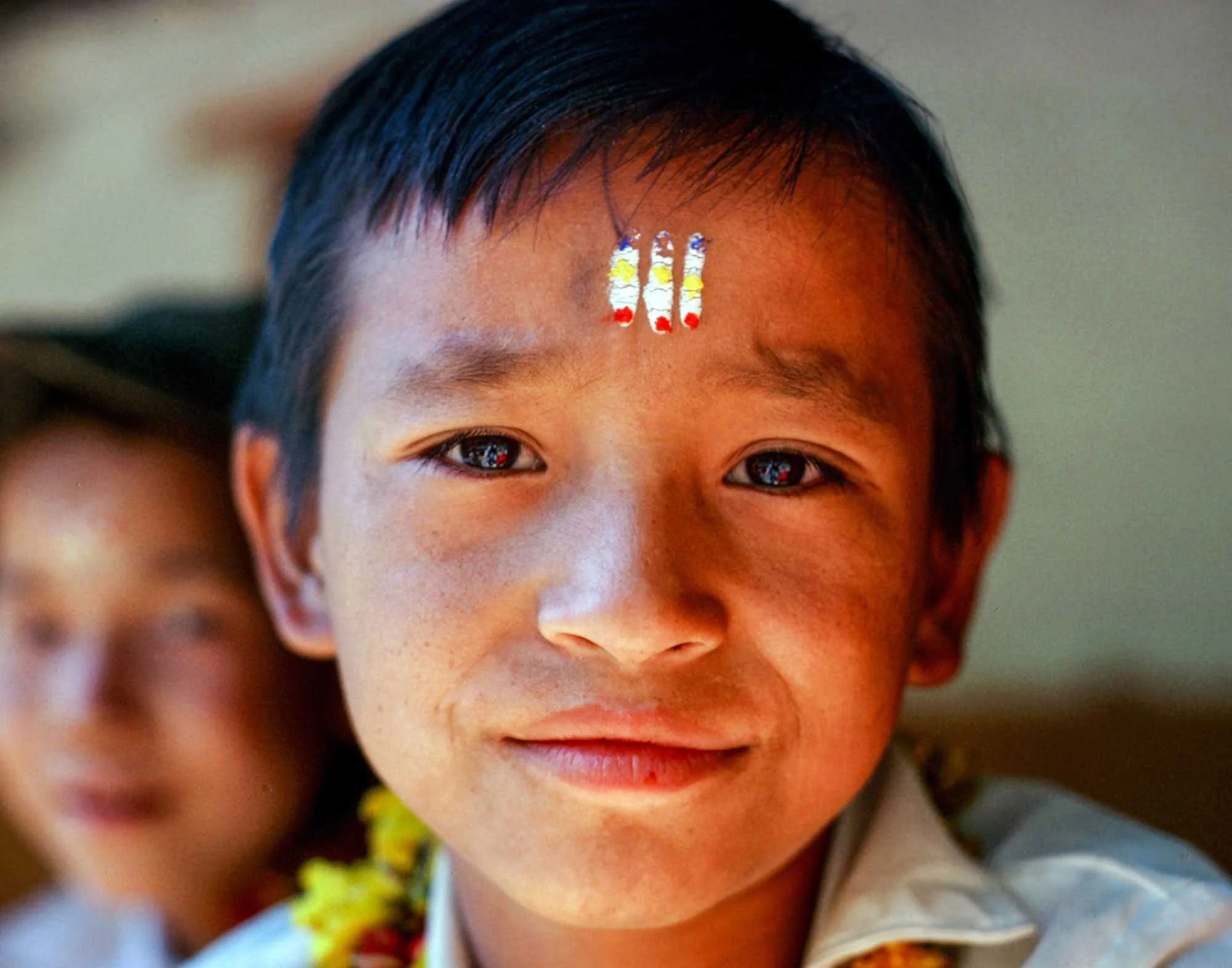
The equipment I used was obviously quite different, which influenced the photographs. In 1979, I had an Olympus SLR and a fast 50 mm lens. The portrait below of a young boy in Lower Mustang, taken with this camera, required me to be very close to the subject. Its power and directness reflect the constraints of 1979 photographic equipment.
A-Young-Boy-in-Lower-Mustang-1979
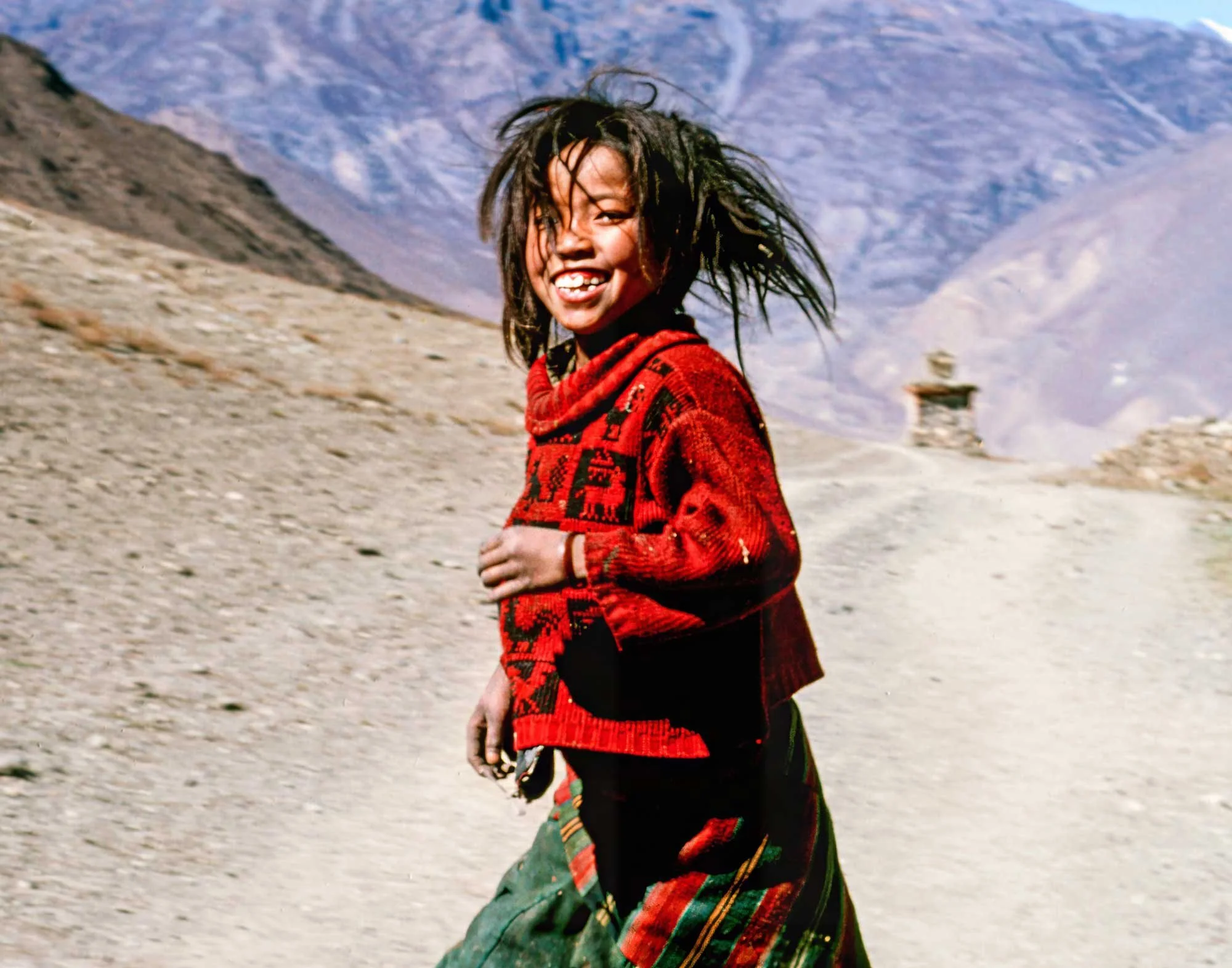
On that same trek, I took the photograph below of a Tibetan girl running across the trail. It also reflects the cameras of 1979 and the street-photography style I had learned. My camera was always at hand to capture a moment that would pass quickly.
A Tibetan Girl Crossing the Trail 1979
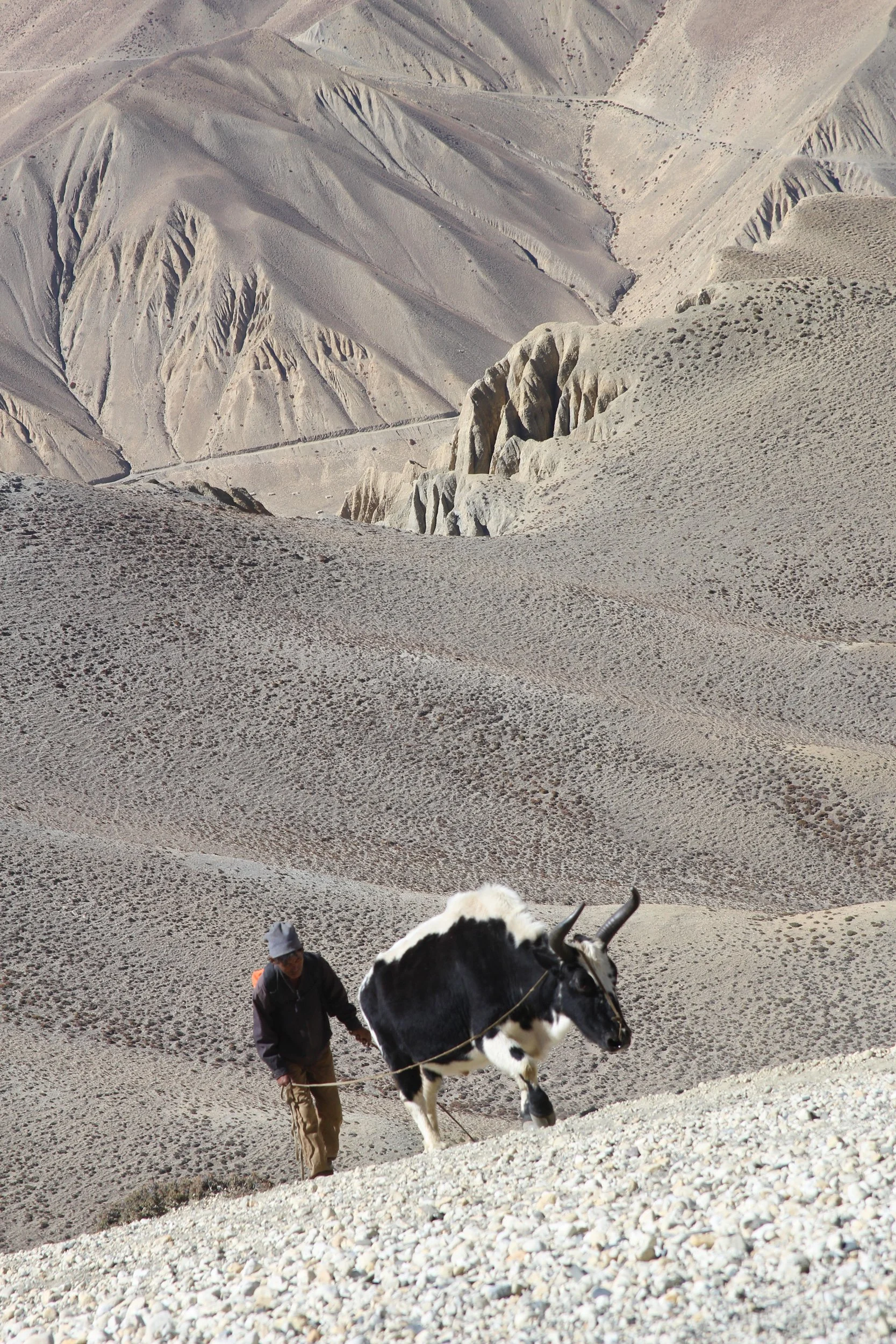
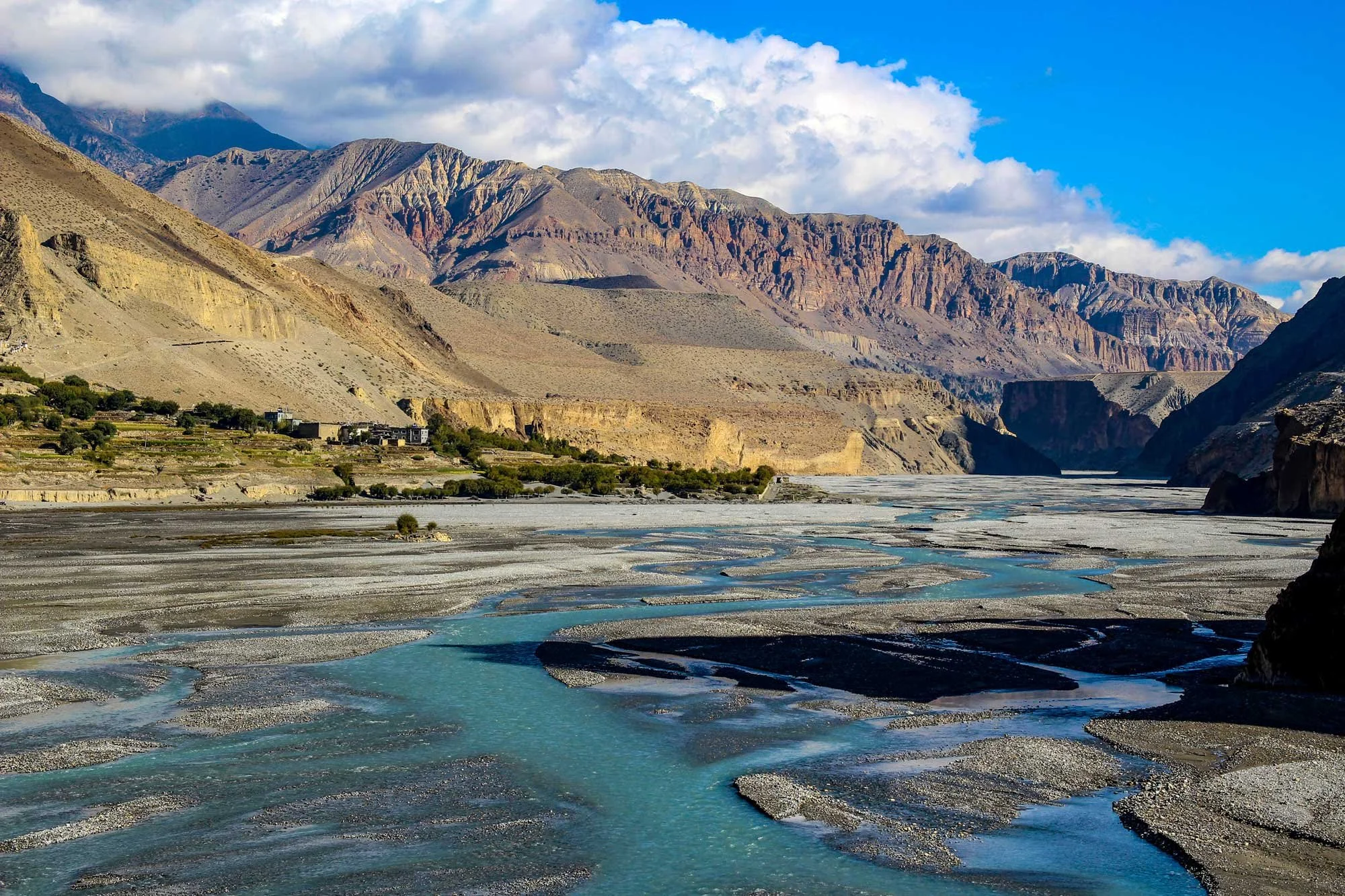
In 2014, I travelled with a Canon DSLR and a 24-85 mm zoom lens. I was able to capture landscapes in a way that was not possible in 1979.
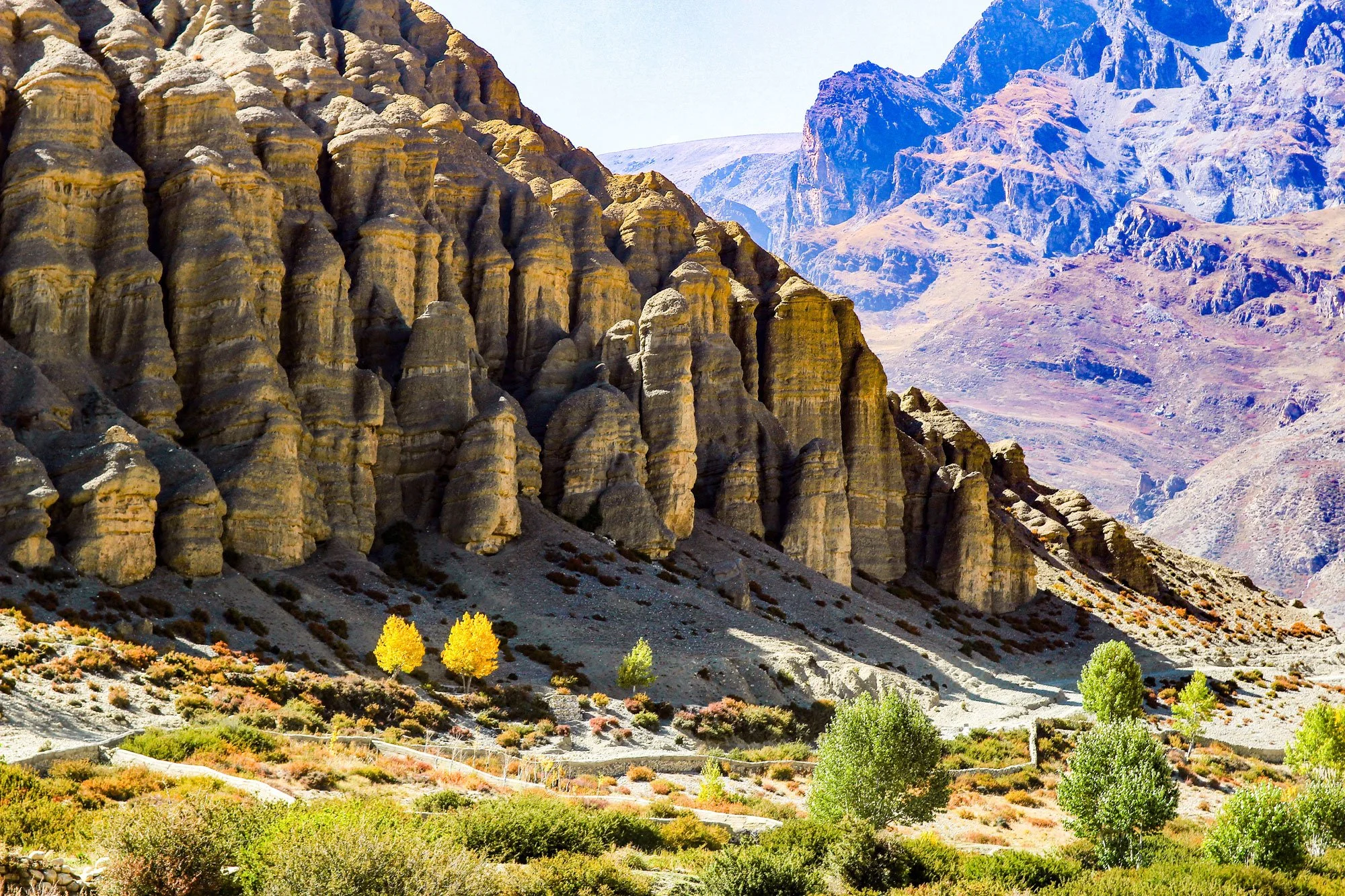
Landscape on the Trail to Ghilling, 2014
I took on this project to link my photographs taken 35 years apart and to explore the role of Tibetan Buddhism. The poem, by the great 12th-century Tibetan poet Jetsun Milarepa, motivated the work:
All the water and drink you’ve consumed
Through beginning less time until now
Has failed to slake thirst or bring you contentment.
Drink therefore this stream
Of enlightenment mind, fortunate ones.
Seeing culture through place: Much of the book shows landscapes, monasteries, and villages rather than dramatic events. How do you decide when a place alone can carry the meaning of a culture?
Mustang’s culture is interwoven with the beliefs and practices of Tibetan Buddhism. Tibetan Buddhism began in the 7th century as a fusion of the local Tibetan religion, Bon, which had a strong focus on nature and landscape deities, and Buddhist beliefs from India. Tibetan Buddhism is defined by the belief that real Buddhas lived among the people and that all beings possess an innate Buddha-nature. It is a reorientation of individual and social life to account for the reality of Buddhas, the possibility of becoming one, and the processes of doing so. It teaches us to use our lives to educate ourselves, to understand the world, and to prepare for death and future lives by cultivating ethical actions, emotional habits, and critical insight.
My book explores the beauty of Lower and Upper Mustang, linking the images to Tibetan Buddhism. People from Mustang identify themselves as “historically from Tibet, but politically from Nepal.” Before China invaded Tibet in 1950, Mustang maintained close political, economic, and cultural relationships with Tibet. Tragically, the events associated with the Cultural Revolution in China destroyed most of the temples and monasteries in Tibet, and Tibetan cultural traditions were and continue to be suppressed. Tibetan culture now survives only in the exile community and Mustang. The Dalai Lama has called Mustang the “... last bastion of living Tibetan Buddhism.”
Mustang's culture is expressed through its landscapes, monasteries, and villages rather than through dramatic events. To focus on “dramatic events” would have reflected a misunderstanding of the teachings of Tibetan Buddhism.
Working with restrictions: Upper Mustang was heavily restricted, with permits, guides, and very few visitors. How did these limits shape how freely you could photograph, and what did they teach you?
Surprisingly, they had little effect. In 2014, my daughter travelled with me. She spoke fluent Nepali. So fluent that the guides and porters we passed on the trail would ask to meet the white girl who sounded like a Nepali. I think her ability to communicate with our guides, the villagers, and the monks in the monastery made the trip unlike most tourists’ experiences.
Although Upper Mustang is isolated, it is not disconnected from the world. As in much of Nepal, a sizeable fraction of the younger generation has immigrated abroad. It was not unusual to meet people with family in the United States. If anything, I saw the influence of globalisation even in the most remote corner of Nepal.
Light and environment: Mustang has high altitude, strong sun, and desert-like weather. What were the biggest technical challenges with light and exposure, and how did you adapt in the field?
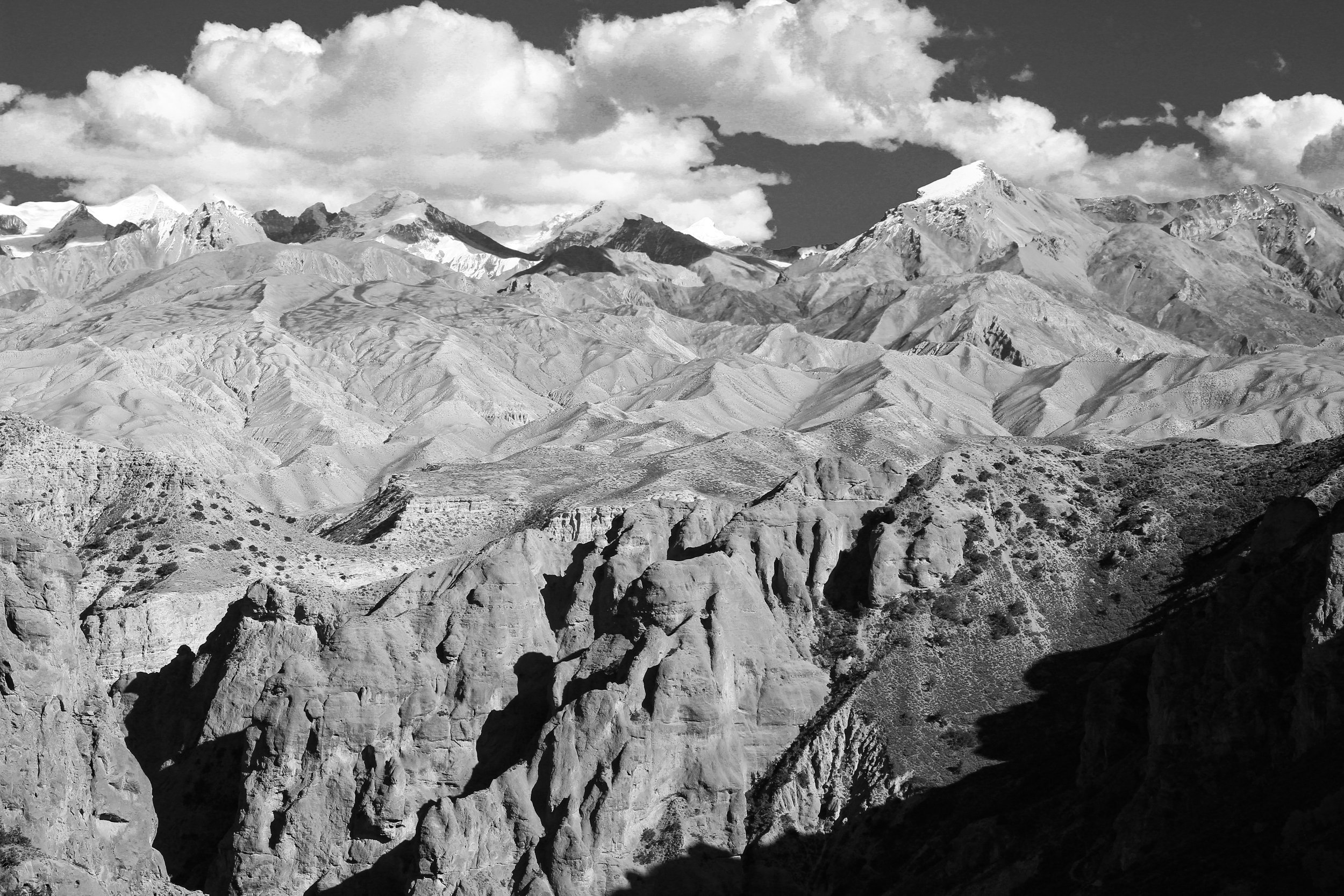
I was in Mustang in October in both 1979 and 2014. That is normally the easiest month to trek. The temperature is moderate, and the climate is very dry. The rivers are at their lowest; the sky is a bright, deep blue, with high-altitude clouds near the mountain peaks.
In 1979, with analogue equipment, the biggest challenge was dealing with the stark contrasts between shadows in narrow alleys and the bright reflections off white-washed buildings in the sun. One can see this in the photograph below.
A Street in Marpha 1979
One of the advantages of modern digital equipment is our ability to handle such large contrasts in both the camera and post-processing.
In 2014, there were different challenges. We trekked over passes above 14,000 feet and slept at altitudes above 12,500 feet. In 1979, at 25, these altitudes were not a concern, but at 60, they were. You learn quickly not to get out of breath by walking very slowly, because once you start to pant, it's hard to catch your breath.
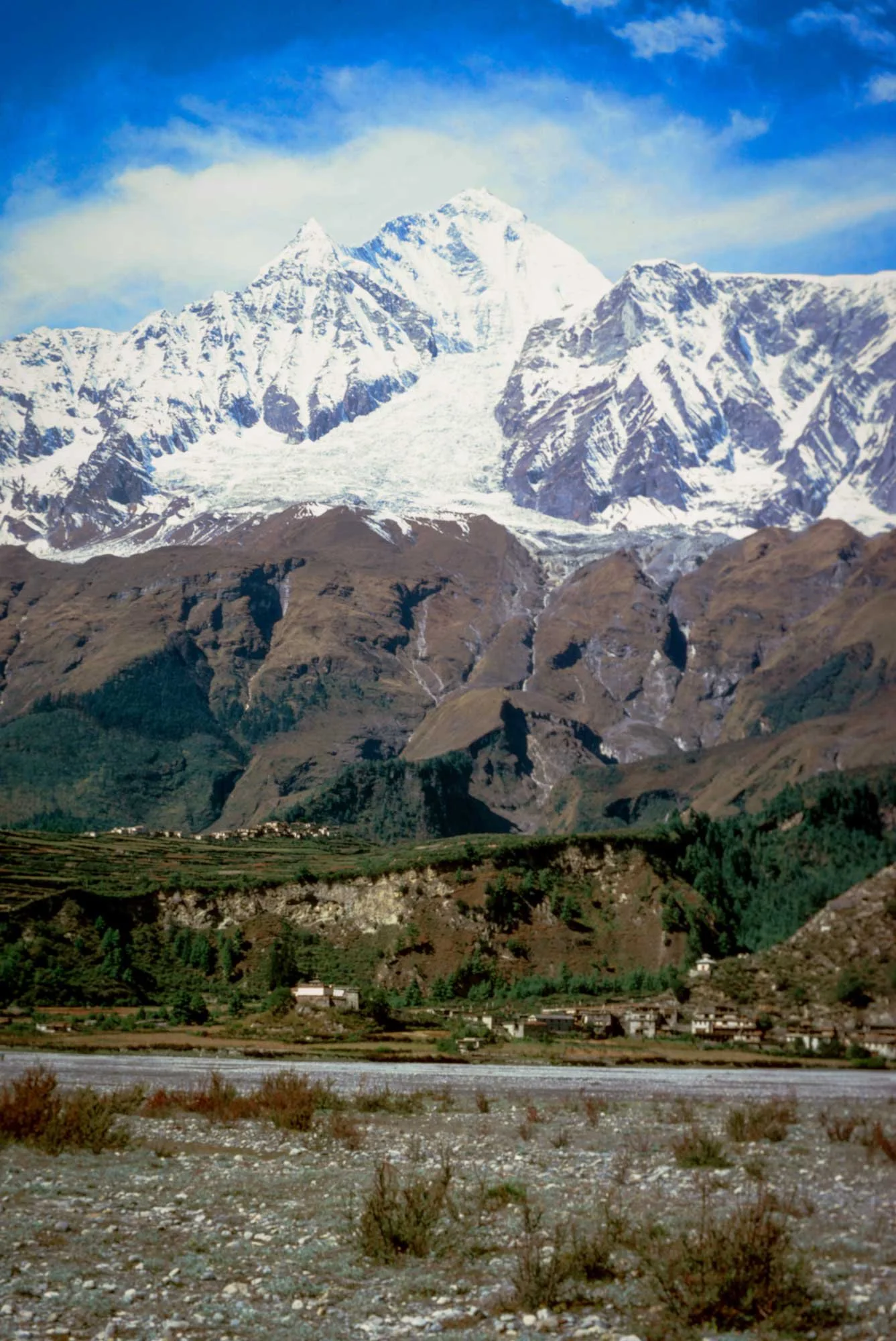
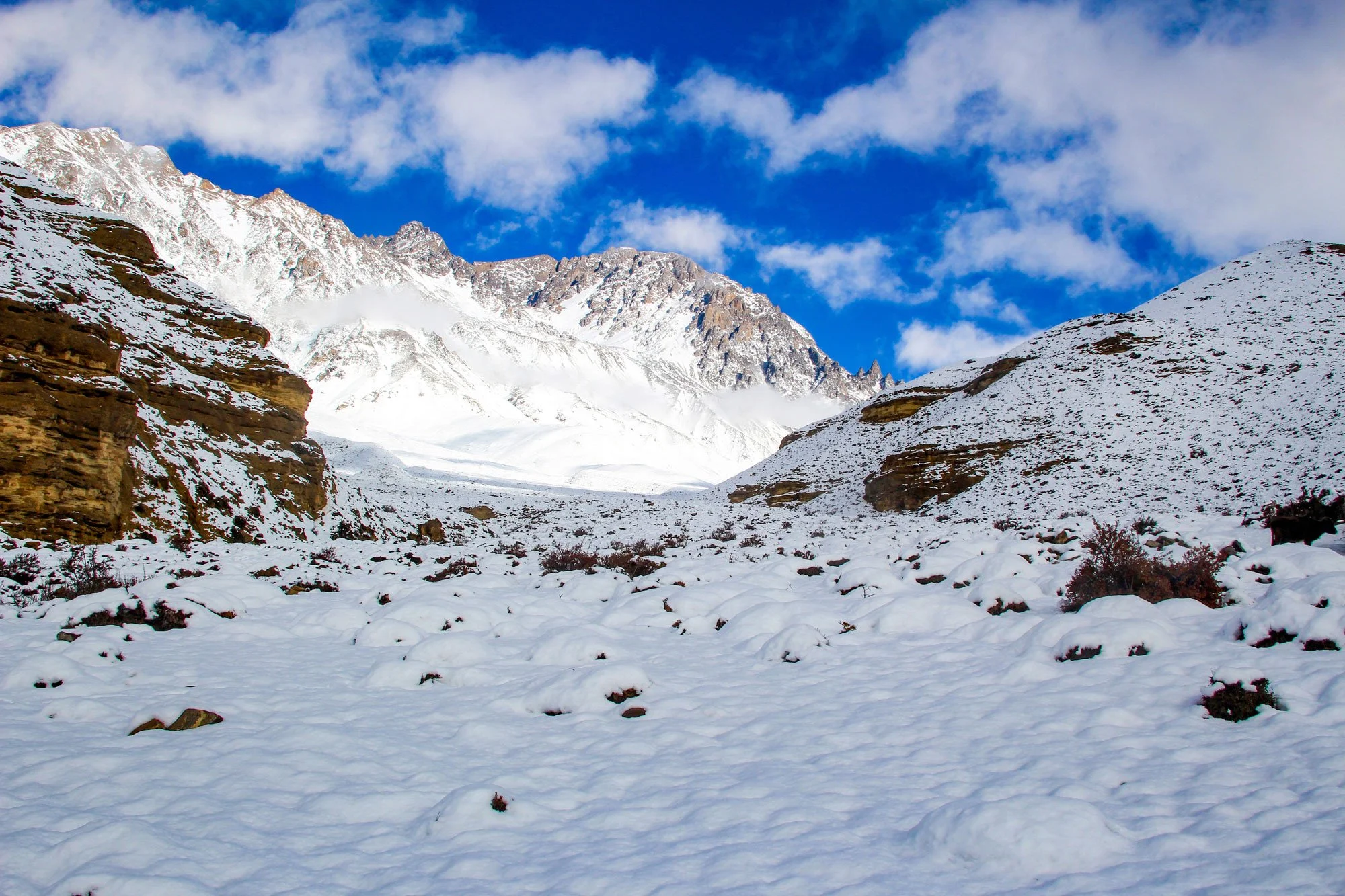
Our biggest challenge was the freak snowstorm that hit in October 2014. A snowstorm and a series of avalanches struck, with nearly 6 feet of snow falling within 12 hours, resulting in the deaths of at least 43 people, including at least 21 trekkers. We were lucky to be on the return leg of our trek, far from the high passes. But we lacked the clothing needed for the cold, wet weather, as we trekked through whiteout conditions, avoiding the most exposed routes. The next day, the bright blue sky of Mustang in fall reappeared.
Snow-Covered Mountains in Mustang 2014
This Mustang landscape is beautifully described by the 12th-century Tibetan poet Jetsun Milarepa.
The snow fell, big as bags of wool,
Fell like birds flying in the sky,
Fell like a whirling swarm of bees.
Flakes fell small as a spindle's wheel,
Fell as tiny as a bean seed,
Fell like tufts of cotton.
The snowfall was beyond all measure.
In this great disaster, I remained in utter solitude.
The falling snow in the year’s-end blizzard
Fought me, the cotton-clad, high on Snow Mountain,
I fought it as it fell upon me
Until it turned to drizzle.
I conquered the raging winds—
Subduing them to silent rest.
The cotton cloth I wore was like a burning brand.
Respect and presence: You were photographing living religious spaces, not museums. How did you make images without feeling intrusive, especially inside monasteries and during festivals?
It was essential to respect Tibetan culture and the religious practices in Mustang. For this reason, I never took pictures inside temples and during festivals without the local monks' consent. In 1979, there were hardly any other Westerners travelling in Lower Mustang. We were often viewed as a novelty. I do not speak Nepali or Tibetan. But by simply lifting my camera and holding it out, I made it clear I wanted to take a picture, and I would photograph only if they nodded yes. In 2014, my daughter, fluent in Nepali, travelled with me. We made sure to take photographs in places that the monks approved. The inner sanctums of the monasteries were off-limits, and I did not photograph those rooms, but all other areas were open to photography.
Tibetan Buddhism is completely interwoven with the life and landscape of Mustang, and so the concept of a division between “religious spaces” and the rest of the world, including the land, is incorrect.
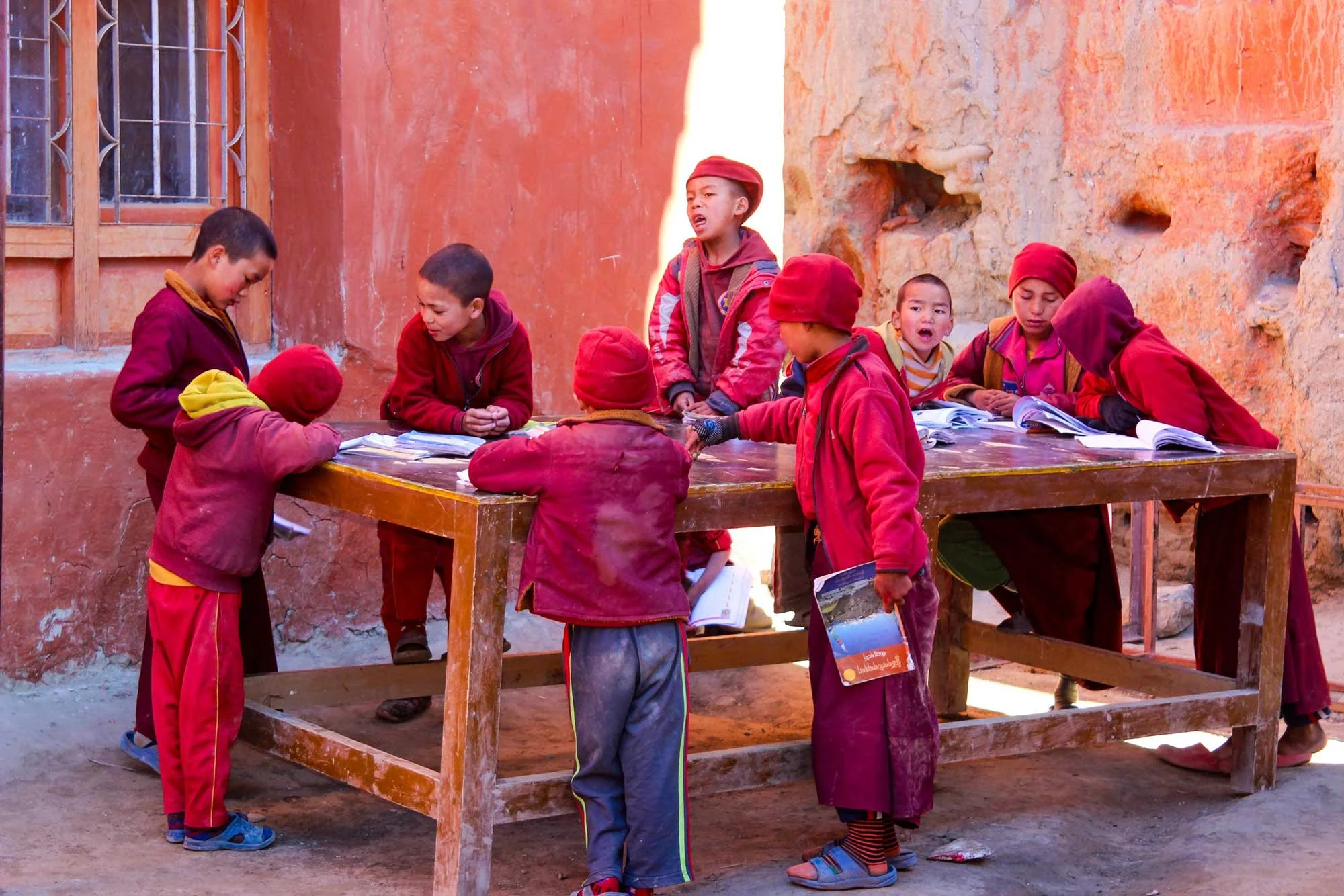
The photograph below shows students in a monastery in Upper Mustang. They are monks in training; this is life for many firstborn sons in Upper Mustang.
Students in the Choede Monastery 2014
Editing and meaning: You included poems by Jetsun Milarepa alongside the photographs. How did pairing text and images help you say things photography alone could not?
To understand the meaning of Tibetan Buddhism, I have included poems by Jetsun Milarepa. Two of which I have listed above. Milarepa lived and travelled across Tibet and Mustang from 1052 to 1135. He is regarded as Tibet’s greatest poet and is a folk hero in the Tibetan world. Milarepa committed a grave crime at a young age. Afterwards, he sought out and followed a spiritual path. He attained the ultimate state of awakening within a single lifetime. His life demonstrates that even a murderer can transform himself into a Buddha.
I wanted the photographs to reflect Mustang's culture, which is inseparable from Tibetan Buddhism. This includes the culture, people, villages, monuments, and monasteries. It is also reflected in Mustang’s connection to the landscape. The holiness of the landscape in Tibetan Buddhism derives from Bon's influence. In Tibet, Buddhism merged with Bon, giving rise to the distinct form of Buddhism we know today as Tibetan Buddhism. Buddhism was introduced to Mustang by Guru Rinpoche during his visit to Lo Manthang in the 8th century. According to legend, Guru Rinpoche pacified the Bon demons in Mustang, who ruled the landscape, and made them the core protectors of the Dharma, the teachings of the Buddha, and the path to enlightenment and the ultimate truth.
Building on past work: In Leaves of Grass, you spoke about patience and long-term looking. What lessons from that project directly helped you shape The Last Refuge of Tibetan Buddhism?
My Leaves of Grass book (Photographic poetry – Leaves of Grass) taught me about the connection between photography and poetry. In that book, I said, “Poetry and photography are both forms of abstraction, capturing aspects of reality. They transform an experience into a memory. Both are interpreted anew by each viewer. The meaning of a poem or photograph is not fixed or constrained but relies on the viewer's sensitivity, knowledge, and understanding.” I still believe this is true, and it was an important lesson to keep in mind as I developed The Last Refuge of Tibetan Buddhism. The Leaves of Grass also taught me about the need to be patient in putting together a photography book. To let it develop naturally and migrate away from your initial conceptions. In a sense, to let it grow organically. That lesson proved invaluable to this new project, although I had to learn it again.
In this new book, the roles of poetry and photographs are flipped: in Leaves of Grass, I used my photographs to amplify and interpret Whitman’s poems. In The Last Refuge of Tibetan Buddhism, I have used Jetsun Milarepa’s poems to support the photographs and give context and nuance to the photographs.
Advice for photographers: For photographers working on long-term cultural projects, what is one mistake you made early on that you would tell them to avoid now?
The biggest one is patience and allowing the material to guide you. To be true to the culture you are illustrating, you must be careful not to impose your own cultural values on the story. The second one is humility. One needs to recognise one's ignorance. Although I have read multiple books on the history and culture of Tibet and Mustang, on the meaning of Tibetan Buddhism, and all of Jetsun Milarepa’s poems translated into English, I am not from Mustang and am not a Buddhist. In a sense, there was an interplay between learning about Tibetan Buddhism and maintaining humility. This book was a personal step in my path to enlightenment, a path that will continue for the rest of my life.
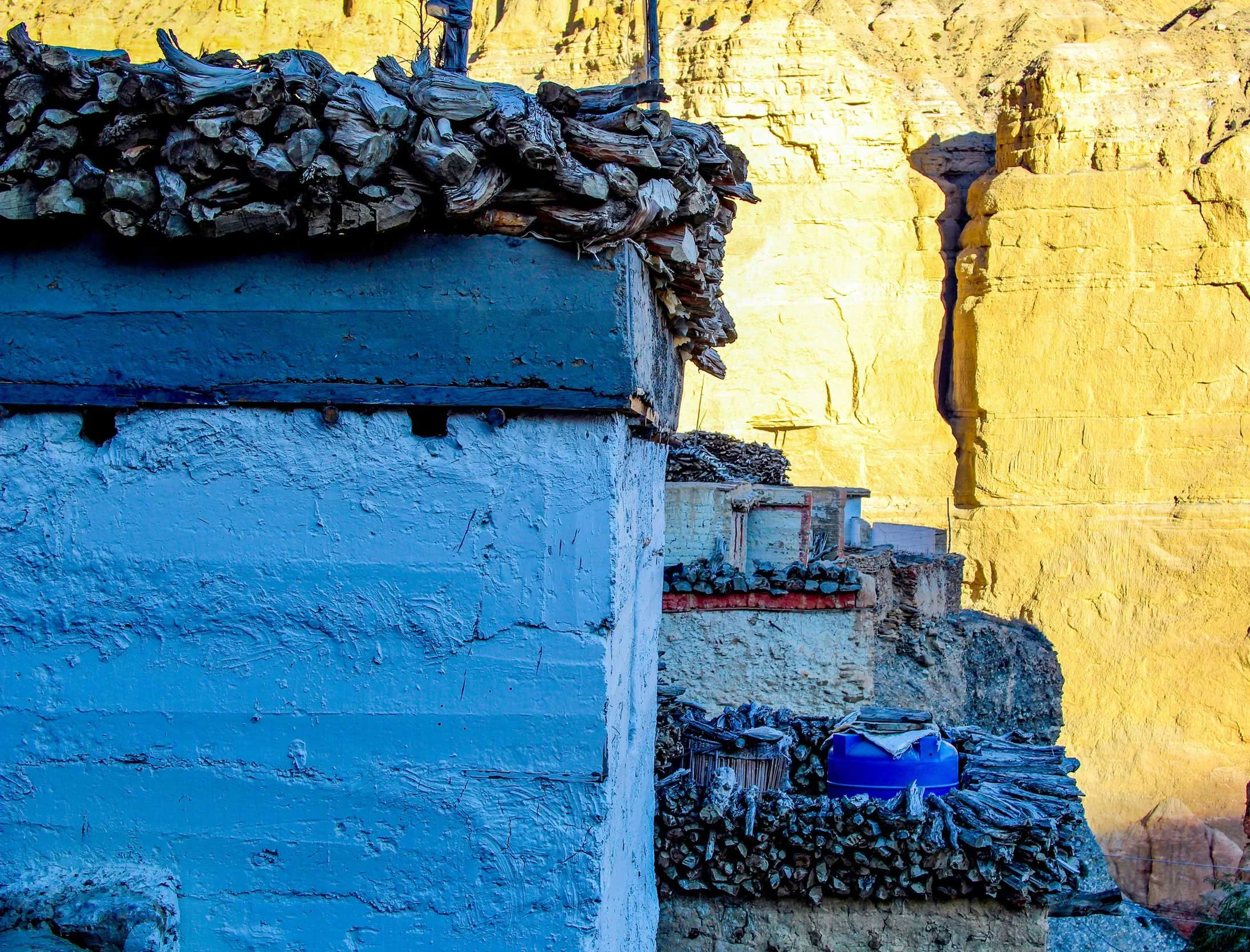
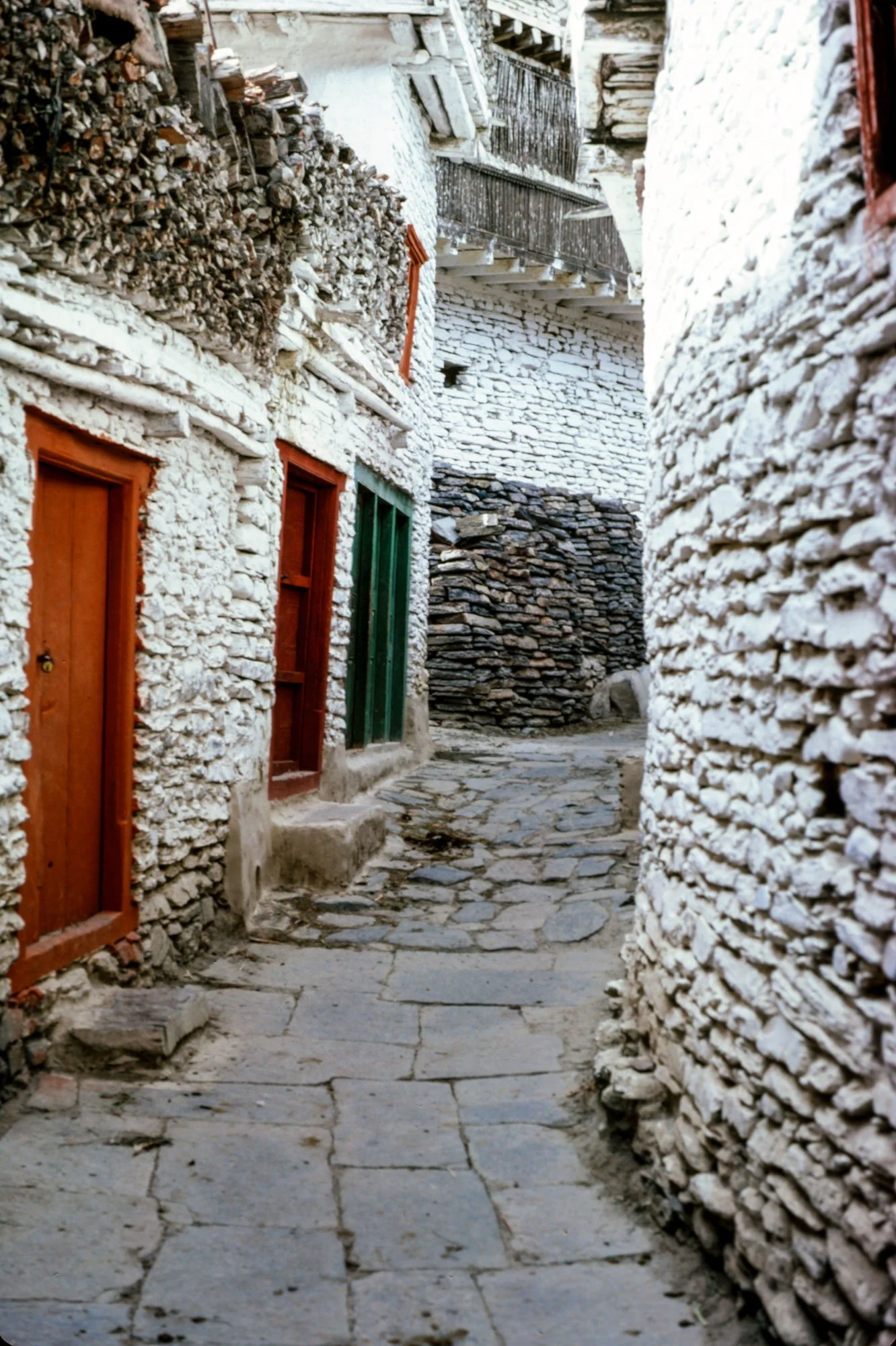
To discover more about this intriguing body of work and how you can acquire your own copy, you can find and purchase the book here. (Kozu Books, JeffreyMarqusee.com, Amazon)
More photography books?
We'd love to read your comments below, sharing your thoughts and insights on the artist's work. Looking forward to welcoming you back for our next [book spotlight]. See you then!
Ian Bates found his wildfire story after the fire. In 2014, he saw his first wildfire while visiting a friend in Eastern Washington. Photography Book Spotlight