AT A GLANCE
- Known for
- Very sharp photographs of the planets taken from Earth, above all Jupiter
- Works in
- Color, built from separate red, green and blue filter images; also deep-sky work
- Camera
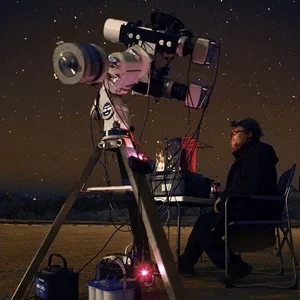
- Celestron C14 telescope with ZWO ASI planetary cameras
- Also
- Overall winner of Astronomy Photographer of the Year 2011; asteroid 26732 Damianpeach is named after him
- Start with
- Lessons from the Masters: Current Concepts in Astronomical Image Processing (Springer, 2013)
- Links
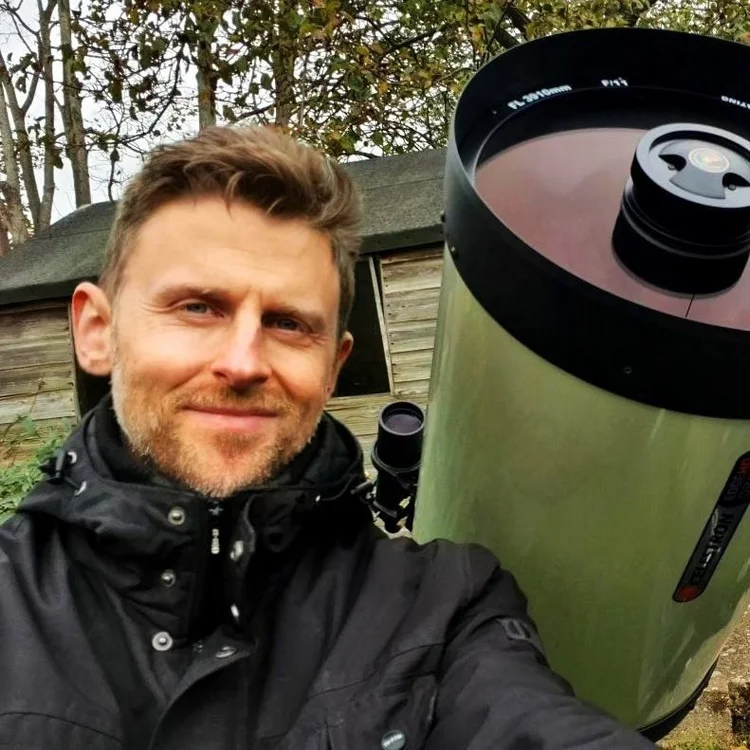
Damian Peach (born 1978) is a British amateur astronomer and astrophotographer. He is known around the world for detailed photographs of the planets, made with telescopes on the ground. In 2011 he was the overall winner of Astronomy Photographer of the Year.
The story
On 23 July 1997, a young observer in Kings Lynn, on the Norfolk coast of England, turned his telescope to Jupiter. It was a new 8-inch Meade, bought that year with help from his mother. The view was the best he had ever seen. He filled his logbook with notes and exclamation marks. “So much detail was visible; I could not hope to sketch it all,” Damian Peach wrote later. From that night on, he was hooked on the giant planet.
The interest had started much earlier. At nine or ten, he found books full of planets and galaxies in his primary school library. At 13, after asking his mother again and again, he got his first telescope, a small Tasco refractor. In the early 1990s his foster father drove him to meetings of the Boston Astronomical Society in Lincolnshire. There he could use the club’s bigger telescopes.
But a pencil could not keep up with Jupiter. So in 1997 he bought a 12-inch telescope and an SBIG ST-7 CCD camera and began to photograph the planets. In 2002 and 2003 he lived for a while in Tenerife and spent more than 100 nights imaging there. In 2003 he showed Mars live on British television from La Palma. That same year he visited his childhood hero, Sir Patrick Moore, in Selsey. The plan was one afternoon. He stayed three days, and they became friends.
Recognition followed. In 2011 his photograph of Jupiter with its moons Io and Ganymede, taken in Barbados with a Celestron C14, won Astronomy Photographer of the Year. In June 2017 he joined a small team at the Pic du Midi Observatory in the French Pyrenees. With its 1.06-metre telescope they made some of the most detailed ground-based images of Jupiter and Saturn. Peach processed the view of Jupiter and Ganymede from 10 June.
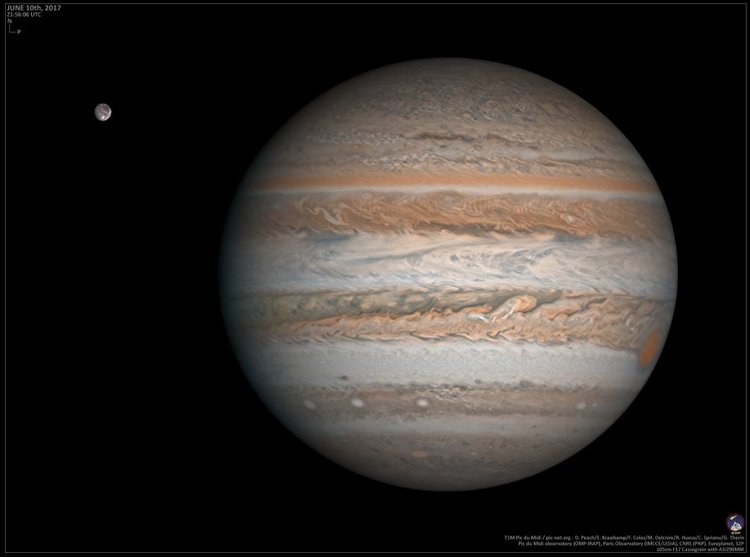
Twenty years after that night in Norfolk, the details he could not draw were all there in one picture. In 2017 an asteroid was also named after him. “My life could have turned out much differently. But astronomy has provided many wonderful friends, lots of travel, and a bit of recognition for my images. I wouldn’t trade it for the universe!”
The work


- 1978Born in Britain
- 1988Becomes interested in astronomy through books in his school library
- 1997Starts photographing the planets with a CCD camera
- 2003Images Mars live on BBC television from La Palma; meets Patrick Moore
- 2006Receives the British Astronomical Association’s Merlin Medal
- 2011Overall winner of Astronomy Photographer of the Year
- 2014Elected a Fellow of the Royal Astronomical Society
- 2017Images Jupiter and Saturn at Pic du Midi; asteroid 26732 Damianpeach is named
- 2022Receives the Julien Saget Prize of the Société Astronomique de France
Lessons
Keep a logbook. His notes from 23 July 1997 still exist, full of exclamation marks. A record of each night shows how your work grows.
Shoot fast. He uses the fastest frame rate he can and records sequences of about 60 seconds. That gives him thousands of frames to choose from.
Learn from people you admire. Paul Money, Donald Parker and Patrick Moore all inspired him, and he later observed and worked with them.
Try this: on a clear night, record several 60-second videos of Jupiter through a telescope. Stack the sharpest frames in a program like AutoStakkert, then compare the result with a single frame.
Gear
Celestron C14 telescope: his own main telescope for many years. He used it for his winning 2011 photograph of Jupiter and says he will never sell it.
ZWO ASI planetary cameras: he mostly uses the ASI120MM-S, ASI174MM, ASI290MM and ASI224MC. Before that he used an SBIG ST-7 CCD camera and, in Tenerife, a Philips Toucam webcam.
Remote telescopes: he images remotely with a 1-metre telescope in Chile. For deep-sky work he has used 20-inch and 27-inch corrected Dall-Kirkham telescopes.
For processing he uses AutoStakkert 3, Registax 6 and Photoshop, with WinJUPOS to correct for the planet’s rotation.
Books
Lessons from the Masters: Current Concepts in Astronomical Image Processing (Springer, 2013). Edited by the astrophotographer Robert Gendler for the Patrick Moore Practical Astronomy Series. Seventeen experts each write a chapter on one area of image processing, from deep-sky and widefield work to eclipses and the Sun. Peach wrote the chapter “High Resolution Lunar and Planetary Imaging.” Other contributors include Rogelio Bernal Andreo, Tony Hallas, Babak Tafreshi and Fred Espenak. It has about 150 illustrations and suits imagers who already know the basics and want to improve their processing.
Lunar and Planetary Webcam User’s Guide (Springer, 2006). Written by the British amateur astronomer Martin Mobberley, also in the Patrick Moore Practical Astronomy Series. It explains how to photograph the Moon, the planets and the Sun with webcams, from a quick-start guide to stacking and color processing. Peach gave more images to the book than anyone else, including a raw and processed Jupiter stack made in Tenerife. A good historical guide to the webcam years that changed planetary imaging.
In his words
“During the summer of 1997, I experienced what I can only describe as the most amazing sight through a telescope ever.”
“So much detail was visible; I could not hope to sketch it all.”
“The learning curve was steep in those early days, but I soon had everything working well.”
“Always go with the fastest frame rate you can. This will help produce sharper images.”