AT A GLANCE
- Known for
- Spacecraft caught crossing the Sun and the Moon, and the Moon lined up with Paris landmarks
- Works in
- Color, digital; planets, the Sun, the Moon, satellites and deep sky
- Camera
- Celestron C14 EdgeHD telescope; Sigma fp L with a Sigma 135mm f/1.8 Art lens
- Also
- Engineer by trade; asteroid 19458 Legault is named after him
- Start with
- Astrophotography (Rocky Nook, 2014)
- Links
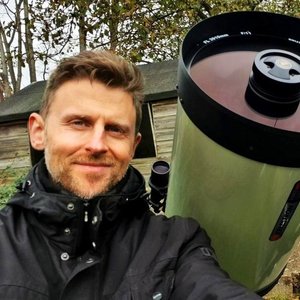
Thierry Legault (born 1962) is a French amateur astronomer and astrophotographer. He is known for photographs of the International Space Station, the Space Shuttle and the Hubble Space Telescope crossing the Sun. He works as an engineer and lives in the suburbs of Paris.
The story
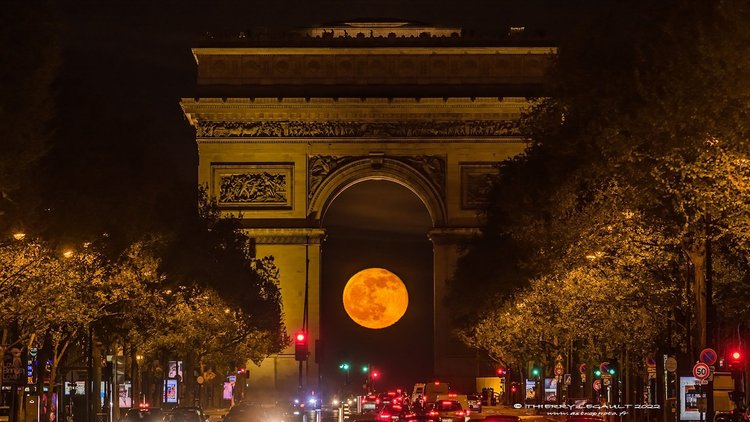
On Easter Sunday 2022, Thierry Legault was on a high-speed train back to Paris. He had spent the weekend with his family about 400 km away. From the window he could see high clouds coming in from the west. The train reached the southern suburbs at 8:15 p.m. That left him “less than two hours to get my car” and get to the Champs-Élysées. At 10:10 p.m. he stood at a pedestrian crossing in the middle of the avenue. The full Moon rose exactly inside the Arc de Triomphe. A few minutes later the clouds covered it. “Just in time!” he wrote.
Legault started photographing the sky in 1993, with one of the first CCD cameras sold to amateurs. “It was a wonderful time, because it was a time of pioneers, and it was a revolution after film,” he remembers. In 1994 he joined Christian Buil at the Pic du Midi Observatory to record Comet Shoemaker-Levy 9 hitting Jupiter.
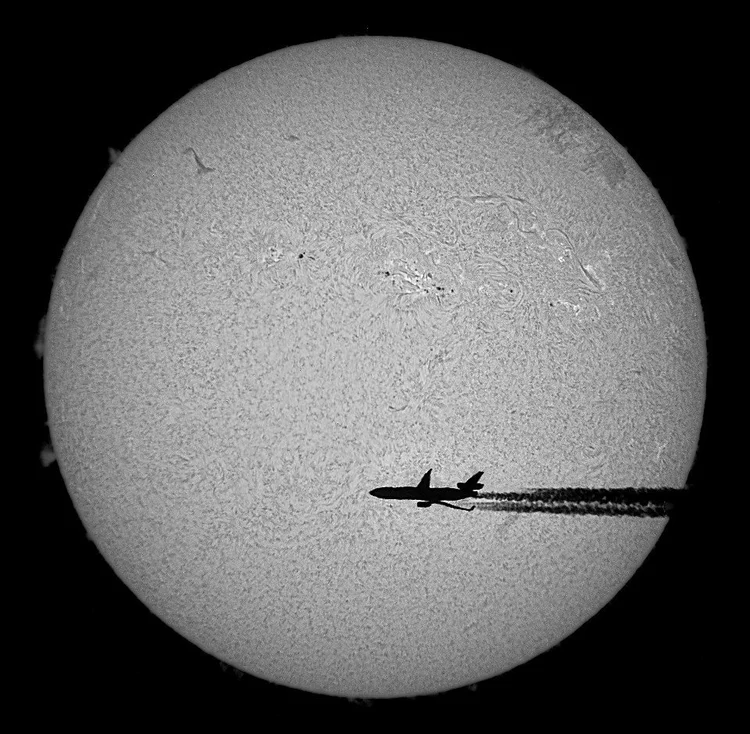
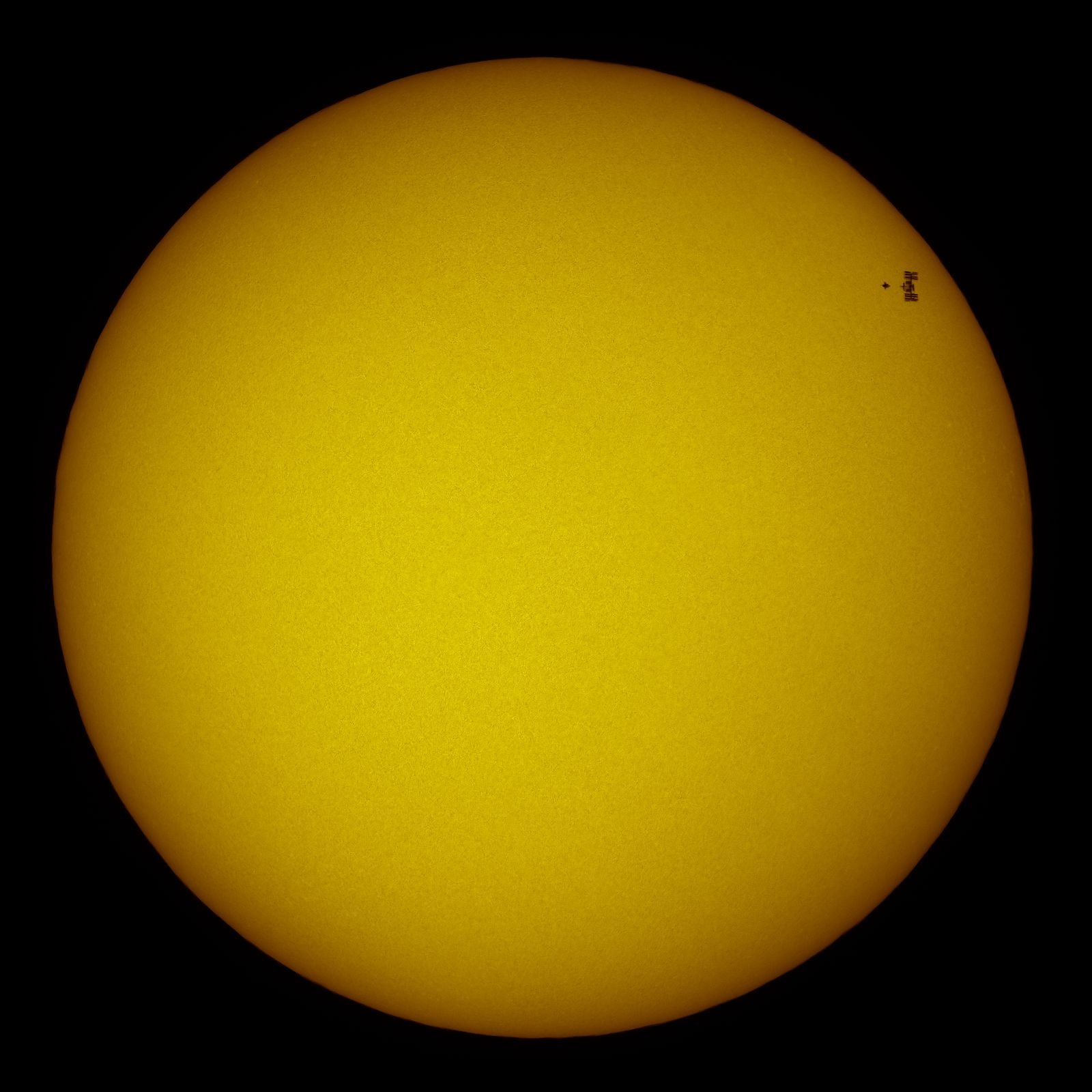
But a plane changed the direction of his work. From his home near Paris, he waited through many near misses until a plane crossed in front of the Sun. In January 2001, NASA’s Astronomy Picture of the Day published the photograph. “It was an incredible success, which was very surprising,” he said. So he began to chase spacecraft. On 13 May 2009, about 100 km south of Kennedy Space Center in Florida, he photographed Atlantis and Hubble together in front of the Sun. The crossing lasted 0.8 seconds. He does not look through the camera during these events. He watches a radio-synchronized clock and starts shooting two seconds early. In 2011 he made the first image from the ground of an astronaut on a spacewalk.
The Paris photographs use the same method. Two days before Easter, on Friday 15 April, he photographed the Moon setting behind the Eiffel Tower. The next day, while studying the Moon’s positions, he saw that it would rise under the Arc de Triomphe on Sunday evening.
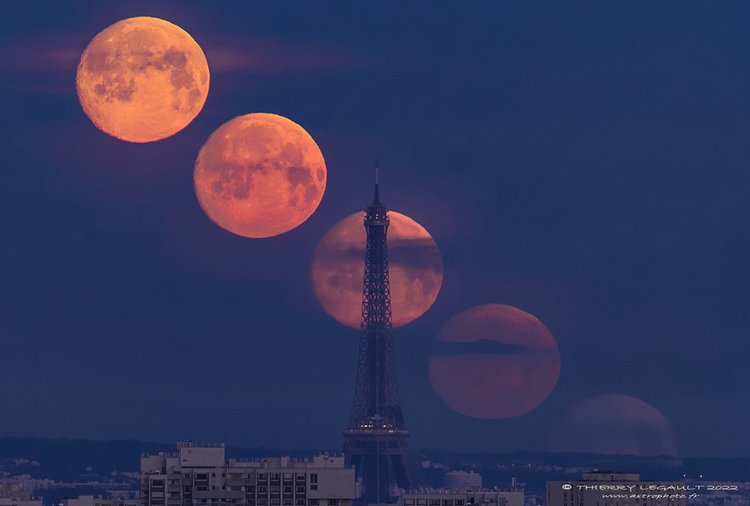
The Arc de Triomphe picture is a single exposure, with no stacking and no assembling. It looks like a lucky moment, but the luck came from maps, calendars and a train timetable. “Such shot cannot be unplanned, the chances are infinitesimal.”
The work


- 1962Born in France
- 1993Starts astrophotography with one of the first CCD cameras for amateurs
- 1994Records Comet Shoemaker-Levy 9 hitting Jupiter at Pic du Midi with Christian Buil
- 1999Receives the Marius Jacquemetton Prize of the Société astronomique de France
- 2001His airplane in front of the Sun appears on NASA’s Astronomy Picture of the Day
- 2004Le grand atlas de la Lune, with Serge Brunier, is published by Larousse
- 2009Photographs Atlantis and Hubble crossing the Sun from Florida
- 2011Makes the first ground-based image of an astronaut on a spacewalk
- 2022Photographs the full Moon rising inside the Arc de Triomphe
Lessons
Plan to the kilometre. For a transit he must stand within about one kilometre of the centre of a path only 5 to 10 km wide. He studies maps and forecasts before he leaves home.
Prepare for one chance. Many of his events last less than a second. Everything must be ready before it starts, because there is no second try.
Keep it real. His Arc de Triomphe Moon is one exposure, as close as possible to the real scene.
Try this: use a planning app to find a night when the full Moon rises or sets behind a building near you. Go early, use your longest lens on a tripod, and make a single exposure.
Gear
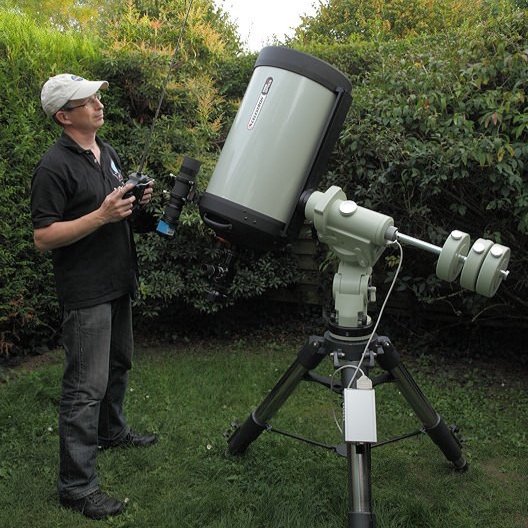
Celestron C14 EdgeHD telescope: the 14-inch telescope he uses to photograph satellites and the planets.
Sigma fp L camera: he used it with a Sigma 135mm f/1.8 Art lens for the Full Moon in the Arc de Triomphe, a single exposure on a tripod.
Radio-synchronized watch: for transits he times the shot by the clock, not by looking through the camera.
He began in 1993 with one of the first CCD cameras made for amateurs.
Books
Astrophotography (Rocky Nook, 2014). The English edition of his French guide, translated with help from Alan Holmes of SBIG. It is a large softcover with more than 100,000 words, and every astronomical image in it is his own. It starts with simple photographs on a tripod: constellations, star trails, eclipses, satellites and auroras. Then it moves to the Moon, the planets, the Sun and deep-sky objects with a telescope. It explains how to choose cameras, filters and mounts, how to plan a session and how to process images. Good for beginners and for people who want to improve.
Astrophotographie (Eyrolles, 2006). The original French book, later updated in a second edition. It won the Special Jury Prize at the Festival d’astronomie de Haute-Maurienne in 2007. It covers the same ground as the English edition and is the version for French readers.
New Atlas of the Moon (Firefly, 2006). Text by the French science writer Serge Brunier, photographs by Legault. It first appeared in French as Le grand atlas de la Lune (Larousse, 2004). A large, illustrated atlas with images of the Moon through all its phases and clear overlays that name craters, mountains, rilles and seas. It also has close-ups of interesting features, maps, the Moon’s history and myths, and advice for observing with binoculars or a telescope. For anyone who wants to learn the Moon’s surface.
In his words
“I suppose it is much like participating in a sport, but the feeling is addictive.”