AT A GLANCE
- Known for
- Pictures of the Moon, nebulae and galaxies, and guides that teach astrophotography with DSLR cameras
- Works in
- Color; digital DSLR images today, film in his earlier deep-sky work
- Camera
- Canon DSLRs, including the EOS 20Da made for astrophotography, on refractors and an equatorial mount
- Also
- Staff sports photographer at The Philadelphia Inquirer from 1987 to 2009, nominated for three Pulitzer Prizes
- Start with
- Catching the Light (Lulu, 2005)
- Links
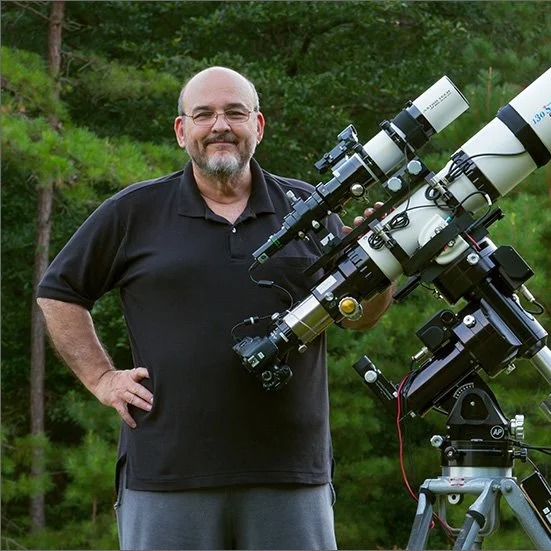
Jerry Lodriguss (born in the 1950s) is an American astrophotographer, author and former sports photographer. For more than twenty years he photographed sports for The Philadelphia Inquirer. He is known for his pictures of the Moon and deep sky, and for books that teach beginners how to photograph the night sky.
The story
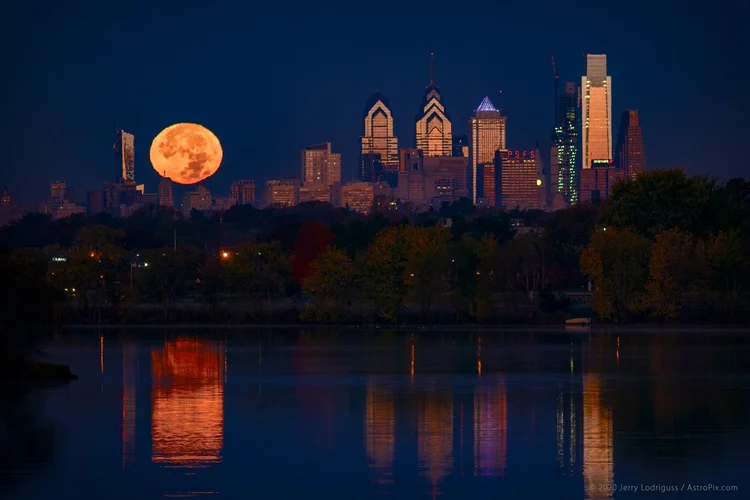
At 6:21 in the morning on 14 November 2016, the full Moon was setting over Philadelphia. It was a supermoon. Within the same few hours it was full and at its closest point to Earth. Jerry Lodriguss photographed it in the twilight, big and orange beside the towers of the city. Below, its light lay on the Cooper River. Four days later NASA showed the picture as its Astronomy Picture of the Day.
Pictures like this need planning. For an earlier shot of a thin crescent Moon setting over the same skyline, in 2014, he planned for three years. A crescent sets in that exact place only one or two days a year.
The Moon is also where it all began. At seven, growing up in New Orleans, he looked at it through a spyglass and saw its craters. At 17 he bought a camera to photograph through a 10-inch reflecting telescope he had built himself.
But the camera soon became his work. In 1974 he started shooting high school sports for a small weekly paper, for five dollars a picture. Then came the Times-Picayune and the Louisiana bureau of United Press International. As a freelancer he shot for Sports Illustrated, Time and The New York Times. From 1987 to 2009 he was a staff sports photographer at The Philadelphia Inquirer. He covered three Olympics and was nominated for three Pulitzer Prizes.
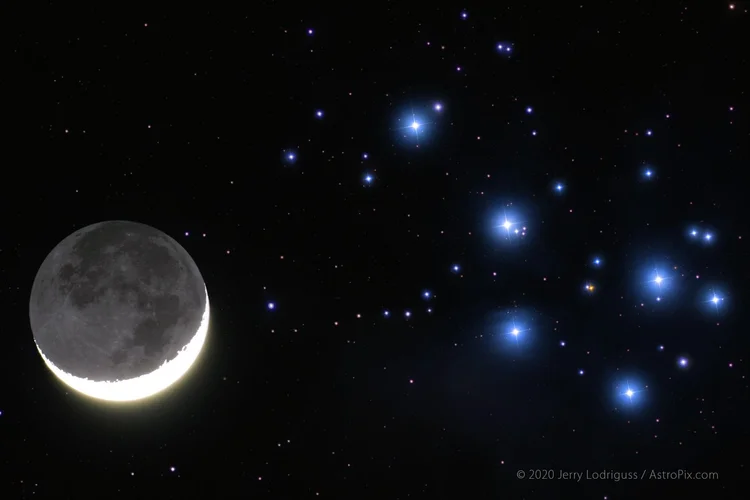
All those years, the night sky stayed with him. He photographed nebulae and galaxies from dark places like the New Jersey Pine Barrens. He wrote guides for beginners and became a contributing editor at Sky & Telescope. The Moon kept coming back too, here as a thin crescent next to the Pleiades.
That first camera no longer works, but he still has it. “It got me started in photography both as a hobby and as a career,” he wrote.
The work


- 1950sBorn; grows up in New Orleans, with Cajun and Creole roots
- 1972Becomes an amateur astronomer and astrophotographer
- 1974Starts shooting high school sports for a weekly paper in New Orleans
- 1987Joins The Philadelphia Inquirer as staff sports photographer
- 2005Publishes Catching the Light; his Moon and the Pleiades is a NASA Astronomy Picture of the Day
- 2009Leaves the Inquirer; publishes A Guide to Astrophotography with Digital SLR Cameras
- 2012Publishes A Guide to DSLR Planetary Imaging
- 2016Philadelphia Perigee Full Moon is a NASA Astronomy Picture of the Day
- 2017Photographs the total solar eclipse of 21 August
Lessons
Plan with the calendar. He planned one Moon-over-Philadelphia picture for three years, because the Moon sets in that place only one or two days a year.
Stack short exposures. Instead of one long exposure, he takes many shorter ones, for example twelve 5-minute frames, and stacks them to reduce noise.
Start with what you have. For beginners he suggests any DSLR on a tripod, a wide-angle lens focused at infinity, ISO around 1600 and the self-timer, with something interesting in the foreground.
Try this: find out when the Moon will rise or set behind a skyline or landmark near you. Choose your spot in advance, go back on the right day, and keep shooting from twilight until the Moon is gone.
Gear
Canon DSLR cameras: in 2010 he used a Canon EOS Rebel XS and an EOS 20Da, a DSLR made for astrophotography. For his planetary book he used a Canon EOS T2i (550D).
Refractor telescopes: an Astro-Physics 130EDT and a Stellarvue SV70ED with a focal length of 420mm at f/6.
Equatorial mounts: a Losmandy GM100EQ, and later a Takahashi EM-200 Temma 2M. The mount follows the sky so the stars do not trail.
Schmidt-Cassegrain telescope: a Celestron C11 Edge, used for many of the planet images in his planetary imaging guide.
For the 2014 crescent Moon over Philadelphia he used a 180mm lens on an ordinary photo tripod, then blended several exposures in Photoshop.
Books
Catching the Light (Lulu, 2005). A 98-page paperback that he describes as a beginner’s guide to the wonders of the cosmos. It has more than 125 color photographs, made with lenses and telescopes from 16mm to 2,500mm focal length, each with a short, clear explanation. It moves from the nearest objects, the Moon and the Sun, out to galaxies whose light has traveled millions of years. A good first book for anyone who wants to know what they are looking at in the night sky.
Photoshop for Astrophotographers (Jerry Lodriguss, 2003). His guide to processing astronomical images in Photoshop. Chapters cover how light is perceived and recorded, astrophotography itself, scanning, Photoshop, and archiving and output, followed by a gallery of his astrophotos and a searchable index. It comes from the years when he was known for digitally improving film-based deep-sky color images, so it suits readers who scan film as well as those learning the basics of processing.
A Guide to Astrophotography with Digital SLR Cameras (Astropix LLC, 2009). A CD-ROM guide of about 350 pages on photographing the night sky with a DSLR. It is the more advanced of his DSLR guides and is meant for readers who already know the basics and want to make better deep-sky images.
A Guide to DSLR Planetary Imaging (Jerry Lodriguss, 2012). A guide to photographing the planets with a DSLR camera. Many of its images were made with a Celestron C11 Edge telescope, a Takahashi EM-200 mount and a Canon EOS T2i, so it shows what is possible with a consumer camera on a mid-size telescope.