
AT A GLANCE
- Known for
- Close-up and microscope photographs of small living things, from poppies and frogs to insect airways and leaf hairs under UV light
- Works in
- Color
- Camera
- Canon EOS 5D Mark II in earlier award pictures; today a Sony Alpha 7R II on an Olympus BX51 microscope
- Also
- Zoologist with a doctorate from UNSW, Fellow of the Royal Photographic Society, judge for Close-up Photographer of the Year, author of The Shape of Nature
- Start with
- The Shape of Nature (Abrams, 2025)
David Maitland is a British nature and science photographer who works with small and microscopic subjects. He trained as a zoologist and did research on how animals are built and how they move. He has won prizes at Wildlife Photographer of the Year many times and lives in St Andrews, Scotland.
The story
In the Chiquibul Forest Reserve in Belize, a cat-eyed snake had caught a Morelet's tree frog, a critically endangered species. The frog did not give up. David Maitland watched the fight from midnight until 3 a.m. “The frog was all the time trying to pull the snake off, but the snake just wouldn't let go,” he said. In the end he was too tired to stay, and he never saw how it finished. His picture, Who eats who, won the Animal Behaviour: All Other Animals category of Wildlife Photographer of the Year 2008.
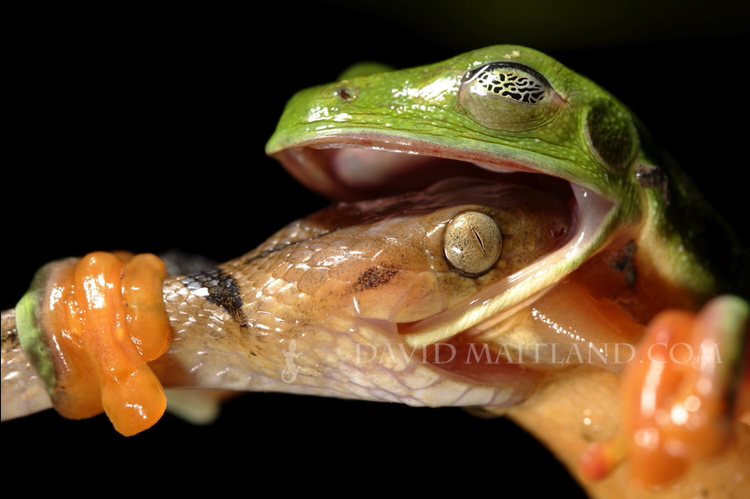
Drama like this is not his usual work. At about 12 he bought an old camera at a jumble sale in St Andrews, Scotland. Later he studied zoology there and earned a doctorate at the University of New South Wales. As a scientist he looked at the form and function of living things. One of his papers in Nature, in 1992, showed that the larva of the Mediterranean fruit fly can jump.
Big wildlife action was never his strength. Once, in Kalimantan, he set up a 400mm lens to catch proboscis monkeys jumping into a river. “I missed the moment every time!” he remembered. So he went close instead, to small things, especially invertebrates and plants that most people pass by.
Patience still matters at that scale. When poppies covered a car-park bank near his home in Wiltshire, he checked them every day for a week. He wanted mostly spent seed heads with just a few flowers still open. Lying on the ground, he shot them against a grey sky. Three days later someone sprayed the patch with weedkiller. Fading beauty was specially commended at Wildlife Photographer of the Year 2011.
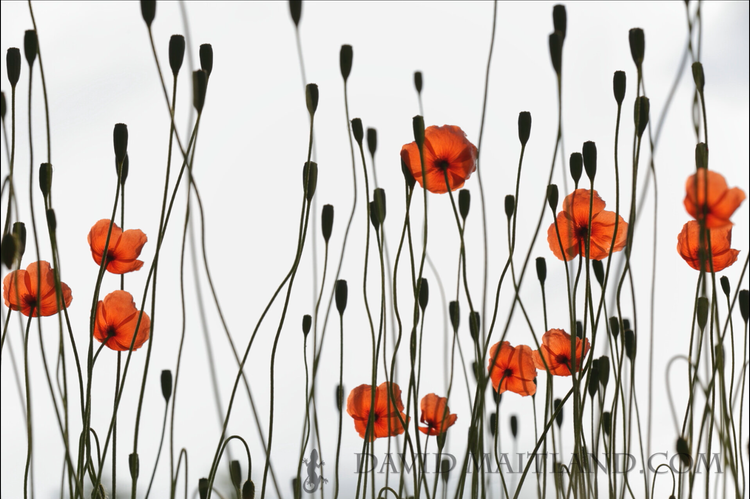
Today much of his work happens under a microscope. He photographs the airways of a silkmoth caterpillar on an old Edwardian slide, or leaf hairs and algae that glow under ultraviolet light. In 2025 he gathered these patterns in his first book, The Shape of Nature.
The frog in Belize was easy to see. Most of what he shows now is not. “It is astonishing the diversity of ‘invisible life’ that is all around us,” he says.
The work


- YouthGrows up in St Andrews, Scotland, and buys an old camera at a jumble sale at about 12
- 1992Publishes a paper in Nature on the jumping larva of the Mediterranean fruit fly
- 2007Wins Best of Show at the International Photography Awards with Frog and Worm
- 2008Wins at Wildlife Photographer of the Year with Who eats who and is named European Wildlife Photographer of the Year
- 2011Fading beauty is specially commended at Wildlife Photographer of the Year
- 2015Outright winner of the International Images for Science awards
- 2022Water Life Photographer of the Year at the British Photography Awards
- 2023Fifth place in the Nikon Small World photomicrography competition
- 2025Publishes his first book, The Shape of Nature, with Abrams
Lessons
Know what suits you. Maitland missed the proboscis monkeys every time with a long lens. Getting close to small subjects turned out to be his way.
Go back every day. He checked the same poppy patch daily for a week until the grouping looked right. Three days later it was gone.
Light can show what eyes cannot. Under ultraviolet light, chlorophyll glows red and leaf hairs stand out. The same leaf looks plain green in daylight.
Try this: pick one small thing near your home, like a patch of weeds, moss or a single leaf. Photograph it as close as your camera or phone allows, every day for a week. Note how the light and the subject change, and keep the one frame that shows something you did not notice at first.
Gear
The details below come from the technical notes published with his competition pictures.
Canon EOS 5D Mark II: he used it with a 70-200mm f/2.8 lens for Fading beauty (2011), shot at f/11 and ISO 50.
Olympus BX51 microscope: for The tracheal tree (2014) he attached the Canon to it at x40, with differential interference contrast lighting.
Sony Alpha 7R II: his camera for recent microscope work, such as Star spangled and Spiral Galaxy, with 5x and 10x Plan Apo microscope objectives.
Ultraviolet lamp: it makes chlorophyll and some plant hairs fluoresce. He stacks many frames to get the whole subject sharp.
Books
The Shape of Nature (Abrams, 2025). His first book, a large hardback of 288 pages published in September 2025. It looks at the shapes, patterns and symmetries that repeat across the natural world, and asks how and why they came about. The book is organised by form, and each chapter opens with an essay that links form to function, with examples from whale baleen to the skin of sea cucumbers. Essays, stories and anecdotes sit next to his photographs, many made with a microscope. The focus is on biology more than mathematics, so it suits readers who love nature and design as much as photographers. A Spanish edition, Las formas de la naturaleza, came out with Blume in October 2025.
In his words
“I find the fine structure of nature fascinating.”
“I love poppies, and I can't resist photographing them. It's hard to think of another plant that's so fleetingly beautiful.”
“Once I had selected the frame of view, the main challenge was to adjust the lighting to create the atmosphere that I wanted.”


