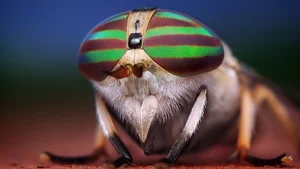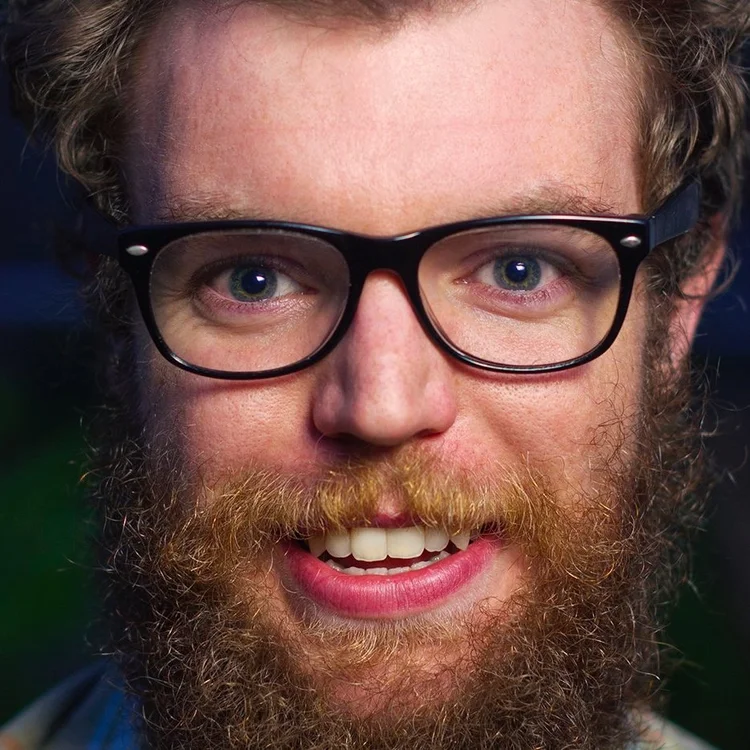
Thomas Shahan (born about 1988) is an American macro photographer from Oklahoma. He is best known for close-up color portraits of jumping spiders, made with simple and often homemade gear. He trained as a printmaker and has worked as an imaging specialist for the Oregon Department of Agriculture.
The story
As a teenager in Tulsa, Thomas Shahan bought and sold used guitars. Buyers wanted close-up photos so they could check the details. With the money from the guitars, he bought a digital SLR and some cheap manual lenses. One day he put a 50mm lens on backwards. Suddenly his thumbnail filled the whole frame.
Then, on his parents' back deck, he saw a jumping spider. “I made eye contact with this little jumping spider,” he remembers. “I decided I wanted to take the very best photographs of them that I could.”
Nobody taught him how. He learned by trial and error, with a reversed lens on extension tubes and an old flash. Its softbox was made of cardboard, tinfoil and paper towel. Sharp focus was the hardest part. “You could shoot 1,000 shots and have 999 out-of-focus shots of a jumping spider,” he says. So he studied the animals too. Put an arching leaf over a jumping spider, he found, and it calms down and sits still.
At the University of Oklahoma he studied printmaking, not biology. Money was tight. “I slept on an air bed, I didn't have a pillow, but I had flies,” he later said. His pictures spread quickly on Flickr. In 2009 he talked about his work on NBC's Today show. In December 2011, National Geographic published his spiders in a story called “Spiders in Focus.”
The hobby turned into a job. The Oregon Department of Agriculture hired him as an imaging specialist, even though he told them he was not a scientist. There he photographs insects so experts can tell if they are native or invasive. In Oklahoma, the Sam Noble Museum gave his photographs their own exhibition, Beautiful Beasts.
It all began with one small spider behind the family house. For him, that is still where the wonder is. “Even in your own backyard, it's like another planet,” he says.
The work


- c. 1988Born in Oklahoma; grows up in Tulsa
- 2007Joins Flickr, where his spider photos later find a wide audience
- 2009Talks about his work on NBC's Today show
- 2011Graduates in printmaking from the University of Oklahoma
- 2011His spiders appear in National Geographic, December issue
- 2013Beautiful Beasts exhibition opens at the Sam Noble Museum in Norman
- 2013Works as imaging specialist for the Oregon Department of Agriculture
- 2016Regal jumping spider portrait runs in National Wildlife magazine
- 2021Beautiful Beasts returns to the Sam Noble Museum; he leads macro workshops there
Lessons
Use what you have. His first close-ups came from a cheap lens turned around and a flash diffuser made from cardboard and paper towel. “You can do a lot with a little,” he says.
Learn the animal. He says understanding the behavior of each animal is the key. A leaf held over a jumping spider like a little roof makes it relax.
Be patient and shoot a lot. Most frames of a moving spider are out of focus. He takes many pictures to get one good one.
Try this: turn a 50mm lens around in front of your camera with a cheap reversing ring. Go into your backyard and find one small spider. Get low and look up at its face.
Gear
Pentax DSLR: he began with a Pentax *ist DL, then used a K200D. By 2011 he worked with a Pentax K-x.
Reversed prime lens: a vintage 50mm f/1.7 or a 28mm lens, mounted backwards on extension tubes. His 50mm lens came from a garage sale. For the highest magnification he sometimes used macro bellows.
Vivitar flash with homemade softbox: an old Vivitar Thyristor flash, held off the camera, with a diffuser made of cardboard, tinfoil and paper towel. There is no metering.
He combines several frames by hand in Photoshop (focus stacking) and says he takes care not to change the form of the animal. At his job in Oregon a single stacked image can use up to 200 shots.
In his words
“I photograph arthropods because I love them and I want others to love them as well.”
“I want to turn revulsion to reverence.”
“Just take good photographs. Don't stress out about equipment.”