Cities Without Humans, Animals Everywhere: How Isabelle Rozenbaum Turned Surveillance Footage Into a Record of a Silent World
Welcome to another captivating photo essay, this time by Isabelle Rozenbaum We'd love to hear your thoughts. Feel free to comment below and, if you're interested, share your photo essay with us. Your perspectives add valuable dimensions to our collective exploration.
In early 2020, the world vanished from its own streets.
Cities emptied almost overnight, leaving behind places built for crowds but suddenly without people. What remained was a strange global silence, recorded not by photographers on the ground, but by surveillance cameras that never stopped watching. These images were not created as art, yet they became one of the most precise visual records of lockdown.
Isabelle Rozenbaum did not photograph the pandemic outside.
Confined at home, she worked inside thousands of surveillance images coming from cities across the world. From this controlled and technical material, she built 2020 – A Viral Odyssey, a photo essay that transforms monitoring images into a visual memory of a global shock. The work reveals empty capitals, unexpected animal presences, and the hidden systems that continued to operate while public life disappeared. What emerges is not only a document of lockdown, but a question about how we see, remember, and accept images made without us.
This article looks at how absence itself became the subject of photography.
Isabelle Rozenbaum
2020 - A Viral Odyssey, photo essay
In January 2020, a client approached me with a particular assignment. Head of a major security company contracted by cities and capitals around the world, he wanted to highlight the power of his surveillance system: technological performance, capturing finesse, detail precision, and the overall reliability of the setup. However, just as we were finalising this order, the lockdown occurred, bringing all activity to a sudden halt due to the emergence of Covid-19. Despite the collective shock, the company’s operations centre continued to function without interruption, carrying on its surveillance mission. It was then decided that I would see this order through to completion.
Through a secure shared connection, I immersed myself in thousands of images captured by cameras spread across the globe: ghost towns, depopulated streets, territories suddenly laid bare. Once the order was fulfilled and the result delivered to the client, showcasing the surveillance system, he authorised me to extract and interpret, from these "archives", a true filmed archaeology of a deserted world, the material necessary to build a more personal photographic series.
The challenge of this project, titled 2020 - A Viral Odyssey, was first and foremost to overcome my own fears, born, like most people, from being confined at home. Then, it became necessary to reveal these surveillance images in a different way: no longer as a mere flow of surveillance, but as a resource of intelligibility and awareness, allowing us to approach a situation we were living through but struggling to comprehend. I must admit that the discovery of surveillance images showing some of the world’s most populated cities and capitals, suddenly emptied of all human presence due to massive restrictions, was a real shock for me. By creating this series, I wanted to make a record of this strange war, an entirely new kind of war, a nameless war.
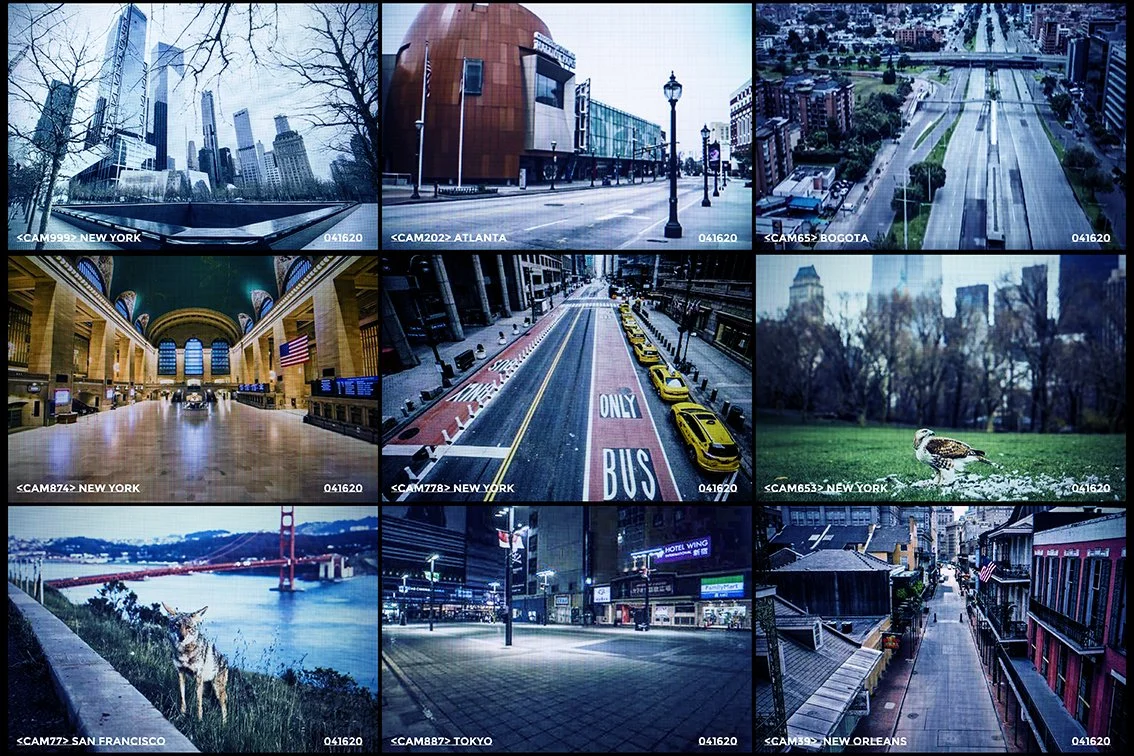
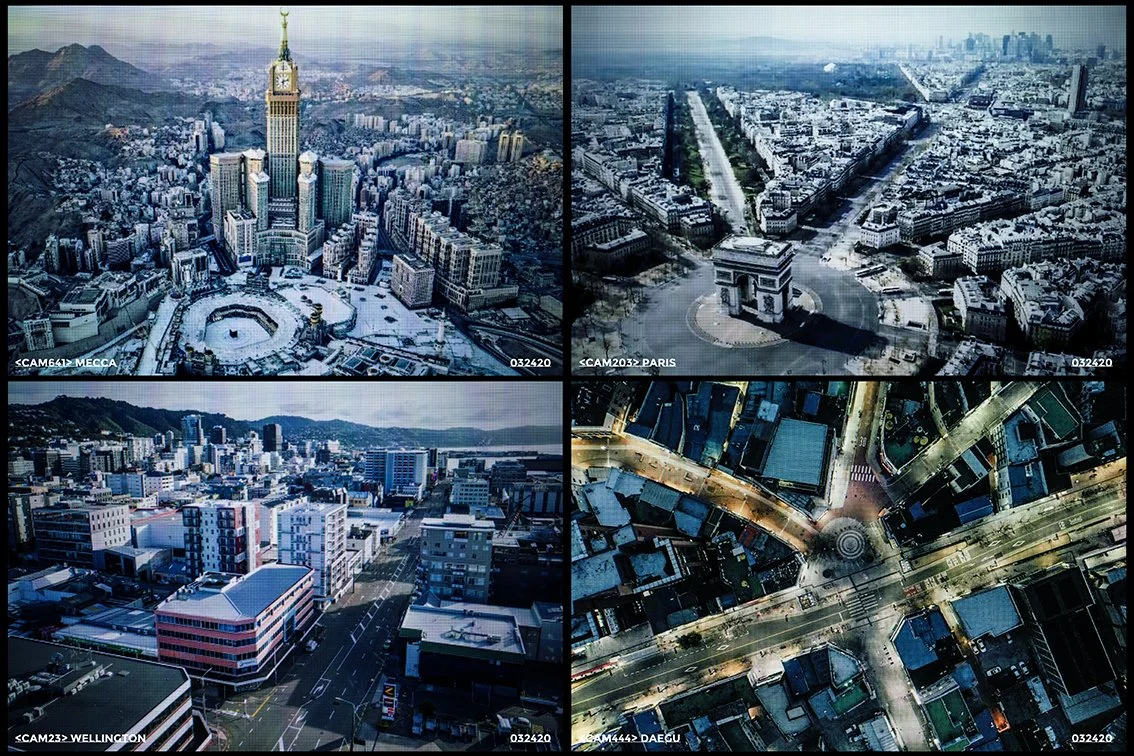
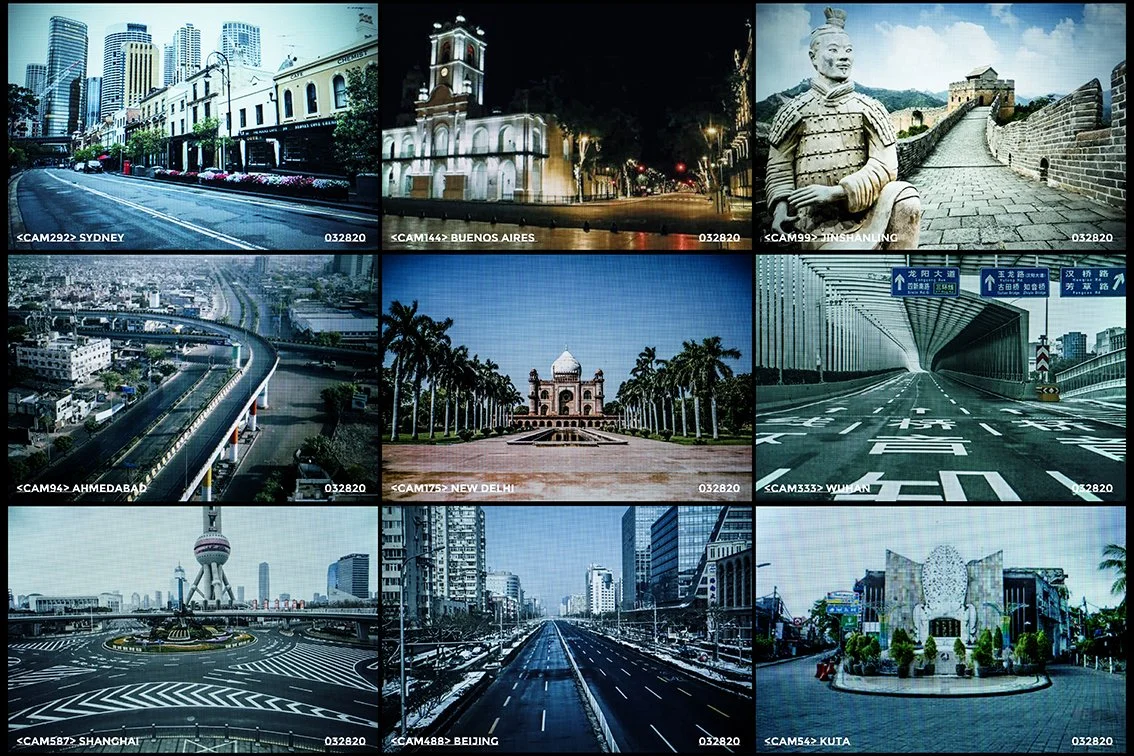
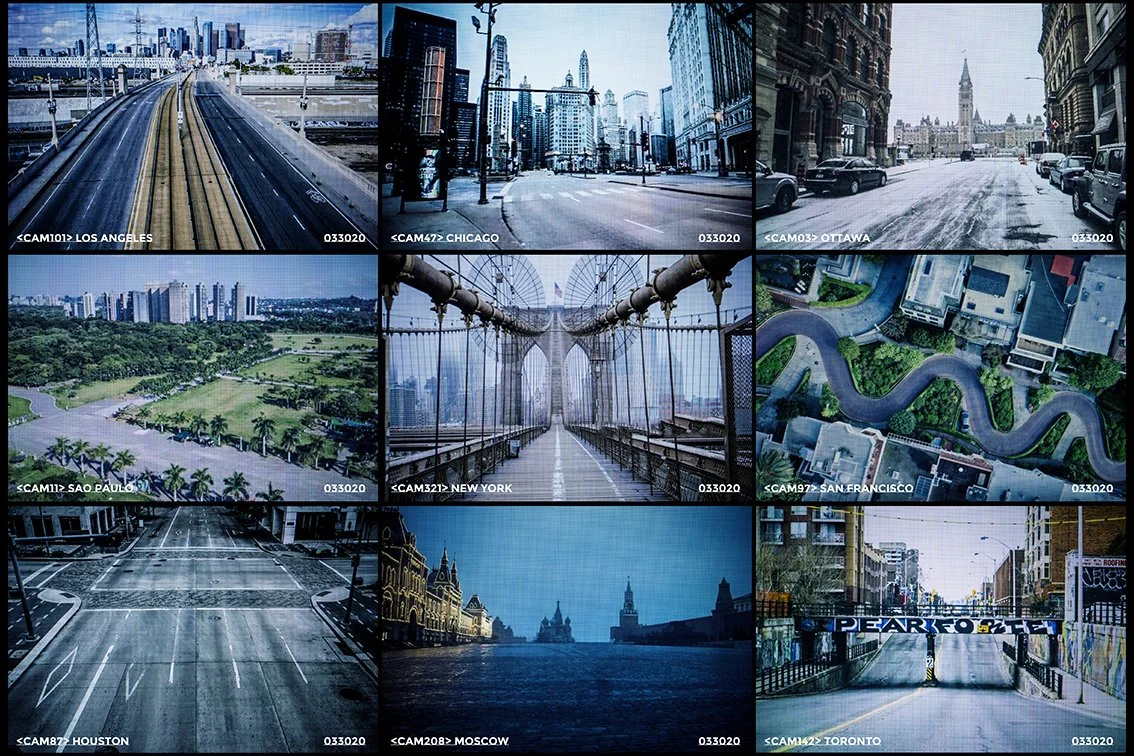
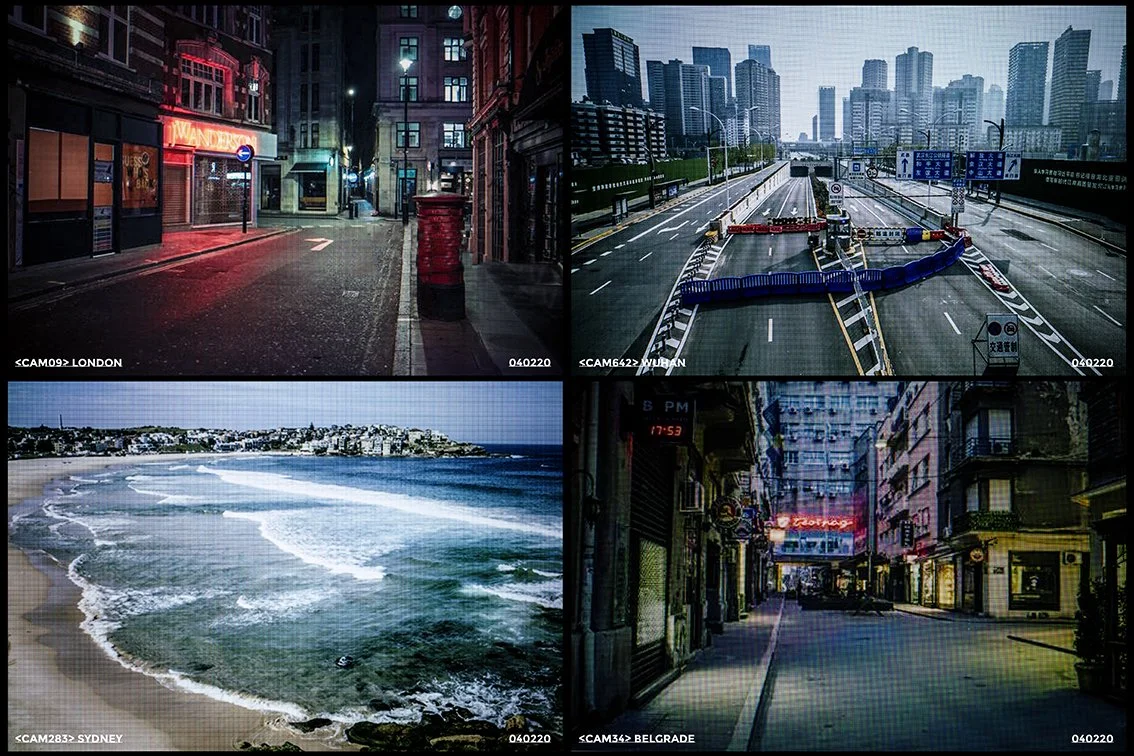
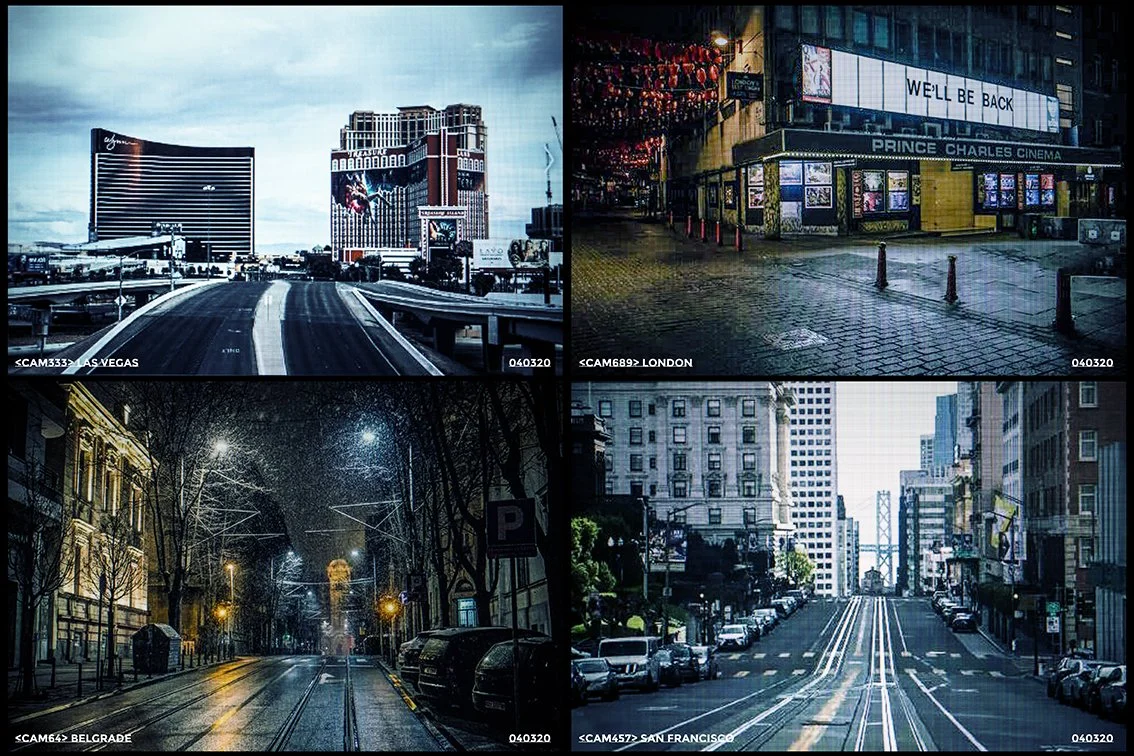
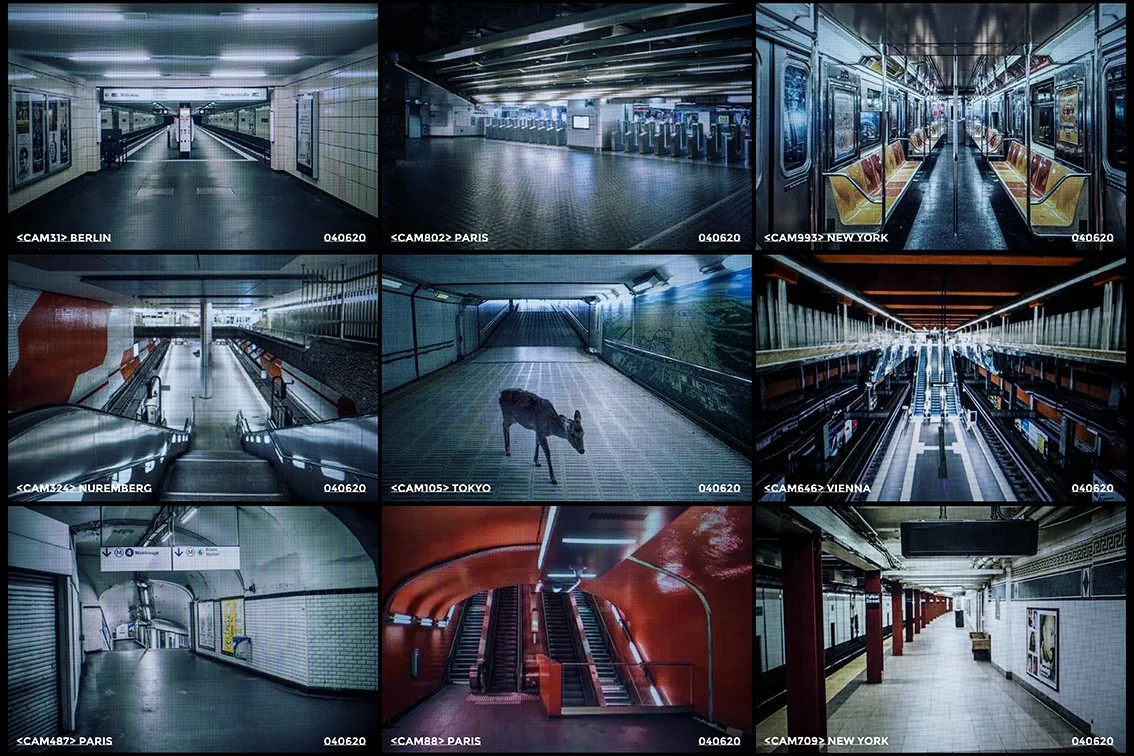
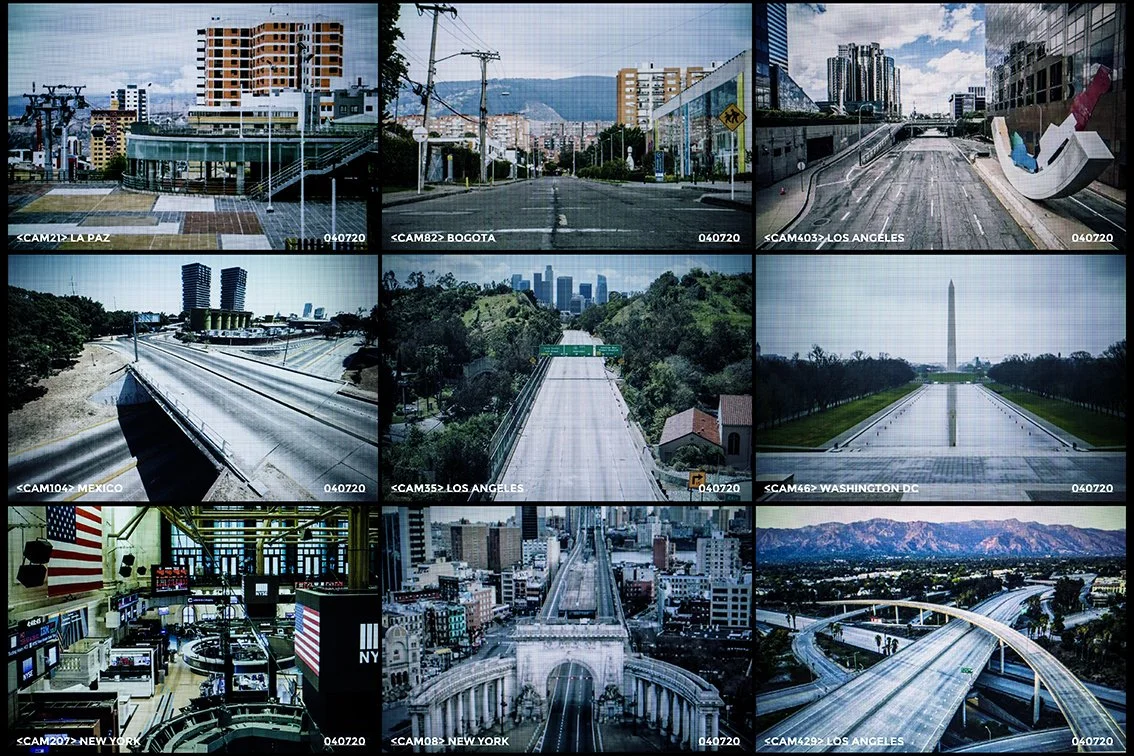
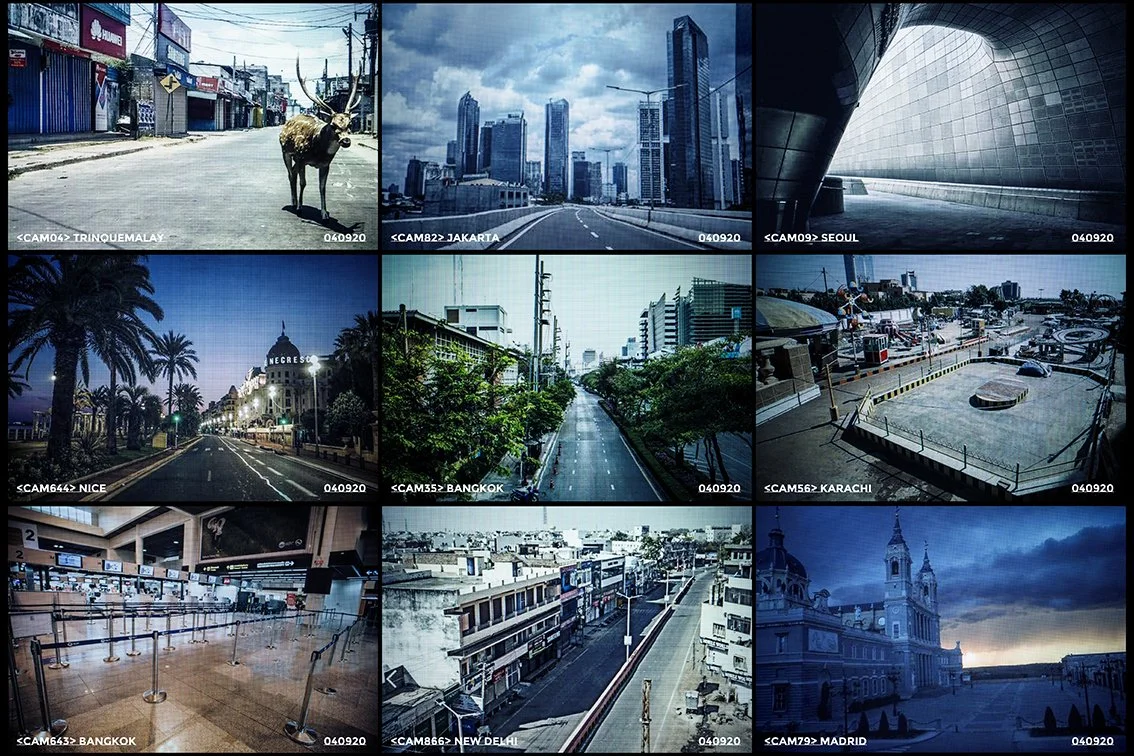
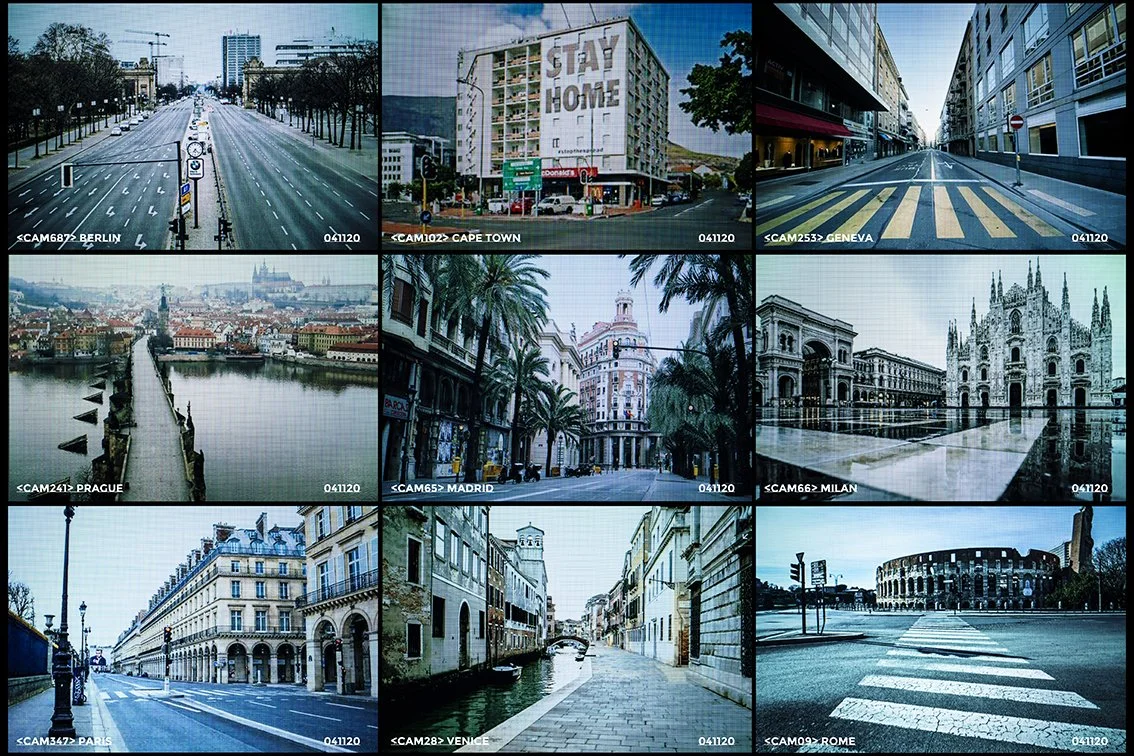
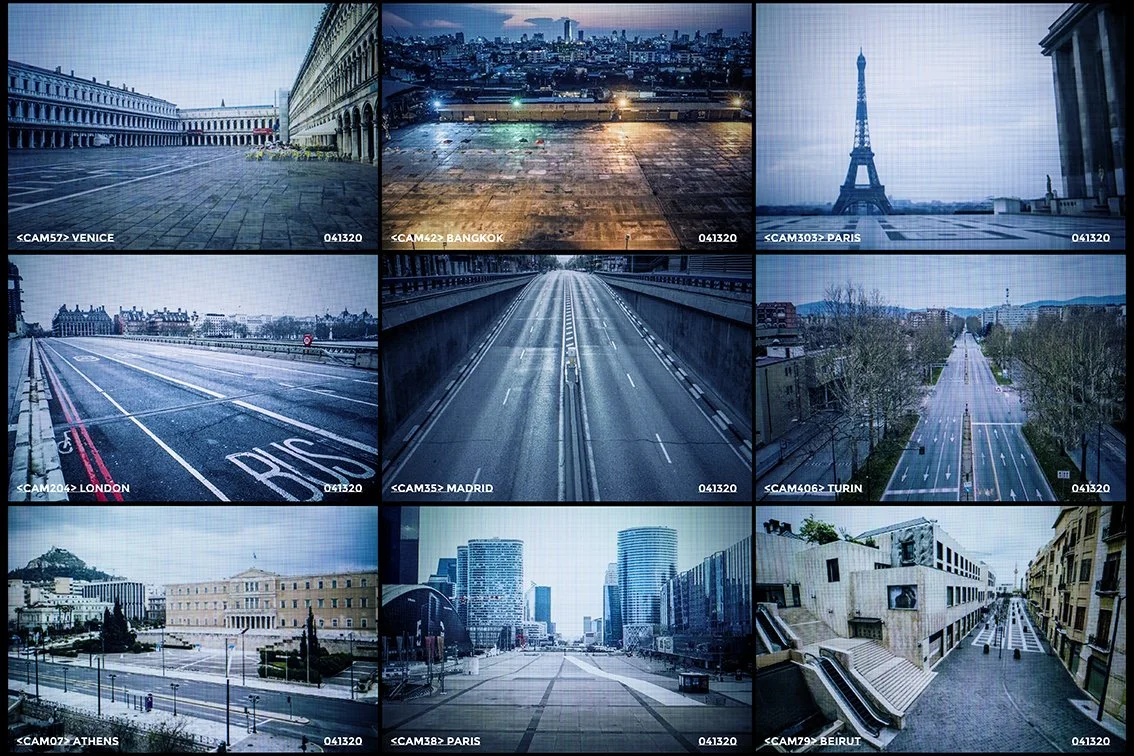
From the images initially selected for the client, I retained for this personal series those showing picturesque capitals or cities renowned for overtourism, which became unrecognisable due to the total absence of activity and movement. While viewing these images on my screen, I photographed each one individually, in order to bring out the significant microstructured texture of the screen itself. I then assembled them according to different time zones, to reflect a geographical and temporal "constellation" on the scale of a single day: for example, between the nine cities of Sydney, Buenos Aires, Jinshanling, Ahmedabad, New Delhi, Wuhan, Shanghai, Beijing, and Kuta; or Venice, Bangkok, London, Madrid, Turin, Athens, Paris, and Beirut; or Munich, Paris, Rome, and London. Throughout this process, I finalised twenty-five compositions in which a world free from human activity appears, but which, paradoxically and disturbingly, is “colonised" by animals of all kinds. The challenge of 2020 - A Viral Odyssey is to show that the photographic act, far from being a mere recording, possesses a revelatory power capable of subverting the banality of the flow and, in doing so, transcending its time. Seeing then becomes a critical act, reminding us that no image can be understood independently of the context in which it was produced. The twenty-fifth image, inspired by subliminal cinema techniques, condenses this tension: it works deeply, subtly shifting our reading of the whole.
Since then, five years have passed. They seem to have been necessary for the viewer to fully grasp the scope of this series, one of a kind. Almost a century ago, in The Molussian Catacomb, philosopher Günther Anders wrote: "We do not see things, but functions. However, we do not see with our eyes either, but with opinions, those that others give us so that we see as they want us to see. These opinions are power, thus reality. And since they are the ones who first decide how we see, they themselves are invisible."
Working Through Fear and Distance: You mentioned needing to overcome your own fears while confined at home during lockdown. How did the act of working with these surveillance images from your screen affect your emotional experience of the pandemic? Did viewing the world through this remote technological lens change how you processed what was happening?
Before the abrupt halt of all activity caused by the outbreak of COVID-19, I had begun a project for an international company that is a leader in protection and security. The company wanted to highlight its video surveillance system and its hyperconnected network. To produce this promotional campaign, I therefore had access to thousands of recordings from its surveillance devices located in major cities around the world where the company operates. However, from the very beginning of 2020, I was no longer receiving footage of bustling capitals and streets saturated with people, but almost unreal images: humans had completely disappeared, the streets were emptied, tourist sites deserted, territories abandoned, cities turned into ghosts. Had he still been alive, the art historian Daniel Arasse would have exclaimed, “You can’t see anything!” Indeed, we could no longer see what these images were truly showing us. I was stunned. And obviously frightened. I even wondered whether what I was seeing were not images entirely fabricated, science-fiction images, and this was before the generative images produced by AI, which only appeared two years later. The continuous flow of images I was receiving from the global lockdown placed me in an ambivalent position where fear and fascination were intertwined. At the same time, I was confronted with all kinds of questions about the security-driven excesses of the pandemic and about the violence inflicted on humanity, suspended and confined in a kind of vast “camp” organised under a closed sky. And, for the first time, globalised. However, from the day I obtained permission to use some of these archives to develop a more personal series aligned with my artistic practice, my agitation paradoxically transformed into a dynamic of living observation, into a laboratory of creation. I therefore confronted this unprecedented crisis head-on, in the way the German philosopher Friedrich Nietzsche urges us to always consider the tragedy of events as the true “central matrix of art”. This is how the series entitled 2020: A Viral Odyssey was born, along with another parallel photographic series that responds to it, Pandemoniopolis.
The Screening Process: When you photographed the surveillance images from your screen to capture the microstructured texture, what were you hoping this additional layer would add to the final work? How does this texture change the way viewers experience these already mediated images?
By viewing a considerable number of surveillance recordings, smooth and without roughness, I immediately became aware that the images I was perceiving did not, for all that, impose themselves upon the gaze. The difficulty of this project therefore lay in choosing those that resonated with the thinking of the German writer Günther Anders, who explained that “what has value is not the unique real event, but the series of its reproductions”. To translate this reflection, I first selected ordinary and widely recognisable images: tourist cities, cosmopolitan capitals, historic squares, road networks, and so on, 151 images, 24 compositions organised by day according to different time zones. Then, in order to bear witness to the system of algorithms at work, those that record, organise, and reconfigure our lives, I enriched the perception of these images by adding an artifice: I photographed each of them directly from the screen, bringing out their microstructured texture and their parasitic moiré effects. This produces the visual, diffracted tension one feels when looking at them. Taken as a whole, the work thus creates an optical disturbance, particularly when the screens are arranged in groups of four images or nine images. In this way, I would say that Plato’s “allegory of the cave” continues to replay itself endlessly: we have merely replaced shadows and light with bits and pixels, and replaced day and night with digital flow and statistics.
Animals Colonising Empty Spaces: You describe the world as “colonised by animals of all kinds" in these empty cities. Can you tell us more about these animal presences? What did their appearance in these typically human-dominated spaces reveal to you about the relationship between urban environments and nature?
Faced with footage from surveillance cameras, I gradually noticed the presence of domesticated and wild animals: seagulls, vultures, does, deer, peacocks, goats, ducks, donkeys, monkeys, dogs, cows, foxes, and so on. They appeared in urban space not merely at the margins, but by occupying places usually reserved for human activity. Their presence reassured me - not because of any naïve romanticism on my part, but because it proved to me that life goes on no matter what. Even without us. This, in a way, validates the idea that the occupation of cities is neither natural nor guaranteed, but fragile, artificial, and constantly called into question. Moreover, the images in which herds of animals appeared allowed me to grasp that, by continually expanding urbanism, paving over land, fragmenting and reducing natural territories, we have pushed the living world “out of frame.” We have learned to tolerate animals only on the condition that they remain assigned to a precise place: domesticated, controlled, folklorised, rendered invisible, or confined to zoos. But in the absence of humans from public or natural spaces during the various periods of lockdowns, restrictions, and curfews, territories ceased to be strictly hierarchical and functional. The city became a porous, silent, unproductive, even superfluous space, in which - reversely - wild and domesticated animals moved about and lived naturally within our own living spaces.
The Mysterious Twenty-Fifth Image: You mention that the twenty-fifth image was inspired by subliminal cinema techniques and works to shift our reading of the entire series. Without revealing too much, can you explain what role this image plays? How does it function differently from the other twenty-four
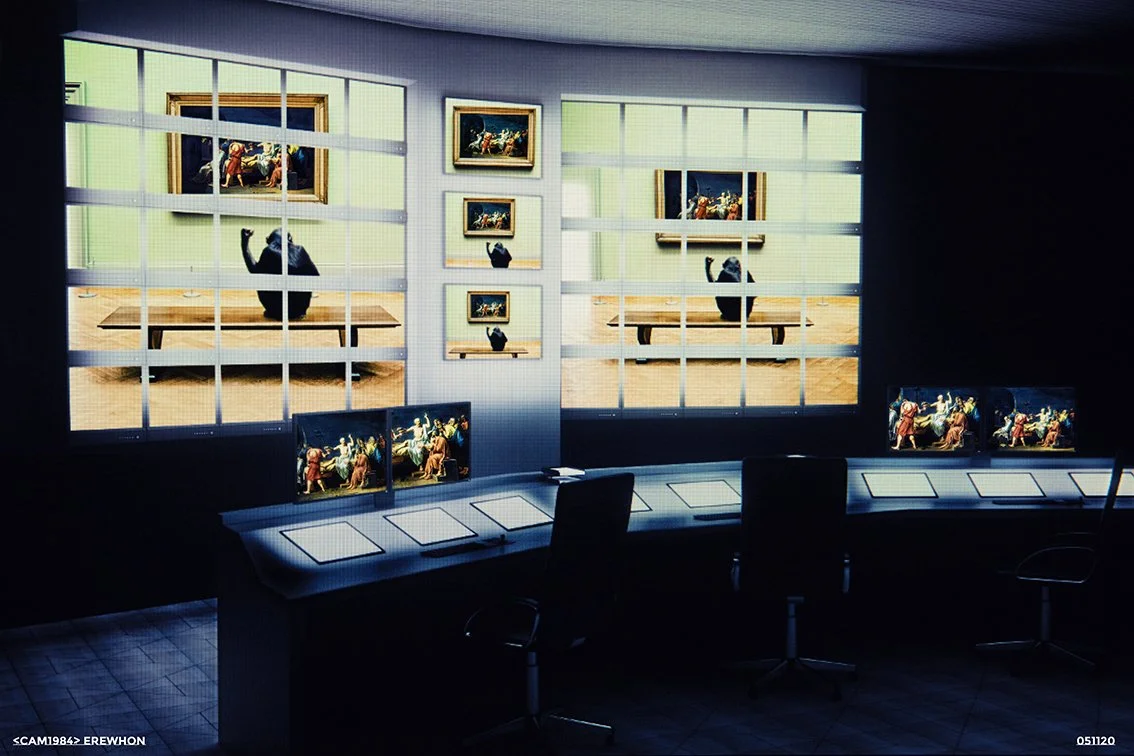
The 25th image occupies a singular place within the series. Unlike the twenty-four other compositions, which are constructed through the assembly and tensioning of multiple images, this 25th image is unique and, of course, highly symbolic. Inspired by the techniques of subliminal cinema, it disrupts reading, acts at a deeper level, and imperceptibly shifts our interpretation of the whole. It even suggests that no image can be understood independently of the context that produces it. This mysterious 25th image stages an empty video surveillance control room. We see only screens broadcasting one and the same image, framed more or less tightly. At the centre of this mise en abyme, one notices the presence of a monkey in a museum, facing an 18th-century painting by Jacques-Louis David entitled The Death of Socrates. This painting, in which Socrates appears, carries the mythical narrative of peoples and of our ideal, while also highlighting a paradox: the death sentence of the greatest Western philosopher, and thus the killing of that very ideal that is ours - the just life, the good life, the free life. If one looks closely at the monkey, one also notices the explicit and provocative gesture it makes in front of this painting - a gesture that calls into question the very credibility of this so-called “democratic” ideal. During the lockdown and the security measures taken to enforce it, one could measure just how much this term “democracy” no longer meant anything at all.
Five Years of Perspective: You note that five years seemed necessary for viewers to fully grasp the scope of this work. Now that we have some distance from 2020, what do you think viewers see in these images today that they might not have seen immediately after the pandemic? Has your own understanding of the series changed over time?
Since 2020, no one seems to consider in the same way as before what the importance of the individual, of the Other, of social bonds, of empathy, of joy, and of the very meaning of what “living” together implies truly represents. Something essential has shifted in our language, in our vision, in our affects, in our vitality. Something seems to have vanished, been erased, to have disappeared from our physical and psychic reality. From life itself. It is moreover striking to note that the Spanish photographer Joan Fontcuberta was able to state, as early as 2017, that “if we photograph, it is to attach ourselves to moments of life, in such a way that we can forget that death exists”, adding that “photography would have the mission of erasing the very idea of death”. This is why my series, 2020: A Viral Odyssey, reveals this extremely violent shift - mental, symbolic, and visual - that has taken place since this global lockdown, and that produced an incredible number of images in which life had disappeared, or death reigned everywhere. And this occurred without our having been able to formulate it at the time, even as we were living it within our reduced and constrained existences. Thus, in the aftermath of this pandemic, the majority of people no longer wanted to see this kind of staggering imagery again, nor to recall the sensations associated with it, nor even to confront this “blind zone” of our existences. I clearly perceived around me a collective fatigue, a vital need to return to “normality”, even if it meant denying this traumatic parenthesis, in order to forget, forget, forget… The French philosopher Jean Baudrillard himself expressed this in chilling terms regarding the Jewish extermination: “Forgetting the extermination is part of the extermination, since it is also the extermination of memory, of history, of the social, etc. This forgetting is as essential as the event itself, in any case untraceable for us, inaccessible in its truth”. You will therefore not be surprised to learn that my photographs have interested no one in France, and even less so critics, experts, curators, or gallerists. Yet I would like to meet professionals worthy of the name who are genuinely interested in works that are more subjective and original than this art without depth or spirit that imposes itself everywhere, and that is no longer anything but a simulacrum of art, if not a mere commodity. Moreover, if my series is ignored in France, it is never for formal reasons or because it does not offer a comforting narrative of the event, but because most people in the art world systematically disdain whatever confronts them with their finitude, beginning with art itself. There is no longer any desire or appetite for art here. This explains why the fake, the “manufactured,” the artificial, and the superficial interest them far more, as do today’s AI-generated contents. Thus, my series has gone unnoticed until now. Perhaps it will one day become “visible,” like one of those works inscribed in a non-linear time, almost premonitory. Already, it has taken five or six years for these images to be seen by some as genuine documents, as “revealing” images, or even as symptoms specific to our era. This delay was necessary to begin to measure the scope of these images, which show nothing less than the denial of our systems of coercion, the massive exclusion of human beings in favour of cybernetics, technological devices of inclusion and exclusion, and consequently the abrogation of our individual freedoms, phenomena that great artists, like Liu Bolin, Adam Broomberg & Oliver Chanarin, Judy Chicago, Valie Export, Anselm Kiefer, Barbara Kruger, Bruce Nauman, Ai Weiwei, and others, or great writers, like Günther Anders, J. G. Ballard, René Barjavel, Ray Bradbury, Anthony Burgess, Aldous Huxley, Ira Levin, George Orwell, Veronica Roth, José Saramago, Walter Tevis, Yevgeny Zamyatin, and others, had already “seen” themselves, and whose works nevertheless continue to warn us… seemingly in vain.
Michael Behlen photographed water that would not stay still. For three years, he returned to Millerton Lake in California’s Central Valley, making all the photographs during storms, when the reservoir became harder to read. Picture Story