Outside the Dream: Child Poverty in America Stephen Shames
(This is the story behind the photograph, a glimpse into the moment, the process, and the vision that brought it to life.)
Asleep in a Car, Ventura County, California, 1985
From the series Outside the Dream: Child Poverty in America by Stephen Shames
In the early light of a California morning, the boy is still asleep. He lies curled in the passenger seat of a car, wrapped in a blanket, his blond hair falling over closed eyes. The windshield is fogged with breath, muting the view outside and trapping the warmth of the night. Fast food wrappers and soda cans are scattered on the floor. The car is old, worn, and lived-in. It is also his bedroom.
In 1985, photographer Stephen Shames was documenting the quiet crisis of child poverty in the United States. This photograph was made in Ventura County, just north of Los Angeles, where an informal encampment of unhoused families had gathered along the beach. Shames set up his own tent and stayed with them.
“Well, as I mentioned, I do a lot of research. So when I was doing this project, I did research to figure out, okay, what are the components of poverty, of child poverty in the United States? And one of them was homelessness, children being homeless with their families.”
Los Angeles had the largest homeless population in the country, partly because of its mild climate. Shames began by visiting churches, food banks, and families sleeping in their cars. Eventually, he heard about families camping in a state park in Ventura. He packed a tent, drove north, and introduced himself not as a visitor or journalist, but as someone willing to live alongside them.
“I bought a tent. I went up there. I approached the families. I told them what I wanted to do and they agreed. And I said, ‘I’m going to camp here with you.’”
One family lived in a small camper, but their teenage sons slept in the car. The boy in this photograph was 13. Shames didn’t photograph him on the first day. He waited. He helped cook, brushed his teeth at the same water trough, and shared meals around makeshift fires. Then one morning, he asked.
“I said to him, you know, I’m going to come at like 5:30, 6:00 in the morning when the sun comes out. Please leave the door unlocked and just don’t get up. Don’t get upset. I may wake you when I open the door, but don’t wake up. Just ‘cause I want to take a picture of you sleeping in the car. Is that okay? You know, and we talked about it and he agreed.”
The timing had to be perfect. He didn’t want to use flash. He wanted natural light, the soft glow of sunrise warming the boy’s face, filtering through the fogged windows.
“I thought, okay, if he’s sleeping in the car, he’s going to steam up the car. And also I didn’t want to photograph it with a flash. I wanted to photograph it as the sun was coming up so that it was lit naturally, because I like natural light.”
But the photograph is more than its technical choices. It is the result of time, trust, and intention.
“Photography is like fishing. Sometimes you get a picture the first day, just as you might catch a fish in the first five minutes, or you might go out for two days and not catch anything.”
“They’re not going to totally trust you the first day. Why should you? I mean, would I trust someone who came into my house the first day?”
By staying, listening, and living among the families, Shames gained permission not just to photograph but to be present. This picture is not posed. It is observed. But it also carries weight beyond its frame.
“That’s one of my favorite all-time pictures. I mean, I think that really…”
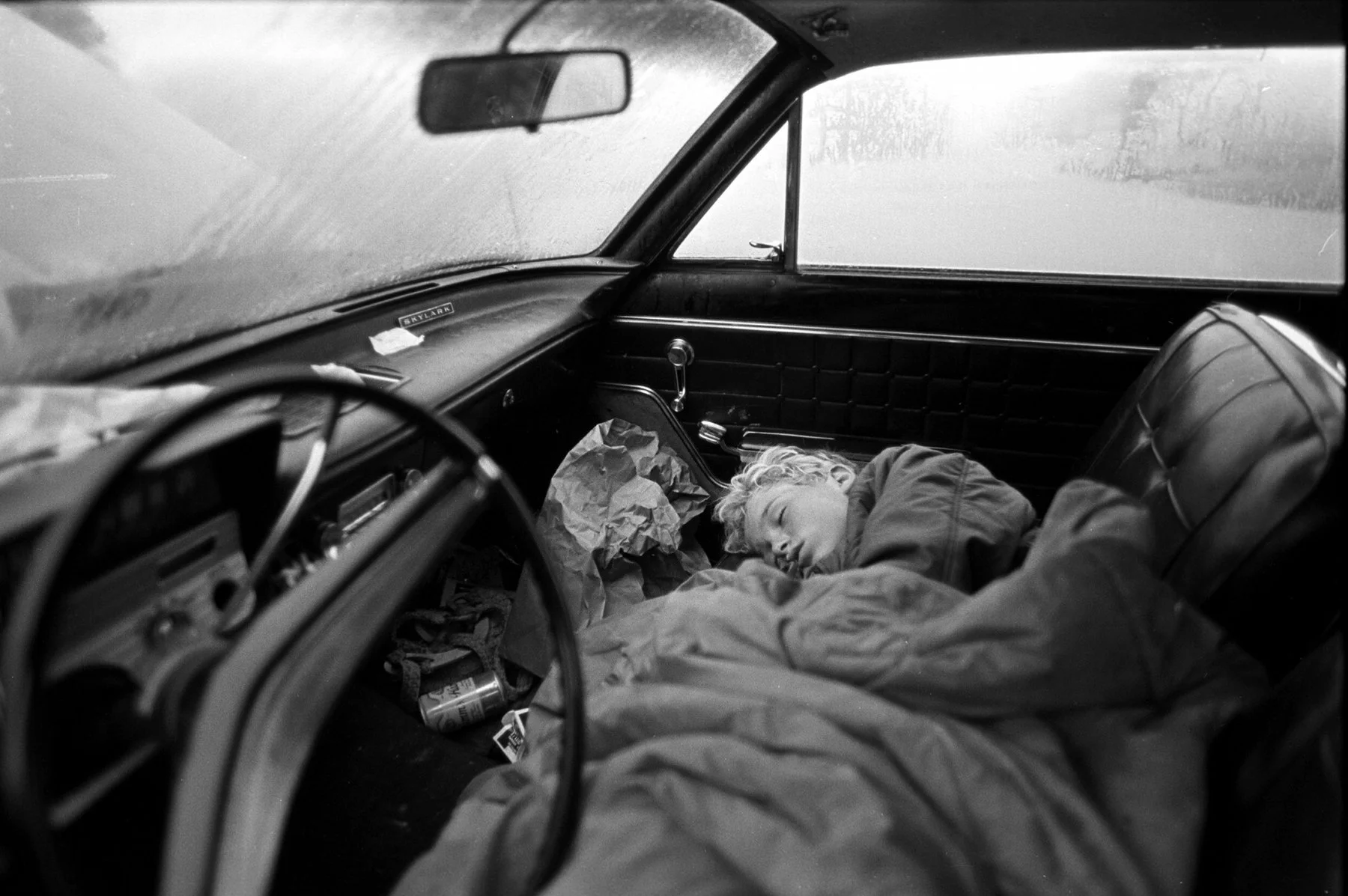
“Here’s an angelic kid. And if you’re doing journalism, you gotta realize that… you know, I photographed all kids. But here’s an angelic, innocent, little white kid that I felt would resonate with people all over the country.”
Shames understood how visual storytelling could connect with the public. This wasn’t about exploitation. It was about impact.
“An artist is one thing, you’re going from your inner feelings. But journalism is like politics. There’s an audience. I mean when you’re a journalist, you know that there’s an audience for what you’re doing. And you’ve got to be aware of who the audience is and how you can reach them.”
That morning, in a fogged-up car by the ocean, Shames created an image that continues to speak decades later. A photograph of innocence, vulnerability, and the quiet, devastating truth of poverty in America.
“I don’t sneak pictures. That would destroy trust.”
Sometimes the best project begins when the first idea fails. You arrive with a plan, but what you find does not fit it. Story Behind The Photograph