Why Martin Parr Says Most Photographers Overestimate Their Talents
Today, we uncover the layers of Martin Parr’s photography, at the Martin Parr Foundation We'd love to read your comments below about these insights and ideas behind the artist's work.
Every bad picture is a step toward a good one.
Martin Parr knows this better than most photographers. After decades of shooting, editing, and publishing more than a hundred books, he admits he still takes plenty of bad photos. He believes failure is part of the process, and without it, there are no strong pictures. That honesty is what makes his work stand out.
Photography today is full of people chasing style and fame.
Parr argues that success comes only when you care more about your subject than about recognition. From turning tourist clichés into surprising images to building a legacy through books, he shows how persistence and personal connection create lasting work. He also speaks openly about editing thousands of images, missing shots, and why humility is essential in photography. His advice is as blunt as it is useful: work harder, stop overestimating yourself, and keep pushing until the good pictures appear.
Every bad picture is a step toward a good one.
This article is based on an interview recorded in 2022 at the Martin Parr Foundation.
Martin Kaninsky (Editor): You have been taking pictures at places where many people regularly take photos, right? For example, when documenting leisure activities, exhibitions, or festivals. Yet, your photos stand out. How do you take pictures that go beyond the mundane and also beyond cliché?
Martin Parr: Well, I often start with a cliche and then try and subvert it. I'm interested wherever there's a lot of people and particularly on the tourism project. So you find people swarming to the same places, the places that were very well known in the world - the pyramids, the Eiffel Tower, whatever it is. If there's a lot of people there, I'm happy and I can get my camera out. And these days, everyone's photographing. They're all photographing on their phones, of course, and some of them still have old cameras. And it's quite easy to do. So, that always creates a certain amount of energy because it's with a place where everybody wants to be at the same time.
How should people photograph their vacation, their leisure to not look like everything else?
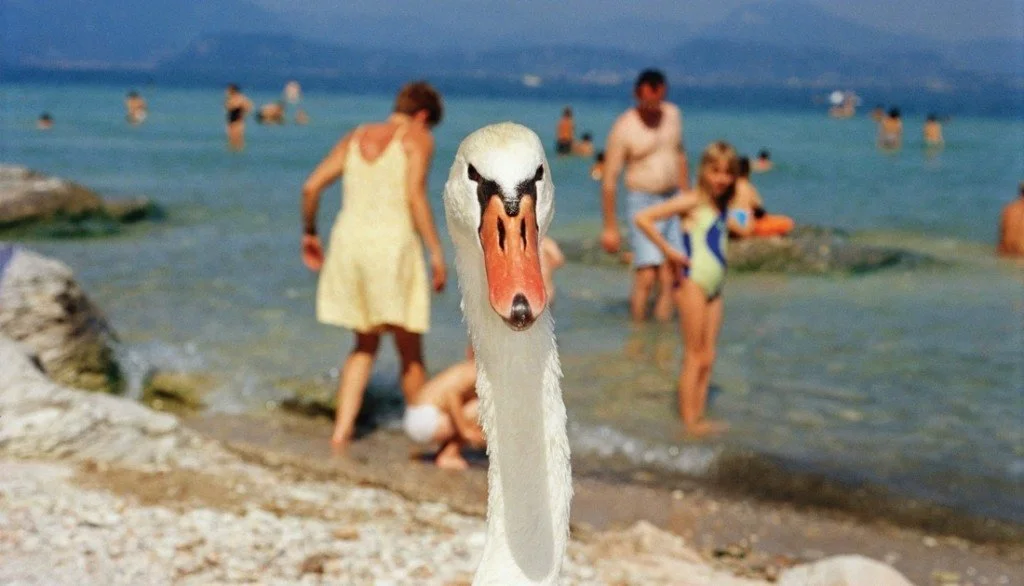
Well I guess people do selfies and then they want the subject in the background and them and their friends or parents or lovers or whatever in front of it and they don't want anyone else in. Whereas I'm interested in getting everybody who's there in. So, my job is not to have no people in. My job is to have as many people in as possible.
There's this photo in front of the Leaning Tower of Pisa, right, where people kind of pretend to lean in and stuff like this. So, this looks to me like a cliche kind of thing. So, do you have a particular idea how to work with the background that has been photographed thousands, millions of times?
Well, obviously the first thing I noticed about the Leaning Tower of Pisa is that people do these photos where they're trying to catch it or push it or lean it and I then started to look for people who were doing that and would introduce that into the pictures and that's what eventually came out as you got two or three people doing it at the same time. And of course when you take the tower away from what they're doing it looks very bizarre and of course bizarre things make good photos.
And then when you photograph subjects how do you make connection with your subject so it communicates your particular vision?
Well there's certain projects I do where you meet people and you talk to people, you do portraits. I did a lot of work in the Black Country which is in the middle of England. And there are other projects like for example the tourism one where you don't need to meet anyone. So it just depends on what project I'm doing and what is required of that. So there are just many different ways of approaching doing a photographic project. And so that's really what I explore and will choose a particular way of doing it and it might mean talking to people. It might mean not having to do that at all.
So it does have to do something with the personal interest. If the person is personally involved in the thing they document, it helps?
Well, of course, I like the fact that people do engage with either a sporting event or being at a location. And that's interesting for me, and when people are watching anything from horse racing to football, I'm photographing people who are actually cheering and shouting and screaming and responding to the race in front of them. And that always or usually can make good photos.
Could you tell me a little bit more about your process on location? How when you enter a certain location, let's say an exhibition or the beach, what is it that draws you in the places or what are you looking for when you arrive?
Well, if I'm going to an event, I'm looking for the places where things sort of happen. So, I'm looking for backdrops which are very good. I'm looking for places where people come and congregate. I'm looking for where I can come back and take more pictures. So you identify if you like the hot spot locations and then sometimes you do it by random. Sometimes you just see something in front of you and you shoot it straight away and you've got the picture or not got the picture as case may be because I don't take many good pictures. I do a lot of very bad pictures because you have to do a lot of bad ones to get the good ones so the struggle goes on to try and make a good photo which is not easy.
So you stick around until you feel you've got something?
Well, you do the best of how you can exploit that situation. If I stuck around until I got something, I might be there for months. So that doesn't really work. You do your best of what you can do and when you get back to edit it, you hope that the picture looks okay.
There are some photographers, and I believe you are one of them, who define a photographic style by the way they take pictures. People like Alex Webb or Saul Leiter. Have you ever felt limited by your style because you’ve established your brand and legacy? At any point in your career, have you felt like, "I’m Martin Parr, I take pictures a certain way"?
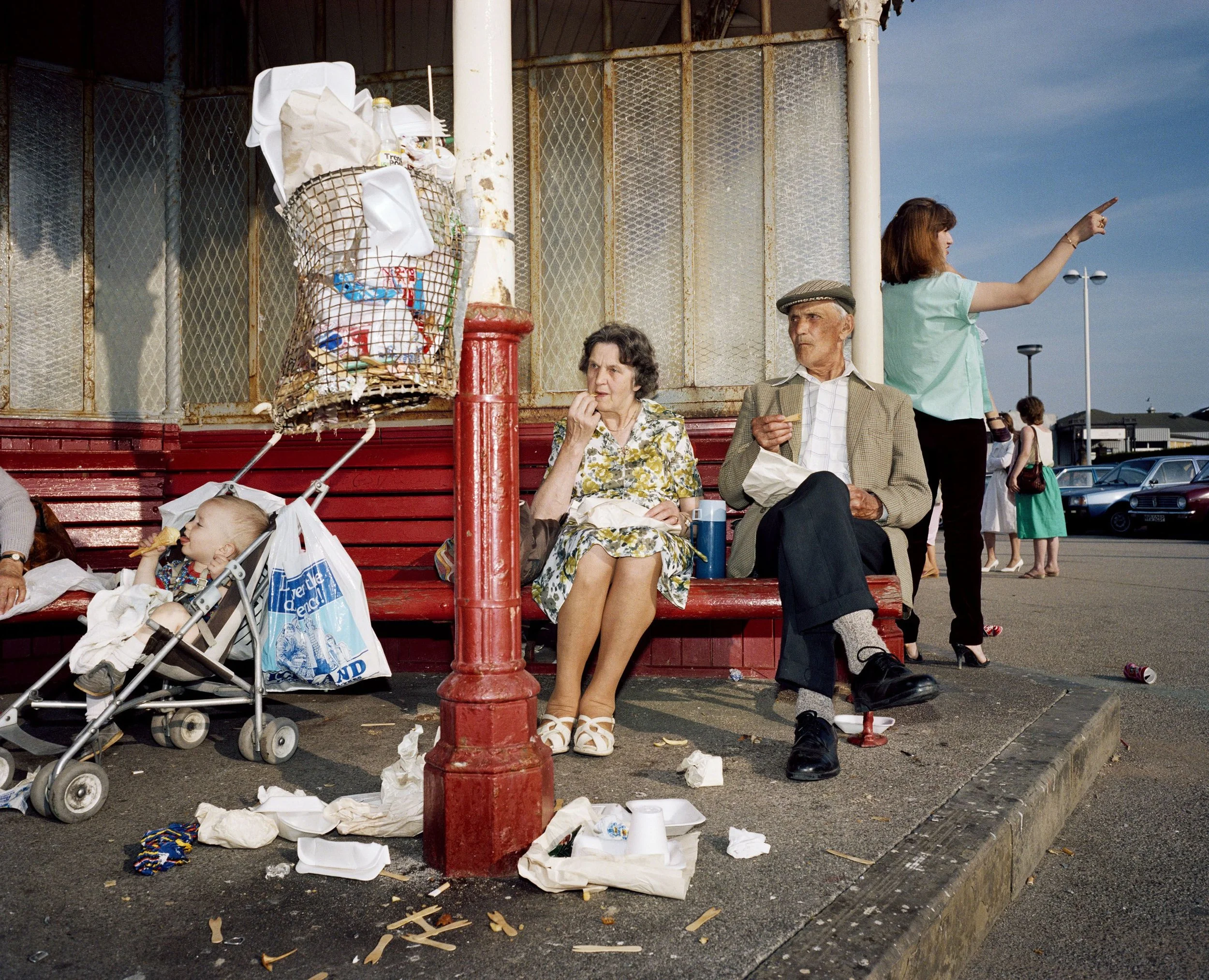
Well, obviously when I went to color because remember I photographed in black and white for about 15 years before I went to color in 1982 and then I used a medium format camera which had just been introduced called a Plaubel and I introduced a flash with that and often used the flash during the daylight which gave this sort of rather surreal effect and because the place New Brighton from the series you know it worked quite well as a location.
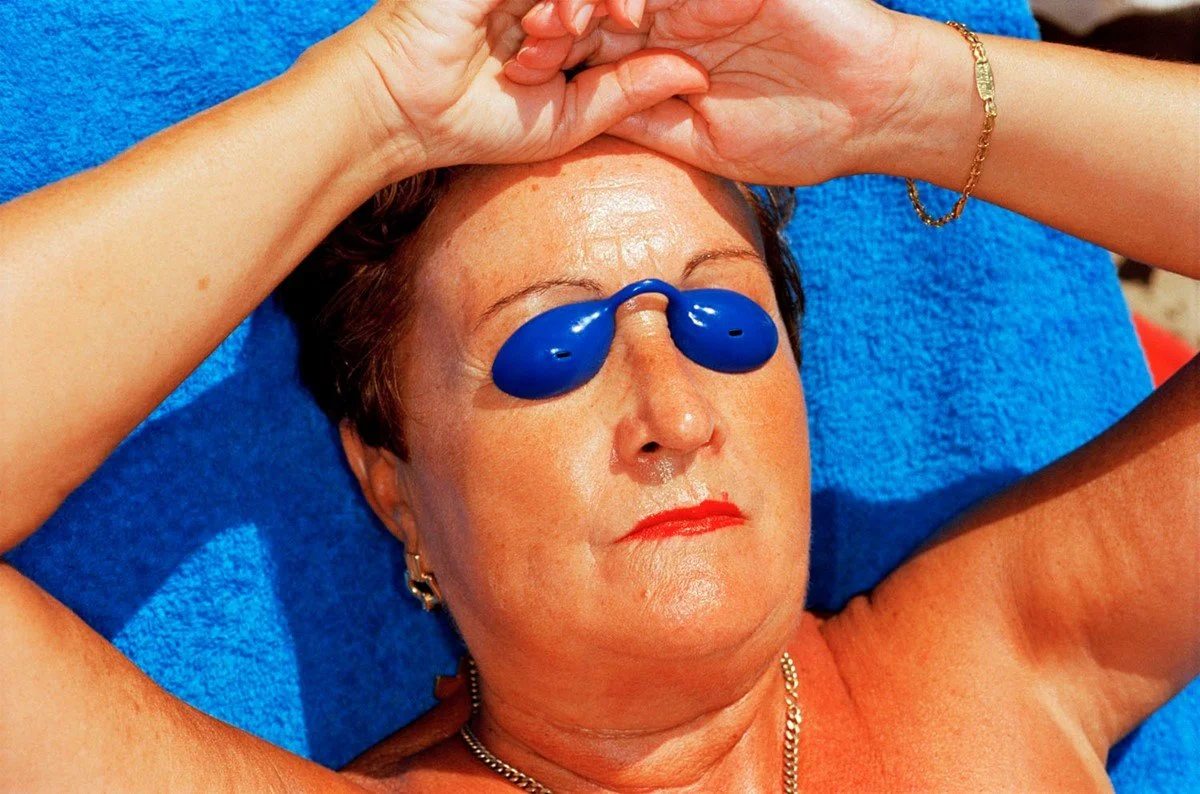
I don't think the style limits me. I mean it gives me a great advantage because if you use flash color negative you get this high sort of saturation which I had seen in the commercial world of photography and then just applied to doing documentary and then I did the ring flash a few years later and that too has a very special look which I liked and then applied it to photographing anything from food to close-ups of people. So if you like I have these two things up my sleeve which I then apply to the times when I'm shooting new projects.
So you have never felt like this scene is nice but I won't photograph it because that's not my style or that's not what I do.
Well sometimes I'm commissioned to do work but usually it's something I'm interested in doing anyway and then sometimes most of the time I just go and do it for myself and enjoy doing it. Like this weekend I'll be out shooting because lots of things are happening in July. It's busy. It's summer and all the people and things I want to photograph are there in front of me.
How much freedom when you are commissioned? How much freedom you have to take the images in your way?
Well, I suppose people commission me because I am Martin Parr. So they want Martin Parr style pictures. So that's what they get. So there's no restriction or issue with that.
I mean I saw your work with Gucci I believe. So I believe they have certain vision how they want their pictures to be presented. Do they communicate that or do they tell you do whatever you want? They just want you to do Martin Parr pictures and whoever they employ as a photographer and there are many that they want it in their style.
Yeah you kind of answered my question. I was talking about I wanted to ask about the flash and color and I got a film. You kind of did it for me.
I’m curious, how do you edit your work? How do you narrow down from 10,000 pictures to the 40 that end up in a book?
Well, the first thing I do is I'm shooting digitally. So, we load them onto the computer. I look at the pictures. I make an edit and then we get them printed and we send them to a lab. We send the high-res images to a lab and they come back the following day as 20 by 30 prints. And I will then edit from those prints and put them onto the Magnum site any that I like. And then I can always refer back to the Magnum site for the pictures that I want to see again. And behind me over here, you can have a look after we've finished, these gray boxes with three quarters of a million pictures in all in 20 by 30 starting with black and white going through to analog the color negatives and now the color prints we get from the digital files. So we always keep a digital print of all the main pictures I'm interested in and I would basically how do I edit? I pick out the good ones and forget the bad ones. It's that simple.
But you've got to be a bit more generous. You have to have a narrative because there might only be three great pictures, but you couldn't have a book with three pictures in. It's not possible. So, you have to compromise sometimes where images are relaying information that's partly interested in the message you're getting across in that particular project.
I'm asking because I know you work rather in series than single pictures, right? Was there ever like a case when you thought like this is a nice photo, but it doesn't really look good in this series?
No. No. Because if it doesn't, I wouldn't use it. Simple as that. But sometimes I make projects just from going through my archive because I have 50,000 images on the Magnum site, all high-res, all ready to download. And sometimes if you came in tomorrow say can we do a book on dogs I'll say yes and I'll pick out the 1500 pictures of dogs and come up with maybe 50. So if you want to commission that I'll be going ahead.
When presenting your photo in the book there is some sort of idea in sequencing right? Is there a difference between an exhibition and a book? How you sequence your work.
Not particularly. I mean, I'd normally if there is a narrative going through in a book, then I would try and probably copy that onto the exhibition. But the good thing about a book is it's there forever and an exhibition comes and goes. So, it gives you a bit of time to experiment, but in the end, it's the book that you really want. All photographers love doing books because it is their technical legacy. And I've done many books and I'm very happy about that. Some are not as good as others, but some work quite well.
And is there a particular idea how you want to communicate your vision when putting the book together? Because I can imagine maybe the exhibitions offer something a little bit more different when with prints being bigger and with audience being closer to the work.
I mean, I make a narrative as best you can with the pictures that you've got and you try and pair them up or make them single pictures. You design the book like this and I'll be working with an editor. Making sure that we both agree on how the sequence should unfold or they may make suggestions and I will tweak it. Just depends on each book is a different situation. Depends who's the editor, depends who's publishing it. I work with many different publishers, not just one. So that's how it works. It just usually solves itself. It's not a big problem.
And do you care about how particular photos will age? Is it a thing you consider?
Well, I'm interested in the fact that I look at my pictures in the 80s and they look very dated and some of them have got things like say Tupperware parties which have disappeared. So I like the fact that society changes and moves on. And part of what I'm recording is that in particular in the UK because I've probably done more pictures here than anywhere else.
Do you feel that trends spoil the photography because like for example smartphones what people say about smartphones now is perhaps what they said about headphones in the '90s and what they said long time ago about classical cars, right? And we now love those classical cars in the photos and the headphones looks kind of cool and stuff. So do you like trends?
Yes. I do. I like them. And the smartphone of course is probably been the biggest change in our society in the last 30 years. So I'm very interested in not only using social media. We have an Instagram account with a lot of followers. So when we do something new we can let people know what we're up to. But also I've done a book of people doing selfies called death by selfie. So I incorporate these things immediately into my work because they're so important.
Is there something that prevails through all the time you do photography?
Well, I suppose my interest in people. I mean I like people. I like watching them. They're funny. They're interesting. They're predictable. They're surprising. All these things really suit me. So I have a basic interest and affection for my fellow human beings and that's mainly my biggest subject. So I like to photograph other people and what they get up to.
I like what you said about family photography. You consider yourself to be a documentary photographer and take this duty to record your family seriously. Some of your Magnum colleagues like for example Christopher Anderson have published books dedicated to their families. Have you ever thought about making book like that?
Not really. I mean, I did a whole load of Polaroids of our daughter when she was very young and was crying. But I think they wouldn't be good enough for a book. So, no, it's not something I've considered.
And do you have an advice for people who want to maybe document their families more seriously than just snapshots?
I guess you need to get away from this idea of everyone smiling at the camera. Get people looking serious and dignified. And of course, you should also photograph things like your kitchen, your living room when you're about to do it up and change it. Photograph it like it was before. And then in years to come you can look back and wonder at how bad my tastes were. So that's always interesting. So basically carrying your camera around and documenting stuff you live in.
I know you are not one of those photographers who carried the camera 24/7 right? You rather take your camera when you do the assignment and then you don't.
So yeah, I'm either working or I'm not working. I mean I'm working today because I'm talking to you. You are work but I won't be taking any photos today.
Do you miss photos because of this? Do you kind of like see situation and thinking about oh see pictures often and I haven't got my camera with me?
Well, I don't mind missing pictures. I accept I'm going to be missing pictures all the time. Even when I got a camera, I miss pictures. Remember, you got to be there before it happens. And very often you see it and it's gone and it's over and you haven't got the picture. Failing is very easy, but you just have to sort of keep going and hope that you can get over that.
So you said photography books are very important and I can see it here when we sit among we're surrounded by photography books. What is it that you're looking for when you open photography book or when you try to learn something from or about other photographers? What are you looking for when you open a photography book?
I guess I'm looking to be surprised. I'm looking for something that really catches my attention. I mean, we've got all these books around me here. I could go around and pick out maybe 20 which I think are really exceptional. And they're just books when you look at it, you haven't seen it before. Most of the books you look at, you're sort of familiar with where they've got their influence from. You can read it and we're not looking at anything that really makes you jolt and think, "Wow, that's amazing. How did this guy get this?" Or, "How did this woman take this picture?" So, I'm waiting. I think in summary, I'm waiting to be surprised and intrigued.
So, should people with their photography books push more into this direction of what has not been done?
Well, that's easy to say, but most of the books that are published, and there must be two or three thousand photo books published every year, most of them aren't very good. And I guess the reason is because they thought they got something original when perhaps they haven't. People overestimate their own talents, and often you can look at it and think, well, I've seen all this before. It's pretty familiar. Doesn't tell me anything new.
So, the good photography book for you communicates like a new idea in some sort of original way?
Yeah. I'm looking for a personal insight. I mean good photography comes from when someone has a good connection to the subject and they've used photography to articulate that and that really is the bedrock of what all good photography is. So, that's what I'm looking for. But at the same time, I'm looking for that unique situation where it's the photographer and the subject and that connection that surprises you or makes you intrigued or makes you want to look at it further. But as I say, most of the people watching this are not doing very good photography. And that's because they're a bit lazy. They haven't found the right subject. They like the idea of being a photographer, a street photographer perhaps, but they haven't really found their own vision within that. So listen you lot out there, don't be lazy. Don't overestimate how good you are. Keep working. Keep at it and you might come up with something.
Speaking of quality of photos, and perhaps you might be able to answer this definitely better than I am because you have the authority to do this. I sometimes look at the photos of great photography masters and even though many of those photos are masterpieces sometimes there are very normal looking photos and when I look at those auctions there are photos like auctions like Christies or some other auctions there are pictures worth tens of thousands US dollars with nothing particularly for me interesting. Like there were a picture of Ansel Adams, right? A great photographer of a door knob selling for $10,000 US dollars. I'm asking if the price of the photos is more connected to who took the photo rather than if this is something particularly unique or great.
Well, obviously the author of the photographer of the photograph is important. If it's a well-known person, then that makes all the difference. But what you're looking at is the very iconic pictures of these photographers, the ones that really stand out and start to sing when you look at them. Not all of them do that but if you look at the prices in auctions it's the best print, the most beautiful print of an iconic picture will probably get the best price and rightly so.
When I see an iconic picture, right, that's quite understandable, right? But sometimes you see quite a mundane picture with which might also be because I don't understand it well enough, right? Or sometimes it's just a fence priced at, you know, $10,000 range. And I'm quite wondering.
Well, what you're saying is you get bad pictures in auctions as well where they're relying on the reputation of the author. I mean, you could say the same for me. I'm lucky I can get things published. But if I've done a hundred books, it doesn't mean there are 100 good books out there. I accept that some are weaker than others and some are stronger. So I accept also that I do bad pictures. I keep saying this, but I have to do all the bad ones to get the good ones.
Where do you see future of photography?
It's going to grow and grow because there's more people like you interested in it. You're providing podcasts on the social media. Instagram is huge. So I mean photography shows are very popular. I mean it's just going to grow and grow. So I'm very optimistic about the future of photography.
I mean it's difficult to earn a living from by to be a photographer. I accept that. But those of you who actually do come up with something that's interesting are going to find it relatively easy to make a living. Trouble is if that's all you want to do you'll fail. So if you sit there like you lot again I'm talking to you and say I want to be a famous photographer you're fucked. Because you'll never do it. The people that really go on and do well are the people that aren't interested in being a famous photographer. They're interested in the connection and the fact that they found a subject that really suits them, that moves them, that makes them feel one way or the other. And they're the people that will succeed.
But if you're sitting here, how can I go out and be a better photographer by watching your podcast? You're basically failing. Sorry about that, Martin. I know all you're trying to do is help people, but in a sense, we shouldn't have any of these podcasts. We shouldn't do interviews because then it would be easier for people to either fail or succeed.
At this stage in my photography, I'm particularly interested in capturing images of small children, because I myself have two small children, which has become rather challenging nowadays, especially on the street. I've noticed you took many photos of children on beaches, right?
I did that about 35 years ago, and back then, people didn’t really think twice about it. Today, if you’re photographing on a beach with kids around, you need to get permission. Things have changed significantly. As an older white man, people might perceive me with suspicion. They don’t know who I am, and that can be unsettling. This shift in perception is one reason I’ve started using a telephoto lens more often. It allows me to photograph people from a distance without needing to approach them directly, eliminating the need for explicit permission. I explored this technique in my book "Beach Therapy" and continue to take photos in that style. It reflects a somewhat disturbing aspect of modern street photography, especially when it involves children.
Do you think there’s a possibility or danger of street photography being banned eventually, with regulations like GDPR and similar restrictions?
That’s always a possibility. That’s why it’s important to get out and capture images while we still can. Different countries have varying rules. For example, France and Germany have become more problematic for photographers. However, in the UK, the US, Italy, and I’d imagine other countries as well, it’s still permissible. You can take pictures in public places and publish them without legal issues.
What is it about socks and sandals that you like?
I just like it. At the moment, I haven't got any socks on because it's really warm. But yes, it's a very British thing, and I basically pull people's legs about it. I’ve made it into a joke almost. I have indeed photographed people with socks and sandals, and I'm always delighted when I come across people with their feet up, showing their socks. I always photograph that. I can't get enough of socks and sandals. It’s something I also enjoy, and I do it myself as well.
If you had to give one piece of advice to your younger self when starting with photography, what would it be?
Work harder and don't overestimate your talents.
Thank you very much for your time. I wish you the best with the foundation.
I wish you the best with your podcast. Thank you.
More photography books and interviews?
We'd love to read your comments below, sharing your thoughts and insights on the artist's work. Looking forward to welcoming you back for our next [book spotlight]. See you then!
Robin de Puy could no longer make this project alone. She first photographed Randy in Ely, Nevada, during a 2015 road trip and kept returning to him for more than ten years. Interviews