AT A GLANCE
- Known for
- Wildlife, landscapes and traditional cultures, photographed on every continent
- Works in
- Color; digital since the Canon EOS-1Ds, film before that
- Camera
- Canon (EOS-1Ds, later EOS-1D X and 5DS R)
- Also
- Trained as a painter; host of the public TV series Art Wolfe’s Travels to the Edge (2007); leads photo tours and teaches
- Start with
- Earth Is My Witness (Earth Aware Editions, 2014)
- Links
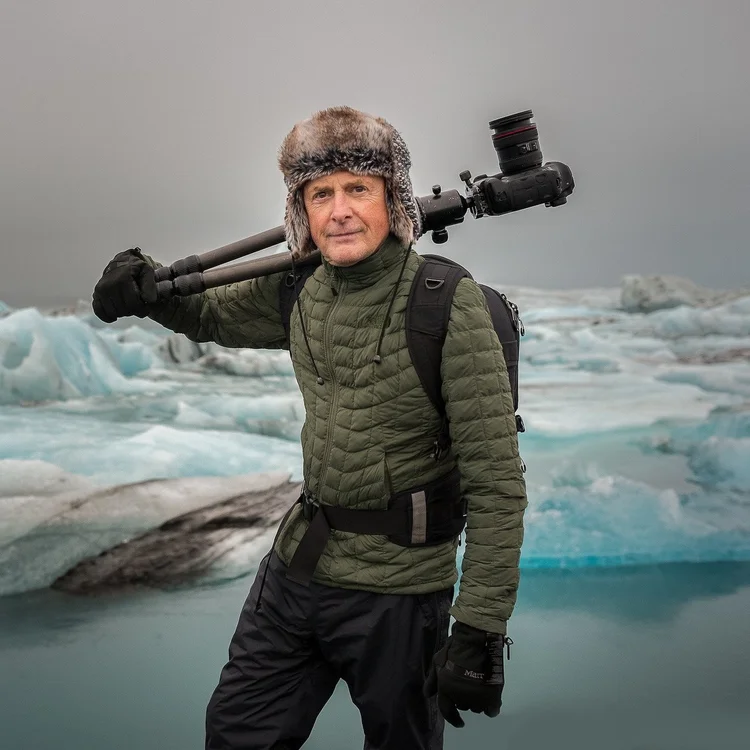
Art Wolfe (born 1951) is an American photographer and conservationist from Seattle. For nearly fifty years he has photographed wildlife, landscapes and cultures all over the world. He has published dozens of books and hosted the public television series Art Wolfe’s Travels to the Edge.
The story
Art Wolfe was 12 when the bulldozers came. Just down the hill from his house in West Seattle was a wooded greenbelt that the kids called Forest Court. Then road graders arrived to clear it for houses. “A gang of us kids stopped it,” he remembers. “We covered the culverts and flooded the roads.” They kept it up until the machines went away. In 1972 the ravine became part of a city park, today’s Fauntleroy Park.
Nature was one love. Art was the other. His mother was a commercial artist, and when she took a correspondence course, her youngest child sat next to her. “I’d do the lessons alongside her,” he says. As a teenager he began to photograph nature with a Kodak Brownie Fiesta. Still, painting came first. At the University of Washington he studied painting and watercolor, with teachers such as Jacob Lawrence, and graduated in 1975.
The plan was to teach art. But jobs in Seattle schools were scarce, and the classroom was not for him. After about a year he quit. “I hated it,” he said later. So he turned to his hobby. He sold photographs at Seattle street fairs and showed them to his climbing instructor, who ran The Mountaineers Books. That led to his first book, Indian Baskets of the Northwest Coast, in 1978. Within a few years of graduating, he had also worked on assignments for National Geographic.
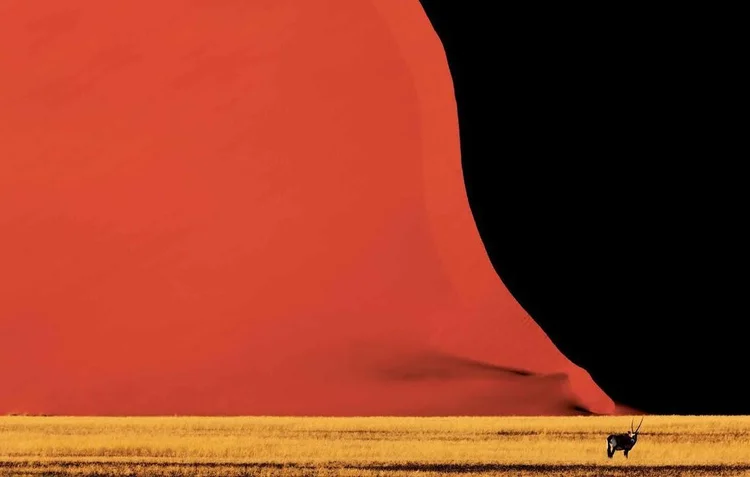
The painter never left. His teachers had told him not to fall into a rut, and he took it to heart. He photographs animals, mountains, deserts, tribes and religious rituals. In Namibia’s Namib-Naukluft National Park, he ran down a trail to catch the curve of a red dune, one side in morning sun and the other in deep shade. He framed it so the line of the dune ends at a single gemsbok.
Now in his seventies, he still travels and teaches. Every year he leads a group to Katmai National Park in Alaska. There, brown bear mothers sometimes leave their spring cubs near the people while they go fishing. “It’s a great honor to be trusted babysitters for such awe-inspiring animals,” he says.
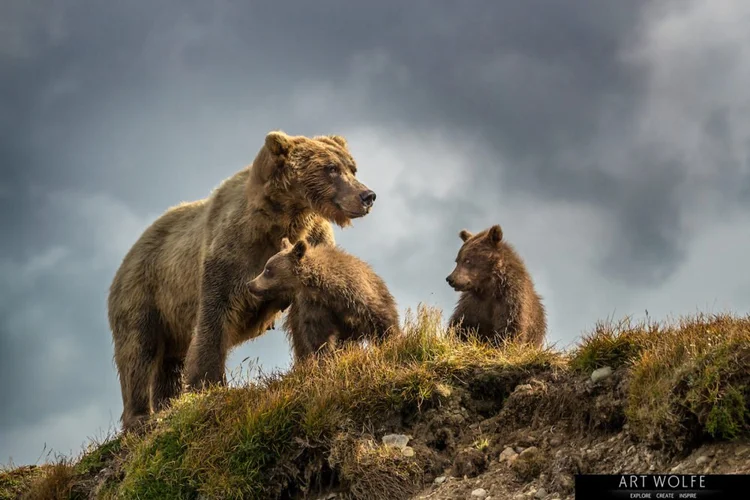
The boy who flooded a road to save a small wood did not really change. He only found a bigger way to show people what is worth keeping. “As an adult, I have the same awe of nature as I did as a 7-year-old,” he says.
The work


- 1951Born in Seattle on September 13
- 1975Graduates from the University of Washington in fine arts and art education
- 1978First book, Indian Baskets of the Northwest Coast
- 1998Outstanding Nature Photographer of the Year, North American Nature Photography Association
- 2000Alfred Eisenstaedt Award for Magazine Photography
- 2005Honorary Fellowship of the Royal Photographic Society
- 2007Art Wolfe’s Travels to the Edge starts on public television
- 2014Publishes Earth Is My Witness
- 2024Receives the UW’s highest alumni honor, the Alumnus Summa Laude Dignatus
Lessons
Train your eye with art. Wolfe studied painting for years before photography became his work. He still composes like a painter, with color, line and shape.
Do not fall into a rut. His teachers told him not to paint the same things again and again. That is why he moves between wildlife, landscapes and people.
Know your subject. He advises learning the history, culture and biology of a place before you go. Do not arrive cold.
Try this: go out early in the morning or late in the afternoon. Find one strong line, like the edge of a hill or a shadow. Frame it so the line leads to one small subject, and wait for it.
Gear
Wolfe talks about his gear in interviews and keeps a gear page on his website. These are the details he has shared.
Kodak Brownie Fiesta: the simple camera he used as a teenager, when nature photography was still a hobby.
Canon EOS-1Ds: his first digital camera. He tested it on a trip to Antarctica and, as he said, never shot a single frame of film again.
Canon EOS-1D X and 5DS R: the go-to cameras he named in a Nature TTL interview.
Canon 16-35mm f/2.8 and 70-200mm f/2.8 lenses: his workhorse lenses, with him wherever he goes.
Books
Earth Is My Witness: The Photography of Art Wolfe (Earth Aware Editions, an imprint of Insight Editions, 2014). The big book of his career, with nearly 400 pages and more than 400 photographs. It began when the publisher, Raoul Goff, asked to make his “opus.” Instead of a simple retrospective, the pictures are grouped by type of place: desert and savannah, ocean and islands, tropical and subtropical. Animals, landscapes and people sit side by side. The best single book to see the full range of his work.
Wild Lives: The World’s Most Extraordinary Wildlife (Earth Aware Editions, 2023). A large book of 352 pages, with eight gatefolds. Wolfe made the photographs and Gregory A. Green wrote the essays. It covers common and rare animals, many of them endangered, and also tells hopeful stories, like the return of the bald eagle and the humpback whale. It includes his close-up pictures of crocodiles off the coast of Mexico. For anyone who loves wildlife and conservation.
Human Canvas (Earth Aware Editions, 2019). A 204-page hardcover with a foreword by the photographer Chris Rainier. Here Wolfe brings together his two crafts, painting and photography. Models are painted so their bodies blend into painted backgrounds, like animals that hide in their habitat. The idea grew from his time with peoples who paint the body, especially in Ethiopia and Papua New Guinea. A book for anyone interested in where photography meets painting.
The New Art of Photographing Nature (Amphoto Books, 2013). An updated version of his 1993 bestseller The Art of Photographing Nature, written with Martha Hill, a former photo editor at Audubon magazine, with sidebars on digital work by Tim Grey. About 250 images, more than half of them new. Wolfe and Hill talk through each picture, comparing images that work with ones that do not, with chapters on color and composition. The most practical of his books for learning photographers.
In his words
“Making art has always been the main goal of my life.”
“My favorite spot is invariably the last place I was.”
“The challenge of learning & exploring never ends, even after a lifetime.”